
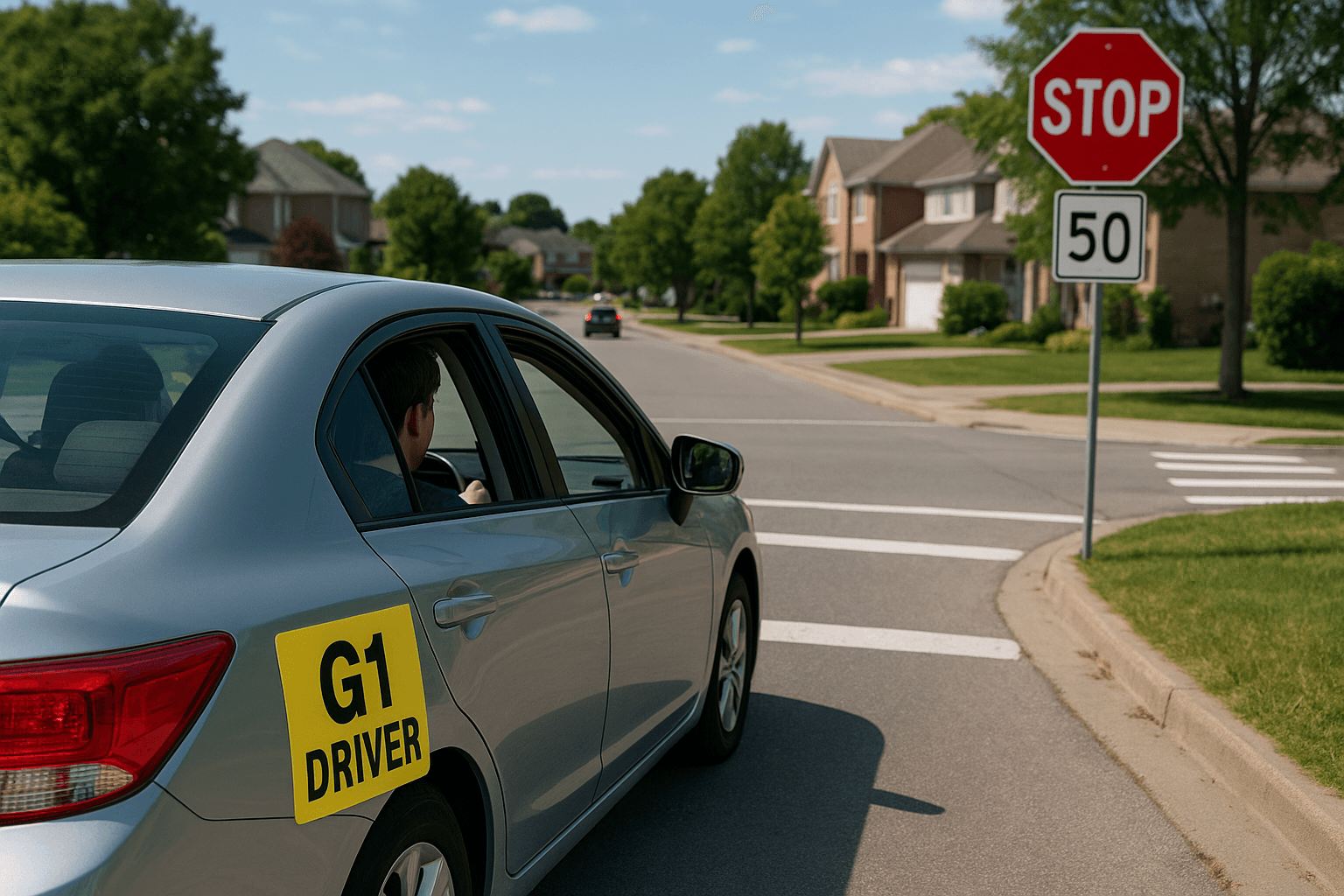
Half of your G1 test focuses entirely on road rules. You will face 20 questions about traffic laws, and you need to get at least 16 correct to pass this section. Miss five or more and you fail, even if you aced the signs portion.
The tricky part is that road rules questions go beyond simple memorization. The test presents scenarios where you need to apply multiple rules at once. A question might ask what to do when approaching a school bus with flashing lights while another vehicle is tailgating you. Knowing isolated facts is not enough. You need to understand how these rules work together in real driving situations.
This guide breaks down the road rules that appear most frequently on the G1 test. Study these carefully, because they form the foundation of safe driving in Ontario and will show up repeatedly during your exam.
Right-of-Way Rules
Right-of-way questions are some of the most common on the G1 test, and they trip up a lot of people. The concept seems simple until you encounter an intersection where multiple rules could apply.
At a four-way stop, the first vehicle to come to a complete stop goes first. When two vehicles stop at the same time, the driver on the right has the right-of-way. If you are facing another driver head-on and you both stopped simultaneously, the vehicle going straight proceeds before the one turning left.
Uncontrolled intersections, meaning those without signs or signals, follow similar logic. Yield to any vehicle already in the intersection. If you arrive at the same time as another driver, yield to the vehicle on your right.
Pedestrians have right-of-way at crosswalks, whether marked or unmarked. An unmarked crosswalk exists at any intersection, even without painted lines. When a pedestrian is waiting to cross, you must stop and let them go. Do not wave them across or try to direct traffic yourself. Just stop and wait.
Emergency vehicles with flashing lights and sirens have absolute right-of-way. Pull over to the right side of the road and stop. Stay stopped until the emergency vehicle passes. If you are in an intersection when you hear a siren, clear the intersection first, then pull over.
Funeral processions also have right-of-way once the lead vehicle enters an intersection. Do not cut into the middle of a funeral procession, even if you have a green light.
Speed Limits and Adjusting for Conditions
Ontario sets default speed limits that apply even when no signs are posted. In cities, towns, and villages, the default limit is 50 km/h. On highways outside urban areas where no limit is posted, the default is 80 km/h.
School zones and community safety zones often have reduced limits of 40 km/h or lower. These limits apply during posted hours, which typically cover school arrival and dismissal times. Pay attention to the time restrictions on these signs.
The G1 test will ask about adjusting speed for conditions. Posted limits represent the maximum speed under ideal conditions. Rain, snow, fog, heavy traffic, or poor visibility all require slower speeds. Driving the posted limit during a snowstorm could still earn you a careless driving charge if conditions called for a slower pace.
Construction zones deserve extra caution. Fines double in construction zones when workers are present. Slow down, watch for lane changes, and follow the directions of flag persons. Construction zone speed limits remain in effect 24 hours a day unless signs specify otherwise.
Traffic Signals and What They Mean
Green means go, but only after confirming the intersection is clear. Check for pedestrians finishing their crossing, vehicles completing left turns, and red-light runners coming from the other direction. A green light gives you permission to proceed, not a guarantee of safety.
A yellow light means stop if you can do so safely. It does not mean speed up to beat the red. If you are too close to the intersection to stop safely, proceed through with caution. The test may present scenarios asking you to judge whether stopping is possible.
Red means stop completely behind the stop line, crosswalk, or before entering the intersection. In Ontario, you may turn right on a red light after coming to a complete stop, unless a sign prohibits it. You must yield to pedestrians and cross traffic before turning.
Flashing red lights function as stop signs. Come to a complete stop and proceed when safe. Flashing yellow lights mean proceed with caution and be prepared to yield.
A green arrow means you have a protected turn in that direction. Oncoming traffic has a red light, so you can turn without yielding. When the arrow disappears and only a green light remains, you may still turn, but you must yield to oncoming traffic.
Advanced green lights, also called advanced left turn signals, give left-turning drivers a head start before oncoming traffic gets a green. Watch for the flashing green or green arrow that indicates your protected turn phase.
Lane Usage and Changing Lanes
Stay in your lane unless you have a reason to change. Ontario roads use lane markings to control traffic flow, and understanding them matters for your test.
Solid white lines between lanes mean you should stay in your lane. You can cross them if necessary, but they indicate lane changes are discouraged in that area. Solid yellow lines separate traffic moving in opposite directions. Never cross a solid yellow line to pass.
Broken white lines allow lane changes when safe. Broken yellow lines mean passing is permitted when the way is clear. A combination of solid and broken yellow lines means passing is allowed only from the side with the broken line.
When changing lanes, follow these steps in order: check your mirrors, signal your intention, check your blind spot by looking over your shoulder, and move into the lane when clear. The blind spot check is critical and will appear on your G2 road test, so build the habit now.
High Occupancy Vehicle lanes, marked with diamond symbols, require two or more people in the vehicle during posted hours. Using an HOV lane solo during restricted times results in significant fines.
School Buses and Emergency Situations
School bus rules generate some of the most heavily penalized violations in Ontario, and the G1 test asks about them frequently.
When a school bus has its red lights flashing and stop arm extended, you must stop. This applies whether you are behind the bus or approaching from the opposite direction. The only exception is on roads with a median. If a physical barrier separates your lanes from the bus, oncoming traffic does not need to stop.
Remain stopped until the lights stop flashing and the stop arm retracts. Do not proceed just because you cannot see children. They may be crossing behind the bus or still approaching from a distance.
Fines for passing a stopped school bus run into the hundreds of dollars for a first offense and increase dramatically for repeat violations. The G1 test wants to make sure you understand this rule completely.
When you hear an approaching emergency vehicle, pull to the right and stop. On one-way streets, you may need to pull left to clear a path. Stay stopped until the emergency vehicle passes. If multiple emergency vehicles are responding, wait for all of them to pass before moving.
The "move over" law requires you to slow down and move over one lane when passing emergency vehicles, tow trucks, or other designated vehicles stopped on the roadside with flashing lights. If you cannot change lanes safely, slow down significantly below the posted limit.
Sharing the Road
Cyclists have the same rights and responsibilities as drivers in Ontario. Pass cyclists with at least one metre of space between your vehicle and the bike. When one metre is not possible, wait until you can pass safely. Do not squeeze by.
Check for cyclists before opening your door when parked on the street. Dooring a cyclist is illegal and dangerous. Use the Dutch reach method: open your door with your far hand, which forces you to turn and check your mirror and blind spot.
Pedestrians have right-of-way in crosswalks. When turning at an intersection, yield to pedestrians crossing the street you are entering, even if you have a green light. At intersections without traffic signals, yield to pedestrians waiting to cross.
Motorcycles get a full lane just like cars. Do not try to share a lane with a motorcycle or squeeze past one in traffic. Treat motorcycles as you would any other vehicle.
Large trucks have significant blind spots on all sides, especially on the right. If you cannot see the truck's mirrors, the driver cannot see you. Give trucks extra space and avoid lingering beside them.
Common Road Rule Mistakes on the G1 Test
Some questions appear repeatedly because they address rules that people get wrong in real driving situations.
Many test takers miss questions about yielding when entering a roadway from a private driveway or parking lot. You must yield to all traffic and pedestrians on the road you are entering. The traffic on the main road never has to yield to you.
Questions about following distance come up often. The standard recommendation is a two-second gap between you and the vehicle ahead under normal conditions. Increase this to three or four seconds in rain, snow, or heavy traffic.
Roundabout rules confuse drivers who have not encountered them before. Yield to traffic already in the roundabout. Signal right as you approach your exit. Do not stop inside the roundabout unless traffic requires it.
Railway crossing rules appear on nearly every G1 test. Stop at least five metres from the nearest rail when lights are flashing or gates are down. Never try to beat a train or drive around lowered gates. If your vehicle stalls on the tracks, get everyone out immediately and move away from the crossing.
Putting Road Rules Into Practice
Reading about road rules is the first step. The next step is recognizing how they apply in different scenarios, which is exactly what the G1 test measures.
Take practice tests that present realistic situations rather than simple fact recall. Look for questions that combine multiple rules, like right-of-way at an intersection where a pedestrian, a cyclist, and another vehicle all arrive together.
When riding as a passenger, observe how drivers handle various situations. Notice when they yield, how they approach intersections, and what they do at railway crossings. Real-world observation reinforces what you read in the handbook.
Ready to test your knowledge of Ontario road rules? G1 Ready CA offers practice tests focused specifically on the rules portion of the exam. You can also review how the G1 test is structured to understand what to expect on exam day and how the road rules section fits into the overall test.


