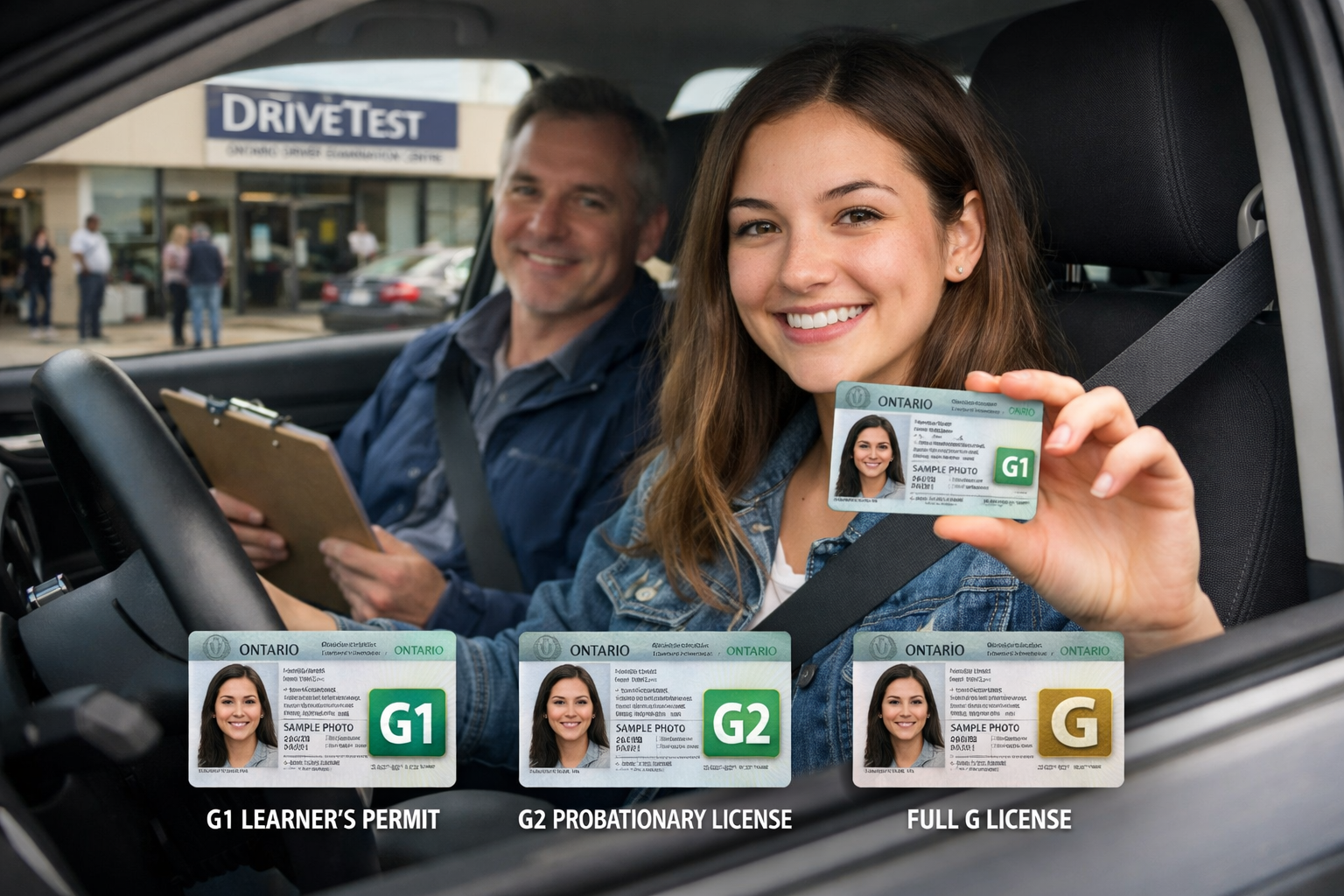
Getting a driver's license in Ontario is not a single event. It is a multi-year process with distinct stages, each building on the last. The province calls this the Graduated Licensing System, and it applies to virtually everyone pursuing their first Ontario driver's license.
Understanding the complete journey from beginner to fully licensed driver helps you plan ahead, set realistic expectations, and avoid surprises along the way. Some people assume they will have full driving privileges within a few months of starting. The reality involves a minimum of 20 months even on the fastest possible track.
This guide explains the entire graduated licensing system from start to finish, covering what happens at each stage and what you need to do to keep moving forward.
Why Graduated Licensing Exists
Ontario introduced graduated licensing in 1994 after research showed that new drivers face dramatically higher crash risks than experienced drivers. The statistics were stark: young, inexperienced drivers were overrepresented in serious collisions far beyond their share of the driving population.
The graduated system addresses this by phasing in driving privileges over time. Instead of handing someone full driving freedom after passing a single test, Ontario requires new drivers to gain experience under progressively fewer restrictions. Each stage allows more independence as skills develop.
The approach works. Collision rates among new drivers dropped significantly after graduated licensing took effect. Other provinces and many jurisdictions worldwide have adopted similar systems based on evidence that gradual exposure to driving reduces accidents.
For individual drivers, the system means patience is required. You cannot rush through the process regardless of how capable you feel. The timelines are fixed, and the only way to shorten them involves completing approved driver education.
Stage One: The G1 License
Every new driver in Ontario starts with the G1 license. This is a learner's permit that allows you to practice driving under supervision while you build foundational skills.
Getting Your G1
To obtain a G1, you must be at least 16 years old and pass two requirements at a DriveTest centre: a vision screening and a written knowledge test.
The knowledge test has 40 multiple choice questions covering road signs and traffic rules. You need at least 16 correct answers out of 20 on each section to pass. The test draws from the Ontario Driver's Handbook, which covers everything you need to know.
After passing the vision screening and knowledge test, you receive your G1 license the same day. You can immediately begin practicing driving under supervision.
G1 Restrictions
The G1 comes with significant restrictions designed to keep new drivers safe while they learn.
Supervision required: A fully licensed driver with at least four years of experience must sit in the front passenger seat whenever you drive. You cannot drive alone under any circumstances.
Highway restrictions: G1 drivers cannot use 400-series highways, the Queen Elizabeth Way, or other controlled-access highways. These high-speed roads require more experience than a beginner has.
Time restrictions: Driving is prohibited between midnight and 5:00 a.m. regardless of whether your supervisor is present.
Zero alcohol: Your blood alcohol level must be 0.00% at all times while driving. No exceptions.
Passenger limits: You can carry only as many passengers as there are working seatbelts, and your supervising driver counts toward this total.
These restrictions remain in place throughout your time as a G1 driver. Violating them results in fines, suspensions, and delays in your licensing progress.
How Long You Hold the G1
The minimum time at the G1 stage is 12 months. After holding your G1 for a full year, you become eligible to take the G2 road test.
Completing an approved driver education course reduces this minimum to 8 months. This is the only way to shorten the G1 period. No amount of practice hours or demonstrated skill allows earlier testing.
Your G1 license remains valid for five years. If you do not pass your G2 road test within five years of getting your G1, your G1 expires and you must start the entire process over.
Stage Two: The G2 License
The G2 license represents a major step toward driving independence. Most G1 restrictions disappear, and you can finally drive without someone sitting beside you.
Getting Your G2
After holding your G1 for the required period (12 months standard, 8 months with driver education), you can take the G2 road test.
The G2 road test is a practical driving evaluation. You provide a vehicle and drive with an examiner for approximately 15 to 20 minutes. The examiner evaluates your ability to control the vehicle, obey traffic laws, and handle various driving situations safely.
Skills tested include starting and stopping, steering, turning at intersections, lane changes, parking maneuvers, and general road awareness. Some test locations include highway driving in the evaluation.
Passing the road test earns your G2 license. Failing means rebooking, paying another fee, and trying again after additional practice.
G2 Privileges
The G2 removes most G1 restrictions and grants substantial independence.
Drive alone: No supervising driver required. You can go anywhere by yourself.
Use all roads: Highway restrictions end. You can drive on 400-series highways, the QEW, and all other roads in Ontario.
Drive anytime: Time restrictions end. You can drive at 3:00 a.m. if you want.
Carry passengers: General passenger restrictions end, though special rules apply to young drivers.
The G2 feels like a real driver's license because it mostly functions like one. For everyday driving purposes, G2 holders have nearly the same privileges as fully licensed drivers.
G2 Restrictions That Remain
Some restrictions continue at the G2 stage.
Zero alcohol: The 0.00% blood alcohol requirement continues for all G1 and G2 drivers regardless of age. Even if you are over 19 and can legally drink, you cannot have any alcohol in your system while driving with a G2.
Young driver passenger limits: G2 drivers aged 19 and under face passenger restrictions for the first six months. During this period, between midnight and 5:00 a.m., you can carry only one passenger aged 19 or under unless a fully licensed driver is in the front seat or the passengers are immediate family members.
These restrictions reflect continued elevated risk for new drivers, particularly young ones driving with peer passengers late at night.
How Long You Hold the G2
The minimum time at the G2 stage is 12 months. After holding your G2 for a full year, you become eligible to take the full G road test.
Unlike the G1 stage, no driver education option reduces this waiting period. Everyone must hold their G2 for at least 12 months before attempting the final road test.
Your G2 license remains valid for five years from the date you received your original G1. The five-year clock that started when you got your G1 continues running through your G2 period. If you do not pass your full G test before your G2 expires, you must restart the licensing process.
Stage Three: The Full G License
The full G license is the final stage of Ontario's graduated licensing system. Earning it completes your journey from complete beginner to fully licensed driver.
Getting Your Full G
After holding your G2 for at least 12 months, you can take the full G road test.
The full G road test is another practical driving evaluation, but it focuses on advanced skills that were not heavily tested at the G2 level. Highway driving is a central component at most test locations. The examiner evaluates your ability to enter highways safely, maintain appropriate speeds, change lanes in highway traffic, and exit properly.
The test also covers general driving skills similar to the G2 test. Overall performance must demonstrate competence across all driving situations a fully licensed driver might encounter.
Passing this final road test earns your full G license.
Full G Privileges
The full G license removes all remaining restrictions from the graduated licensing system.
No alcohol restriction: The zero blood alcohol rule that applied to G1 and G2 licenses ends. Fully licensed drivers over 21 are subject to the standard 0.08% legal limit, though Ontario also has administrative penalties starting at 0.05%. Drivers under 21 maintain the zero requirement regardless of license class.
No passenger restrictions: All passenger-related rules from the G2 stage end.
License longevity: Your full G license remains valid as long as you renew it. The five-year expiration clock that governed G1 and G2 no longer applies in the same way. You renew your license periodically, but you do not lose your license class for simply not upgrading further.
Why Pursue the Full G
Some people question whether pursuing the full G license is worth the effort since G2 privileges cover most driving needs. Several reasons make the full G worthwhile.
Removing the zero alcohol restriction matters if you ever want to have a single drink at dinner and then drive home. With a G2, any alcohol at all is illegal. With a full G (if you are over 21), moderate consumption within legal limits is permitted.
Some employers require a full G license for driving-related positions. Delivery drivers, salespeople with company vehicles, and various other jobs may specify full G as a requirement.
Insurance companies sometimes offer better rates to drivers with full G licenses, viewing completion of the graduated system as an indicator of experience and commitment to driving competence.
Finally, holding a full G simply means you finished what you started. There is satisfaction in completing the process rather than remaining indefinitely at an intermediate stage.
The Complete Timeline
Understanding the minimum timeline helps set realistic expectations.
Fastest possible path with driver education:
- Day 1: Pass G1 knowledge test, receive G1 license
- Month 8: Eligible for G2 road test (with approved driver education)
- Month 8: Pass G2 road test, receive G2 license
- Month 20: Eligible for full G road test
- Month 20: Pass full G road test, receive full G license
Standard path without driver education:
- Day 1: Pass G1 knowledge test, receive G1 license
- Month 12: Eligible for G2 road test
- Month 12: Pass G2 road test, receive G2 license
- Month 24: Eligible for full G road test
- Month 24: Pass full G road test, receive full G license
These timelines assume you pass each test on your first attempt and book tests immediately upon becoming eligible. In practice, booking delays, failed attempts, and life circumstances often extend the actual timeline beyond these minimums.
Keeping Your Progress on Track
The five-year validity period creates an outer boundary that you must respect. Starting from when you receive your G1, you have five years to complete the process through full G.
Running out of time means starting over completely. Someone who got their G1 at 16, let years pass without progressing, and suddenly finds themselves at 21 with an expiring license faces losing everything and retaking the G1 knowledge test as if they never started.
Monitor your license expiration date. If you are approaching the deadline without having completed the system, prioritize getting your remaining tests done.
Life sometimes interferes with licensing progress. University, work, moving to a new city, or simply not having access to a vehicle for practice can all delay progress. These circumstances are understandable, but the five-year clock keeps running regardless.
Making the Most of Each Stage
Each stage of graduated licensing serves a purpose in your development as a driver.
Use your G1 period to build fundamental skills with guidance from your supervising driver. Practice in varied conditions and accumulate as many hours as possible behind the wheel.
Use your G2 period to gain independent driving experience. Drive regularly without relying on someone else's judgment beside you. Develop your own decision-making abilities through real-world practice.
Use the full G as confirmation that you have become a competent, experienced driver ready for any situation Ontario roads present.
Ready to begin your graduated licensing journey with a solid foundation? G1 Ready CA offers practice tests that prepare you for the G1 knowledge test and beyond. For specific details on waiting periods between license stages, check out the guide on how long after G1 you can get your G2 to plan your timeline effectively.