Young drivers face higher crash risk than experienced drivers, so G1 preparation should build safe decision-making before a mistake has consequences. The Official MTO Driver's Handbook is a reference for learning the rules and decisions expected of Ontario drivers.
A practice score should answer one question: What do I need to understand next? A strong total can hide a weak area. A learner might recognize most road signs yet miss licence restrictions, or know the cellphone rule but still choose to check a notification. Review each kind of decision on its own, then practise applying them together. That makes practice a check on understanding, not just a score.
The G1 Test Blueprint and Pass Mark
The Ontario G1 knowledge test has 40 multiple-choice questions: 20 on road signs and 20 on rules of the road. The pass mark is 80% in each section, or 16 correct answers out of 20 in both. Check the G1 test passing-score guide and the current Official MTO Driver's Handbook for the requirement.
Each section is scored separately. A strong result on road rules cannot make up for a signs score below the pass mark. Read your results as two separate signals about what you know and what needs more practice.
G1 knowledge test blueprint
Section Questions on the test Pass mark Topics to drill Road signs 20 16 correct (80%) Regulatory, warning and guide signs Rules of the road 20 16 correct (80%) Right-of-way, lane use, speed, parking, safe driving decisions Whole test 40 Pass both sections Each section scored separately
For example, a learner might answer every road-rule question correctly but get only fifteen signs right. The combined total may look reassuring, yet the signs section still falls short. The next study session should focus on signs rather than relying on the overall score.
Sort signs into families so each one has a clear purpose:
- Regulatory signs state what drivers must or must not do, including at stop signs and speed limits.
- Warning signs alert drivers to conditions ahead, such as hills, curves and school zones.
- Guide signs help drivers find their way, including highway exits and directional information.
Rules questions test decisions rather than sign recognition. A learner may need to decide who proceeds at an intersection, whether a lane change is safe, how to control speed, where parking is permitted, or how to respond to another road user.
Read for the action, not just the answer
Use Ontario's Official MTO Driver's Handbook as your study reference. When you identify a sign, say what action it calls for. When you answer a rules question, explain which condition shaped your choice. This connects recognition to the decision a driver would make on the road.
A parent can ask why a tempting wrong answer does not apply. That brief explanation helps show whether the learner understands the rule or only remembers seeing an answer before.
Take a full practice test and record the signs and rules scores separately. Aim for seventeen correct in each section as a study target, not an official requirement. If one score is lower, drill that subject on its own before trying another mixed test.
Why Young Drivers Need Targeted G1 Practice
Ontario government safety information identifies ages 19, 20 and 21 as the peak ages for drinking-and-driving collisions, and reports that drivers aged 19 to 21 were almost one-and-a-half times as likely to be involved in drinking-and-driving fatal and injury crashes, according to its Keeping Drivers Safe release. Those findings make impairment a practical study priority, not a topic to skim.
Supervised practice is where knowledge starts becoming behaviour.

The Ontario Driver's Handbook also identifies distraction as a serious concern for young drivers. Preparation should therefore include attention, passenger management and protecting pedestrians and cyclists, rather than stopping at sign recognition.
Turn risk into a study priority
Choose Ontario-specific questions that reflect provincial rules. Generic North American practice may use familiar-looking signs or driving vocabulary without teaching the exact rule you need to apply in Ontario.
Make these topics deliberate parts of your study:
- Impairment: Decide whether a proposed trip should happen, not whether an answer mentions alcohol.
- Distraction: Choose what to do when a phone, passenger or navigation instruction competes for attention.
- Passenger rules: Check whether the arrangement meets the learner's supervision and seating conditions.
- Vulnerable road users: Practise noticing pedestrians and cyclists before deciding to proceed.
G1 is a learning stage within a graduated system, so misunderstandings can follow a learner into supervised driving. Passing without understanding leaves the supervising adult trying to explain a rule while the learner is already managing a vehicle.
Use the video as a discussion prompt, then ask the learner to explain a safe decision in their own words.
Self-check: If you can answer only immediately after rereading the explanation, try a differently worded scenario before calling the topic mastered.
Improvement after reading is useful, but it doesn't by itself prove application. Change the setting, remove the answer choices and ask what the learner would do.
Flag the two highest-risk topics you find difficult. Give them extra practice during the coming week, even if your overall results look comfortable.
Drill Each Domain Before Mixing Questions
Mixed questions are useful once you understand the individual subjects. Before that, they can make it difficult to tell whether you're improving at signs, intersection decisions or recognising familiar wording.
The Ontario Ministry of Transportation's licensing guide identifies the Official MTO Driver's Handbook as the preparation reference for the knowledge test. Check explanations against it instead of accepting an answer because it sounds plausible.
Follow a diagnostic study order
- Run the Diagnostic Test. Record the sign families and rule topics you miss. Include answers you guessed correctly, since a lucky choice isn't evidence of understanding.
- Drill signs separately. As a study routine, use fifteen-question sets grouped into regulatory, warning and guide signs. Repeat any group below the pass-mark benchmark before combining families.
- Practise road rules by topic. Work through right-of-way, lane changes, speed control and parking separately. Explain the condition that makes an answer correct.
- Finish with mixed practice. Once topic results are consistently strong, use full-format mock tests to check whether your skills hold together when subjects alternate.
The order has a purpose. The diagnostic establishes a baseline; sign drills develop visual recognition; rule drills require conditional reasoning. Mixed practice then checks whether you can select the right rule without being told which subject you're answering.
For this study plan, define topic mastery as performance above the pass-mark benchmark across three consecutive sessions. That's a coaching checkpoint, not an additional licensing requirement.
Make mistakes useful
Don't record only the correct letter. Write a short explanation such as: I recognised the intersection but didn't check who was already moving. That note tells you what to practise next.
Newcomers who have driven elsewhere should give right-of-way its own practice time. Familiar habits may not match Ontario's requirements, even when the road layout looks familiar.
We're made for Ontario learners, and our preparation material follows the provincial handbook. Still, the learner's job is to understand the explanation rather than rely on familiarity with a question.
Keep a notebook with the topic, date, result and reason for each miss. Use it to choose tomorrow's session instead of taking another random quiz.
Learn G1 Restrictions as Scenarios
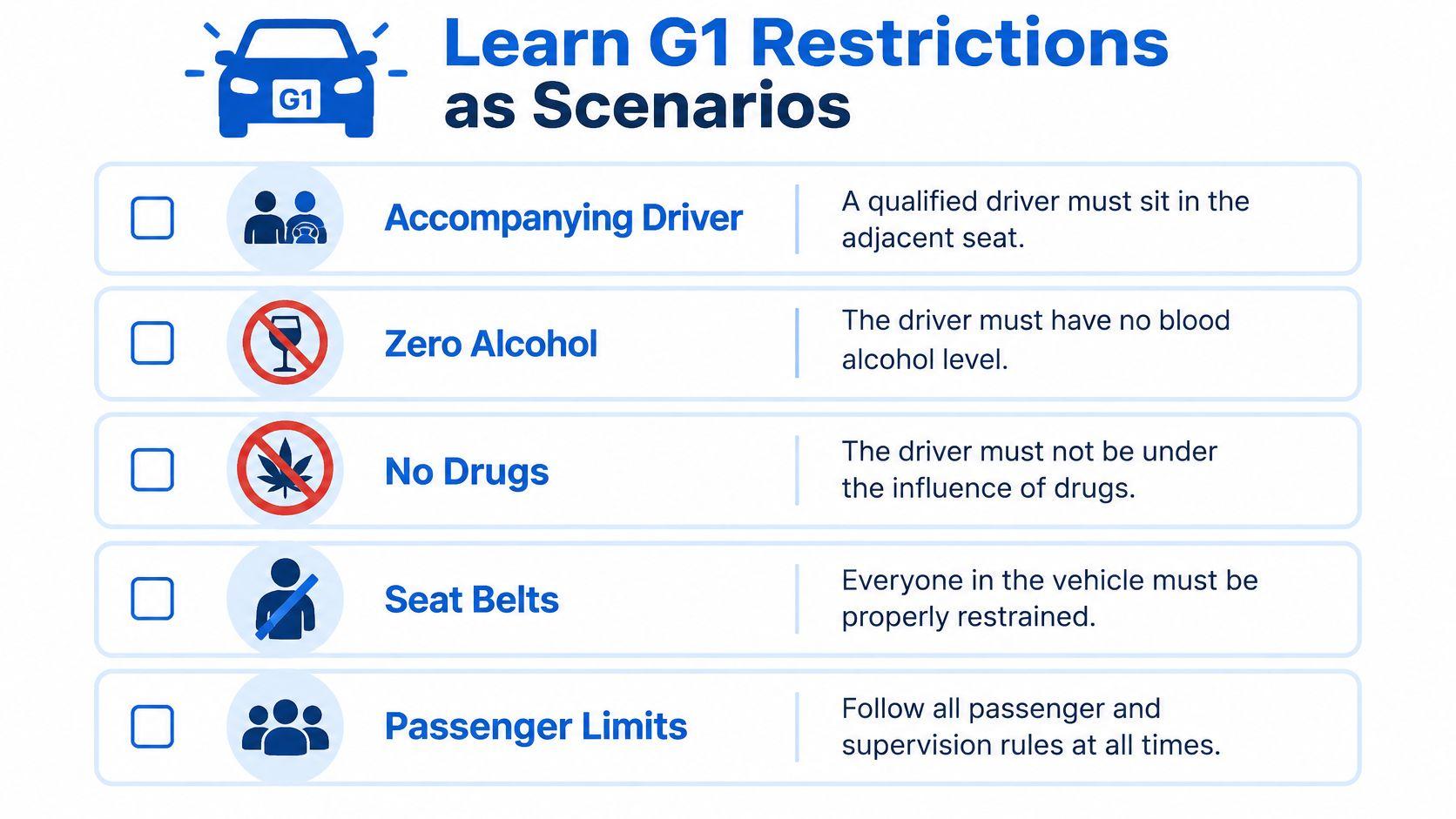
A G1 trip is allowed only when all the relevant conditions are met at once. Treat each restriction question like a pre-drive checklist: one failed condition means the proposed trip does not meet the rules.
The Ontario driver-licensing regulation sets requirements for an accompanying driver in the front passenger seat, zero blood alcohol for the learner, available rear seat belts, prohibited highways, and no driving between midnight and 5 a.m. It also sets the accompanying driver's blood-alcohol threshold below 50 mg per 100 mL. The regulation describes a 365-day minimum for each novice level, so these requirements apply throughout the learner's time at that level.
Check every condition together
- Supervision: A qualified accompanying driver must sit beside the learner.
- Alcohol: The learner must meet the zero-alcohol requirement, and the accompanying driver must meet their separate threshold.
- Passengers: Rear passengers must not exceed the number of available operable seat belts.
- Roadway: The route must comply with the G1 highway restrictions.
- Time: The trip must fall within the permitted driving hours.
The accompanying driver must hold a full licence authorising the vehicle and have at least four years of driving experience, according to Ontario's new-driver licensing guidance. A parent does not qualify automatically; check the person's licence and experience, as well as their seat in the vehicle.
Work through the whole proposed trip
A late ride with a parent in the back. A friend asks for a drive at half past midnight. The trip fails the time check, and a parent sitting behind the learner does not meet the adjacent-seat supervision requirement. Moving the parent beside the learner fixes only the supervision issue, not the time restriction.
More passengers than rear belts. A learner offers to carry three rear passengers when only two operable seat belts are available. The trip fails the passenger check. A short journey does not change the belt requirement.
A prohibited highway with an ordinary supervisor. Every other condition is met, but the route includes a highway prohibited for that learner-supervisor arrangement. The trip still fails. If an instructor exception might apply, check the exact rule rather than assuming any supervisor qualifies.
For another review aid, see this G1 restrictions practice guide. Before your next practice trip, write out the five-condition check and answer every item before setting off.
Distraction Questions That Predict Real Choices
Knowing the distracted-driving rule doesn't guarantee that you'll follow it when a notification arrives. A useful practice question asks for an action, not merely recognition that distraction is dangerous.
For novice Ontario drivers, distracted-driving convictions bring a 30-day suspension for a first conviction, 90 days for a second and licence cancellation after a third, rather than ordinary demerit-point treatment, according to OTIP's Ontario distracted-driving guidance. The same guidance cites Canadian evidence summarised by Parachute: 39% of young drivers admit texting behind the wheel, while 71% don't consider phone use very distracting.
Those findings describe an attitude-behaviour gap. A learner may select the correct textbook answer while still making excuses for a quick glance.
Knowing distraction is illegal is not the same as choosing not to text.
Choose a safe action before the temptation
- The phone buzzes at a red light. Leave it alone. Waiting for a signal change is still part of driving, and your attention belongs on traffic and the intersection.
- A passenger asks you to change the song. Decline to operate the controls while moving. If a passenger can manage the music without involving you, leave that task with them.
- Navigation needs setting up. Enter the destination and check the route while safely parked, before you begin moving. Don't make the first intersection your setup point.
- Hands-free feels harmless. Defer the conversation until you're safely parked. Not holding a device doesn't mean the conversation requires no attention.
These aren't questions about being good at multitasking. They're questions about whether you can remove a competing task before it interferes with driving.
Give parents a coaching question
Ask, What will you do if that happens? before the engine starts. A learner can make a clearer plan while parked than while managing traffic and feeling pressure from a passenger.
Parents and instructors should model the same choices they expect. Put the phone away, prepare directions before departure and avoid turning a practice drive into a continuous conversation.
Pick the situation you'd be most likely to mishandle. Write your safe response in a sentence, then rehearse saying it aloud so you have words ready if someone pressures you.
Test Sequence and Retake Plan
Use the final two to three weeks as a suggested review window, not a deadline you must meet. Move towards longer practice only when your topic log shows that you understand the underlying material.
Start with the 100-question extended test to expose gaps across traffic regulations, road signs and accident prevention. Read the explanation after every miss, including mistakes near the end when you're tempted to rush.
Build endurance without rehearsing errors
Then attempt the 200-question test, which provides immediate feedback and detailed explanations. Its G1 Restrictions and Laws section contains 10 to 20 questions, giving you opportunities to apply combined conditions during a longer session.
Use a full-format mock the day before your assessment as a rehearsal. Set a timer to observe your pace, but don't invent an official time limit or rush merely to beat your previous result.
Follow this review cycle rather than repeating a full set immediately.
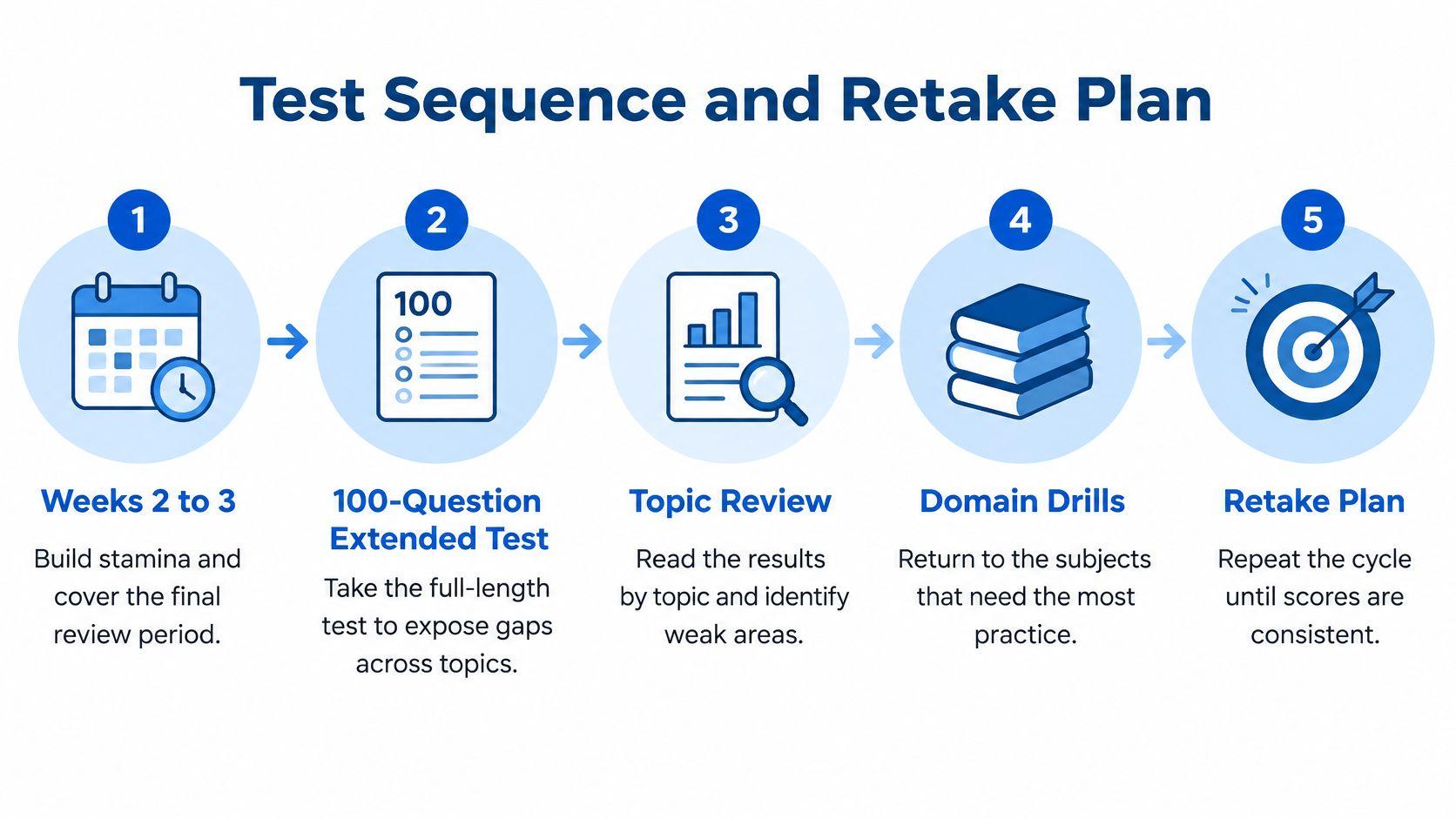
After a miss, name the topic, explain the mistake, read the explanation and redo that topic. Return to a complete set only after you can state the rule without seeing the answer choices.
Parents can use a short evening quiz as a low-pressure check. Ask for reasoning, not speed, and stop to discuss a misunderstanding rather than turning the session into a contest.
Practice symptoms, causes and fixes
Symptom Likely cause Fix Passing overall but failing the signs section Mixed sets hid a weak sign family Run the Road Signs Test alone until the section pass mark is reached twice Missing right-of-way questions Memorised answer wording instead of the rule Reread the handbook rule, then explain why each wrong option fails Missing restriction questions Checking one condition, not all of them Practise combined scenarios involving supervisor, time and passengers Strong early, weak late in long sets Stamina gap Add the 100-question and 200-question tests during final review Same wrong answers on a retake Explanations skipped after misses Read the explanation and write the rule before the next attempt
These are practice recommendations, not official retest policies. Confirm real assessment procedures, retest rules and any waiting requirements through official Ontario licensing information.
Newcomers, Language Support and Test-Day Paperwork
Language support can make the G1 test more accessible, but translated wording doesn't automatically make an unfamiliar traffic concept clear. Confirm current language options when checking the official test process, particularly if you need a specific format or accommodation.
Prepare for both signs and rules, regardless of the language you choose. If you already drive elsewhere, treat that experience as useful background, not proof that Ontario's right-of-way and novice-licence requirements will be familiar.
Separate vocabulary from rule knowledge
- Read the question slowly. Mark unfamiliar words before selecting an answer. Don't assume that a wrong response means you don't understand driving.
- Check the term in context. Find it in the handbook and add a plain-language definition to your vocabulary list.
- Try the decision again. Once the wording is clear, answer a differently phrased example. If you still choose incorrectly, return to the rule itself.
Useful vocabulary includes yield, right-of-way, lane, prohibited and accompanying driver. Write what each term means in a driving situation, not just a dictionary translation.
For example, recognising the word yield isn't enough if you can't explain what you would watch for before proceeding. A translated explanation can clarify the concept, but check that its meaning matches the Ontario handbook.
Confirm the paperwork separately
Don't use a practice-test page as your identity-document checklist. Confirm acceptable identification, any applicable residency requirements, vision-test arrangements and the current assessment process with official Ontario licensing information before making the trip.
If you need accessibility support, ask about the available arrangements in advance rather than assuming they'll be offered automatically. Keep that process checklist separate from your study log so neither gets overlooked.
Readiness check: Explain the sign or rule in plain words, then describe the action you would take.
Being able to explain your reasoning is a stronger preparation signal than recognising a familiar translated answer. It still doesn't replace the official assessment or guarantee a pass.
Start Your First Full Practice Test Today
Begin with the free Diagnostic Test on G1ready.ca. Record your result by topic, including correct answers you guessed, then choose your next practice session from the weakest area in your log.
Our practice options include the Road Rules Test, Road Signs Test, 200-Question Test and Diagnostic Test. You can take the practice exam as many times as needed, but give each retake a purpose: correct a misunderstanding before checking your score again.
Use the homepage to begin your diagnostic session.
Set a checkpoint you can verify
For this study plan, aim for two consecutive full mocks with at least seventeen correct answers in each section before deciding to arrange your assessment. That's a preparation buffer, not a guarantee or a replacement for Ontario's official requirements.
- Learners: Bring your topic log to each session and select the next task from your results.
- Parents and instructors: Review the log weekly, focus on the weakest topics and ask what the learner would do in a realistic situation.
A practice score is a diagnosis of what to study next, not a verdict on your ability. The purpose is to build safe decisions that continue after test day.
G1ready.ca offers free Ontario G1 practice tests with explanations to help you understand mistakes and strengthen weak topics. Visit G1ready.ca, start the Diagnostic Test and record your signs and rules results separately before choosing your next drill.