
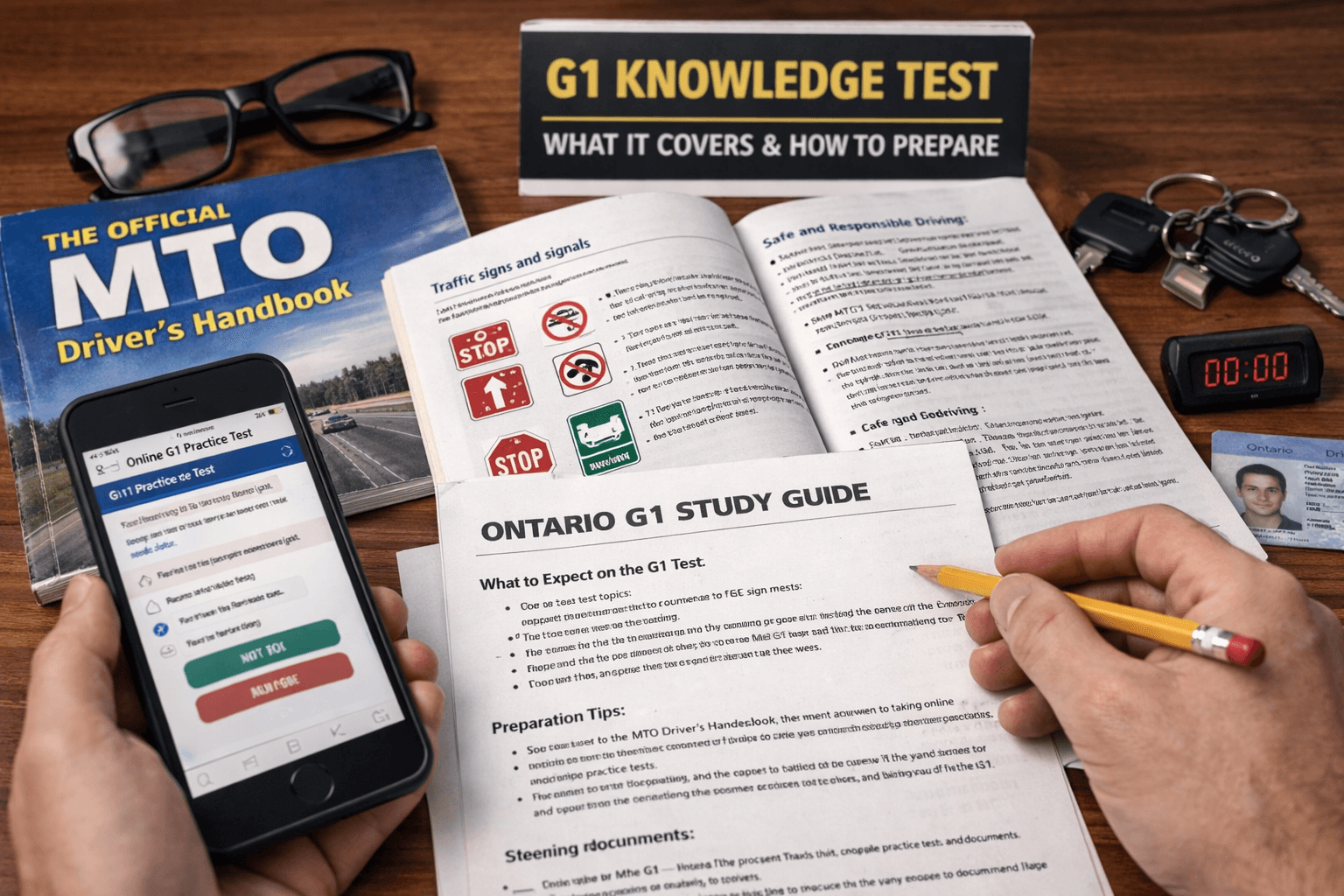
Walking into your G1 knowledge test without knowing what topics it covers is like showing up to a job interview without knowing what the company does. You might get lucky, but the odds are against you.
The G1 knowledge test draws from a specific set of topics outlined in the Ontario Driver's Handbook. Understanding what those topics are lets you study strategically instead of trying to memorize an entire book and hoping the right information sticks.
This guide breaks down every major content area on the G1 knowledge test so you know exactly what to expect and how to prepare for each section.
Overview of Test Content
The G1 knowledge test pulls questions from the Ontario Driver's Handbook, which is published by the Ministry of Transportation. Everything on the test comes from this single source. No trick questions, no outside material, no surprises from left field.
The 40 questions split evenly between two categories. Twenty questions cover road signs, signals, and pavement markings. The other twenty cover rules of the road, traffic laws, and safe driving practices.
Within those two broad categories, questions touch on dozens of specific topics. Some topics appear on nearly every version of the test while others show up less frequently. Knowing which areas get heavy coverage helps you prioritize your study time.
Road Signs: What You Need to Know
The signs section tests your ability to recognize and interpret the visual information you will encounter while driving. Ontario uses hundreds of different signs, but they follow logical patterns that make them easier to learn.
Regulatory Signs
Regulatory signs tell you what you must or must not do. They carry legal weight, meaning violating them can result in tickets or other penalties.
Stop signs and yield signs fall into this category. So do speed limit signs, do not enter signs, no parking signs, and one-way markers. The test expects you to recognize these signs instantly and know exactly what action they require.
Pay attention to the shapes and colors. Stop signs are the only octagon-shaped signs on the road. Yield signs are the only inverted triangles. These unique shapes allow drivers to identify them even when visibility is poor or the sign is damaged.
Warning Signs
Warning signs alert you to hazards or changes ahead. They do not give commands but provide information you need to drive safely.
Most warning signs use a yellow diamond shape with black symbols or text. You will see signs warning about curves, intersections, railway crossings, school zones, deer crossings, slippery conditions, and construction zones.
The test often asks what a specific warning sign means or what action a driver should take after seeing one. A sign showing a winding road ahead does not legally require you to slow down, but a safe driver would reduce speed in response to that warning.
Information and Guide Signs
Information signs help you navigate and find services. Highway route markers, distance signs, exit signs, and destination signs fall into this category. Green signs typically indicate directions and distances. Blue signs point toward services like gas stations, food, and lodging. Brown signs mark recreational areas and tourist attractions.
The G1 test includes fewer questions about information signs than regulatory or warning signs, but you should still recognize the common ones.
Pavement Markings
Road markings painted on the pavement communicate important information. Solid lines, broken lines, yellow lines, white lines, arrows, and crosswalk markings all have specific meanings.
Yellow lines separate traffic moving in opposite directions. White lines separate traffic moving the same direction. Solid lines indicate you should stay in your lane while broken lines allow lane changes or passing when safe.
Questions about pavement markings often present scenarios asking whether passing is permitted or which lane you should use for a specific maneuver.
Traffic Signals
Traffic lights seem straightforward, but the test digs into details that some drivers overlook. You need to know what each light color means, including flashing versions. A flashing red light requires a complete stop just like a stop sign. A flashing yellow means proceed with caution.
Advanced green signals, also called left turn signals, give turning drivers a protected phase. You should know when you have a protected turn versus when you must yield to oncoming traffic.
Pedestrian signals also appear on the test. The walk signal, the flashing hand, and the solid hand each communicate different information to pedestrians and drivers.
Rules of the Road: What You Need to Know
The rules section tests your understanding of Ontario traffic laws and how to apply them in various situations. These questions require more than recognition. You need to understand concepts and think through scenarios.
Right-of-Way Rules
Right-of-way questions appear frequently because they govern how drivers interact at intersections, crosswalks, and other shared spaces. You need to know who goes first in different situations.
Four-way stops follow the first-to-arrive rule, with ties going to the driver on the right. Uncontrolled intersections work similarly. Vehicles entering a roadway from a driveway or parking lot yield to all traffic already on the road. Pedestrians have right-of-way at crosswalks, both marked and unmarked.
Emergency vehicles with sirens and flashing lights have absolute right-of-way. You must pull over and stop until they pass.
Speed Limits and Safe Speeds
Ontario sets default speed limits that apply when no signs are posted. The test expects you to know these defaults: 50 km/h in urban areas and 80 km/h on rural highways.
Beyond posted limits, questions address adjusting speed for conditions. Rain, snow, fog, and heavy traffic all require slower speeds regardless of what the signs say. Driving the posted limit during a blizzard could still be considered careless driving if conditions called for a slower pace.
School zones and community safety zones have reduced limits during posted hours. Construction zones carry doubled fines when workers are present.
Sharing the Road
Ontario roads are shared by cars, trucks, motorcycles, bicycles, pedestrians, and other users. The test covers how drivers should interact safely with each group.
Cyclists have the same rights as motor vehicles and deserve at least one metre of passing space. Pedestrians have right-of-way at crosswalks and intersections. Large trucks have significant blind spots that drivers should avoid lingering in.
School bus rules receive heavy coverage on the G1 test. When a school bus displays flashing red lights and its stop arm, drivers in both directions must stop unless separated by a physical median.
Impaired Driving Laws
Ontario takes impaired driving seriously, and the test reflects that priority. You need to know the blood alcohol limits for different license classes.
G1 and G2 drivers face a zero tolerance policy. Your blood alcohol concentration must be 0.00% at all times while driving. This applies regardless of your age. A 19-year-old G1 driver has the same zero limit as a 16-year-old.
Fully licensed drivers over 21 face the standard 0.08% criminal limit, but Ontario also has administrative penalties starting at 0.05%.
Cannabis impairment follows similar rules. G1 and G2 drivers cannot have any THC in their system while driving.
G1 License Restrictions
The test includes questions about limitations specific to G1 license holders. You should know the highway restrictions, supervision requirements, time restrictions, and passenger rules that apply to your license class.
G1 drivers cannot use 400-series highways, the QEW, or other controlled-access highways. A fully licensed driver with at least four years of experience must sit in the front passenger seat at all times. Driving is prohibited between midnight and 5:00 a.m.
Safe Driving Practices
Some questions address general safe driving habits rather than specific laws. Following distance, mirror usage, blind spot checks, and proper signaling all fall into this category.
The two-second following rule provides a baseline for safe distance behind other vehicles. Increase this gap in poor weather or heavy traffic. Always signal your intentions before turning or changing lanes. Check mirrors regularly and look over your shoulder to check blind spots before lane changes.
How to Prepare for Each Content Area
Different content areas benefit from different study approaches.
For road signs, visual recognition is the skill you need. Flashcards work extremely well because they train quick identification. Go through your flashcards daily, spending extra time on signs you confuse with each other.
For traffic rules, understanding beats memorization. Read the handbook sections carefully and think about why each rule exists. Right-of-way rules exist to prevent crashes at intersections. Speed limits exist because stopping distance increases with speed. When rules make logical sense, they become easier to remember and apply.
For scenario-based questions, practice tests are your best preparation tool. These questions present situations and ask what a driver should do. The more scenarios you work through during practice, the more prepared you will be for similar questions on the real test.
Topics That Catch People Off Guard
Certain topics generate more wrong answers than others. Railway crossing rules appear on nearly every test, and many people miss them. You must stop at least five metres from the nearest rail when signals are active. Never drive around lowered gates.
Roundabout rules confuse drivers who have not encountered roundabouts in their area. Yield to traffic already in the circle. Signal right as you approach your exit.
Questions about what to do after a collision also trip people up. You must remain at the scene, render assistance, and report the collision to police if injuries occurred or damage exceeds a certain threshold.
Connecting Content Areas
The best preparation recognizes that signs and rules work together. A warning sign about a curve ahead connects to rules about adjusting speed. A school zone sign connects to reduced speed limits during posted hours. A railway crossing sign connects to rules about stopping distance and never driving around gates.
Study these connections rather than treating signs and rules as completely separate topics. On the road, you will process signs and apply rules simultaneously. Building that mental connection during your preparation helps on both the test and in actual driving.
Ready to see how well you know the G1 knowledge test content? G1 Ready CA offers practice tests covering every topic area discussed in this guide. For a deep dive into the signs portion specifically, check out the Ontario road signs study guide to make sure you can identify every sign you might encounter on test day.


