
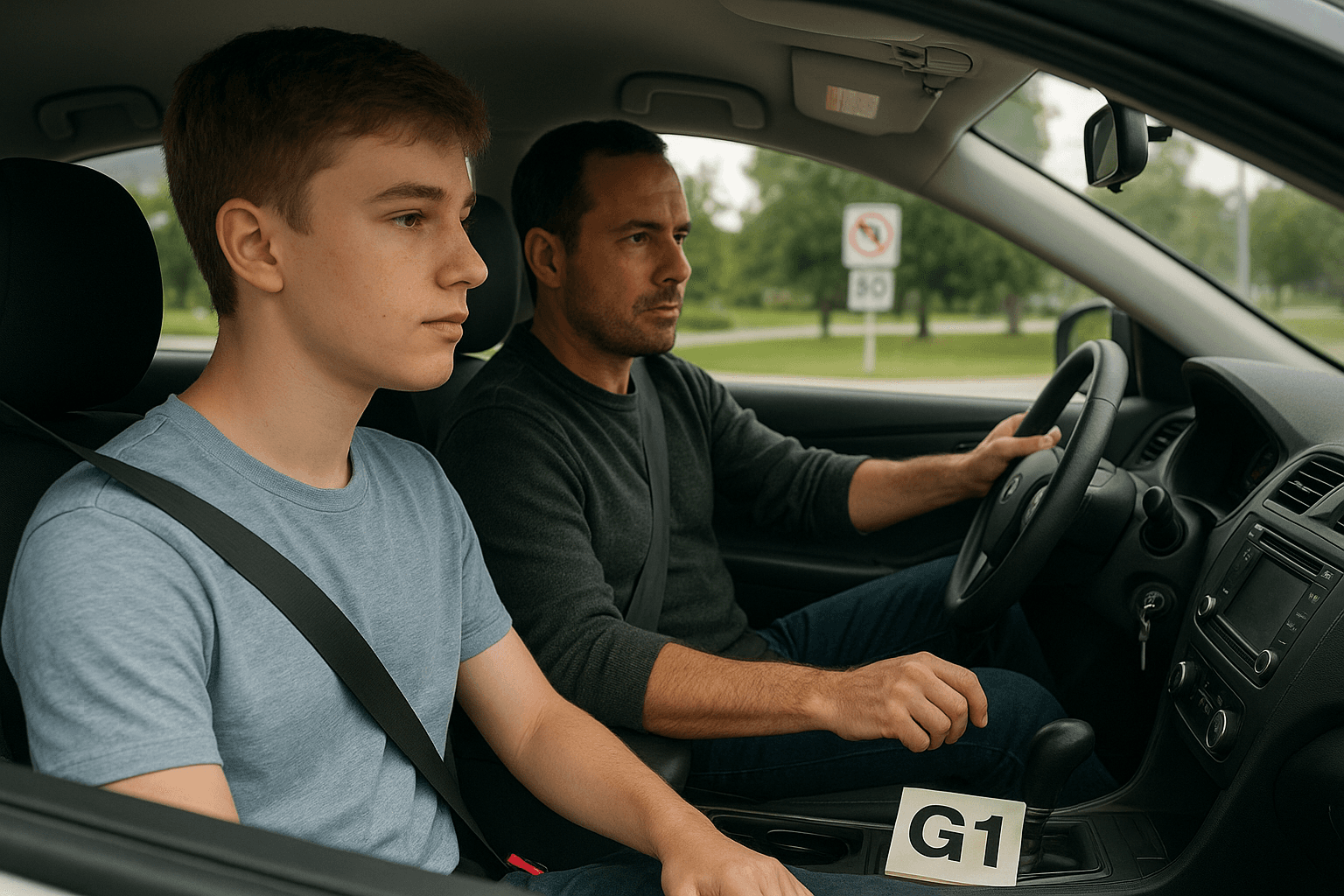
So you passed your G1 test. Congrats! You have officially taken your first step toward becoming a fully licensed driver in Ontario. But before you grab the keys and head out, you need to know that your G1 comes with a pretty strict set of rules attached to it.
These restrictions exist for good reason. New drivers need time behind the wheel with supervision before they are ready to handle every driving situation on their own. The Ontario government designed the Graduated Licensing System to give you that experience gradually, reducing your risk of accidents along the way.
Breaking these rules is not just a bad idea. It can result in fines, license suspension, and even delays in getting your G2. Let's walk through exactly what you can and cannot do with your G1 license so you stay on the right side of the law.
Where You Cannot Drive With a G1
The biggest restriction that catches new drivers off guard is where you are allowed to drive. With a G1 license, certain roads are completely off limits.
You cannot drive on any 400-series highways. That means Highway 401, Highway 400, Highway 404, Highway 407, Highway 410, Highway 417, Highway 427, and all similar numbered routes are not available to you. These highways have high speed limits and fast-moving traffic that requires more experience to handle safely.
The Queen Elizabeth Way, commonly called the QEW, is also prohibited for G1 drivers. This highway connects Toronto to Niagara Falls and sees heavy traffic volumes, especially on weekends.
Other controlled-access highways fall under the same restriction. The Don Valley Parkway, the Gardiner Expressway, the E.C. Row Expressway in Windsor, and the Conestoga Parkway in Kitchener-Waterloo are all off limits. If a road has controlled access points, high speeds, and no traffic lights, assume you cannot use it with your G1.
This restriction trips up a lot of new drivers who live in suburban areas where highway access is everywhere. Plan your routes carefully and use local roads and streets to get where you need to go. Yes, it takes longer. But it keeps you legal and gives you valuable practice on roads that match your experience level.
Supervision Requirements
You cannot drive alone with a G1 license. Every single time you get behind the wheel, you must have a fully licensed driver sitting in the front passenger seat beside you.
This supervising driver must hold a valid Class G license (or higher) with at least four years of driving experience. Someone with a G2 license cannot supervise you, even if they have been driving for years. The person beside you needs to have completed the entire graduated licensing process themselves.
Your supervisor must be awake, alert, and in a condition to take over driving if needed. That means they cannot be impaired by alcohol, drugs, or fatigue. If your supervisor has been drinking, you cannot drive, period.
There is no exception to this rule. It does not matter if you are just moving the car in a driveway or making a quick trip to the corner store. Every time the car moves with you in the driver seat, your qualified supervisor must be right there beside you.
Blood Alcohol Rules
Ontario enforces a zero tolerance policy for G1 drivers when it comes to alcohol. Your blood alcohol concentration must be 0.00% at all times while driving. Not 0.01%, not 0.02%. Absolute zero.
This applies even if you are of legal drinking age. A 19-year-old with a G1 license faces the same zero tolerance rule as a 16-year-old. The restriction is tied to your license class, not your age.
The same rule applies to cannabis and other drugs. You cannot have any presence of THC or other impairing substances in your system while driving with a G1.
Getting caught violating this rule leads to an immediate license suspension, fines, and potentially criminal charges depending on the circumstances. Your G1 driving privileges will be revoked, and you will need to start the licensing process over again. It is simply not worth the risk.
When You Can Drive
G1 drivers face time restrictions on when they are permitted to operate a vehicle. You can only drive between 5:00 a.m. and midnight.
Driving between midnight and 5:00 a.m. is prohibited regardless of the circumstances. It does not matter if your fully licensed supervisor is with you. It does not matter if you have an emergency. During those overnight hours, someone else needs to drive.
This restriction exists for safety reasons. Nighttime driving presents additional challenges including reduced visibility, fatigue, and a higher likelihood of encountering impaired drivers on the road. New drivers benefit from building their skills during daylight and evening hours first.
Plan your schedule accordingly. If you have a late shift at work or an early morning commitment, arrange for alternate transportation during the restricted hours.
Passenger Limits
With a G1 license, the number of passengers you can carry depends on the time of day and your supervisor's presence.
From 5:00 a.m. to midnight, you may carry as many passengers as there are working seatbelts in the vehicle, provided your supervising driver is in the front passenger seat. A car with five seatbelts can carry five people total, including you and your supervisor.
There are no special exemptions for family members. Your supervisor counts toward your passenger total. So in a five-seatbelt vehicle, you can have your supervisor plus three additional passengers.
The seatbelt rule is strict. If your back seat only has two working seatbelts, you can only put two passengers back there. Non-functional seatbelts do not count, and carrying passengers without proper restraints leads to fines and demerit points.
Device Restrictions
Ontario's distracted driving laws apply to all drivers, but G1 holders face even stricter enforcement. You cannot use any handheld electronic device while driving. This includes phones, tablets, GPS units, and any other device you hold in your hand.
You are not permitted to talk on a handheld phone, text, check social media, adjust a playlist, or enter a destination into a handheld GPS. Even holding the device while stopped at a red light counts as a violation.
Hands-free devices are technically permitted under Ontario law, but as a new driver, your focus should be entirely on the road. Many driving instructors recommend avoiding even hands-free calls until you have more experience. Learning to drive requires your full attention, and conversations, even through speakers, create mental distractions.
If you need navigation assistance, set up your GPS before you start driving and mount it on your dashboard. If you need to make a call, pull over safely and park first.
What Happens If You Break These Rules
Violating G1 restrictions carries real consequences that can derail your licensing progress.
A first offense typically results in a 30-day license suspension. You may face fines ranging from several hundred to over a thousand dollars depending on which rule you broke and the circumstances.
Multiple violations lead to longer suspensions and increased fines. Serious violations involving alcohol or drugs can result in criminal charges that follow you for years.
Perhaps most frustrating for new drivers is the impact on your licensing timeline. Suspensions add delays to when you can take your G2 road test. Every month of suspension pushes back your progress toward driving independence.
Insurance companies also pay attention to violations. Even after you complete your licensing, a history of G1 violations can mean higher premiums for years.
Tips for Following G1 Restrictions
Staying compliant with G1 restrictions is mostly about planning ahead.
Map out your routes before you leave. Know which highways and expressways to avoid, and identify alternate routes using local roads. Google Maps and other navigation apps let you select options that avoid highways.
Schedule your driving practice during permitted hours. Late afternoon and early evening offer plenty of daylight while avoiding the overnight restriction.
Always confirm your supervisor is available and qualified before you plan to drive. Keep a backup plan in case they become unavailable at the last minute.
Leave your phone in your bag or glove compartment while driving. Removing the temptation makes compliance automatic.
Talk with your supervisor about the rules so they understand their responsibilities too. They need to stay alert and sober every time you drive together.
Moving Beyond G1 Restrictions
The good news is that G1 restrictions are temporary. After holding your G1 for 12 months (or 8 months if you complete an approved driver education course), you become eligible to take the G2 road test.
Passing the G2 test removes most G1 restrictions. G2 drivers can use highways, drive at any hour, and drive without a supervising passenger. The zero tolerance alcohol rule and some passenger restrictions for young drivers remain, but your independence increases dramatically.
Use your G1 period to build solid driving habits. The supervision requirement means you always have an experienced driver beside you who can offer guidance and help you handle unexpected situations. Take advantage of that mentorship while you have it.
Practice in varied conditions including rain, different traffic levels, and unfamiliar areas. The more experience you gain now, the better prepared you will be for your G2 test and for driving on your own.
Ready to make sure you understand all the rules of the road? Visit G1 Ready CA for practice tests that cover Ontario's driving laws and restrictions. You can also check out the complete G1 test guide to see everything you need to know about the licensing process from start to finish.


