
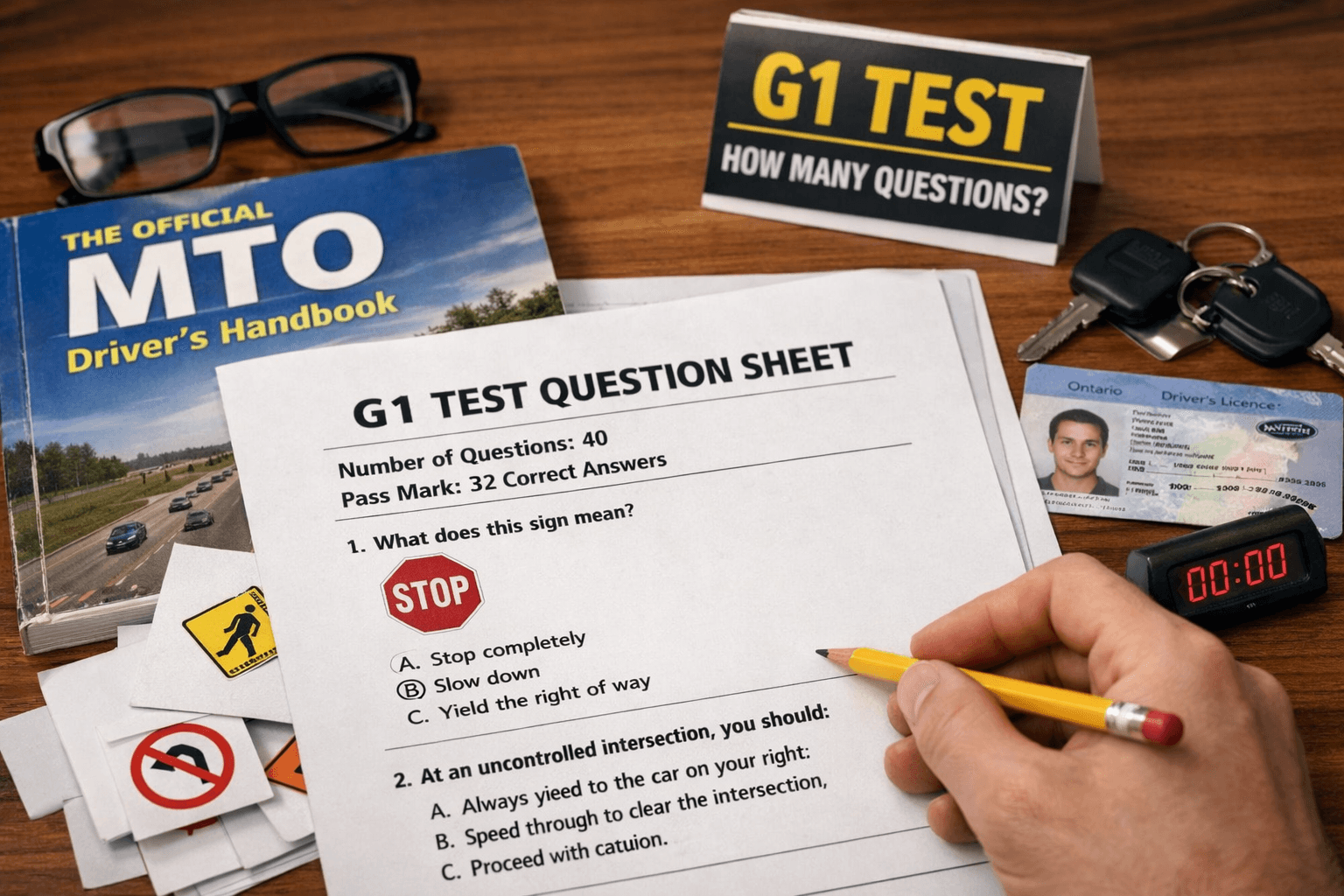
The Ontario G1 test contains 40 multiple choice questions. But that single number does not tell the whole story, because the test is actually split into two separate sections that you need to pass independently.
This catches a lot of people off guard. You cannot just aim for 32 correct answers out of 40 and assume you passed. The way those correct answers are distributed across the two sections matters just as much as your total score.
Here is exactly how the G1 test is structured and what you need to do to pass.
The Two Sections Explained
Your G1 test is divided into two distinct parts with 20 questions each.
Section one covers road signs. These 20 questions test your ability to recognize and understand traffic signs, pavement markings, and signals used on Ontario roads. You will see images of signs and need to identify what they mean or what action they require from drivers.
Section two covers rules of the road. These 20 questions test your knowledge of Ontario traffic laws, safe driving practices, and how to handle various driving situations. Questions might ask about right-of-way, speed limits, what to do at railway crossings, or how to share the road with cyclists and pedestrians.
Both sections carry equal weight. You cannot skip one to focus on the other.
Passing Score Requirements
To pass the G1 test, you must score at least 16 out of 20 on each section. That means you can miss a maximum of four questions per section.
Here is where the math gets important. If you score 20 out of 20 on road signs but only 14 out of 20 on rules, you fail the entire test. Your perfect score on signs does not compensate for falling short on rules. Each section stands alone.
The same applies in reverse. Scoring 18 on rules means nothing if you only got 15 correct on signs. Both sections must hit that 16-question minimum.
This structure rewards balanced preparation. Spending all your study time on road signs while ignoring traffic laws will likely result in a failed test, even if you can identify every sign in Ontario.
Why the Test Uses Two Sections
The Ministry of Transportation designed the test this way for good reason. Safe driving requires two different types of knowledge working together.
Recognizing road signs is a visual skill. When you are driving, signs appear quickly and you need to process their meaning almost instantly. A sign warning about a curve ahead gives you only seconds to react. The signs section tests whether you can identify these visual cues accurately.
Understanding traffic laws is a different mental process. Rules govern how you interact with other drivers, pedestrians, and various road situations. Knowing that pedestrians have right-of-way at crosswalks requires understanding a concept, not just recognizing a shape.
Both skills matter equally on the road, which is why both sections matter equally on the test.
Time Limit and Pacing
The G1 test does not have a strict time limit that most people need to worry about. You generally have plenty of time to read each question carefully and think through your answer.
Most test takers finish in 20 to 30 minutes. Some finish faster while others take longer, and both approaches are fine. Rushing through questions leads to careless mistakes, while taking your time to read carefully improves your accuracy.
The test is administered on a computer touchscreen at DriveTest centres. You select your answer by touching the screen, then move to the next question. The interface is straightforward and does not require any special computer skills.
You can flag questions you find difficult and return to them before submitting your final answers. This feature lets you move past a tough question without losing time, then revisit it after completing the rest of the section.
Question Format
Every question on the G1 test is multiple choice with four possible answers. You select one answer per question. There is no penalty for guessing, so never leave a question blank.
Sign questions typically show you an image and ask what it means. You might see a yellow diamond-shaped sign and need to choose between four descriptions of what that sign indicates. Some questions show a sign and ask what action a driver should take upon seeing it.
Rules questions present scenarios or ask directly about traffic laws. A question might describe an intersection situation and ask who has the right-of-way. Another might ask about the legal blood alcohol limit for G1 drivers or how far you must stop from a railway crossing.
Some questions are straightforward knowledge checks. Others require you to apply multiple rules to a situation. The second type tends to be trickier because you need to think through the scenario rather than just recall a fact.
What Happens If You Fail One Section
If you pass one section but fail the other, you fail the entire test. There is no partial credit or option to retake just the section you failed.
When you fail, you must wait until the next day to retake the test. You cannot attempt the test twice in the same day. You also need to pay the test fee again for each attempt.
Some people fail multiple times before passing. While frustrating, this is not uncommon. Each failed attempt shows you which areas need more study. Use the feedback to focus your preparation before trying again.
There is no limit to how many times you can attempt the G1 test, though the fees add up. Most people find that dedicated studying after a failed attempt leads to success on the next try.
How the G1 Compares to Other Tests
If you have taken driving knowledge tests in other provinces or countries, you might be calibrating your expectations based on those experiences. Ontario's G1 test has its own characteristics worth noting.
The 40-question format with two mandatory sections is specific to Ontario. Other provinces use different structures. Alberta's knowledge test has 30 questions. British Columbia uses 50 questions. Do not assume your experience with another province's test tells you what to expect here.
The 80% passing threshold (16 out of 20) is relatively standard across Canada, but the two-section requirement makes Ontario's test somewhat less forgiving. You need consistent performance across both knowledge areas rather than being able to offset weakness in one area with strength in another.
Preparing for Both Sections
Given that both sections require independent passing scores, your study approach needs to cover both areas thoroughly.
Spend roughly equal time on signs and rules during your preparation. If practice tests reveal that one area is weaker, give that area extra attention, but do not abandon the other section entirely.
For signs, focus on recognition speed and accuracy. Flashcards work well for building quick recall. Group similar signs together to understand their patterns. Yellow warning signs, red regulatory signs, and green information signs each have distinct purposes.
For rules, focus on understanding concepts rather than memorizing isolated facts. Right-of-way rules make more sense when you understand the logic behind them. Knowing why certain rules exist helps you apply them correctly in scenario-based questions.
Practice tests that separate scores by section help you track your readiness for each part independently. Knowing your overall score is less useful than knowing you scored 18 on signs and 14 on rules. That breakdown tells you exactly where to focus your remaining study time.
Test Day: What to Expect
When you arrive at the DriveTest centre, you will check in, verify your identification, pay the fee, and complete a brief vision test. After passing the vision screening, you will be directed to a computer terminal for the knowledge test.
The test begins with the road signs section. Answer all 20 sign questions before moving to the rules section. You can navigate between questions within a section and flag questions for review.
After completing both sections, the computer displays your results immediately. You will see your score for each section and whether you passed or failed. There is no waiting period for results.
If you pass, you will have your photo taken and receive your G1 licence that same day. If you fail, staff will let you know you can return the next day to try again.
The Bottom Line on Question Count
Forty questions, two sections, 16 correct minimum per section. Those are the numbers that matter for your G1 test.
The structure rewards balanced preparation across both road signs and traffic rules. Strong performance in one area cannot rescue weak performance in the other. Study both sections thoroughly, take practice tests that track your scores separately, and make sure you are consistently hitting at least 16 out of 20 on each part before booking your real test.
Want to see how the questions actually look and feel? G1 Ready CA offers practice tests that mirror the real exam format, including separate scoring for signs and rules sections. If you want to build endurance for the 40-question test, try the 100-question extended practice test to make the real thing feel easy by comparison.


