
You're probably here for one reason. You want a free G1 test in Ontario that helps you pass the official one on the first try.
That makes sense. Most learners aren't looking for endless random quizzes. They're trying to avoid that awful feeling of sitting down at DriveTest, second-guessing simple road sign questions, and wondering whether one bad section will mean paying again and coming back another day.
A calm study plan fixes that. If you use free practice the right way, you're not just “doing questions.” You're learning the test format, spotting weak areas early, and reducing the chance that a failed attempt turns into extra cost and extra stress.
The Real Meaning of a Free G1 Test
A free G1 test in Ontario usually refers to free practice. That's the important distinction.
The official process isn't free. Ontario's G1 process includes a $159.75 Class G1 licence package fee and a $16 retake fee for each extra knowledge-test attempt, as explained by Ontario G1 fee details. So the true value of free practice isn't just that it costs nothing to use. It's that it can help you avoid paying again.
That changes how you should think about studying. A free quiz you click through once for fun won't do much. A practice tool you use with a plan can save money, reduce stress, and help you walk into DriveTest knowing what kind of questions you're likely to face.
Practical rule: A free G1 test is only “free” in a useful sense if it lowers your chance of needing a paid retake.
Many learners get stuck because they treat practice like entertainment. They answer a few road sign questions, score decently, and assume they're ready. Then the official test feels stricter, more specific, and less forgiving than expected.
A smarter approach is to use free resources as a rehearsal system. Read the handbook. Test yourself. Review mistakes. Repeat the weak topics until your answers feel deliberate instead of lucky. If you want an example of how learners use online quizzes as part of a focused routine, this guide to a free Ontario G1 practice test is a useful starting point.
Why the word free can be misleading
Free doesn't always mean low-effort or low-value. It can mean flexible, repeatable, and available whenever you have ten minutes to study.
That matters if you're a teen fitting study around school, a newcomer learning Ontario-specific rules, or a parent helping someone prepare. The right free practice tool lets you make mistakes privately, correct them immediately, and build confidence before test day.
What your real goal should be
Your real goal isn't to collect practice scores. It's to pass the official G1 test once, calmly.
Keep that goal in front of you whenever you study. It makes it easier to choose better practice, ignore noisy or outdated resources, and focus on the material that shows up in Ontario licensing.
Official G1 Exam vs Free Practice Tests
The easiest way to understand this is to think of the official G1 exam as the final exam, and free practice tests as your homework and unit quizzes.
Homework helps you learn. The final exam decides the result.
One is the licence test and one is practice
Ontario's G1 knowledge test has 40 multiple-choice questions, split into 20 road sign questions and 20 rules-of-the-road questions. You must answer at least 16 out of 20 correctly in each section, which means an 80% score in both parts, according to Ontario G1 test format details.
That structure catches people off guard. You can feel strong overall and still fail if one section slips.
Free practice tests serve a different purpose. They let you learn without pressure. You can pause, review, redo questions, and notice patterns in your mistakes. That's what makes them useful. They don't replace the official test, but they prepare you for it.
Side by side comparison
Feature Official DriveTest G1 Exam High-Quality Practice Test Purpose Determines whether you pass the knowledge stage for your licence Helps you study, rehearse, and find weak areas Question style Formal multiple-choice questions based on Ontario content Similar multiple-choice questions designed for practice Sections Separate road signs and rules sections May be split by topic or mixed for review Passing pressure High, because the result matters immediately Low, because mistakes are part of learning Feedback Limited in the moment Best versions explain why an answer is right or wrong Retakes Failing can mean paying again You can repeat as often as needed Study value Measures readiness Builds readiness
A practice test should feel like rehearsal, not like a mystery game.
There's another difference that matters. The official test asks you to make sense of Ontario driving rules under pressure. Good practice lets you slow that process down first. You can learn why a sign means what it means, or why a rule applies in one situation and not another.
That's why practice works best when you treat it as training, not prediction. A score on a free quiz doesn't “guarantee” anything by itself. But a pattern of steady, accurate performance across signs and rules is a much better sign that you're ready.
How to Spot High-Quality Free G1 Practice Tests
Not every free G1 test in Ontario is worth your time. Some are too generic. Some feel outdated. Some give you a score but no explanation, which means you can't learn much from mistakes.
The strongest practice tools share a few features. Once you know what to look for, it becomes much easier to ignore low-value quizzes.
Start with Ontario-specific content
Ontario's G1 test is tied to the province's graduated licensing system, which begins at age 16, and the content is drawn from the official Ontario Driver's Handbook, making province-specific practice essential, as outlined in Ontario G1 licensing guidance.
That means a general “Canadian driving test” page isn't enough. You want practice built around Ontario road signs, Ontario traffic laws, and Ontario rules.
Use this quality checklist
When you open any practice site, check for these signs of quality:
- Ontario focus: The questions should clearly match Ontario rules and handbook language, not broad national content.
- Coverage of both categories: You should see material for both road signs and rules of the road.
- Answer explanations: A score alone isn't enough. You need short explanations so mistakes turn into learning.
- Topic-based practice: It helps if you can isolate weak areas instead of repeating mixed questions every time.
- Realistic test mode: A good simulator helps you practise the feeling of completing a full test.
- Easy access: Registration-free tools are helpful when you want quick study sessions on your phone or computer.
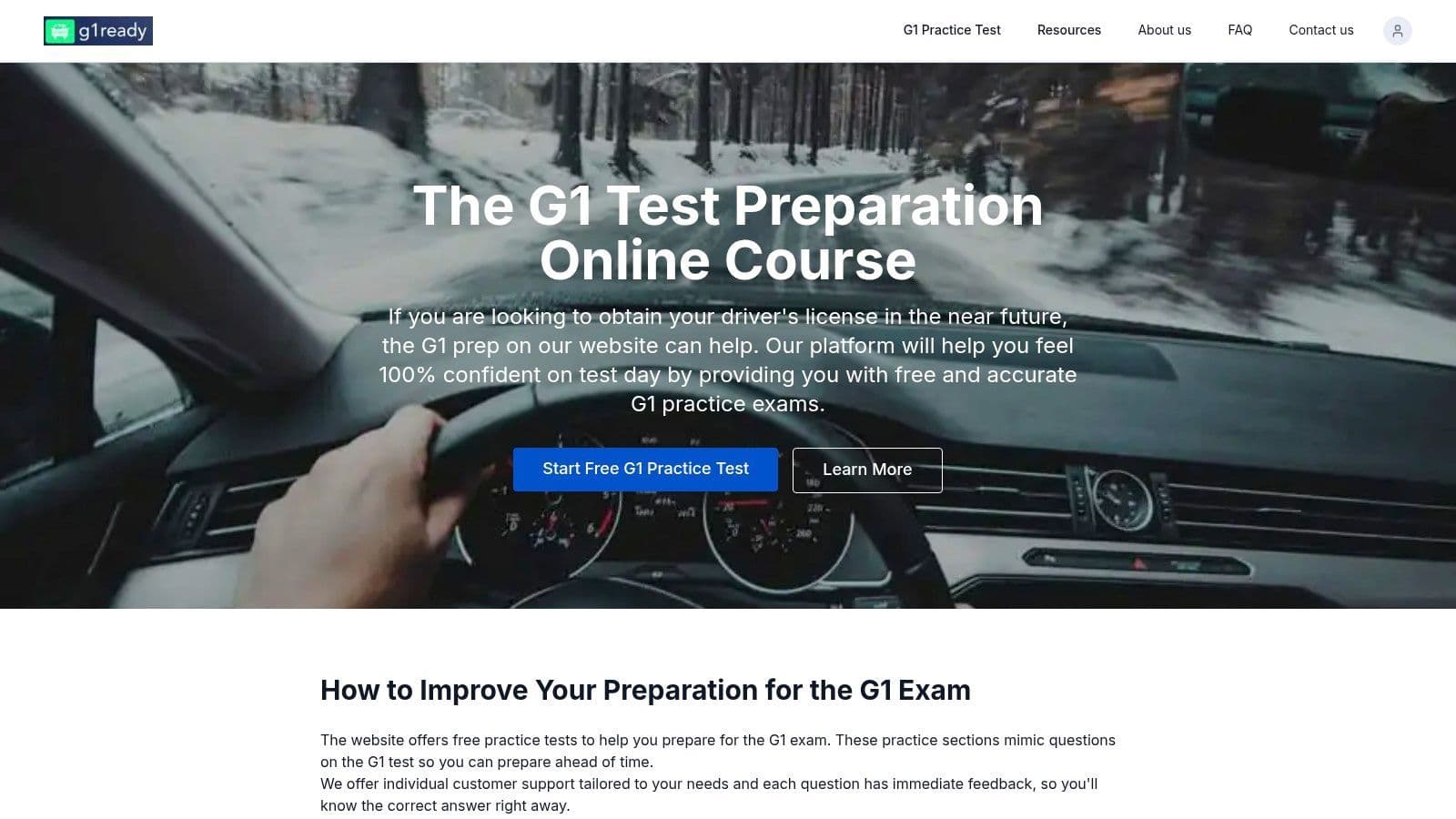
One example is G1ready.ca, which offers registration-free Ontario practice exams, topic quizzes, a diagnostic test, and a simulator aligned to the Ontario handbook. That kind of setup is useful because it supports both quick practice and structured review.
A simple way to judge a tool in five minutes
Open a test and answer a small set of questions. Then ask yourself:
- Did the questions sound Ontario-specific?
- Did the site explain errors clearly?
- Could you tell what topic you were weak in?
- Would you trust it for repeat study sessions?
If the answer to those questions is mostly no, move on.
A good practice tool should make you feel more organised after using it, not more confused.
Your 4-Step G1 Study Plan Using Practice Tests
Cramming rarely feels good for the G1. A short, repeatable system works better because it builds confidence in layers.
Start simple. Add pressure gradually. Keep reviewing your weak points until they stop being weak points.
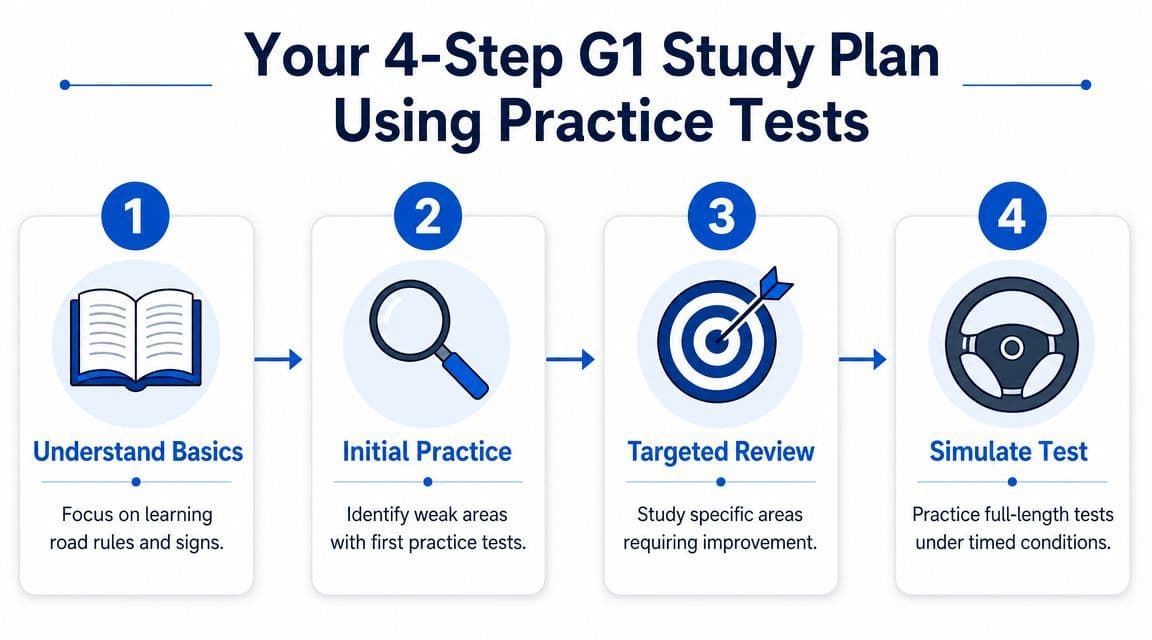
Step 1 Learn the handbook in a practical way
Read the Ontario Driver's Handbook with a purpose. Don't try to memorise every line in one sitting.
Instead, group what you read into simple buckets such as signs, right-of-way, lane use, speed choices, and safe responses. If a rule feels abstract, pause and picture a real road situation. That's important because official sample questions focus on applied driving judgment in scenarios such as skid recovery, highway entry, lane changes, passing, U-turn safety, and choosing a speed that allows stopping within a safe distance, as shown in Ontario's sample knowledge questions.
Don't ask, “Can I recite this rule?” Ask, “Would I recognise this situation in a question?”
Step 2 Use practice to find weak spots
Your first few practice tests are not there to prove you're ready. They're there to show you where you're shaky.
Take a mixed practice set and pay close attention to the types of mistakes you make. Some learners miss unfamiliar signs. Others understand signs but get tangled in judgment questions about passing, lane choice, or safe driving behaviour.
A practical study routine like the one in this guide on how to study for the G1 test works well because it treats mistakes as a map, not as a verdict.
Here's a useful habit:
- Mark recurring errors: If the same topic shows up twice, it needs dedicated review.
- Write the rule in plain language: Turn confusing handbook wording into a short sentence you'd remember.
- Retest soon: Revisit that topic while it's still fresh.
To see the pacing of a calm review session, this short video can help:
Step 3 Review by topic not by mood
A lot of learners study whatever feels easiest that day. That's comforting, but it leaves gaps.
Use targeted quizzes after each practice round. If road signs are weaker, stay with signs until the meanings become automatic. If rules questions are the issue, focus on scenarios where judgment matters. That could include questions about safe speed selection, highway entry, or what a driver should do when conditions change.
The best review sessions are short and specific. One topic, one goal, one correction loop.
Step 4 Prove you're ready with a simulator
Once your topic work feels steady, switch to full-length simulated tests. During these, you practise staying calm, reading carefully, and finishing without rushing.
You're looking for consistency, not one lucky high score. The official test rewards balanced understanding, so your simulator work should show that you can stay accurate across different question types and not just the ones you enjoy.
By the time you reach this stage, your confidence should feel quieter and more solid. That's a good sign. Real readiness usually feels steady, not dramatic.
Common Pitfalls and G1 Scoring Tips
A lot of G1 failures don't come from zero preparation. They come from preparation that missed the structure of the test.
The most common problem is uneven ability. A learner may do very well with road signs but struggle with rules questions, or the reverse. That matters because the G1 exam has two sections, and you must answer at least 16 out of 20 correctly in each one. A strong result in one section can't make up for a weak result in the other, as explained in this G1 scoring breakdown.
What trips learners up
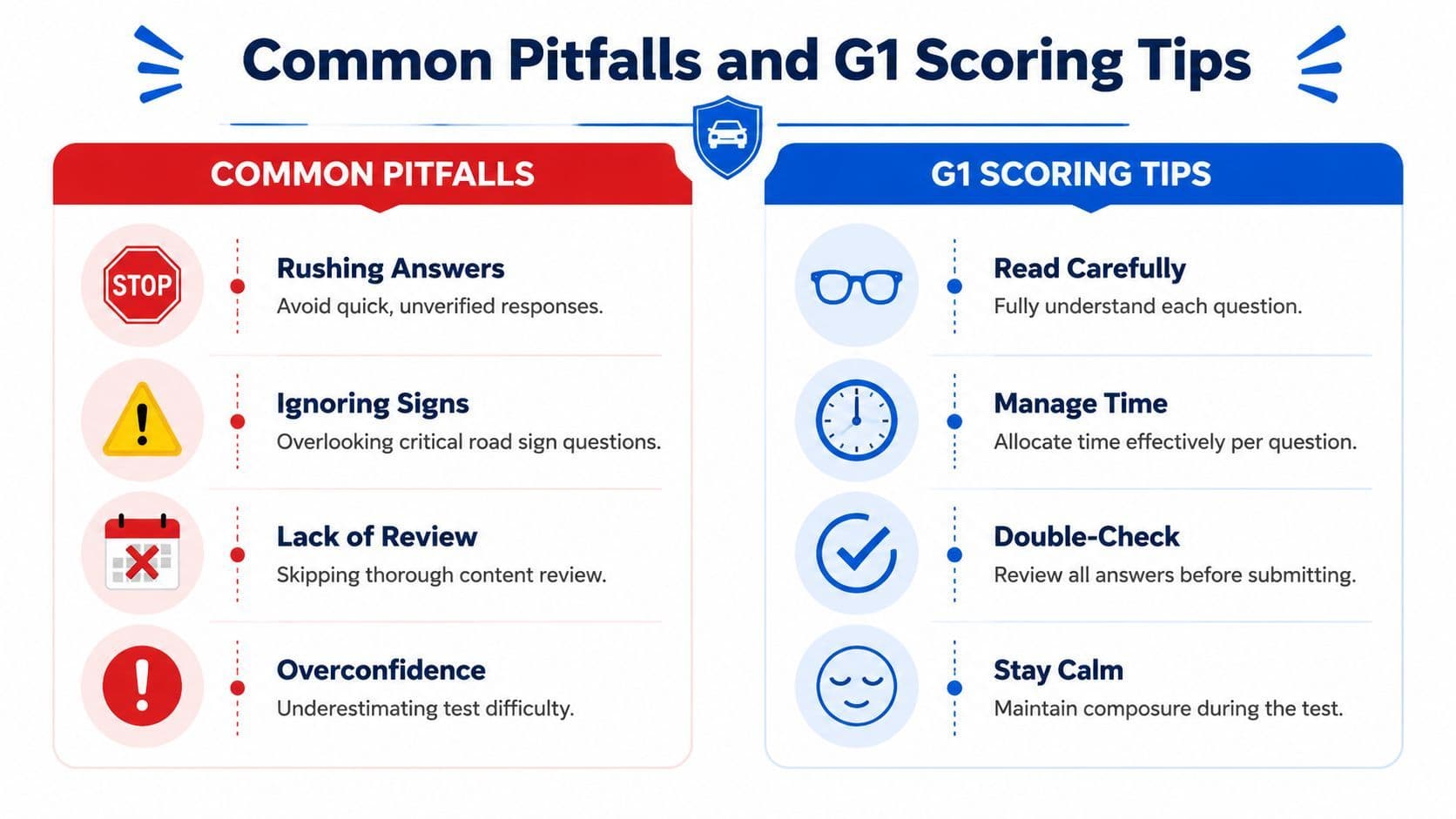
These patterns cause trouble again and again:
- Over-relying on memorisation: Some questions test judgment, not just recall.
- Reading too fast: Small wording details can change the meaning.
- Ignoring one category: Signs and rules both need dedicated study.
- Mistaking familiarity for mastery: Seeing a question before isn't the same as understanding it.
Many learners don't fail because the test is impossible. They fail because they prepare unevenly.
Scoring habits that protect you on test day
Use habits that match the way the test is marked.
- Treat each section as its own pass target: Don't assume one strong area will rescue the other.
- Slow down on scenario questions: If the question describes a situation, picture it before choosing.
- Watch for legal wording: Words such as safest, must, or should often matter.
- Review your mistake patterns before test day: If you usually miss the same kind of question in practice, fix that before booking.
A simple mental check helps. Ask yourself, “Am I prepared in both buckets?” If the answer is uncertain, keep practising.
Calm accuracy beats rushed confidence every time.
From Practice to Passing Booking Your Official G1 Test
At some point, studying has done its job. You know the handbook better. Your practice is more consistent. The next move is to take that preparation into the official process.
Ontario's G1 path begins when a person turns 16 and goes to a DriveTest location for the written knowledge test, vision screening, and entry into the G1 stage. Ontario rules also require a G1 driver to be accompanied by a fully licensed driver with at least 4 years of driving experience and a blood alcohol level below 0.05%, according to Ontario G1 rules and requirements. Those details matter because they remind you that the G1 isn't just a written hurdle. It's the start of Ontario's graduated licensing system.
A simple readiness checklist
Before you book or head to DriveTest, make sure you can say yes to these:
- I can answer signs and rules questions with equal confidence
- I'm not relying on lucky guesses
- I've reviewed my recurring mistakes
- I understand that Ontario-specific rules matter
What to bring and what to expect
Keep test day as boring as possible. Boring is good.
Bring your identification, payment for the licensing process, and any eyewear you need for vision screening. Give yourself enough time so you're not rushing in already stressed. Once you sit down, read slowly, trust your preparation, and treat each question as one decision at a time.
If you've used free practice as a study system instead of as random entertainment, you've already done the hardest part.
If you want a simple place to continue practising, G1ready.ca offers Ontario-focused G1 practice tests, topic quizzes, and exam-style study tools you can use to build a steady routine before test day.


