
An Ontario Class G license is the final, unrestricted driver's license for cars, vans, and light trucks, allowing the most freedom but also requiring the highest level of skill and responsibility. If you're asking what is Class G license, the simple answer is that it's the full licence most Ontario drivers work toward after building safe habits in the earlier G1 and G2 stages.
You're probably here because you've seen “full G required” on a job posting, heard someone say they finally got their “full G,” or you're staring at Ontario's licensing steps and wondering what the end goal looks like. That's a normal place to be.
A full G licence matters because it marks the point where Ontario trusts you to drive independently in the widest range of everyday situations. More importantly, it shows that you didn't just memorize rules. You learned how to manage speed, watch for hazards, merge smoothly, make decisions under pressure, and stay calm when traffic gets messy.
Ontario's graduated system can feel slow when you're eager to drive on your own. But there's a reason it works this way. Each stage teaches a different part of real-world driving, and the Class G licence is the reward for putting those skills together consistently.
What Exactly Is a Full G License?
A full G licence is Ontario's standard licence for everyday passenger vehicles. When people ask what is Class G license, they usually mean the licence that lets you drive without the learner and intermediate restrictions that apply earlier in the graduated system.
Think of it this way. G1 means you're learning the rules. G2 means you're proving you can handle the road with some independence. Full G means you've shown that you can manage the full mix of driving conditions most adults face, including city traffic, higher-speed roads, changing weather, and more complex decision-making.
That's why a full G often matters outside the test centre too. Employers may ask for it. Families may feel more comfortable handing over the keys once you have it. And many drivers feel more settled once they've reached the final stage.
Practical rule: A full G licence gives you more freedom, but it also assumes you can make safe decisions without someone else stepping in.
The bigger point isn't just permission. It's trust. Ontario's licensing path is built around the idea that good driving develops in layers, and the full G sits at the top because it represents mature, repeatable driving habits.
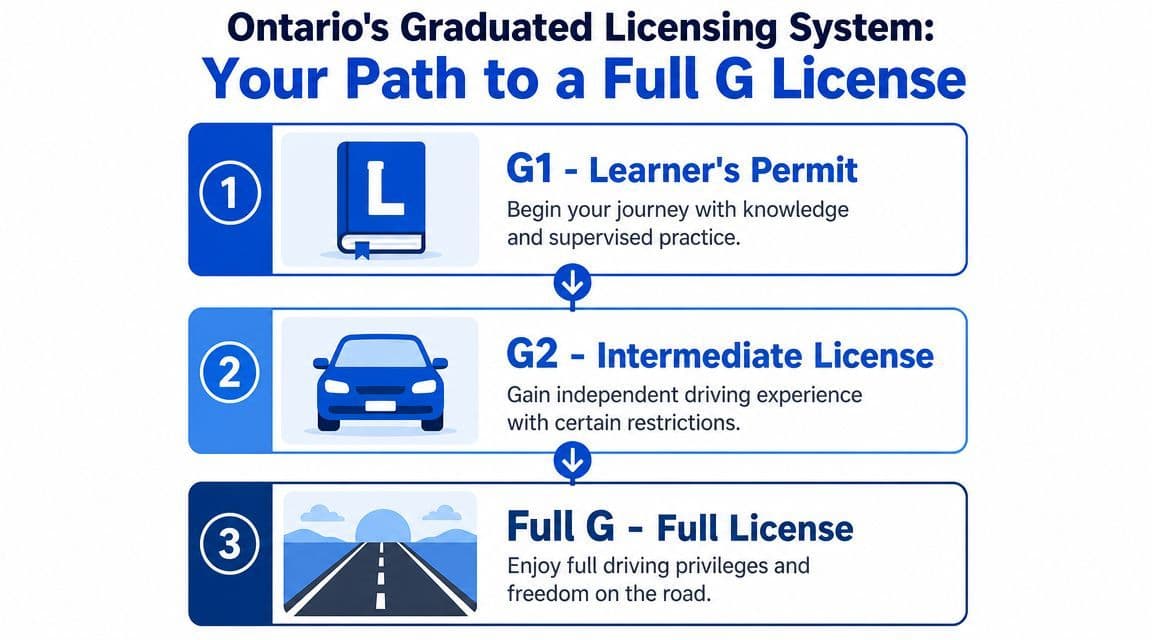
How the G License Fits into Ontario's Graduated System
Ontario doesn't hand out full driving privileges all at once. It uses a gradual system so new drivers can build judgment before they face the most demanding situations on their own.
That's the “why” behind the process. Driving isn't only about steering, braking, and parking. It's also about scanning ahead, reading other drivers, adjusting to risk, and staying composed when traffic changes quickly.
For a plain-language overview of the system, Ontario graduated licensing explained gives a helpful starting point.
Three stages that build on each other
A simple way to understand the system is comparable to an apprenticeship.
- G1 is the learner stage. You study road signs, rules, and safe-driving basics. You practise with guidance because early mistakes are easier to correct when an experienced driver is beside you.
- G2 is the experience stage. You begin driving more independently and learn what traffic feels like when decisions are yours to make. With this independence, confidence begins to grow, yet caution remains vital.
- Full G is the mastery stage. You're expected to handle more demanding driving with consistency, not luck. That includes choosing safe gaps, merging at the right speed, and reacting smoothly when conditions change.
Many people get frustrated with the pacing of the system because they want the final licence right away. But if you've ever watched a brand-new driver handle their first busy intersection, the reason becomes obvious. They don't just need rules. They need repetition.
Why Ontario doesn't start with full privileges
The graduated system protects new drivers from being thrown into every challenge at once. A learner who is still working on mirror checks and lane position shouldn't be under pressure to manage every high-speed situation alone.
That's why the full G is worth aiming for. It isn't a random final card. It's proof that you've built enough real-world skill to drive with greater independence.
Ontario's system makes more sense when you stop viewing it as a set of hurdles and start viewing it as structured practice with increasing responsibility.
If you're still at the beginning, that's fine. Every experienced driver with a full G started by learning signs, making awkward turns, and getting corrected after mistakes.
G1 vs G2 vs G License Privileges and Restrictions
One of the easiest ways to understand what is Class G license is to compare it with the two earlier stages. The difference becomes clear when you look at what each stage allows you to do on the road.
A practical side-by-side view
Restriction G1 License G2 License Full G License Supervision Must drive with a qualified accompanying driver Can drive independently Can drive independently Driving freedom Most limited More freedom, but still not the final stage Broadest driving freedom for regular passenger vehicles Experience level expected Beginner Developing Fully licensed everyday driver Road test status Knowledge test stage completed First road test completed Final road test completed Typical focus Learning rules and basics Building judgment through practice Managing varied road conditions confidently Why it exists To reduce risk while you learn To bridge learning and independence To confirm you can drive safely without stage-specific limits
This kind of comparison matters because many new drivers only think in terms of restrictions. They ask, “What am I allowed to do yet?” A better question is, “What skill am I still building?”
What changes most when you reach full G
The biggest shift with a full G isn't just convenience. It's the expectation that you can manage the full driving task without the safety net built into the G1 and G2 stages.
That means things like:
- Handling faster roads calmly. You need to merge with confidence, match traffic flow, and change lanes without hesitation or panic.
- Reading risk earlier. Full G driving means spotting problems before they force a hard brake or rushed decision.
- Driving consistently. One smooth trip isn't enough. Safe driving has to become your normal habit.
If you want to understand one common area of confusion before reaching full G, this guide to G2 highway restrictions can help clear up how intermediate driving rules affect road access and confidence-building.
A G1 driver often thinks about the car. A G2 driver starts thinking about traffic. A full G driver has to think about both at the same time.
That's why the final stage matters. It rewards more than technical ability. It rewards judgment.
Your Roadmap from a G2 to a Full G License
Once you have your G2, the path to a full G becomes more practical. At this stage, you're no longer proving that you understand the basics. You're learning to make good decisions in busy, fast-moving, real-world traffic.
What to do before you book
A lot of G2 drivers make the same mistake. They treat the full G test like a formality. Then they discover that highway driving, speed control, lane choice, and observation under pressure feel very different from lower-speed practice.
A better approach is to prepare in layers.
First, build variety into your driving. Don't only practise in your own neighbourhood or at quiet times of day. Use different routes. Drive in heavier traffic. Get comfortable entering and exiting major roads. Practise when conditions aren't perfect, as long as they're safe.
Second, pay attention to habits, not just destinations. Anyone can get from point A to point B. The key question is how you do it. Are you checking mirrors early? Are you choosing lanes with a plan? Are you maintaining a steady speed instead of drifting up and down?
A simple preparation checklist
Before you book your full G test, make sure you can confidently say yes to most of these:
- I can merge without freezing. You don't need to be aggressive, but you do need to join traffic smoothly and at a sensible speed.
- I scan well before changing lanes. Mirror checks, blind-spot checks, and timing should feel deliberate, not rushed.
- I can keep a safe pace. Examiners notice hesitation just as much as speeding.
- I stay organized in busy areas. Intersections, ramps, and lane changes shouldn't scramble your thinking.
- I can take feedback and correct quickly. If a practice drive shows a weak spot, you work on it instead of hoping it won't come up.
Some learners use lessons with an instructor. Others practise with an experienced family driver. Some also use study tools such as G1ready.ca, which offers Ontario practice tests and explanations for road rules, signs, and common weak areas that still affect later-stage driving decisions.
The strongest preparation usually comes from combining knowledge review with active road practice. The written rules tell you what to do. Repetition teaches you when and how to do it smoothly.
How to Pass Your G Road Test
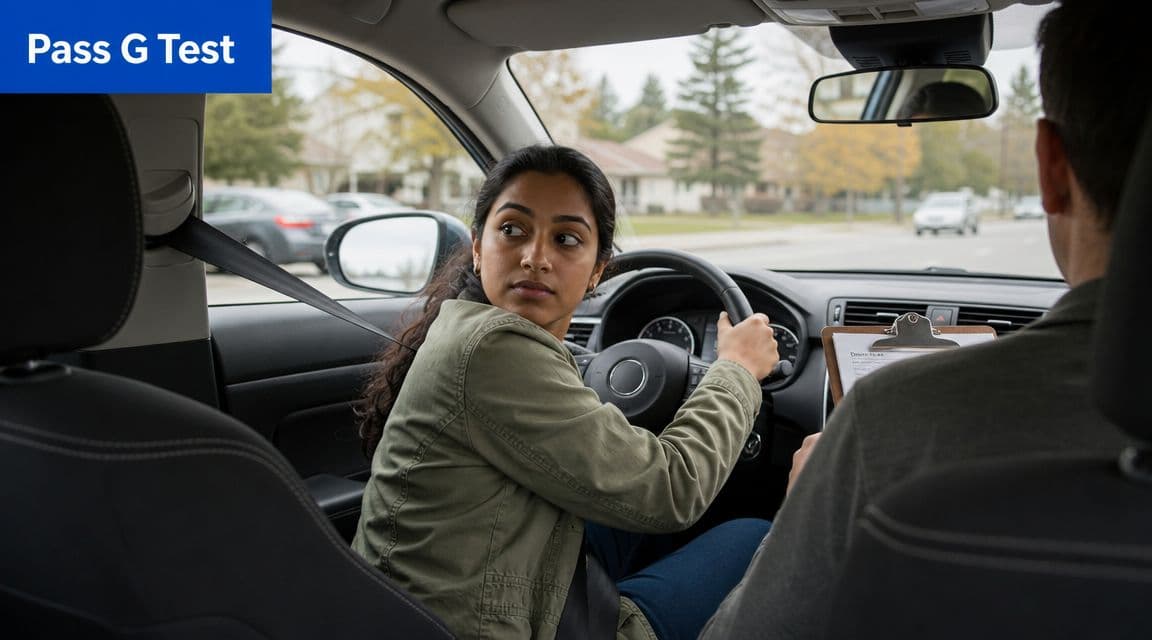
The G road test checks whether you can drive like someone who belongs on the road independently, not just someone who can follow simple directions for a few minutes. Examiners look for calm control, awareness, and decisions that make sense in live traffic.
What the examiner is really watching
Many drivers focus too much on one dramatic fear, like a bad merge or a missed turn. In reality, examiners are usually looking at your full pattern of behaviour.
They want to see whether you observe properly, react in time, and move with traffic in a controlled way. That includes how you approach intersections, how early you prepare for lane changes, and whether your driving looks planned instead of improvised.
A useful way to prepare is to review practical test skills that overlap across licence stages. For example, parallel parking on a driving test may not define the full G test on its own, but it reflects the same broader standard of control, observation, and vehicle awareness.
Here's a useful walk-through to study before your next practice session:
Practice habits that make the biggest difference
The best test prep isn't flashy. It's repetitive and honest. Focus on the habits that examiners can see right away.
- Use visible observation. Don't just move your eyes. Make your checks clear enough that the examiner can tell you're scanning mirrors and blind spots.
- Match the road environment. If traffic is moving steadily, don't crawl out of fear. If conditions are tighter, don't force speed just to look confident.
- Finish manoeuvres decisively. Half-committed lane changes and timid merges often create more risk than a smooth, well-timed action.
- Recover calmly from small mistakes. Missing a turn or needing to re-centre yourself doesn't automatically ruin a test. Unsafe reactions do.
- Practise on the kinds of roads the test expects. If higher-speed driving still feels unfamiliar, that's your clearest practice priority.
When drivers struggle on the G test, it's often because they're trying to “act tested” instead of simply driving in a safe, organised, predictable way.
One more tip. Narrate your thinking during practice, even if you stay silent on test day. Saying things like “mirror, signal, blind spot, move when clear” helps turn scattered actions into a reliable routine.
Guidance for Newcomers and International Drivers
If you're new to Ontario, the question “what is Class G license” often comes with a second question. Do you need to start from the beginning, or can your previous driving experience count?
Start by checking how your experience may count
Ontario may recognize some out-of-province or international driving experience, depending on where you're licensed and what documents you can provide. That can make a big difference in how quickly you move through the system.
The smartest first step is to gather proof early. That may include your current licence, a driving record, or official confirmation from the authority that issued your original licence. If anything needs translation, handle that before you book appointments.
This part matters because many newcomers are experienced drivers, but not all experience is automatically visible to Ontario's system. You may know how to drive well, yet still need paperwork that proves the length and status of your driving history.
What catches many newcomers off guard
The hardest part usually isn't basic car control. It's adjusting to local expectations.
A driver can have years of experience elsewhere and still need time to adapt to Ontario signs, lane discipline, test standards, winter conditions, and the way examiners assess observation. That's normal. It doesn't mean you're a poor driver. It means driving rules are local, and safe habits need to match the place you're driving in now.
A few practical moves help:
- Study Ontario-specific rules carefully. Don't assume signs, right-of-way habits, or testing standards work the same way as they did back home.
- Take a few local practice drives before any test. This helps you adjust your timing, scanning, and lane choices to Ontario traffic patterns.
- Consider a professional assessment lesson. An instructor can spot small habits that might be acceptable elsewhere but problematic on an Ontario test.
Newcomers often improve fastest when they treat Ontario driving as adaptation, not translation.
That mindset lowers frustration and speeds up learning.
The Freedom of the Open Road Starts Here
A full G licence is the end point of Ontario's graduated system, but it's also the beginning of a different kind of driving life. You gain more independence, more flexibility, and more responsibility at the same time.
That's why the journey matters. G1 teaches the rules. G2 builds experience. Full G shows that your habits are strong enough to hold up when the road gets busy, fast, or unpredictable.
If you're just starting, don't get discouraged by the steps. Each one prepares you for the next, and every confident full G driver began exactly where you are now.
If you're getting ready for the first step, G1ready.ca offers Ontario G1 practice tests, sign quizzes, and study tools that can help you build the road-rule foundation you'll use all the way through to your full G licence.


