
You've got your G2, the keys are in your hand, and one question keeps coming up. Can you drive on Highway 401, the QEW, or other 400-series highways by yourself? The short answer is yes. That's the part many new drivers want to hear.
The part that matters just as much is this: legal permission and real readiness aren't always the same thing. A G2 gives you far more freedom than a G1, but it also puts more responsibility on you right away. Highway speed, lane changes, merging pressure, and fast decision-making can feel very different from city driving.
That's where many drivers get confused about g2 highway restrictions. They expect a long list of highway-only rules, when the primary issue is usually broader: what roads you can use, what conditions still apply to your licence, and how to judge whether you're ready for a busy expressway today, not just allowed to be there.
Your G2 Licence and the Open Highway
A lot of new drivers hit the same moment. You pass your test, your G2 arrives, and suddenly the roads that used to be off-limits don't seem so off-limits anymore. You start wondering whether the highway is now fair game, or whether there's some hidden restriction you've missed.
The answer is simple. Yes, a G2 driver can use Ontario highways, including major expressways. If you've recently moved up from your G1 stage, that change can feel big. If you're still working through the timeline between licence stages, this guide on when you can get your G2 after your G1 helps put the process in order.
But “yes” doesn't mean “nothing else matters.” The highway itself may be open to you, yet your licence still comes with conditions that apply everywhere you drive. Those conditions matter just as much on the 401 as they do on a neighbourhood street.
What new G2 drivers often miss
Some drivers assume g2 highway restrictions are about special highway curfews or road bans. For most G2 drivers, that's not where the problem is. The actual trouble usually comes from rules such as:
- Alcohol restrictions: You must keep a zero blood alcohol concentration while driving.
- Passenger limits for younger drivers: If you're 19 or under, extra nighttime passenger rules can apply.
- Higher stakes for mistakes: Novice drivers face stricter consequences than fully licensed drivers.
Practical rule: Before your first solo highway trip, make sure you understand both your road access and your licence conditions. Many drivers know one and forget the other.
A calm approach works best here. Learn what your G2 allows. Learn what it still limits. Then build highway experience in a way that matches your actual comfort and skill.
Understanding Your Highway Driving Permissions
Here's the clearest way to think about it. A G2 licence gives you access to roads that a G1 driver can't use alone.
According to Ontario's official driver guidance, once licensed at the G2 level, drivers in Ontario have full authorization to operate vehicles on all 400-series highways without time-based or road-type restrictions, making G2 highway driving significantly less restricted than G1 driving, which prohibits highway use entirely. That includes highways such as the 401, 400, 417, and the QEW, as explained in Ontario's official level two road test guidance.
That's a major jump in freedom. With a G1, you can't drive on 400-series highways at all, and your driving is tightly limited. With a G2, the road access side of the equation opens up.
If you want the bigger picture of how each stage fits together, this guide to Ontario graduated licensing explained is useful background.
What this means in real life
If you hold a valid G2, you can legally:
| Road Type | Can a G2 driver use it? |
|---|---|
| Residential streets | Yes |
| City roads and arterial roads | Yes |
| Expressways | Yes |
| 400-series highways | Yes |
Many learners often overcomplicate this issue. They ask whether there's a separate highway permit, a special highway waiting period, or a rule that says they can only use certain major roads after a set amount of time. The key point is that your G2 itself is the permission.
Permission is not the same as readiness
Being allowed onto a highway doesn't automatically mean today is the right day to start with the busiest route in the province. A driver may be legally fine on the 401 and still feel overwhelmed by fast merges, short on-ramps, or dense traffic.
Legal access answers one question. Safe judgment answers the second one.
That's why the rest of this topic matters. Once the road is legally open to you, the next step is understanding the rules that still follow you there.
Zero Alcohol and Passenger Rules for G2 Drivers
Many people search for g2 highway restrictions expecting highway-only rules. The more important limits are licence conditions that apply wherever you drive, including on highways.
Zero alcohol means zero
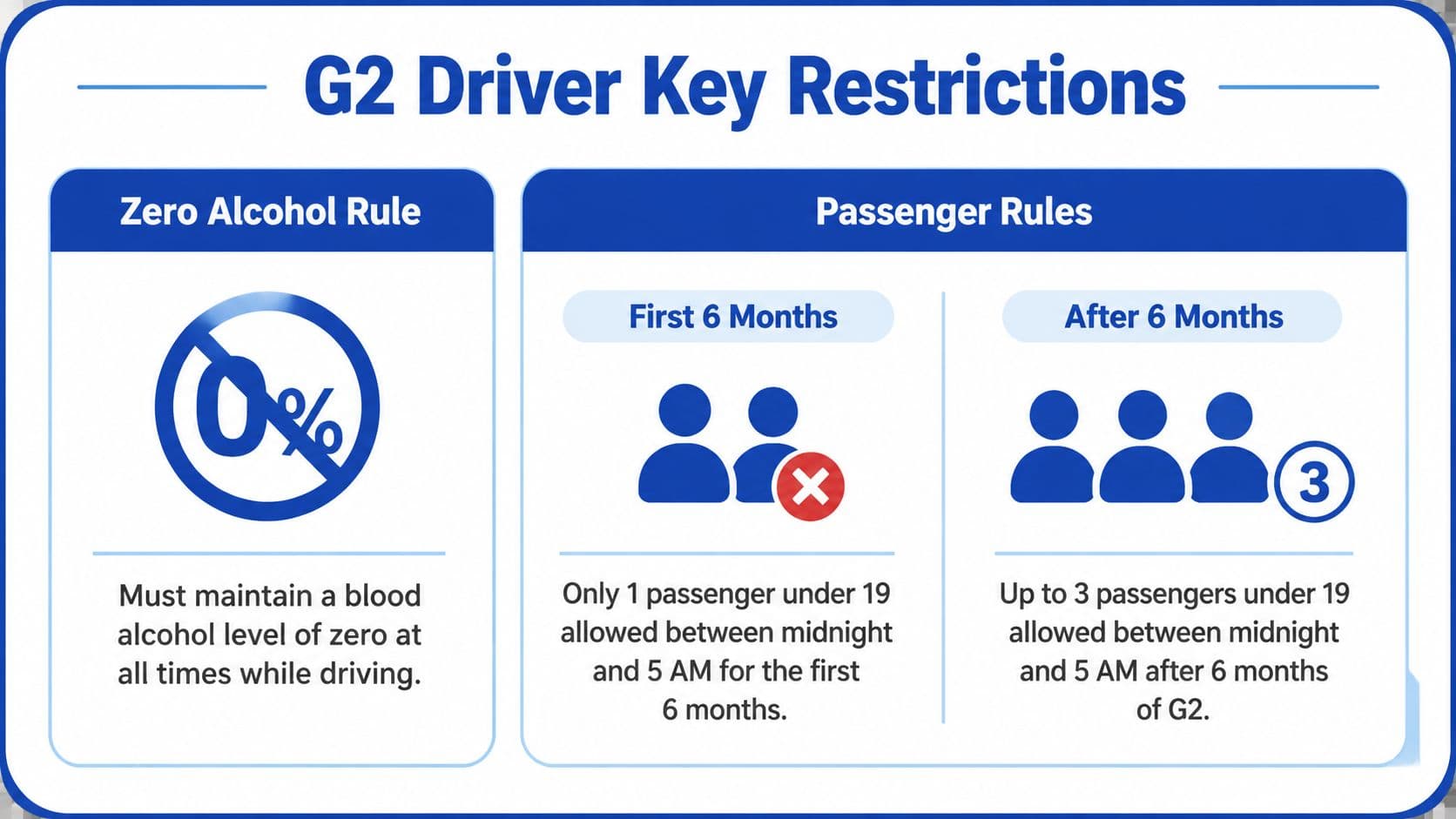
A G2 driver must maintain 0.00% BAC at all times while driving, as outlined in this overview of Ontario graduated licensing and G2 conditions. There isn't any “small amount is fine” zone here for a novice driver.
That matters on highways for an obvious reason. Highway driving asks more of you, not less. You're processing speed, spacing, mirrors, signs, exits, and the behaviour of other drivers in a shorter amount of time. A G2 licence treats alcohol as incompatible with that responsibility.
Passenger limits for drivers 19 and under
The passenger rule is one of the most misunderstood parts of the G2 stage. The restriction applies to drivers aged 19 or under, and it applies between midnight and 5 a.m.
The rule is:
- First six months with a G2: You may carry one passenger aged 19 or under.
- After six months: You may carry up to three passengers aged 19 or under.
Those limits come from the same Ontario G2 overview linked above.
Important exceptions
These passenger restrictions don't apply in every situation. The limits don't apply if:
- Immediate family members are the passengers
- A fully licensed driver with at least four years of driving experience is accompanying you
These details matter because many real trips are mixed situations. You might be driving home from work, picking up a sibling, or travelling with a parent in the car. The legal answer changes based on who's in the vehicle.
Keep it simple: If you're 19 or under and driving late at night, count the number of passengers who are also 19 or under before you start the trip.
A common point of confusion
Some drivers think these passenger rules are only about city driving, parties, or weekend trips. They aren't. They apply whether you're on a local road or a 400-series highway. The location doesn't cancel the condition.
Another common mistake is focusing only on the time you picked someone up. What matters is the time you're driving. If your trip continues into the restricted period, that's where questions can start. I'll come back to that in the FAQ section with a practical answer.
Consequences of Breaking G2 Rules
A G2 licence gives you independence, but Ontario also treats novice-driver violations seriously. That's especially important if you've been thinking about g2 highway restrictions as something minor or technical. They aren't.
For Highway Traffic Act violations carrying 4 or more demerit points, G2 drivers face an escalating penalty system. A first conviction triggers a 30-day suspension, a second conviction triggers a 90-day suspension, and a third conviction results in complete novice licence revocation requiring a restart of the graduated licensing system, according to this summary of Ontario G2 licence restrictions and penalties.
That should change how you think about “just one mistake.” For a novice driver, one serious error can create a much bigger setback than expected.
Demerit points leave less room for error
Ontario also uses a stricter demerit threshold for G2 drivers than for full G drivers. A G2 driver faces suspension at 9 demerit points, while a full G driver suspends at 15 demerit points. That lower threshold reflects the fact that novice drivers are held to a tighter margin.
Here's the practical takeaway:
Licence class Suspension threshold G2 9 demerit points Full G 15 demerit points
If you're a new driver, that difference means you can't treat tickets or serious violations casually.
Why the stakes feel so high
Newly licensed drivers aged 16 to 19 show 2 to 3 times higher crash involvement rates than experienced drivers in the source material behind Ontario's novice-driver penalty structure. That doesn't mean every new driver is unsafe. It means the system assumes inexperience creates extra risk and responds with stricter rules.
After you understand the legal penalties, it helps to hear a plain-language explanation of how novice-driver consequences can affect your licence status:
A G2 doesn't give you much room to learn by breaking rules. It expects you to learn by driving carefully.
For many families, the strongest reason to take these rules seriously isn't fear of punishment. It's avoiding the stress of losing hard-earned progress and having to start over.
Beyond the Rules Practical Highway Safety for G2 Drivers
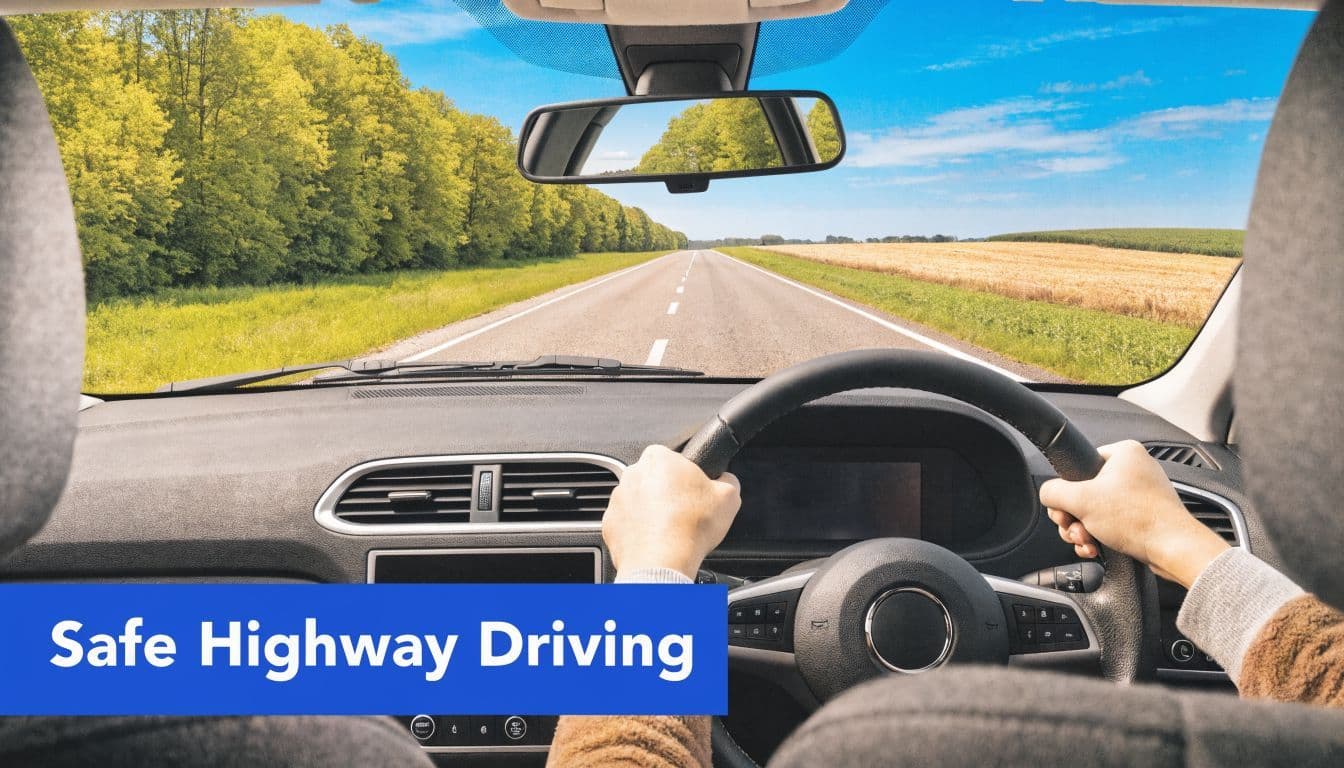
Beyond legal permission, your judgment is the safety tool that matters most on a highway. A G2 licence lets you enter faster roads. It does not guarantee that today is the right day, or that this route is the right one, or that you are in the right state of mind for it.
A common first-time highway problem is overload. At city speeds, you can correct a late mirror check or a hesitant lane change with a little more time. On a highway, everything arrives sooner. Cars close gaps faster, signs appear and disappear more quickly, and one missed decision can create a second problem right away.
Some guidance on G2 highway driving explains that new drivers can develop “tunnel vision” at highway speeds, as discussed in this article on G2 drivers and highway readiness. That is why a driver may stare at the vehicle ahead, miss an exit sign, or freeze at the end of an on-ramp.
A simple readiness check
Before you get on the highway, run a quick self-check, the same way a pilot checks conditions before takeoff.
- Merging confidence: Can you press the gas firmly enough to reach the speed of traffic on the ramp?
- Mirror routine: Can you check mirrors and blind spots without drifting?
- Lane discipline: Can you keep a steady lane position when traffic around you speeds up?
- Exit planning: Do you already know where you are leaving the highway?
- Stress level: Are you calm and alert, or already tight and rushed before the drive begins?
If a few of those answers feel uncertain, that is useful information. It means this drive should be simpler, shorter, or postponed.
Build difficulty slowly
New drivers often make the same mistake. They pick a busy highway, at a busy time, headed to an unfamiliar place, and then judge their ability based on that one stressful trip.
A better approach is to reduce the number of things your brain has to handle at once. Use a familiar route. Go in daylight. Pick a quieter period. Drive one or two exits and come off. Then repeat that route until the pace feels normal instead of intense.
After that, add one new challenge at a time. Busier traffic on one trip. A different interchange on another. Light rain on a day when you already know the route well.
Build skill one variable at a time. Do not try to learn highway speed, route planning, heavy traffic, and night driving all on the same trip.
What-if situations to prepare for
Mental readiness matters because highway problems rarely announce themselves early. They show up as fast decisions.
What if you reach the end of the on-ramp and traffic is moving faster than you expected? Keep accelerating if space allows, scan early, and commit to a clear gap. Hesitation at the merge point creates danger for you and for drivers behind you.
What if you miss your exit? Keep going and take the next one. A five-minute detour is minor. A sharp last-second move across lanes is not.
What if a transport truck is beside you? Give it room and avoid sitting in its blind spots. If you need to pass, do it steadily and with purpose. If you are not sure, wait.
What if your heart rate jumps and you feel yourself locking onto one car ahead? Widen your view. Check farther down the road, then return to your mirrors and lane position. That wider scan helps break the tunnel effect.
Small habits that prevent big problems
Highway driving rewards calm, early decisions.
Look farther ahead than feels natural at first. Leave more following space than the minimum. Set up for exits early. If traffic feels messy, stay in a steady lane rather than weaving for small gains. Smooth driving usually means safer driving.
If you want to connect these practice habits with the skills expected later, this guide to G2 test requirements and highway driving practice can help you focus each trip with a clear purpose.
How Highway Driving Prepares You for the G Test
Your G2 stage isn't just a waiting period before the full licence. It's your practice window for the kind of driving the final test expects.
Before taking the G2 exit test, candidates must complete and sign a Declaration of Highway Driving Experience form that records how many times they've driven on freeways or highways with speed limits of at least 80 km/h in the previous period before the test. Ontario includes that requirement because highway driving is part of what you're expected to handle as you move toward a full licence.
That means highway practice isn't optional in any practical sense. If you avoid it for your whole G2 stage, you're leaving a major skill untrained. If you use the stage well, each trip helps you improve lane changes, merging, speed control, scanning, and route planning.
Practice with a purpose
Random driving helps a little. Focused driving helps much more. Try to notice one specific skill on each trip:
- One drive: Work on smooth merging
- Next drive: Focus on checking mirrors earlier
- Another drive: Practise choosing your exit lane calmly
This guide to G2 test requirements can help you connect your everyday practice with what the final stage demands.
The best highway practice for your G test is calm, repeatable practice. Not brave practice.
A driver who builds confidence gradually usually performs better than one who avoids highways for months and then tries to rush preparation near test day.
Common Questions About G2 Highway Driving
Real confusion usually starts with everyday scenarios, not the basic rule itself. Here are some of the questions new drivers and parents ask most often.
What if I pick up a friend at 11 55 p.m. and it turns midnight during the trip
This is one of the practical gaps many guides don't explain well, as noted in this discussion of common G2 restriction questions. The safest approach is to assume the restriction applies once you are driving during the restricted time window.
If you're 19 or under, don't plan a trip that becomes non-compliant at midnight just because it started a few minutes earlier.
Do the nighttime passenger rules apply on highways too
Yes. The passenger restriction applies based on your licence condition, not the type of road. A highway doesn't cancel the rule.
If my parent is with me, does that change the passenger rule
It can. Earlier in this article, I covered the exemption for a fully licensed accompanying driver with enough driving experience. In practical terms, having that qualified accompanying driver can change how the passenger rule applies.
Do immediate family members count in the same way as friends
The passenger restriction has an immediate-family exemption. That's why a sibling trip and a late-night drive with friends may be treated differently under the rule.
I'm legally allowed on the highway, but I still feel nervous. Should I go anyway
Only if the trip matches your current skill level. There's nothing weak about delaying a busy highway trip until you've practised merging, lane changes, and route awareness under easier conditions. Good drivers don't prove themselves by forcing a situation before they're ready.
Is there a blanket curfew for G2 highway driving
No blanket highway curfew applies the way it does for G1 driving. The main issue for most G2 drivers is not highway access itself. It's whether other licence conditions, such as passenger restrictions for younger drivers, apply to that specific trip.
If you're preparing for any stage of Ontario's graduated licensing system, G1ready.ca offers practice tests, handbook-based study tools, and guides that can help you build the rule knowledge behind safer, more confident driving.
Crafted with the Outrank app


