
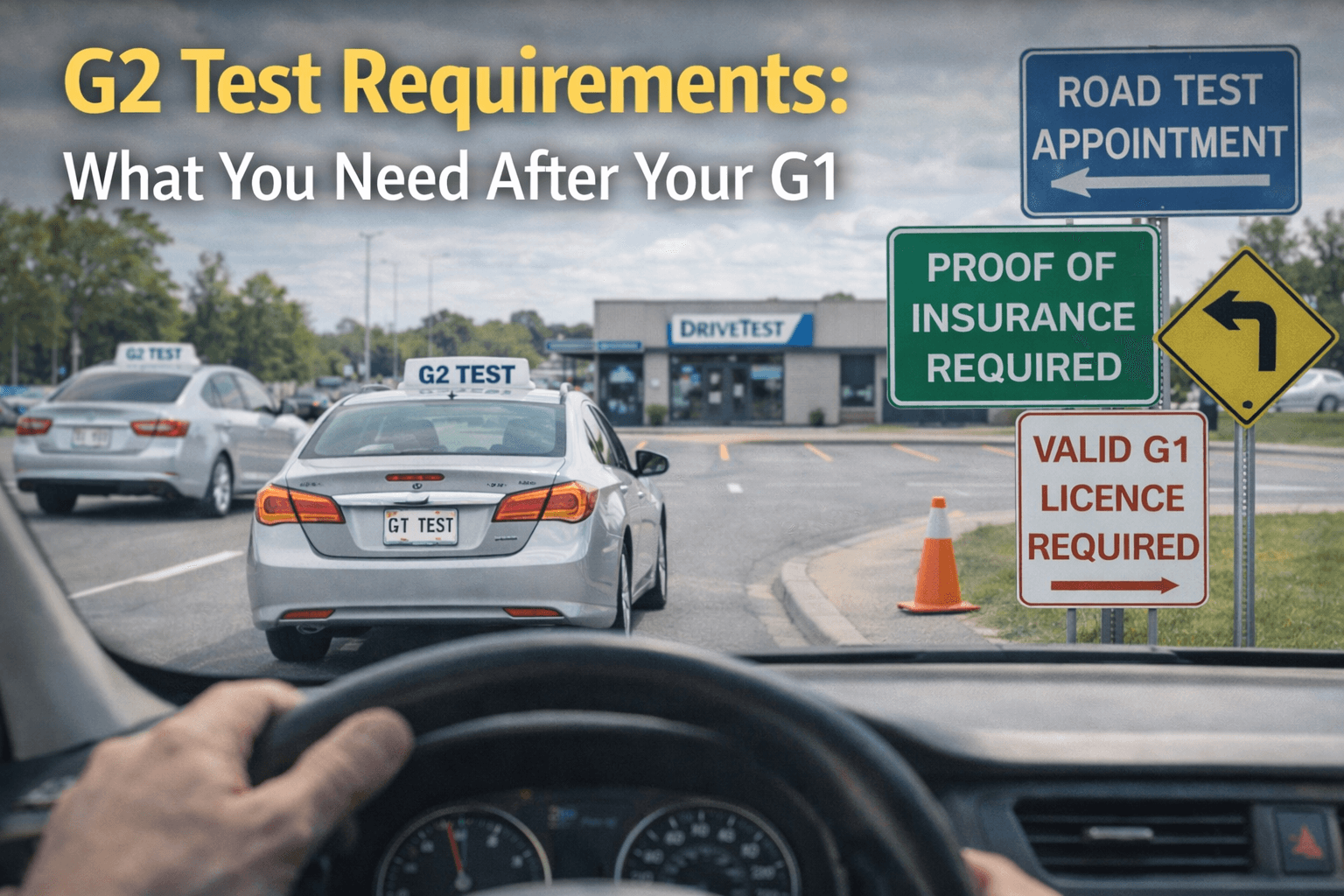
Getting your G1 was the first step. Now you are looking ahead to the G2 road test and the independence that comes with passing it. But before you can sit in that driver's seat with an examiner beside you, several requirements must be met.
The G2 road test has more requirements than the G1 knowledge test did. You need to have held your G1 for a specific period, bring proper documentation, provide a suitable vehicle, and meet various eligibility criteria. Missing any of these requirements means you will not test that day, regardless of how well you can drive.
This guide covers every requirement for the G2 road test so you can prepare properly and avoid showing up only to be turned away.
Time Requirements
The most basic requirement is holding your G1 license for a minimum period before becoming eligible for the G2 road test.
The standard waiting period is 12 months. If you received your G1 on any given date, you become eligible for the G2 test exactly 12 months later. The system tracks this automatically, and you cannot book a test before your eligibility date.
Completing an approved driver education course reduces the waiting period to 8 months. This is the only way to shorten the mandatory wait. No amount of practice hours or demonstrated skill allows you to test earlier than these timelines permit.
If you took an approved driver education course, you need proof of completion to claim the reduced waiting period. Your driving school provides a certificate documenting your completion. Have this certificate information available when booking your G2 test.
The DriveTest booking system verifies your eligibility automatically based on when you received your G1. If you try to book before you are eligible, the system will not allow the booking to proceed.
Valid G1 License
Your G1 license must be valid on the day of your G2 road test. An expired G1 means you cannot test and would need to restart the entire licensing process.
G1 licenses are valid for five years from the date of issue. Most people complete their G2 well within this window, but delays sometimes push people close to expiration. Check your G1 expiration date and make sure your G2 test happens before that deadline.
If your G1 is close to expiring and you cannot get a G2 test appointment in time, contact DriveTest or ServiceOntario to discuss your options. In some cases, extensions or alternative arrangements may be possible, but do not count on this. Plan ahead to avoid the situation entirely.
Your physical G1 license card or proof of your license status must be brought to the test. If you lost your card, obtain a replacement before your test date.
Identification Documents
You must present valid identification at your G2 road test appointment. The requirements are similar to what you provided for your G1, but verification happens again.
Bring your G1 license as your primary identification. This serves as both proof of identity and proof that you hold the prerequisite license for the G2 test.
Additional government-issued photo identification strengthens your documentation. A passport, citizenship card, or other official ID confirms your identity beyond the G1 card.
If any of your information has changed since you got your G1, such as your address or legal name, bring documentation supporting those changes. Address changes should be updated with ServiceOntario before your test.
Vehicle Requirements
Unlike the G1 knowledge test where you just sat at a computer, the G2 road test requires you to provide a vehicle. DriveTest does not supply cars for road tests.
The vehicle must be in safe operating condition. All lights must work, including headlights, brake lights, and turn signals. Tires must have adequate tread. Brakes must function properly. Windshield wipers, mirrors, horn, and other safety equipment must work correctly.
The vehicle must have valid registration. Bring the registration document showing current, unexpired registration for the vehicle you are using. Expired registration means you cannot use that vehicle for the test.
The vehicle must be properly insured. Bring proof of insurance, typically the pink insurance slip, showing the vehicle has valid coverage. The insurance must be current on the day of your test.
The vehicle must be appropriate for testing. Standard passenger vehicles work for G2 tests. The vehicle needs to have a functional parking brake accessible to the examiner, working seatbelts, and doors that open from inside and outside.
Certain vehicle types are not permitted for road tests. Vehicles with only a driver's seat, vehicles requiring special licenses, and vehicles with certain modifications may not be acceptable. If you have any doubt about whether a vehicle qualifies, contact DriveTest before your appointment.
Most people use a family member's vehicle or borrow a car from someone they know. Driving schools often provide vehicles for road tests, either as part of a lesson package or for an additional fee. Renting a car specifically for the test is another option, though you need to verify the rental company's policies about using their vehicles for road tests.
Whatever vehicle you use, practice in it before the test. Familiarity with the specific car's controls, dimensions, and handling helps you perform your best. Taking a road test in an unfamiliar vehicle adds unnecessary difficulty.
Pre-Test Vehicle Inspection
When you arrive for your G2 road test, the examiner conducts a brief vehicle inspection before the driving portion begins.
The examiner will ask you to demonstrate that various vehicle components work. This typically includes turning on headlights, activating turn signals, pressing the brake pedal while they observe the brake lights, and similar checks.
If the vehicle fails inspection, your test cannot proceed. You would need to fix the problem and rebook for another day. This is why verifying everything works before leaving for your appointment matters so much.
Check your vehicle the day before your test. Walk around it and visually inspect lights, tires, and overall condition. Sit inside and test all controls. If anything seems wrong, address it immediately rather than hoping the examiner will not notice.
Vision Requirements
Your vision must meet Ontario's driving standards. While you completed a vision screening for your G1, your vision can change over time, and some circumstances require re-screening.
If you wear glasses or contact lenses, wear them to your G2 test. Your G1 license indicates whether you have a corrective lens restriction. Showing up without your required corrective lenses can prevent you from testing.
If your vision has changed significantly since your G1, consider visiting an optometrist before your G2 test. Struggling to see clearly during a road test creates obvious problems for your performance.
Test Fees
The G2 road test requires payment of applicable fees. However, if you paid the full licensing package fee when you got your G1, your G2 road test fee was included in that payment.
The standard G1 licensing fee covers your G1 knowledge test, your G2 road test, and your license for five years. Most people pay this package fee at the G1 stage and do not pay again for the G2 test itself.
If you fail the G2 road test, rebooking and testing again requires an additional fee. The fee paid at G1 covered one attempt at each test level. Subsequent attempts cost extra.
Confirm your fee status when booking if you are uncertain whether you owe additional payment. The booking system typically indicates any fees due.
Booking the Test
G2 road test appointments are booked through the DriveTest website or by phone. Walk-in road tests are generally not available the way walk-in knowledge tests sometimes are.
When booking, you select your preferred DriveTest centre, date, and time from available options. Availability varies significantly by location and season. Urban centres often have longer wait times for appointments than smaller towns.
Book well in advance of when you want to test. Popular times fill up quickly, and waiting until the last minute might mean accepting a much later date than you wanted or traveling to a less convenient location.
When booking, you may need to provide your G1 license number, confirm your eligibility date, and enter driver education certificate information if claiming the 8-month timeline.
After booking, you receive confirmation of your appointment. Save this confirmation and bring it with you on test day, either printed or accessible on your phone.
Rescheduling is possible through the booking system, but policies about how close to the appointment you can change may apply. Canceling with insufficient notice might result in losing your booking without refund of any fees paid.
What to Bring on Test Day
A checklist helps ensure you have everything needed when you arrive for your G2 road test.
Bring your G1 license. This is mandatory and non-negotiable.
Bring additional photo ID. Passport, citizenship card, or other government-issued identification.
Bring vehicle registration. The current registration document for the vehicle you are using.
Bring proof of insurance. The pink slip showing valid insurance coverage.
Bring your appointment confirmation. Either printed or on your phone.
Bring driver education certificate information. If applicable to your eligibility.
Bring your glasses or contacts. If you have a corrective lens restriction.
Bring payment if required. If rebooking after a failed attempt or if fees are due for any other reason.
Arriving without required items means your test cannot proceed. Double-check your documents before leaving home.
Physical and Mental Readiness
Beyond paperwork and vehicle requirements, you need to be in condition to drive safely on test day.
Get adequate sleep the night before. Fatigue impairs reaction time, decision-making, and focus. A well-rested driver performs better than an exhausted one.
Eat a reasonable meal before your test. Hunger creates distraction and can cause lightheadedness. You do not want physical discomfort competing for your attention during the test.
Avoid alcohol and any impairing substances. This should be obvious, but it bears mentioning. G1 and G2 drivers must maintain zero blood alcohol while driving. Arriving at a road test impaired would result in immediate failure and potentially criminal consequences.
Manage your nerves. Some anxiety is normal, but excessive stress interferes with performance. Practice relaxation techniques, arrive early to settle in, and remind yourself that you have prepared for this.
Practical Skill Readiness
Meeting all the administrative requirements means nothing if you cannot actually drive competently. The G2 road test evaluates real driving ability, not just paperwork compliance.
Before your test date, honestly assess your readiness. Can you perform all the maneuvers the test might include? Are you comfortable driving in the conditions you might encounter on the test route? Have you accumulated enough practice hours to feel confident?
If gaps exist in your preparation, address them before test day. Additional practice with your supervising driver, professional lessons to target weak areas, or simply more time behind the wheel might be needed.
Failing the G2 test is not catastrophic, but it wastes time and money. Showing up genuinely prepared gives you the best chance of passing on your first attempt.
After You Meet All Requirements
Once you have confirmed your eligibility, gathered your documents, verified your vehicle, and built your driving skills, you are ready for the G2 road test.
Arrive at the DriveTest centre early on your appointment day. Check in, present your documents, and complete the vehicle inspection. Then demonstrate the driving skills you have developed during your months of supervised practice.
Passing the G2 test opens up a new level of driving freedom. The supervised practice period ends, and you gain the independence to drive alone, access all roads, and drive at any hour.
The requirements exist to ensure that everyone taking the G2 test has met minimum standards for safety and preparation. Meeting them is not difficult when you plan ahead and stay organized.
Ready to make sure your traffic law knowledge stays sharp for your road test? G1 Ready CA offers practice materials covering the rules you need to apply during actual driving. For a detailed comparison of what the G1 knowledge test and G2 road test each require, review the guide on G1 written test vs road test to understand exactly how the two tests differ.


