
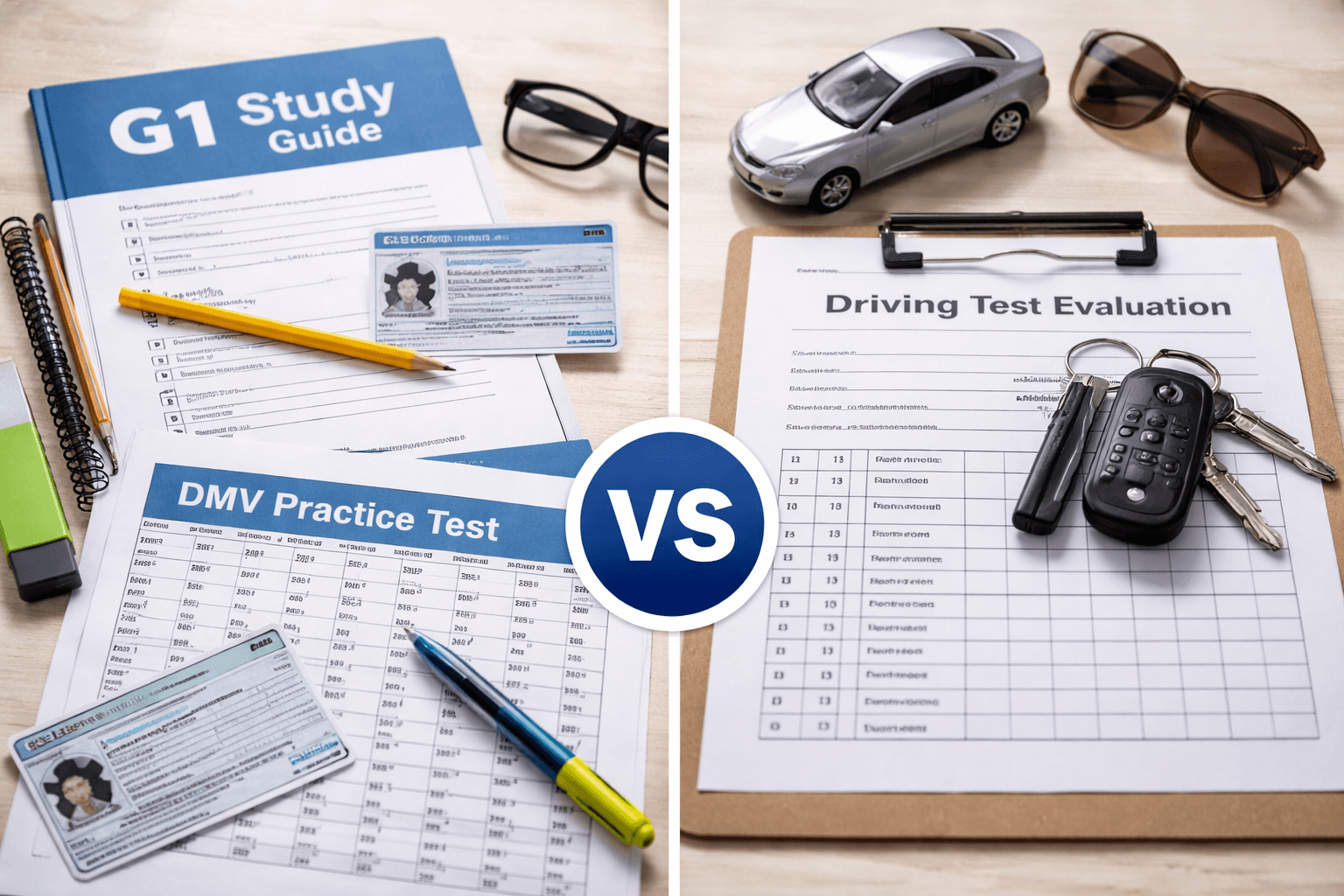
Ontario's graduated licensing system involves multiple tests, and the terminology confuses a lot of people. You hear about the G1 test, the G2 test, the written test, the road test, the knowledge test, and the driving test. Some of these are the same thing with different names. Others are completely different tests at different stages of your licensing journey.
Getting these mixed up causes real problems. People show up at DriveTest centres expecting one type of test and discovering they need something else entirely. Others study for the wrong test or misunderstand how long the licensing process takes.
This guide clears up the confusion by explaining exactly what each test involves, when you take it, and how the pieces fit together.
The Two Main Tests in Ontario's System
Ontario's graduated licensing system requires you to pass two separate tests to get a full driver's license. These tests happen at different times and evaluate completely different skills.
The first test is the G1 knowledge test, also called the written test. This is a multiple choice exam taken on a computer at a DriveTest centre. You do not drive a car during this test. You answer questions about road signs, traffic laws, and safe driving practices. Passing this test earns you a G1 license.
The second test is the G2 road test, also called the driving test. This is an in-car evaluation where you actually drive a vehicle with an examiner sitting beside you. You demonstrate practical driving skills on real roads. Passing this test upgrades your G1 license to a G2 license.
These are not two parts of the same test. They are separate evaluations taken months apart, testing different things, with different preparation requirements.
What the G1 Written Test Involves
The G1 test is purely a knowledge assessment. You sit at a computer terminal and answer 40 multiple choice questions. Twenty questions cover road signs and twenty questions cover rules of the road. You need at least 16 correct answers in each section to pass.
No driving happens during the G1 test. You do not need to know how to operate a vehicle. You do not need access to a car. The test measures what you know about Ontario's traffic laws, not whether you can apply that knowledge behind the wheel.
The questions come from the Ontario Driver's Handbook. Topics include speed limits, right-of-way rules, what various road signs mean, how to handle emergency situations, sharing the road with cyclists and pedestrians, and impaired driving laws.
You take the G1 test at a DriveTest centre. After checking in, providing identification, paying the fee, and passing a vision screening, you complete the computerized test. Results appear immediately on screen. The entire visit typically takes one to two hours.
Passing the G1 test earns you a G1 license. This is a learner's permit that allows you to practice driving under supervision. You cannot drive alone with a G1. A fully licensed driver with at least four years of experience must sit in the front passenger seat whenever you drive.
What the G2 Road Test Involves
The G2 test evaluates your actual driving ability. You get behind the wheel of a car and drive on real roads while an examiner observes and scores your performance.
You must bring a vehicle to the G2 test. The car needs to be in safe operating condition with valid registration and insurance. Most people borrow a vehicle from a family member, use a driving school car, or rent a vehicle specifically for the test.
The examiner sits in the passenger seat and gives you directions. Turn left here. Pull over and park. Enter the highway. The specific route varies by location, but all tests cover the same basic skills.
During the G2 road test, the examiner evaluates your ability to control the vehicle, obey traffic signs and signals, check mirrors and blind spots, make safe lane changes, navigate intersections properly, park the vehicle, and handle various road situations. The test typically lasts 15 to 20 minutes.
You receive your results at the end of the test. The examiner explains what you did well and what errors you made. Passing earns you a G2 license. Failing means you need to book another road test and try again.
A G2 license removes most G1 restrictions. You can drive alone, use highways, and drive at any hour. Some restrictions remain for young drivers regarding passengers and alcohol, but your independence increases dramatically compared to the G1 stage.
The Timeline Between Tests
You cannot take the G2 road test immediately after passing your G1 written test. Ontario requires a waiting period to give you time to practice driving before the road test.
The standard waiting period is 12 months. If you pass your G1 test in March, you become eligible for the G2 road test the following March at the earliest.
Completing an approved driver education course shortens this waiting period to 8 months. These courses combine classroom instruction with in-car training and must be approved by the Ministry of Transportation.
During the waiting period, you should be actively practicing your driving skills. The G1 license exists specifically to let you gain experience behind the wheel with a supervising driver. People who spend their waiting period actually driving tend to pass the G2 road test at higher rates than those who rarely practice.
The waiting period is a minimum, not a deadline. You can take as long as you need before attempting the G2 road test. However, your G1 license expires after five years. If you do not pass your G2 test within that window, you lose your G1 status and must start over from the beginning.
Different Preparation Requirements
Studying for the G1 written test and preparing for the G2 road test require completely different approaches.
G1 preparation is academic. You read the Ontario Driver's Handbook, memorize road signs, learn traffic rules, and take practice tests. This preparation happens through books, websites, apps, and study guides. You can prepare for the G1 test without ever sitting in a car.
G2 preparation is practical. You need actual driving experience on real roads. No amount of reading prepares you for the physical skills of steering, braking, accelerating, and managing a vehicle in traffic. You must spend hours behind the wheel practicing the maneuvers the examiner will test.
Some skills tested on the G2 road test connect to knowledge from the G1 written test. Understanding right-of-way rules helps you navigate intersections correctly. Knowing what road signs mean helps you respond appropriately during the driving test. But knowing the rules and executing them while operating a vehicle are different abilities that develop separately.
Many people pass the G1 written test easily but struggle with the G2 road test because they underestimate how much driving practice they need. Reading about parallel parking does not teach your hands and feet how to do it.
Common Points of Confusion
Several misunderstandings come up repeatedly around these two tests.
Some people believe the G1 test includes a driving component. It does not. The G1 is entirely written. You will not touch a steering wheel during the G1 test.
Some people think they can take both tests on the same day. You cannot. The mandatory waiting period between tests exists regardless of how prepared you feel.
Some people confuse the G2 road test with the full G road test. Ontario actually has three license levels: G1, G2, and G. The G2 road test earns you a G2 license. After holding a G2 for another 12 months, you can take the full G road test to earn an unrestricted license. That third test exists but is separate from the G1 and G2 tests discussed here.
Some people assume that passing the G1 test means they can drive. Technically true, but only under strict supervision. The G1 is a learner's permit with significant restrictions, not a license to drive independently.
Which Test Are You Preparing For?
If you have never held an Ontario driver's license, you need the G1 written test. This is your starting point regardless of driving experience elsewhere.
If you already passed your G1 test, held your G1 license for the required waiting period, and want to upgrade to driving independently, you need the G2 road test.
If you moved from another province or country with driving experience, you might qualify for license exchanges that skip some tests. Visit a ServiceOntario location with your existing license to find out what applies to your situation.
If you previously had an Ontario license that expired, the requirements depend on how long ago it expired and what class you held. Recent expirations may allow partial credit while licenses expired for many years typically require starting fresh.
Preparing for Each Test
For the G1 written test, focus on studying the Ontario Driver's Handbook. Learn road signs by category and memorize specific rules about speed limits, right-of-way, and impaired driving laws. Take practice tests repeatedly until you consistently score well above the passing threshold.
For the G2 road test, accumulate as many practice driving hours as possible. Drive in varied conditions including different weather, traffic levels, and times of day. Practice specific maneuvers like parallel parking, three-point turns, and highway merging. Consider professional driving lessons if you struggle with particular skills.
Both tests require preparation, but the nature of that preparation differs completely. Treat them as separate challenges requiring separate strategies.
The Path Forward
Understanding how these tests fit together helps you plan your journey toward full licensing.
Start by passing the G1 written test. This earns your learner's permit and allows you to begin driving with supervision.
Spend your waiting period actually driving. Use those 8 to 12 months to build real skills behind the wheel with your supervising driver.
When eligible, pass the G2 road test. This earns the independence to drive alone and access highways.
After another 12 months with your G2, you can pursue the full G license by passing a final road test. That third step completes Ontario's graduated licensing system.
Ready to start with the first step? G1 Ready CA offers practice tests that prepare you specifically for the G1 written exam. For a detailed breakdown of what the knowledge test covers and how to study effectively, check out the G1 knowledge test preparation guide to make sure you pass on your first attempt.


