
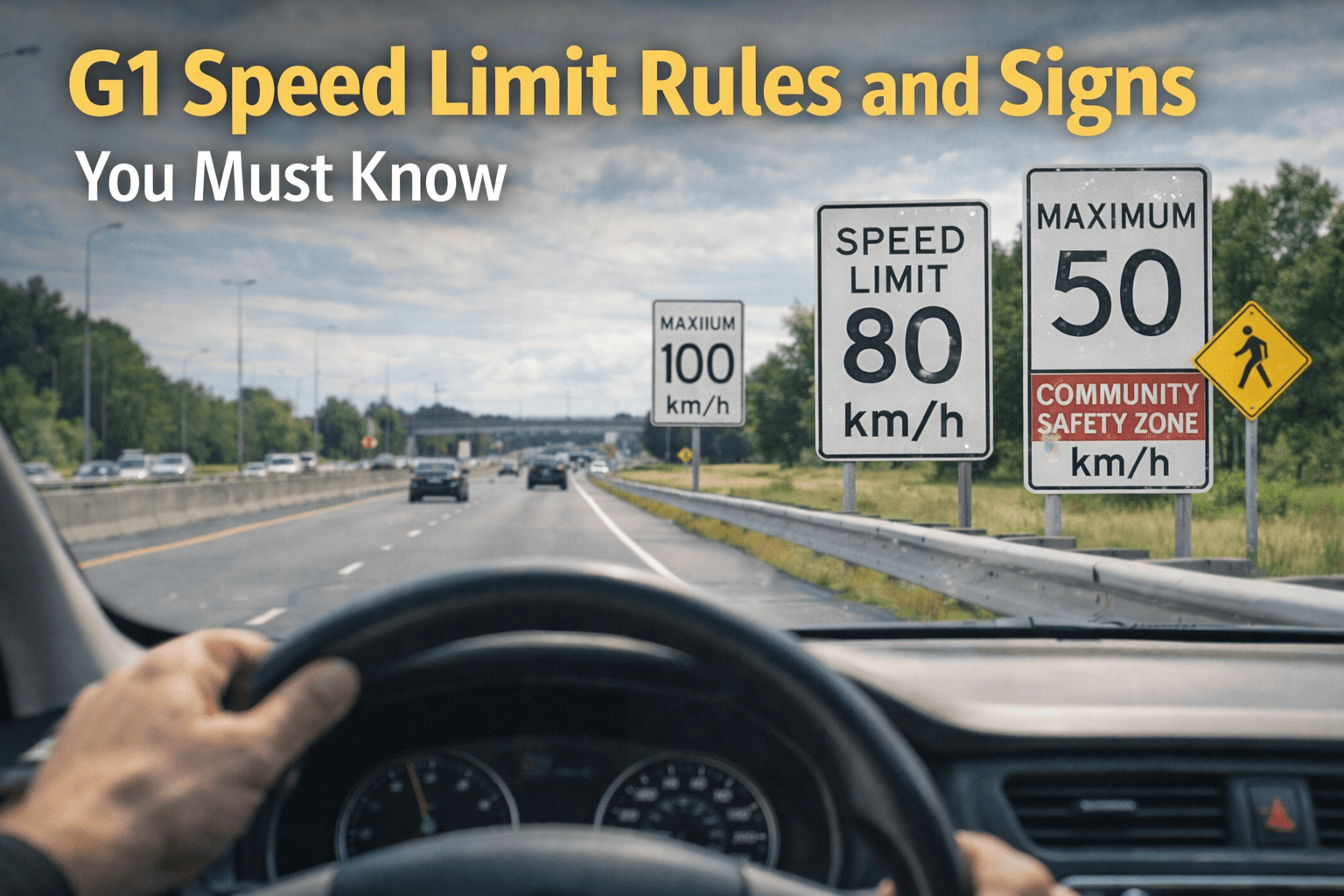
Speed limits seem straightforward until you realize how many variations exist. Ontario does not just post a single number and call it a day. Different roads, different zones, and different conditions all affect how fast you can legally drive.
The G1 test asks multiple questions about speed limits, and these questions go beyond simply knowing that highways allow faster speeds than city streets. You need to understand default limits that apply when no sign is posted, reduced limits in special zones, and when driving below the posted limit is actually required by law.
Getting these questions wrong is frustrating because speed limits feel like common knowledge. But common knowledge and testable knowledge are different things. This guide covers every speed-related rule and sign that appears on the G1 test.
Default Speed Limits When No Sign Is Posted
Not every road in Ontario has speed limit signs. When signs are absent, default limits apply based on the type of area you are driving through.
In cities, towns, and villages, the default speed limit is 50 km/h. This applies on any road within a built-up area where no other limit is posted. If you are driving down a residential street with no signs in sight, assume 50 km/h is the maximum.
On highways and roads outside built-up areas, the default limit is 80 km/h. Rural roads without posted limits fall under this default. If you leave a town and enter open countryside on a road with no signs, 80 km/h becomes your ceiling.
These defaults exist because posting signs on every single road would be impractical. The province assumes drivers know the baseline rules and only posts signs when limits differ from these defaults.
The G1 test frequently asks about default limits. A question might describe a scenario on an unsigned residential street and ask what speed limit applies. Knowing the 50 km/h urban default and 80 km/h rural default answers these questions instantly.
Speed Limit Sign Recognition
Posted speed limit signs in Ontario follow a consistent design. Recognizing them quickly matters for both the test and actual driving.
Standard speed limit signs are rectangular with a white background, black border, and black numbers. The word "MAXIMUM" appears above the number, which shows the limit in kilometres per hour. These signs are simple and direct.
Some speed limit signs include additional information. A sign might show the speed limit along with the times or conditions when that limit applies. School zone signs often specify hours when the reduced limit is active.
Speed limit signs appear at the start of a zone where that limit takes effect. The limit remains in force until you see a different speed limit sign or until road conditions change in ways that affect the default (such as entering or leaving a built-up area).
Watch for speed limit signs after intersections, as limits sometimes change at major junctions. A road that allowed 60 km/h might drop to 50 km/h after crossing into a different municipality or neighborhood.
School Zones and Reduced Limits
School zones have reduced speed limits to protect children. These zones appear near schools and typically have limits between 30 and 40 km/h, depending on the municipality.
School zone signs are distinctive. They display the reduced speed limit along with a symbol showing children or a school. Many include flashing amber lights that activate during the hours when the reduced limit applies.
The reduced limit in school zones typically applies during specific hours corresponding to school arrival and dismissal times. Signs indicate these hours, often something like "8:00 AM to 5:00 PM on school days." Outside those hours, the regular speed limit for that road applies.
Some school zones have reduced limits that apply only when children are present rather than during set hours. The sign will indicate this condition. When no children are visible, the regular limit may apply, but when children appear, you must slow down.
The G1 test expects you to know that school zones require extra caution and reduced speeds. Questions might ask about when school zone limits apply or what a school zone sign indicates.
Community Safety Zones
Community safety zones are designated areas where traffic safety is a heightened concern. These zones appear near schools, community centres, parks, and other areas where pedestrians are common.
Signs mark the beginning and end of community safety zones. The signs identify the area as a community safety zone and may indicate a reduced speed limit that applies within the zone.
The major consequence of community safety zones relates to penalties rather than speed limits themselves. Fines for speeding and other traffic violations are increased within these zones. A ticket that would cost a certain amount on a regular road costs more within a community safety zone.
Some community safety zones overlap with school zones. An area might be both a school zone with a reduced limit and a community safety zone with increased penalties. The combined effect creates strong incentives to drive carefully.
Construction Zones
Construction zones have their own speed limit rules that the G1 test covers. When road work is happening, speed limits drop to protect workers and account for changed road conditions.
Signs mark construction zones clearly. Orange signs indicate construction ahead and specify the reduced speed limit within the work area. These signs appear before you reach the construction so you have time to slow down.
The critical rule about construction zones involves penalties. Fines for speeding double when workers are present in a construction zone. The increased penalty reflects the danger that speeding poses to people working on the road.
Construction zone speed limits apply 24 hours a day unless signs specify otherwise. Even if you pass through a construction zone at 3 AM with no workers visible, the posted construction speed limit technically applies. Some zones have variable limits that increase during off-hours, but assume the reduced limit is in effect unless signs clearly indicate otherwise.
Do not assume that empty-looking construction zones allow normal speeds. Equipment, uneven pavement, lane shifts, and other hazards exist whether workers are present or not. The reduced limit exists for safety reasons beyond protecting workers.
Highway Speed Limits
Ontario's 400-series highways and other major routes have their own speed limit patterns. While G1 drivers cannot use most of these highways, the test still asks about highway speed rules.
Standard highway speed limits are typically 100 km/h on 400-series highways. Some sections allow 110 km/h, and certain designated areas have been approved for 110 km/h limits. Signs indicate the specific limit for each section.
The Queen Elizabeth Way, Don Valley Parkway, and Gardiner Expressway have limits that vary by section, typically ranging from 90 to 100 km/h. These urban expressways sometimes have lower limits due to traffic density and interchange frequency.
Rural highways that are not controlled-access routes often have limits of 80 km/h, matching the default for roads outside built-up areas. Two-lane highways through the countryside typically fall into this category.
Even though G1 drivers cannot use 400-series highways and certain other routes, knowing their speed limits matters for the test. A question might ask about the typical limit on Ontario's major highways or present a scenario involving highway speeds.
When Posted Limits Do Not Apply
The posted speed limit represents the maximum speed under ideal conditions. This distinction matters because conditions are not always ideal.
Rain reduces visibility and increases stopping distances. Driving the posted limit during a heavy rainstorm may be unsafe even though it is technically legal. The law requires you to drive at a speed that is reasonable for current conditions, which might be well below the posted maximum.
Snow and ice dramatically change how vehicles handle. Posted limits assume dry pavement with good traction. On snow-covered or icy roads, safe speeds may be 20, 30, or even 40 km/h below the posted limit depending on conditions.
Fog reduces visibility to the point where you cannot see hazards in time to react. When fog is thick, slowing down significantly below the posted limit becomes necessary for safety.
Heavy traffic creates situations where driving the posted limit is impossible regardless of weather. When vehicles ahead of you are moving slowly, your speed is limited by traffic flow rather than signs.
The G1 test asks about adjusting speed for conditions. A correct answer might indicate that you should drive below the posted limit when weather or traffic conditions warrant it. The test wants to confirm you understand that posted limits are maximums, not targets you must reach regardless of circumstances.
Speeding and Its Consequences
Understanding penalties for speeding reinforces why speed limits matter. The G1 test touches on consequences to emphasize the seriousness of these rules.
Speeding tickets in Ontario carry fines that increase with how much you exceed the limit. Going 15 km/h over costs less than going 30 km/h over, which costs less than going 50 km/h over. At extreme speeds, consequences escalate beyond fines to include license suspension and vehicle impoundment.
Demerit points accumulate on your driving record for speeding convictions. Accumulating too many demerit points leads to license suspension. New drivers on G1 and G2 licenses face suspension at lower demerit point thresholds than fully licensed drivers.
Stunt driving laws apply when speeds reach dangerous levels. Driving 40 km/h or more over the posted limit on roads with limits under 80 km/h, or 50 km/h or more over on roads with higher limits, triggers stunt driving charges. These charges carry immediate roadside license suspension and vehicle impoundment for up to 14 days.
Insurance rates increase after speeding convictions. Even a single ticket can raise your premiums. Multiple tickets compound the increase and may make insurance difficult to obtain at any price.
Speed-Related Test Questions
The G1 test asks about speed limits in several ways. Knowing what to expect helps you prepare.
Questions about default limits describe a road without posted signs and ask what limit applies. Remember 50 km/h for urban areas and 80 km/h for rural areas.
Questions about special zones ask about school zones, community safety zones, or construction zones. Know that reduced limits apply and that penalties increase in certain zones.
Scenario questions describe weather or road conditions and ask about appropriate speeds. The correct answer usually involves driving below the posted limit when conditions are poor.
Questions about signs show a speed limit sign and ask what it means. These are straightforward recognition questions if you know what standard speed limit signs look like.
Questions about consequences ask what happens when you speed. Know that fines, demerit points, and possible license suspension result from speeding convictions.
Practical Speed Limit Tips
Beyond passing the test, these speed limit principles matter for real driving once you have your license.
Watch for speed limit changes, especially when entering new municipalities or crossing from rural to urban areas. Limits often change at boundaries, and signs can be easy to miss if you are not watching for them.
When uncertain about the limit, drive at or below what you believe it to be until you see a sign confirming the actual number. Assuming a higher limit than what actually applies creates risk.
In poor conditions, let traffic flow guide you if everyone is driving slowly. When other drivers reduce speed due to rain or snow, matching their pace is usually appropriate. Do not feel pressured to drive faster than conditions allow just because the posted limit is higher.
Pay attention to your speedometer regularly. It is easy to creep above the limit without noticing, especially on open roads where higher speeds feel natural. Periodic speedometer checks keep you aware of your actual speed.
Ready to test your knowledge of speed limits and other road rules? G1 Ready CA offers practice tests covering the full range of topics on the Ontario exam. For a broader overview of traffic regulations beyond speed limits, check out the guide on G1 road rules to make sure you have all the rules covered before test day.


