
You've landed in Ontario, your car keys are on the counter, and the licence in your wallet worked perfectly where you came from. Then the questions start. Can you still drive here? Do you need a full retest? Will DriveTest accept your documents? What if your licence is from a country that doesn't have a direct swap?
That confusion is normal. The ontario drivers license exchange process looks simple from a distance, but most delays happen in the details. The biggest problems usually aren't filling out a form. They're proving your driving experience properly, understanding whether your jurisdiction qualifies for a direct exchange, and knowing what happens if it doesn't.
There's also a real deadline. According to a 2026 summary of Ontario exchange procedures, a newcomer may drive in Ontario with a valid foreign driver's licence for up to 60 days after moving to the province. After that, the foreign licence is no longer valid for driving in Ontario, and the driver must either exchange it for an Ontario licence or apply as a new driver, as explained in this Ontario exchange summary.
Welcome to Ontario Let's Get You Driving
Most newcomers don't struggle with the idea of exchanging a licence. They struggle with the gap between official rules and real life. You may be juggling housing, work, school registration, insurance, and childcare, all while trying to stay legal on the road. Licence exchange often gets pushed down the list until that deadline starts feeling uncomfortably close.
The practical move is to treat your first few weeks in Ontario as document-prep time. Don't wait until the end of your driving window to figure out whether your current licence can be swapped directly. Some drivers can move through the process with relatively little friction. Others discover late that they need extra proof of experience, translations, or testing.
Practical rule: Start with your licence origin and your driving history, not with the booking page.
That one shift saves time. When people begin by booking an appointment before confirming eligibility, they often arrive missing the one document that matters most for their case.
Ontario's system is strict because it's trying to place you correctly within the province's licensing structure. If you qualify for an exchange, the process can be straightforward. If you don't, Ontario may still credit your previous experience, but you may need to follow a more test-based path.
A calm, methodical approach works best:
- Identify your licence jurisdiction.
- Confirm whether Ontario has a reciprocal exchange arrangement for it.
- Gather originals before you book.
- Prepare for the possibility that your experience must be proven, not just claimed.
People usually feel much better once they know which lane they're in. That's the part that clears the fog.
Determine Your Exchange Path and Eligibility
The ontario drivers license exchange process splits very quickly into two different realities. Either your licence comes from a jurisdiction Ontario recognizes for direct exchange, or it doesn't. Almost every later question flows from that starting point.
The first question is reciprocity
Ontario has reciprocal exchange partnerships with Ireland, Australia, Austria, Belgium, France, Germany, Great Britain, the Isle of Man, Japan, Northern Ireland, South Korea, Switzerland, most American states, and all Canadian jurisdictions, according to Global News reporting on Ontario's reciprocal licence exchange partnerships.
If your current licence was issued in one of those jurisdictions, you may qualify for a more direct route. If it wasn't, that doesn't automatically mean starting from zero. It means Ontario will look more closely at experience, testing, and how you enter the graduated system.
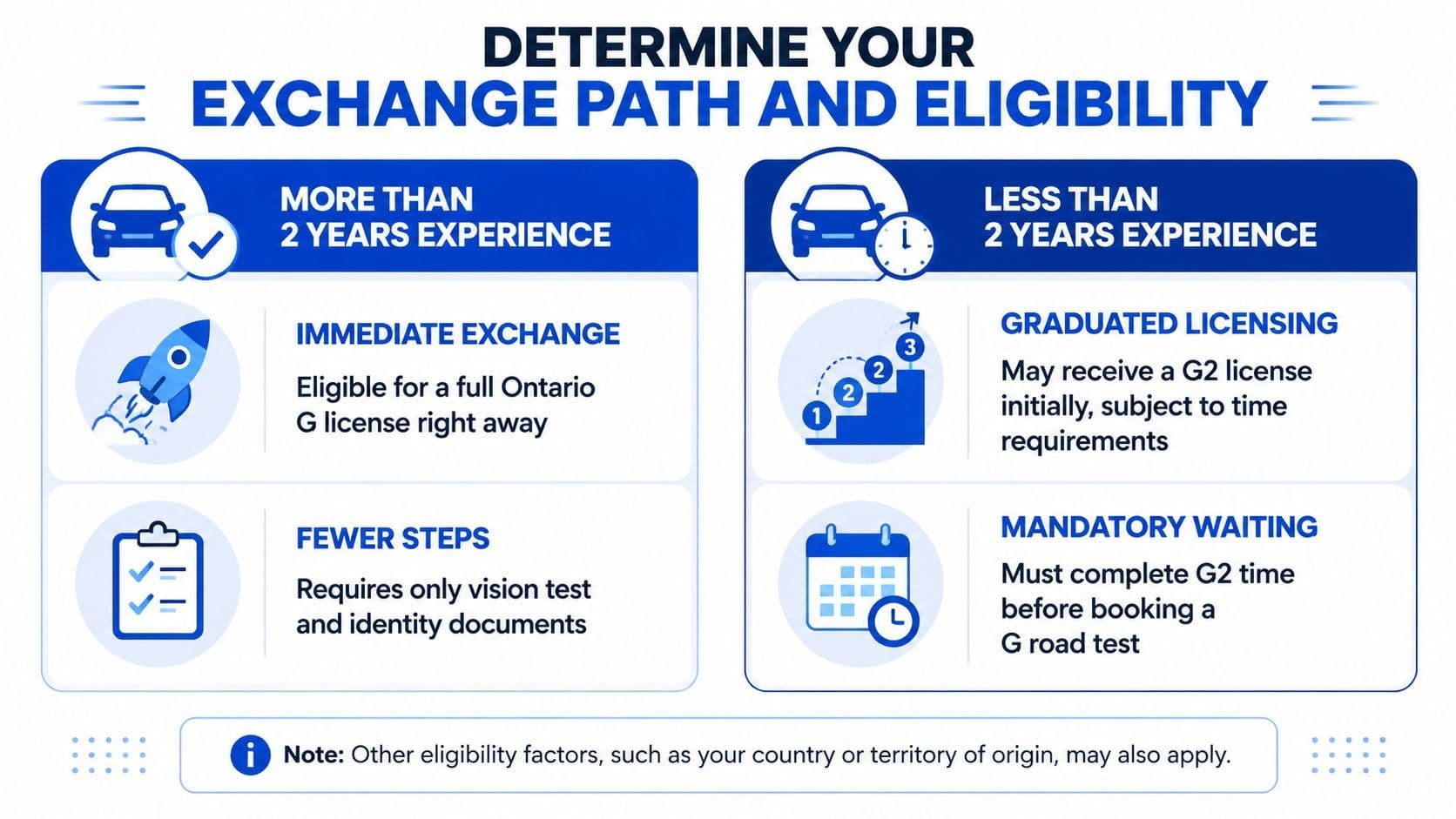
A second filter is your driving experience. That can affect whether you receive a full Ontario licence right away or enter at a lower stage first. If you need a refresher on how those stages work, this guide to Ontario graduated licensing explained is useful background before you book anything.
A quick path comparison
Requirement Reciprocal Agreement (e.g., USA, Germany, Japan) No Reciprocal Agreement (e.g., India, Brazil, China) Basic starting point Possible direct exchange if your licence and experience fit Ontario's rules You may need to apply through Ontario's graduated licensing route Testing exposure Often fewer testing steps, depending on your experience and class More likely to involve knowledge and road testing Experience matters Strongly affects whether you receive full G or a lower stage Strongly affects whether waits can be shortened and which test comes next Document pressure Still high. Originals and proper proof matter Even higher. Experience proof often becomes the deciding document Common misunderstanding Assuming “reciprocal” means automatic approval Assuming “non-reciprocal” means no credit for prior driving
That table captures the broad difference, but it's the document review that decides the outcome. A driver from a reciprocal jurisdiction can still run into trouble if the licence class is unclear or the experience proof doesn't support the claim being made. A driver from a non-reciprocal jurisdiction can still move ahead effectively if their paperwork is complete and realistic.
Where experience changes everything
Many applicants are surprised by this part of the process. People often think Ontario only cares about the card itself. In practice, the province also cares about what your records can support.
Two applicants can show up with valid foreign licences and leave on very different paths. One has clear records showing substantial driving history in an acceptable format. The other has a licence card with no supporting proof, unclear class details, or documents that aren't in English or French. The card may be real in both cases. The outcome may not be.
If your case is even slightly unusual, assume the staff member will need your paperwork to tell the story clearly on its own.
What works:
- Matching documents: Names, dates of birth, and licence details line up cleanly.
- Official experience proof: Records come from the issuing authority, not from memory or informal screenshots.
- Realistic expectations: You're prepared for a direct exchange only if your jurisdiction and experience support it.
What doesn't:
- Assumptions based on a friend's case: Their country, class, and driving history may not match yours.
- Last-minute translations: Poor or incomplete translations can stall the whole visit.
- Treating all foreign licences the same: Ontario doesn't.
Your Essential Document Checklist
Most unsuccessful exchange attempts fail before the staff member even gets to eligibility. The issue is usually paperwork. Ontario's exchange process is procedure-heavy, and common failure points include missing original documents, insufficient proof of driving experience in English or French, and underestimating test requirements tied to jurisdiction-specific agreements, as outlined on Ontario's out-of-province licence exchange page.
Bring originals, not substitutes
Photocopies, phone photos, and scanned printouts often cause trouble. For this process, the safest assumption is that the counter staff will want to inspect original documents.
Your core checklist should include:
- Original driver's licence: Bring the physical licence from your previous jurisdiction. It should be valid for exchange purposes and readable.
- Original identity document: Use an official document that clearly shows your legal name and date of birth.
- Original supporting records: If you're relying on prior experience, bring the official proof in original form.
- Translation documents where needed: If any required document isn't in English or French, bring the proper translated version with the original.
Non-negotiable: If you only have copies, there's a real chance you'll be sent away and asked to return with originals.
If you're unsure how Ontario handles identity paperwork more generally, this overview of documents needed for the G1 test helps clarify the style of documentation Ontario expects.
What counts as proof of experience
This is the document many newcomers either skip or misunderstand. Your licence card proves you hold a licence. It doesn't always prove how long you've been driving in a way Ontario will accept for credit.
The strongest version is usually official proof from the authority that issued your licence. It should clearly support your driving history and be easy for Ontario staff to interpret. If your records are vague, partially translated, or inconsistent with your licence class, you can end up on a more restrictive path than you expected.
Bring proof that is:
- Officially issued: Not self-written, not edited, not informal.
- Clear on experience: It should help staff understand your driving history, not force them to guess.
- In English or French: Or accompanied by proper translation.
- Consistent with your licence: Dates, class, and identity should align.
A useful habit is to review your packet the way a stranger would. If someone who has never met you looked at these documents for the first time, would they instantly understand who you are, what licence you hold, and how much experience you're claiming?
Translations and name differences
Translation problems are common because applicants focus on the licence itself and forget the supporting documents. If the key information isn't in English or French, the staff member reviewing your file may not be able to use it as experience proof.
Name mismatches create a separate issue. A licence, passport, and immigration document might all belong to the same person, but if the name appears differently across them, you should bring the linking documents that explain the difference.
Practical examples include:
- Marriage-related name changes
- Spacing or order differences in multi-part names
- Shortened given names on one document but full names on another
- Transliteration differences between alphabets
When the file is tidy, the appointment tends to move smoothly. When staff have to reconstruct your history from incomplete papers, delays begin.
Navigating the In-Person Exchange Process
The appointment itself is less intimidating when you know what will happen in order. Many applicants imagine a confusing back-and-forth at the counter. In reality, the day is usually manageable if your documents are ready and your expectations are realistic.
What booking online does and doesn't do
Ontario introduced online booking for licence-exchange appointments at 15 DriveTest locations, but the core exchange still requires an in-person application, a vision test, and submission of original documents, according to Ontario's licence exchange booking announcement.
That distinction matters. Booking online can reduce scheduling friction. It does not turn the process into a digital upload-and-approve service. You still need to attend in person, bring your paperwork, and complete the required steps at the centre.
If you're still deciding where to go, this list of Ontario G1 and DriveTest locations can help you narrow down practical options.
What happens at the counter
Once you arrive, the exchange usually unfolds in a simple sequence.
- Check in for your appointment or join the service queue.
- Present your licence and identity documents.
- Complete the vision screening.
- Have staff review your eligibility and experience proof.
- Pay the applicable fee for the path you're taking.
- Receive instructions for the next step, or a temporary Ontario licence if your exchange is approved at that stage.
The vision test is usually the least stressful part. The document review is where most decisions happen. Staff are trying to verify your identity, your legal entitlement to be licensed in Ontario, the validity of your current licence, and whether your prior experience supports an exemption or upgrade.
Bring your documents in the order they're likely to be requested. Licence first, ID second, experience proof third, translation and linking documents behind those. A neat folder saves time and avoids fumbling at the counter.
That sounds minor, but it changes the tone of the interaction. When staff can review a clean packet quickly, the appointment feels far more straightforward.
A short walkthrough can also help if you want to visualise the setting before you go:
If your path includes testing
Not every applicant walks out with the same result on the first visit. If your licence isn't eligible for direct exchange, or if your experience proof doesn't support the class you expected, staff may place you into a testing path.
This is the point where people often get frustrated, but it helps to see it for what it is. Ontario isn't necessarily rejecting your driving history. It may be requiring you to prove your knowledge or practical skill within Ontario's framework.
If you need to take a knowledge test, prepare for Ontario-specific rules rather than relying only on overseas driving habits. This is one of the few places where a study tool can reduce stress. G1ready.ca offers Ontario-focused G1 practice tests and explanations that can help drivers entering the graduated system through a non-exchange or partial-exchange route.
What works well on appointment day:
- Arriving with time to spare: Rushing leads to avoidable mistakes.
- Expecting questions: Staff may ask about dates, class, or licensing history.
- Planning a backup route: If more testing is required, treat that as the next step, not as a failure.
Handling Special Cases and Licence Types
Standard exchange advice breaks down when your situation doesn't fit the common path. Expired licences, commercial classes, and learner permits often create the most confusion because people assume the same rules apply across the board. They usually don't.
Expired foreign licences
An expired licence is harder to exchange than a current one. The more time that has passed, the more likely Ontario is to treat the case differently or require extra steps. This is one of those situations where assumptions cause the most trouble.
The safest approach is practical:
- Bring the expired licence anyway if that's what you have.
- Add any supporting records that show your licensing history clearly.
- Be prepared for staff to assess it more strictly than a current, valid licence.
If your licence has been expired for a significant period, don't build your whole plan around the expectation of a clean direct swap. Prepare mentally for a testing route.
Commercial and specialty classes
Drivers with truck, bus, or other commercial classes often expect Ontario to convert the equivalent class automatically. That's usually where disappointment starts. Commercial licensing is more tightly controlled, and foreign commercial credentials often don't move over in the same way as a standard passenger vehicle licence.
In practical terms, many applicants should separate two questions:
- What Ontario class can I get based on my current record?
- What Ontario class will I need to test for later if I want to work in a commercial role?
That keeps expectations grounded. You may still be able to obtain a passenger vehicle class while needing additional Ontario-specific steps for a commercial class.
Commercial experience can still matter, but don't assume it replaces Ontario's class-specific requirements.
Learner licences and novice permits
Learner, novice, and permit-stage licences are a different category. These typically do not function like full licences for exchange purposes. If your current credential only reflects learner-level driving privileges, expect Ontario to evaluate you within its own graduated licensing system rather than treating it as a direct swap candidate.
This is especially important for families relocating with teen drivers. Parents often focus on the adult licence exchange and only later realise their child's permit doesn't transfer the way they expected.
If you don't qualify for a direct swap
Many people need reassurance at this stage. Not qualifying for a direct exchange doesn't mean your prior driving life disappears. It means you need a more procedural route into Ontario's system.
A practical response looks like this:
- Accept the lane you're in: Don't waste weeks arguing with the rule set.
- Use your previous experience strategically: Bring the strongest proof available.
- Prepare for Ontario testing standards: Especially the knowledge test and staged licensing requirements.
- Keep your documents organised for follow-up visits: Non-standard files often require more than one step.
The drivers who move through this most smoothly are rarely the ones with the easiest cases. They're the ones who stop treating the process like a mystery and start treating it like a file that needs to be built properly.
Frequently Asked Questions about Licence Exchanges
Can I keep my old licence after I exchange it?
Often, applicants are required to surrender the previous licence as part of the exchange process. Don't assume you'll keep the physical card. If retaining it matters to you for personal reasons, ask the counter staff what happens in your specific case before the transaction is finalized.
What if the name on my licence doesn't exactly match my passport or other ID?
Bring linking documents that explain the difference. Staff need to connect the records confidently. If the names vary because of marriage, transliteration, or formatting differences, don't leave the explanation to guesswork.
Is an International Driving Permit enough to exchange my licence?
No. An International Driving Permit is generally a supporting document, not a substitute for the original licence. If your case involves foreign documents, think of the permit as supplementary rather than decisive.
Can I do the entire ontario drivers license exchange online?
No. As noted earlier, online booking helps with scheduling, but the actual exchange still requires you to attend in person with your original documents and complete the vision screening.
What if my documents are not in English or French?
Bring proper translations together with the original documents. If the translated material doesn't clearly support your identity or driving history, staff may not be able to use it the way you expect.
What should I do if I'm not sure whether I qualify for direct exchange?
Treat uncertainty as a signal to prepare for both outcomes. Bring the strongest identity and experience file you can. Also be ready for a knowledge-test route if Ontario places you into the graduated system instead of issuing a direct swap.
If I have prior experience, will Ontario always count it the way I expect?
Not always. Experience only helps if it's documented in a form Ontario can use. A long driving history that isn't properly supported can produce the same result as a much shorter history.
If you're preparing for the possibility of a knowledge-test route, G1ready.ca is a practical next stop. It offers Ontario G1 practice tests, topic-based quizzes, exam simulation, and explanations that help newcomers and first-time drivers study the rules they will be tested on.


