
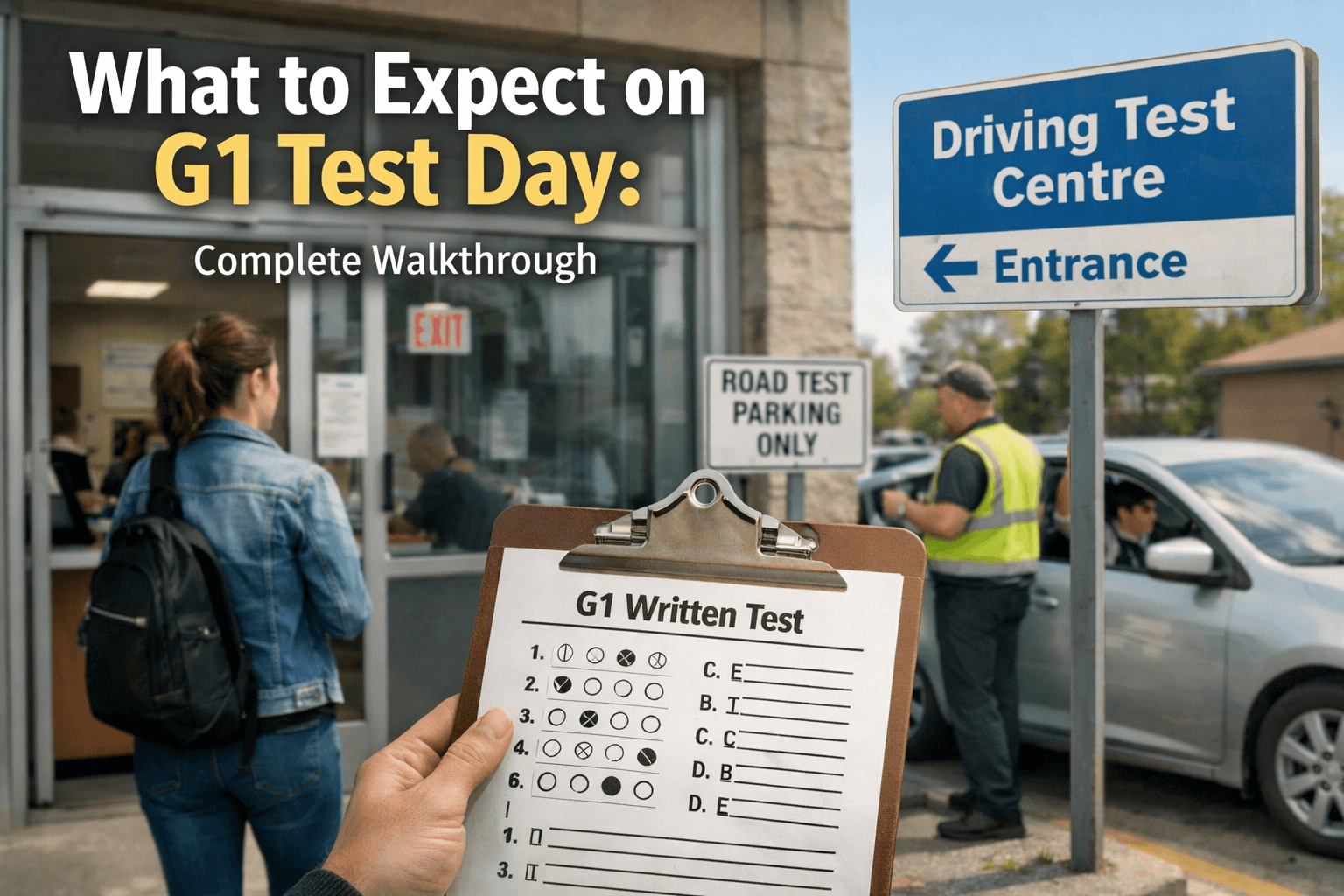
Test day nerves are normal. Walking into an unfamiliar government building to take an exam that determines whether you can start driving creates anxiety for almost everyone. Not knowing what to expect makes those nerves worse.
The good news is that the G1 test day process is straightforward once you understand it. Thousands of people go through it every week. The staff at DriveTest centres handle nervous test takers constantly and keep things moving efficiently.
This guide walks you through exactly what happens from the moment you arrive until you leave with your results. Knowing the process ahead of time lets you focus on the test itself rather than worrying about logistics.
Before You Leave Home
Test day preparation starts before you walk out the door. A few minutes of organization at home prevents problems at the DriveTest centre.
Gather your identification documents and put them somewhere you will not forget. Your primary ID, proof of residency, and any supporting documents should be together in a folder or envelope. Double-check that nothing is expired.
If you wear glasses or contact lenses, make sure you have them. The vision screening happens before the knowledge test, and showing up without your corrective lenses means you might fail before reaching the actual exam.
Eat a proper meal before you go. An empty stomach makes concentration harder and can increase anxiety. You do not want hunger distracting you during the test.
Bring a method of payment for the licensing fee. Cash, debit, and credit cards are accepted at most locations. Confirm your card works or have backup payment ready.
Check the weather and traffic conditions. Give yourself extra travel time if conditions might slow you down. Arriving stressed and rushed after a difficult commute puts you in the wrong headspace for testing.
Arriving at the DriveTest Centre
Plan to arrive at least 30 minutes before your scheduled appointment. If you are walking in without an appointment, arriving early in the day improves your chances of testing without excessive waits.
DriveTest centres are located in various types of buildings depending on the area. Some are standalone facilities while others share space in strip malls or office complexes. Look for signage indicating the DriveTest entrance.
Parking is available at most locations, though busy urban centres may have limited spots. If parking fills up, nearby street parking or public lots are usually options. Budget a few extra minutes for parking logistics at busier locations.
When you enter, you will typically see a waiting area with chairs and a service counter where staff handle check-ins. Some centres use a number system where you take a ticket and wait to be called. Others have a line that moves to the next available staff member.
The atmosphere varies by location and time of day. Some centres feel calm and quiet while others bustle with activity. Weekday mornings tend to be less hectic than afternoons or weekends.
The Check-In Process
When you reach the counter, tell the staff member you are there for the G1 knowledge test. If you have an appointment, mention your scheduled time. If you are a walk-in, they will let you know the current wait situation.
The staff member will ask for your identification documents. Hand over everything you brought. They will verify that your documents meet the requirements and that the information matches across your various IDs.
This is also when you answer questions about your eligibility. Staff may ask about your residency status, whether you hold licenses from other jurisdictions, and whether you have any medical conditions that could affect your ability to drive. Answer honestly. Providing false information creates legal problems down the road.
If your documents are in order and you meet the eligibility requirements, you will proceed to payment. The fee covers your G1 knowledge test, your future G2 road test, and a five-year license. Pay with your preferred method and keep any receipt you receive.
The check-in process takes anywhere from five to fifteen minutes depending on how busy the centre is and whether any questions arise about your documentation. Straightforward applications move quickly. Unusual situations or missing documents slow things down.
The Vision Screening
After check-in, you will complete a vision screening before the knowledge test. This happens in the same visit, not at a separate appointment.
The vision test uses a screening device that you look into with both eyes. You will be asked to read letters, identify symbols, or perform similar visual tasks. The specific format varies but the purpose is confirming your eyesight meets minimum driving standards.
The screening takes only a minute or two. It is not an extensive eye exam like you would get at an optometrist. It simply verifies that you can see well enough to safely operate a vehicle.
If you wear corrective lenses, use them during the screening. Your corrected vision is what matters. If you pass while wearing glasses, your license will note that you must wear corrective lenses while driving. This restriction is standard and not a penalty.
Passing the vision screening lets you proceed to the knowledge test. Failing means you cannot continue that day. You would need to address your vision issues and return another time.
Most people pass the vision screening without difficulty. If you have concerns about your eyesight, visiting an optometrist before your G1 appointment gives you time to address any issues rather than discovering them at the DriveTest centre.
Waiting for a Computer Terminal
After passing the vision screening, you will wait for an available computer terminal. The knowledge test is administered electronically, and the number of terminals limits how many people can test simultaneously.
Wait times vary enormously. On slow days at less busy locations, you might sit down immediately. On busy days at popular centres, you might wait 30 minutes or more for a terminal to open up.
Use waiting time productively if you have any. A final review of tricky road signs or rules you find confusing can reinforce your preparation. Some people bring pocket-sized notes or use flashcard apps on their phones for last-minute review. Others prefer to relax and stay calm rather than cramming.
When a terminal becomes available, staff will call your name or number and direct you to your testing station.
Taking the Knowledge Test
The testing area contains rows of computer terminals with touchscreens. Each station has a divider or spacing to give you privacy from neighboring test takers. You cannot see other people's screens and they cannot see yours.
A staff member will log you into the system and briefly explain how the interface works. The computer displays one question at a time with four possible answers. You select your answer by touching the screen.
The test begins with the road signs section. You will see 20 questions about traffic signs, signals, and pavement markings. Many questions display an image of a sign and ask what it means or what action it requires from drivers.
After completing the signs section, you move to the rules of the road section. These 20 questions cover traffic laws, safe driving practices, and how to handle various situations on the road. Questions describe scenarios and ask what a driver should do.
You can navigate between questions within each section. If a question stumps you, flag it and move on. The system lets you return to flagged questions before submitting your answers. Do not let one difficult question consume time you could spend on questions you know.
Read each question carefully before answering. Some questions include details that change the correct answer. A question about school buses might hinge on whether the lights are flashing. A question about passing might depend on the type of road markings described. Rushing leads to missed details and wrong answers.
There is no strict time limit that pressures most test takers. You have enough time to read questions thoroughly and think through your answers. Moving too fast causes more failures than moving too slow.
When you finish all questions in a section and have reviewed any flagged items, submit your answers to move forward. Once submitted, you cannot go back to change answers in that section.
Getting Your Results
After completing both sections, the computer displays your results immediately. You do not wait days or check online later. You find out right there whether you passed or failed.
The results screen shows your score for each section. You need at least 16 out of 20 on road signs and 16 out of 20 on rules of the road. Meeting both thresholds means you passed. Falling short on either section means you failed the entire test.
If you passed, the screen will indicate your success and provide instructions for the next steps. Staff will direct you to the photo station to have your picture taken for your new G1 license.
If you failed, the screen shows which section or sections fell below the passing threshold. Staff can provide general guidance, but they cannot tell you which specific questions you got wrong. You will need to study further and return another day to try again.
Take a moment to process your results either way. Passing brings relief and excitement. Failing brings disappointment. Both reactions are normal.
After Passing: Getting Your License
The final steps after passing move quickly. Staff will guide you through the remaining process.
You will have your photo taken for your license. This photo appears on your G1 card and stays with you through the G2 stage, so try to look presentable. Standard ID photo rules apply: face the camera directly, keep a neutral expression, and remove sunglasses or head coverings unless worn for religious reasons.
After the photo, you receive your G1 license. Ontario now issues licenses that include both a physical card and digital access. The physical card may be provided immediately or mailed to your address depending on the centre's equipment and current procedures.
Staff will explain the restrictions that apply to your G1 license. You can drive only with a fully licensed supervisor, cannot use certain highways, must maintain zero blood alcohol, and cannot drive between midnight and 5 a.m. Make sure you understand these rules before you leave.
The entire process from entering the DriveTest centre to walking out with your license typically takes one to two hours, though busy days can stretch longer.
After Failing: What Comes Next
Failing the G1 test is disappointing but not catastrophic. Many people fail on their first attempt and pass on their second.
You cannot retest the same day. DriveTest centres require you to wait until at least the following day before attempting the test again. This waiting period gives you time to study the areas where you fell short.
You will need to pay the full licensing fee again for your next attempt. Each test attempt requires a new payment regardless of how close you came to passing.
Use the failure as information. If you failed the signs section, focus your studying on sign recognition. If you failed the rules section, review traffic laws more thoroughly. Targeted preparation based on your weak areas produces better results than generic studying.
Most people who fail once and study seriously before their next attempt go on to pass. Persistence matters more than perfection on the first try.
Tips for a Smooth Test Day
A few practical strategies make test day easier.
Dress comfortably. You will sit in a chair taking a computer test, so comfort matters more than appearance.
Bring water if the centre allows it. Staying hydrated helps concentration.
Use the restroom before the test begins. Once you start, you should complete it without interruption.
Stay calm during the test. Anxiety makes questions seem harder than they are. If you feel nervous, take slow breaths between questions.
Trust your preparation. If you studied the handbook and passed practice tests consistently, you have the knowledge to pass. Let that confidence steady you.
Ready to make sure you are fully prepared before test day arrives? G1 Ready CA offers practice tests that mirror the real exam experience. For strategies on avoiding the errors that cause people to fail, review the guide on common G1 test mistakes so you walk in ready to pass on your first attempt.


