You studied, you showed up, you took the test, and the screen displayed a result you did not want to see. Failing the G1 test is disappointing. Maybe embarrassing. Definitely frustrating when you thought you were ready.
But failing is not the end of anything. It is a setback, not a roadblock. Thousands of people fail the G1 test every year, and most of them pass on a subsequent attempt. The path forward is clear once you understand what happens next and how to approach your retest.
This guide covers everything that follows a failed G1 attempt, from the immediate aftermath to preparing for success on your next try.
The Moment You Find Out
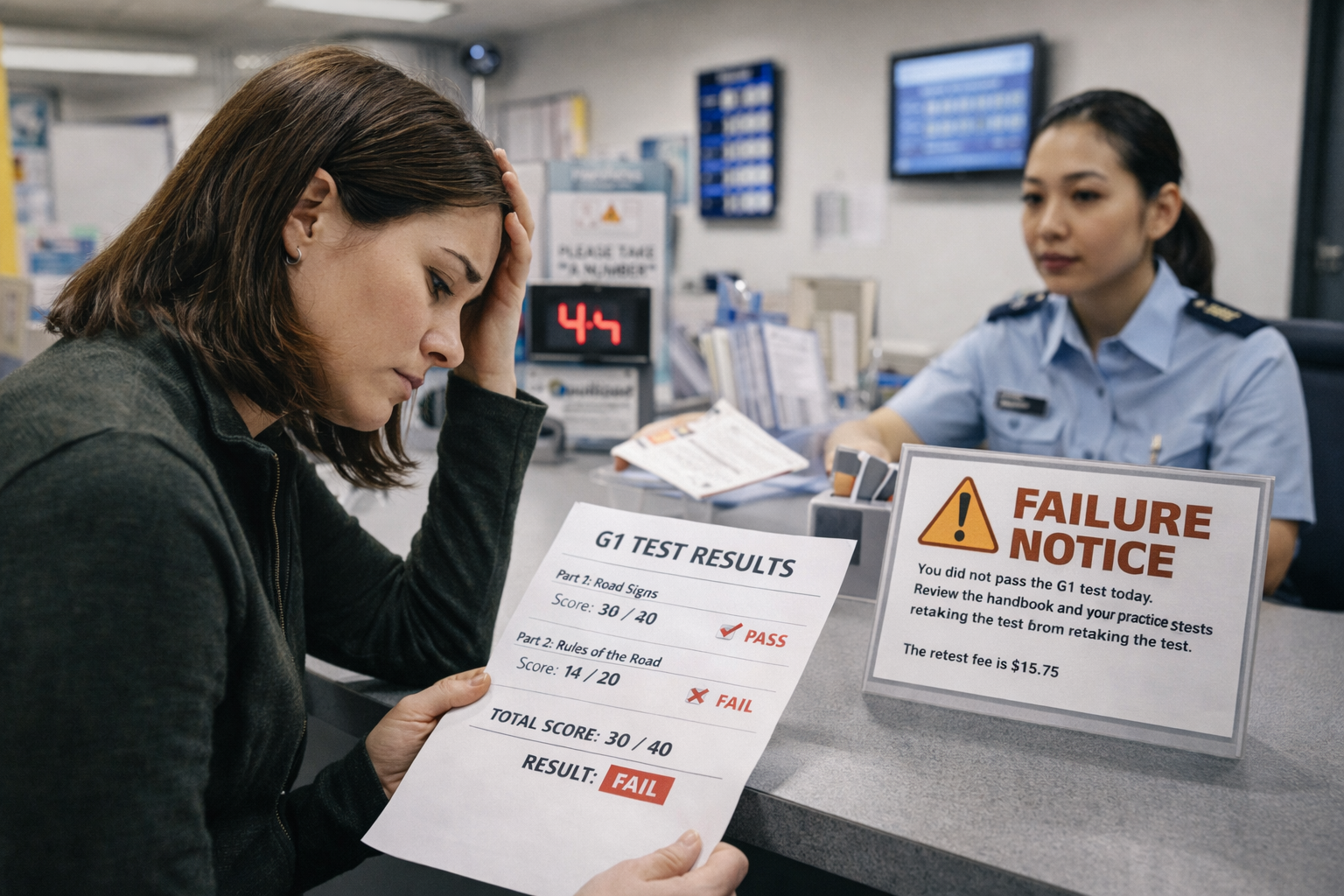
When you finish the G1 test, results appear on the computer screen immediately. There is no waiting period, no checking online later, no letter in the mail. You know right there whether you passed or failed.
The screen displays your score for each section. You see how many questions you got right out of 20 on road signs and how many out of 20 on rules of the road. If either score falls below 16, you failed.
The screen clearly indicates the failure. There is no ambiguity about whether you passed or not. Staff at the DriveTest centre can see your result as well and will not proceed with the licensing steps that follow a successful test.
Take a breath. Process the disappointment. Then gather yourself and leave the testing area so the next person can use the terminal.
What You Will Not Learn
The test tells you which section or sections fell short of the 16-question minimum. This information has value for directing your future studying.
What the test does not tell you is which specific questions you missed. You might know you got 14 correct on rules of the road, but you will not find out which 6 questions were wrong. The system provides section-level feedback only.
This limitation makes targeted review harder. You know rules need work, but you do not know whether your mistakes involved right-of-way, speed limits, impaired driving laws, or some other topic. You have to review the entire section rather than fixing specific gaps.
Some people try to remember which questions they were uncertain about during the test. This can help guide your review, but memory under test stress is unreliable. The questions you thought were tricky might have been ones you actually got right.
When You Can Retest
You cannot attempt the G1 test again on the same day you failed. Ontario requires waiting until at least the following day before retesting.
This mandatory gap exists for practical reasons. Same-day retesting would mean answering many of the same questions you just saw, which would not accurately measure whether you actually learned the material. The questions are drawn from a pool, and while you would not see an identical test, significant overlap would occur.
The waiting period also gives you time to study. A few hours between attempts is not enough to meaningfully improve your knowledge. At least one night of sleep, during which your brain consolidates new learning, improves retention of any studying you do.
Most people take more than one day before retesting anyway. Rushing back the very next morning without additional preparation usually leads to the same result. Taking several days or even a week or two to study properly increases your chances of passing.
There is no maximum waiting period. You can retest the next day, the next week, or the next month. The choice is yours based on when you feel genuinely ready.
Fees for Retesting
Each G1 test attempt requires payment of the licensing fee. When you failed, the fee you paid covered that attempt. It is not refunded, and it does not carry forward to future attempts.
To take the test again, you pay the full fee again. As of 2025, this fee is $159.75 CAD. It covers the knowledge test, your eventual G2 road test, and a five-year license if you pass.
Multiple failures become expensive. Three attempts means paying the fee three times. Five attempts means five payments. The costs add up, creating financial incentive to prepare thoroughly before each attempt rather than treating the test as something you can take repeatedly until you get lucky.
Some people react to failure by wanting to retest immediately and just get it over with. Consider whether paying another fee for a likely second failure makes sense compared to spending more time studying and passing on your next attempt.
How Many Times You Can Retest
Ontario does not limit how many times you can attempt the G1 knowledge test. You can take it twice, five times, ten times, or more if necessary.
Each attempt is a fresh test with a fresh score. Previous failures do not count against you in any cumulative way. The system cares only whether you pass on a given attempt, not how many attempts preceded it.
That said, repeated failures suggest something about your preparation approach is not working. Someone who fails five times using the same study method should probably try a different method rather than expecting attempt six to magically produce different results.
Most people who fail once and adjust their preparation pass on their second attempt. Those who fail repeatedly often benefit from professional help, whether through driver education courses, tutoring, or other structured learning approaches.
Why People Fail
Understanding common reasons for failure helps you avoid repeating mistakes.
Insufficient studying: The most common cause of failure is simply not preparing enough. People assume the test is easy, skim the handbook once, and show up expecting common sense to carry them through. The G1 test requires actual knowledge of specific rules and signs that you will not know without studying.
Studying only one section: The test requires passing both sections independently. Someone who loves memorizing road signs but finds traffic rules boring might ace signs and fail rules. Balanced preparation across both areas is mandatory.
Relying only on practice tests: Practice tests help, but they cannot cover every possible question. Someone who only takes practice tests without reading the handbook will encounter questions on topics their practice tests never addressed.
Test anxiety: Some people know the material but freeze under test conditions. Anxiety causes rushing, misreading questions, and second-guessing correct answers. If you perform well on practice tests at home but poorly on the real test, anxiety may be the issue.
Confusing similar signs or rules: Questions often test your ability to distinguish between similar signs or apply the correct rule to a specific situation. Surface-level knowledge that recognizes sign categories but not specific variations leads to wrong answers.
Rushing through questions: The test has no strict time pressure, but some people race through questions anyway. Rushing causes careless errors that proper reading would prevent.
Identify which factors contributed to your failure and address them specifically before retesting.
Preparing for Your Next Attempt
A failed test is feedback. Use it to improve your preparation.
Review the section or sections where you fell short. If you failed rules but passed signs, spend most of your study time on traffic laws. If you failed both sections, comprehensive review is needed.
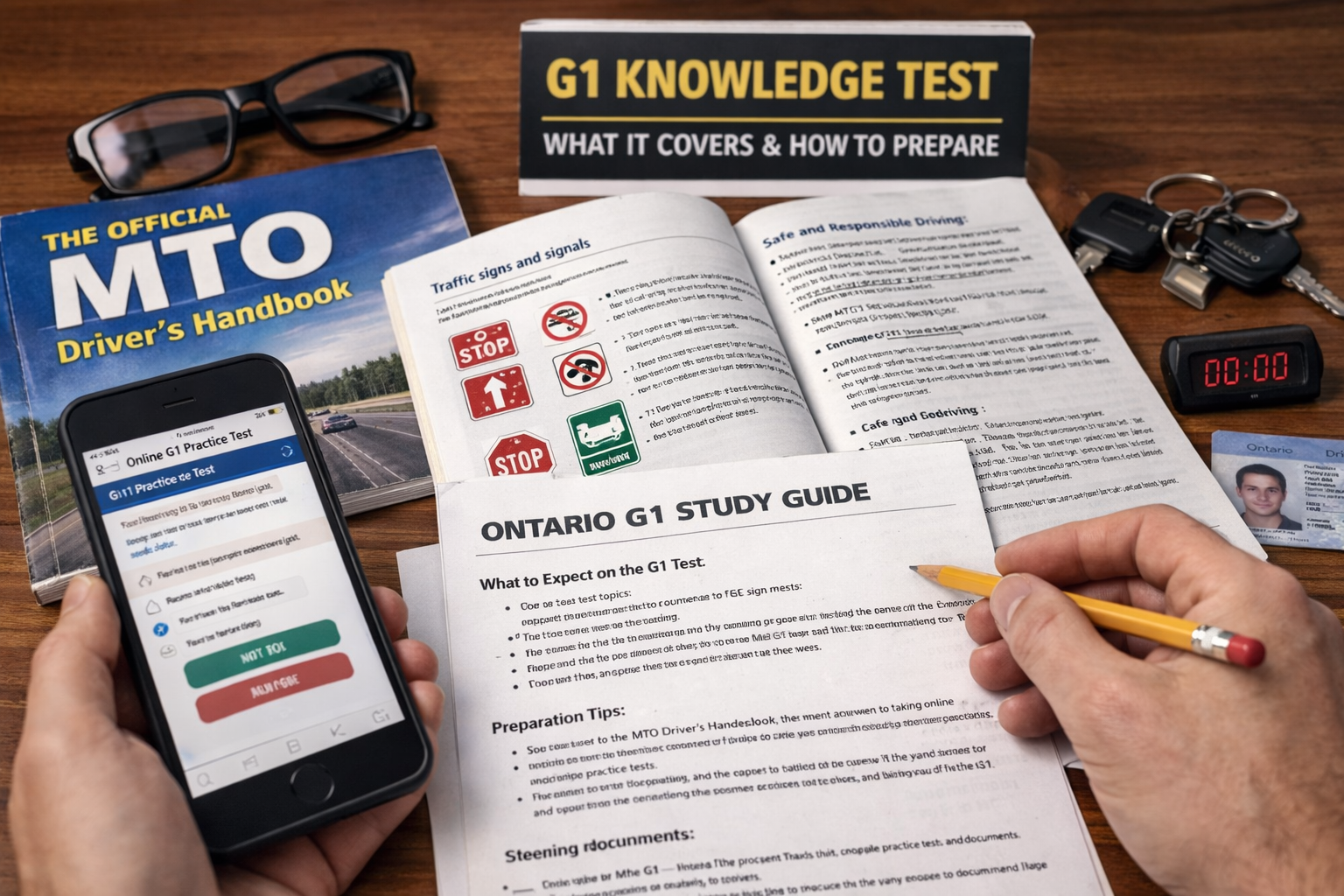
Go back to the Ontario Driver's Handbook. Reading the handbook thoroughly is preparation that practice tests alone cannot replace. If you skipped the handbook or skimmed it lightly before your first attempt, read it properly this time.
Take practice tests under realistic conditions. Time yourself, put away notes, and complete full 40-question tests. Track your scores by section. Do not consider yourself ready until you consistently score at least 17 or 18 on both sections.
Identify your weak areas. If you keep missing right-of-way questions on practice tests, spend extra time on that topic. If warning signs confuse you, drill them until they become automatic.
Space out your studying. Cramming everything into the night before your retest is less effective than studying over several days. Your brain needs time to move information from short-term to long-term memory.
Address test anxiety if applicable. Practice relaxation techniques. Arrive early on test day to settle your nerves. Remind yourself that failing again would be frustrating but not catastrophic.
Booking Your Retest
When you feel ready to try again, book another appointment through the DriveTest website or by phone. The process is the same as booking your first attempt.
You can return to the same DriveTest centre or choose a different location. The test content is identical regardless of where you take it. Some people prefer a different location just for the psychological fresh start.
Appointment availability varies by location and time. Booking several days or a week in advance is often necessary at busy centres. Do not wait until you feel ready and then expect same-day availability.
When you arrive for your retest, the process is the same as your first visit. Check in, present identification, pay the fee, complete the vision screening if required, and take the knowledge test on a computer terminal.
The Emotional Side of Failing
Failing any test feels bad. Failing a test that determines when you can start driving feels worse. Emotions are part of this experience, and pretending otherwise is not helpful.
Embarrassment is common, especially if you told friends or family you were taking the test. Some people feel ashamed to admit they failed, as if it reflects on their intelligence or capability.
Reality check: failing the G1 test says nothing meaningful about you as a person. It means you did not score high enough on 40 multiple choice questions on one particular day. That is all. Many intelligent, capable people fail the G1 test and go on to become perfectly good drivers.
Frustration is also normal. You wanted to pass. You expected to pass. Now you have to wait, study more, pay again, and try again. That is legitimately annoying.
Use the frustration productively. Let it motivate more serious preparation rather than a rushed retest with the same inadequate studying that failed the first time.
Do not let embarrassment prevent you from retesting. Some people fail and then avoid rebooking because they do not want to face potential failure again. This avoidance accomplishes nothing except delaying your eventual license.
Learning From Failure
People who fail and then pass often report that the failure made them better prepared than if they had squeaked by on their first attempt.
Failing forced them to study more thoroughly. They learned material they would have skipped if their first attempt had succeeded. When they eventually got their G1 and started driving, they had stronger knowledge than someone who barely passed without that extra review.
This silver lining does not make failure pleasant, but it offers perspective. The additional studying required by a failed attempt is not wasted time. It builds knowledge you will use throughout your driving life.
Some rules and signs you learn while preparing for a retest will prevent real-world mistakes that could cause collisions, tickets, or worse. That knowledge has value far beyond passing a test.
Moving Forward
Failing the G1 test is a temporary obstacle on your path to becoming a licensed driver. It delays your progress but does not end it.
Take time to process the disappointment, then get to work preparing for your next attempt. Study the areas where you fell short. Take practice tests until you consistently pass with margin to spare. Book your retest when you are genuinely ready rather than when you are merely impatient.
Most people who fail once pass on their second attempt. Some need a third try. A small number take longer. Eventually, with proper preparation, virtually everyone who wants a G1 license gets one.
Your failed attempt is not your final attempt. It is just another step on the way to success.
Ready to prepare properly for your next attempt? G1 Ready CA offers practice tests that identify your weak areas before you pay for another test attempt. For specific strategies on what mistakes to avoid and how to prepare more effectively, review the guide on common G1 test mistakes so your next attempt produces the result you want.