
For most Ontario drivers, a standard Class G driving licence renewal costs C$90 for a 5-year term. If you're 80 or older, the renewal fee can be C$0 when you complete Ontario's senior renewal process.
That's the information often sought first. Then the questions start. Do you have to go in person? Can you renew online? What if your card is lost instead of expiring? What if the notice says you need a new photo?
Those are the spots where people get tripped up. Renewal fees for driving licence issues sound simple until you realise the amount you pay depends on what kind of transaction you're doing. A renewal is not the same as a replacement. A standard renewal is not the same as a senior renewal. And if your licence has been expired too long, you may not be renewing at all. You may be starting over.
This guide keeps it plain. You'll see the official Ontario fee that applies to most passenger drivers, when the process changes, where to pay, and how to avoid turning a basic renewal into a bigger headache.
Understanding Your Driving Licence Renewal Notice
When that renewal notice arrives, most drivers look for one thing first. The amount.
If you hold a regular Ontario licence and drive a passenger vehicle, you're usually dealing with the standard Class G renewal path. This typically entails a routine transaction rather than a complicated one. Still, the notice matters because it tells you whether your renewal will stay simple or whether Ontario needs something extra from you before issuing the next card.
A renewal notice can contain the detail that changes everything. It might indicate that you need a new photo. It might tell you to complete the process in person. It might also point you toward a special process because of your age or licence status.
Practical rule: Read the whole notice before you try to pay anything. The fee is only one part of the job.
Here's what to look for right away:
- Expiry timing: Check whether your licence is close to expiring or already expired.
- Renewal method: Look for language that tells you whether you can renew online or must visit a ServiceOntario centre.
- Photo requirement: If a new photo is required, your next step is different.
- Special instructions: Seniors and drivers in unusual situations may see extra instructions tied to their renewal path.
People often confuse a routine renewal with any update to a licence card. That's where mistakes happen. If you're replacing a damaged card, dealing with a lost one, or returning after a long expiry, the process and cost can be different from a straightforward renewal.
Ontario Driving Licence Renewal Fee Schedule for 2026
You open your renewal notice, see that payment is required, and want one simple answer: how much will this cost me? The tricky part is that Ontario does not treat every licence task as the same job. A standard renewal, a senior renewal, and a replacement card can lead to different fees, so the first step is to name the exact transaction before you budget.
For many drivers, the starting point is straightforward. A regular Class G licence renewal is C$90 for a 5-year term, based on Ontario's published fee schedule. Drivers aged 80 and over may pay C$0 if they are renewing through the province's senior renewal program, as noted earlier in the official fee information.
That tells you something useful right away. Ontario charges for the renewal term itself, not as a yearly subscription. It also means age and renewal path can change the amount on the screen or at the counter.
Licence Class Description Renewal Fee (5 Years) Class G Standard passenger vehicle licence C$90 Senior renewal path for age 80+ Renewal completed through Ontario's senior renewal process C$0
A helpful way to picture this is to treat your licence fee like the fare for a specific route. The amount depends on where you are going and which process applies to you. If you hold a motorcycle, bus, truck, or another special class, check the current Ontario fee listing for that exact class before you pay. If you want help sorting out which Ontario transaction applies to your situation, the G1ready contact page for licence questions can help you clarify the next step.
Renewal and replacement are different charges
Many drivers get tripped up here.
A renewal keeps your licence valid for the next term. A replacement gives you a new physical card if the old one is lost, stolen, or damaged. Ontario treats those as separate services, and the fee can be different.
Ontario's published fee information lists C$32 for a replacement driver's licence card. So if your card disappears a month before expiry, pause and sort out the primary job first. You may need a replacement, a renewal, or both, depending on your timing and status.
Other jurisdictions use the same basic logic even when the dollar amounts differ. For example, the California DMV licensing fees page separates renewal fees from replacement fees and other licence-related charges. The lesson is simple. Do not treat every licence payment as one generic fee.
When looking up renewal fees, start by naming the exact transaction. Renewing, replacing, correcting, and retesting can each lead to a different charge.
How and Where to Pay Your Renewal Fees
You have your renewal notice in hand, you know the fee that applies, and now the practical question is simple: where do you pay it?
Ontario gives many drivers two main payment routes. You can renew online if your notice and licence status allow it, or you can go to a ServiceOntario centre if the province needs to verify something in person. The right choice matters. It works a lot like choosing the correct lane before an exit. Pick the wrong one, and you may still get there, but with extra delay and frustration.
If you can renew online
Online renewal is usually the fastest option for a standard licence renewal. It tends to work best when your notice does not ask for a new photo, extra documents, or another in-person step.
Before you start, put your current licence and renewal notice beside you. That small bit of prep prevents the most common problem: entering a detail from memory and having it rejected. If you have questions about the online process or run into confusion about what information to use, you can find support options on the G1ready contact page for renewal help.
A simple check before you pay can save time:
- Keep your current licence close by: Enter your information exactly as it appears on the card.
- Read every line of the renewal notice: It may tell you that online renewal is not available in your case.
- Use the official Ontario renewal service: That helps you avoid the wrong payment channel or an incomplete transaction.
If you need to renew in person
Some renewals have to be done at a ServiceOntario centre. That often happens when your notice requires a new photo or when your file needs a closer review. Some drivers also choose this option because they want a staff member to confirm everything at the counter.
Bring the documents that support your renewal. In many cases, that means your current licence and your renewal notice. If you still have both, the visit is usually more straightforward.
In-person service can feel slower at first. But if your record needs checking, it is often the cleaner route because problems get handled before the new card is issued.
If your case is unusual, use the channel your notice points you to. That is the plain-English rule to remember. Trying to force an online renewal when Ontario wants an in-person visit usually creates delays instead of saving time.
Fee Exemptions for Seniors and Other Special Cases
A common point of confusion starts like this: a driver opens the renewal notice, sees the usual renewal language, and assumes the standard fee applies. Then a family member notices the driver is now 80 or older, or has a medical review on file, and suddenly the process no longer looks standard.
That is where many people get stuck. The fee question and the process question are tied together.
A common senior renewal scenario
For drivers 80 and over, Ontario uses a separate senior renewal process. As noted earlier in this guide, that process can mean C$0 for the renewal fee. The important part is understanding what “no fee” does and does not mean.
It means the driver may not have to pay the usual renewal amount.
It does not mean the renewal happens automatically.
A senior renewal works a bit like getting through a checkpoint with a different lane. The destination is the same, a valid licence, but the route can include extra steps that younger Class G drivers usually do not face. If the notice asks for specific senior renewal steps, those steps still need to be completed before the licence is renewed.
That distinction matters. Many families focus on the dollar amount and miss the instruction side of the notice.
Other situations that can change the process
Age is only one example. Some drivers run into special cases where the main issue is not a new listed fee, but a different set of requirements.
These are the situations that often change the renewal path:
- Medical review cases: A driver may need medical clearance or other follow-up before renewal can be completed.
- Commercial or special licence classes: Higher classes and added privileges often come with extra checks tied to that class.
- Late, suspended, or irregular renewals: The cost may change because the driver is no longer dealing with a basic on-time renewal.
A simple way to read this is to treat a standard renewal like a routine oil change. Special cases are closer to a full inspection. The goal is still to keep the vehicle on the road, but the province may need more information before it signs off.
How to avoid mistakes in special cases
Start with the renewal notice. Read it as an instruction sheet, not just as a payment request.
Then check whether you may need supporting ID or other documents before you go in. If you are helping a parent or preparing for an in-person visit and want a plain checklist, this guide to Ontario driver document requirements for the G1 test gives a useful overview of the kinds of identification details people often need to confirm.
One rule helps in almost every special case: if your situation falls outside the standard passenger-driver renewal, do not guess based on what another driver paid. Two people can hold Ontario licences and still have different renewal steps because of age, class, medical status, or timing.
That is why the safest approach is simple. Follow the notice first. Confirm the process second. The exact fee makes more sense once those two pieces are clear.
Your Step-by-Step Licence Renewal Process
A calm, orderly approach works best here. Most renewal mistakes happen when people rush, skip the notice, or assume they can do everything online.
Start with the sequence below and you'll avoid most common errors.
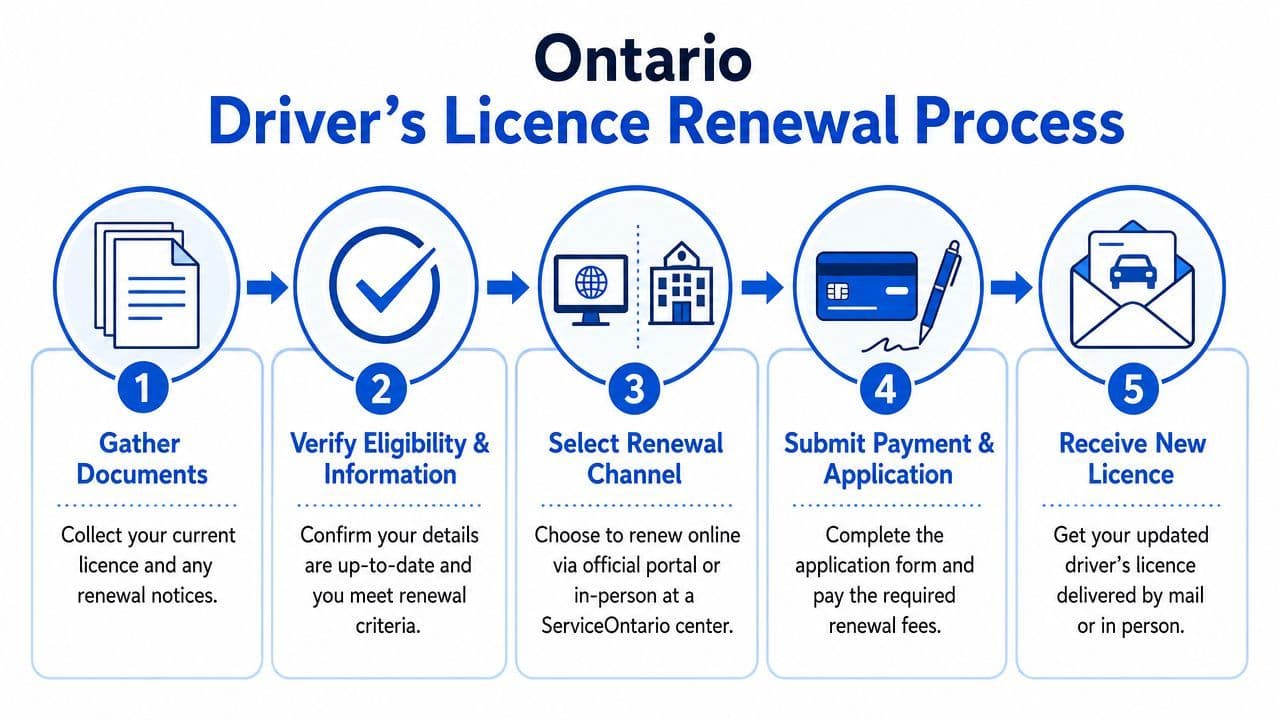
The basic renewal path
- Find your current licence and your renewal notice.
Those two items answer most questions before you even log in or travel anywhere. - Check whether the notice allows online renewal.
Don't assume. Ontario sometimes requires an in-person visit for specific reasons tied to your record. - Confirm your personal details before submitting anything.
Look closely at name, address, and the licence information you're using. - Choose the right channel and complete payment.
If your notice allows online renewal, use the official path. If not, go to a ServiceOntario centre and finish it there. - Keep proof that you completed the transaction.
Hold on to any confirmation until your new card arrives.
If you're gathering documents and want a plain checklist of common licence-related ID requirements in Ontario, the G1ready guide to G1 test documents is a practical reference for the kinds of records new drivers and newcomers often need to organise.
A short visual can also help if you prefer to see the sequence before doing it:
When your renewal notice changes the plan
One official rule catches many drivers by surprise. Ontario says drivers are typically required to take a new licence photo every 10 years, and if your renewal notice says a new photo is needed, you must renew in person at a ServiceOntario centre rather than online, according to the Ontario driver's licence renewal page.
That single line on your notice changes the whole process.
Here's the practical version:
- If no new photo is required: your renewal may be eligible for online processing.
- If a new photo is required: plan for an in-person visit.
- If the notice is unclear: pause and verify before paying.
This is why reading the notice matters more than guessing based on what happened last time.
Avoiding Late Fees and Reinstatement Costs
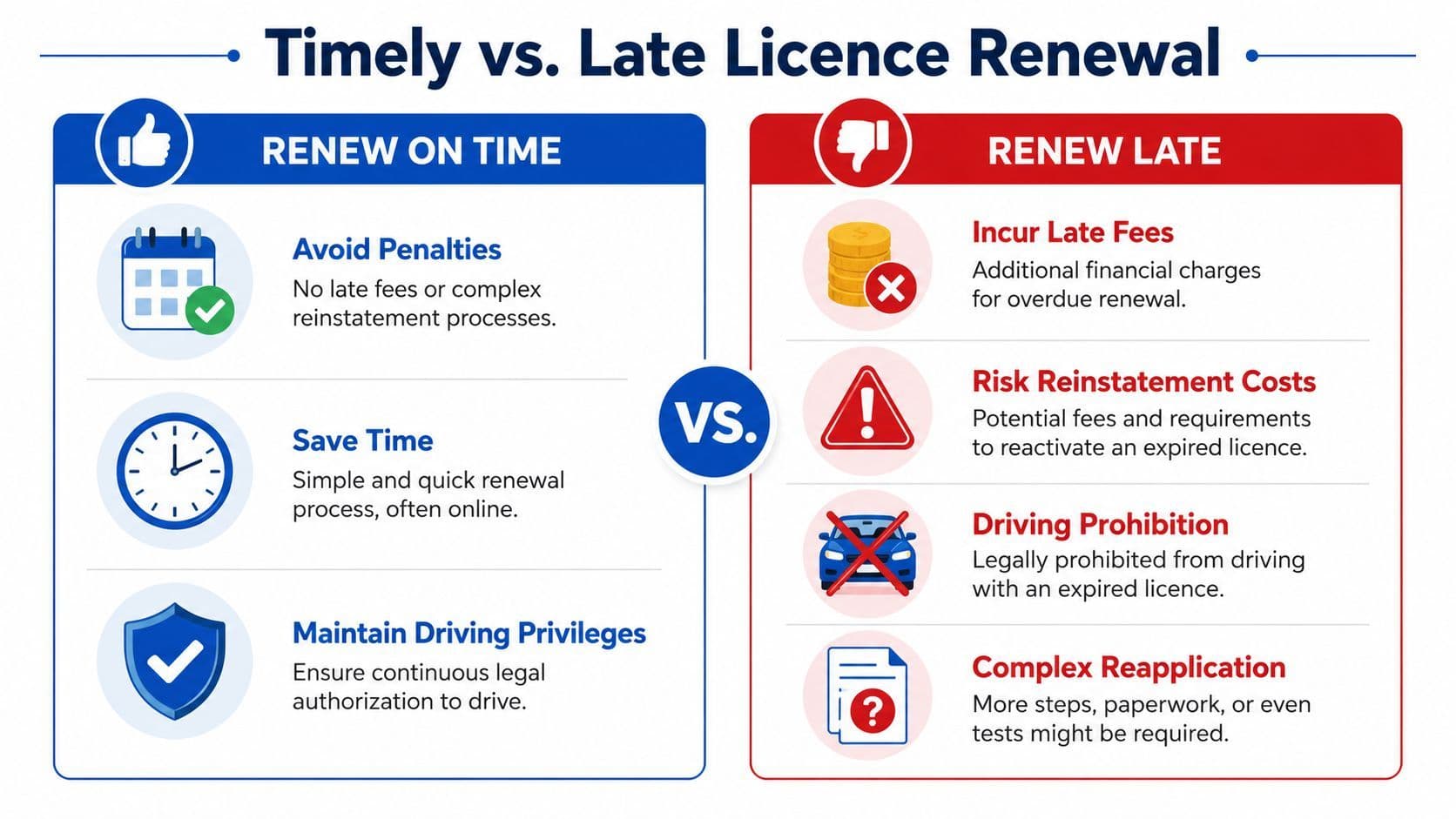
Many drivers ask whether Ontario has a simple late fee for a licence renewal. The more important issue is bigger than that. Letting your licence sit too long can push you out of a straightforward renewal and into a much more burdensome process.
What happens if you wait too long
Ontario's rule is blunt. If a driver's licence has been expired for more than one year, the driver must re-apply as a new driver and pass all required tests again, including written, vision, and road tests, according to the Ontario page on renewing an expired driver's licence.
That's the moment where procrastination stops being a paperwork issue and becomes a licensing reset.
You're no longer just paying renewal fees for driving licence maintenance. You're dealing with the loss of your simple renewal path. You may need to rebuild your status through the testing system instead of extending what you already had.
How to keep renewal simple
The safest strategy is boring, and that's why it works. Renew before expiry, keep your address current, and read the notice as soon as it arrives.
Use this short routine:
- Check the date early: Don't wait until the final week.
- Read for special instructions: Photo requirements and other notes can force an in-person visit.
- Act while it's still a renewal: Once enough time passes, the process can become much harder.
- Keep records of completion: Save confirmations until the new card is in your hands.
Renewing on time protects more than your wallet. It protects your place in the normal system.
If your licence is already expired, deal with it immediately. Even when the path is no longer simple, early action gives you more options than continued delay.
Frequently Asked Questions About Licence Renewal
Can I renew my Ontario driving licence online
Sometimes, yes. It depends on whether your notice allows it and whether Ontario needs you to appear in person for something like a new photo or another requirement tied to your record.
What if I lost my licence card but it hasn't expired yet
That's usually a replacement issue, not a standard renewal issue. The transaction type matters, so don't assume the same fee or process applies.
Do seniors always pay the standard renewal fee
No. Drivers aged 80 and over may qualify for a no-fee renewal when they complete Ontario's senior renewal process, as covered earlier in this guide.
What if my licence has been expired for a long time
If it has been expired for more than one year, Ontario requires you to re-apply as a new driver and complete the required tests again, rather than renewing.
Why does the notice matter so much
Because it tells you whether your renewal is routine. The notice can require a photo update, direct you to renew in person, or place you into a special process that changes what happens next.
Where can I get extra Ontario licence help
If you want broader Ontario licensing help beyond renewal, including common learner questions, the G1ready FAQ page covers many practical issues first-time drivers and newcomers run into.
If you're preparing for any stage of Ontario licensing, G1ready.ca offers Ontario-focused practice tests and study support that can help you build confidence before dealing with the next government step.


