
You've booked the test, downloaded the handbook, opened a few tabs, and suddenly every study option looks equally urgent. One site has quizzes. Another has flashcards. A video explains signs one way, while a practice set asks them another way. For many first-time Ontario drivers, the hardest part isn't motivation. It's deciding what to study first.
That's where good G1 license study material matters. The right mix doesn't just give you more questions. It gives you order. You need one resource for foundation, another for recall, and another for spotting weak areas before test day. If you study everything in a random pile, you can still feel unprepared.
A clear sequence fixes that. It also protects you from one of the most common surprises on the G1: the test isn't just about doing well overall. You have to be ready in both halves of the exam, not only one.
Introduction to G1 License Study Material
Most learners don't fail because they never studied. They struggle because their study material wasn't organised around how the test works.
Good G1 license study material should do three jobs. It should teach the rule clearly, help you remember it later, and expose where you still hesitate. If one tool does only one of those jobs, that's fine. The problem starts when you expect a single resource to do all three.
Learning to cook from scratch provides a good comparison. A recipe teaches you the steps, but practice teaches timing, and mistakes teach what to fix next. G1 prep works the same way. The handbook gives the full picture. Quizzes sharpen memory. Full practice exams show whether you can stay accurate under pressure.
Practical rule: Don't ask, “What's the best study material?” Ask, “What material do I need at this stage?”
That shift makes studying feel much less chaotic.
Understanding the Key G1 Study Resources
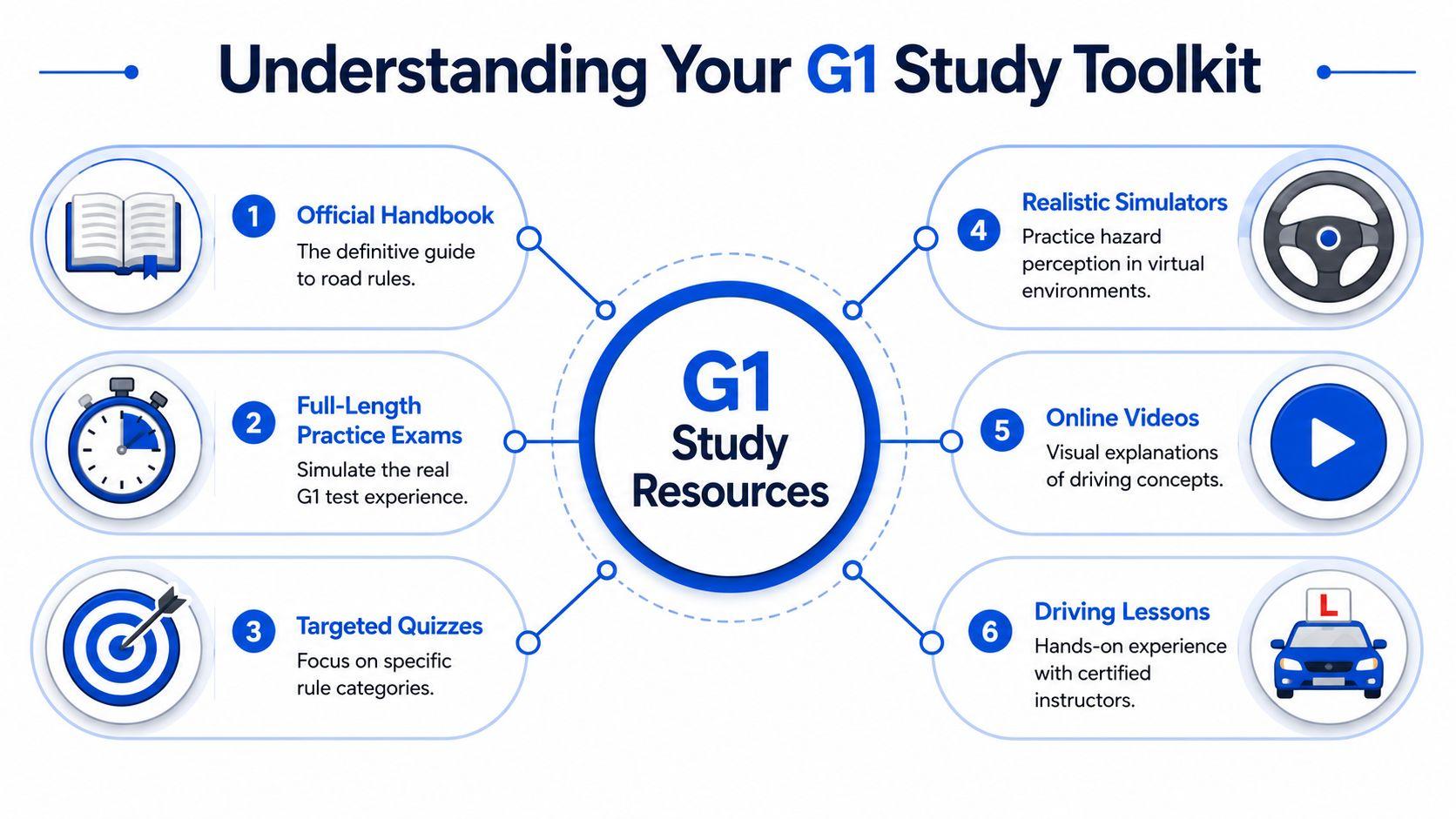
The most useful study toolkit has six pieces. Each one helps in a different way, and each becomes more valuable when used at the right time.
Start with the tool that teaches
The Official Ontario Driver's Handbook is your base layer. It explains the rules in full sentences, not just short answer choices. That matters because multiple-choice questions often test whether you understand the meaning of a rule, not whether you've memorised a phrase.
The actual exam format should shape your material choices. The Ontario G1 knowledge test is a 40-question multiple-choice assessment divided into two equal sections: 20 questions on road signs and 20 questions on rules of the road, with an 80% passing score required in each section independently according to Raven Driving School's breakdown of the G1 knowledge test. That's why broad reading alone isn't enough. You need material that lets you practise signs and rules separately.
Add tools that test recall and timing
Once you've read, use full-length practice exams. These show whether you can stay focused from start to finish. They also reveal a common problem: learners often know a concept when reading but miss it when it appears beside similar answer choices.
Targeted quizzes are different. They're for weak spots. If signs blur together or right-of-way questions keep tripping you up, short topic drills are more efficient than repeating an entire exam.
A simple breakdown helps:
Study tool What it's best for Common mistake Handbook Learning rules properly Treating it like something to memorise line by line Full practice exams Building test readiness Taking too many before understanding basics Targeted quizzes Fixing weak areas Jumping between topics too quickly Simulators Applying ideas in context Using them instead of reading Videos Visual explanation Watching passively without note-taking Flashcards Fast review Using them as your only resource
Some learners also benefit from realistic simulators and instructional videos. Simulators help when a written rule feels abstract. Videos help when a sign or scenario makes more sense visually than in text. Flashcards are the quickest review tool of the group. They work well for sign recognition because repetition builds speed.
If you want to test your baseline early, a G1 practice test with mixed questions can show whether your reading is translating into usable recall.
The best toolkit isn't the biggest one. It's the one where every resource has a job.
Evaluating Roles of Different Study Tools
A study tool can be useful and still be the wrong choice for the moment. That's where many learners lose time. They keep using the tool they like most instead of the one that solves the actual problem.
When the handbook beats a quiz
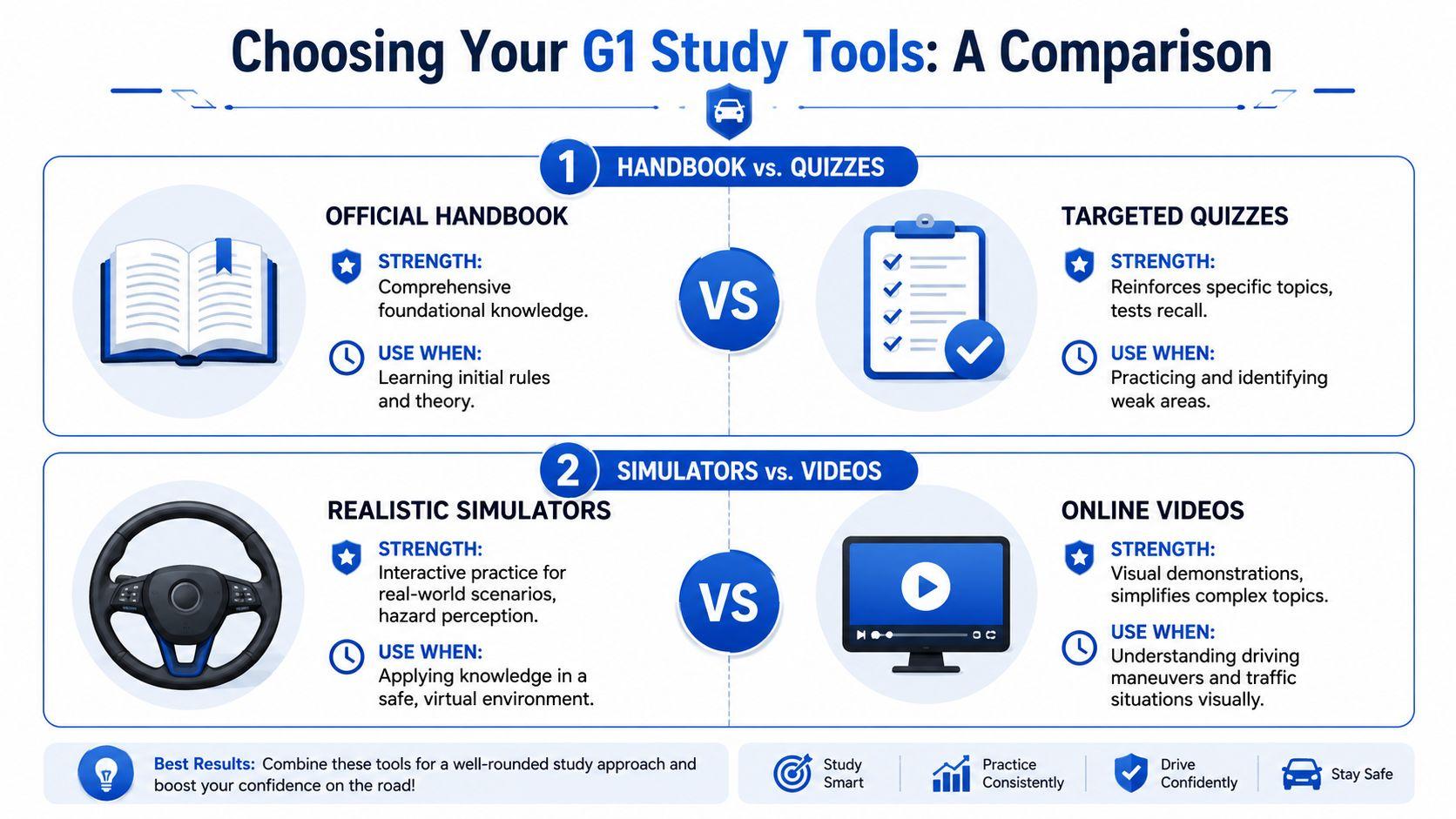
Use the handbook when you're still building understanding. If you don't yet know why a rule exists, a quiz can't teach it well. It only tells you whether you guessed correctly.
Use quizzes when the issue is retrieval. You've seen the rule before, but it doesn't come to mind quickly enough. In that case, short targeted sets are better than another full chapter read.
A side-by-side view makes the choice clearer:
- Handbook first: best when a topic feels unfamiliar, confusing, or too broad.
- Quiz first: better when you already know the material but keep second-guessing.
- Back to handbook after mistakes: useful when you miss a question and need the original explanation.
- Repeat the quiz later: good for checking whether the correction stuck.
When videos and simulators help more
Some topics are easier to understand when you can see movement, spacing, or road position. That's where videos help. A written paragraph about a traffic situation can feel dry. A visual explanation can make it click.
Simulators are strongest when you want to apply several ideas at once. They make you notice how signs, choices, and timing connect. They're not a replacement for core study, though. They're more like a rehearsal room.
One risk matters more than people realise. A video explaining the G1 no partial credit rule highlights that passing one section but failing the other by even one question results in a total test failure. That changes how you should evaluate study tools. If one resource helps road rules but leaves road signs weak, your prep is unbalanced.
That's why a G1 diagnostic test that separates your weak areas can be more useful than counting your total score. A balanced result matters more than one strong half and one shaky half.
Study tools shouldn't compete with each other. They should cover each other's blind spots.
Developing Actionable Study Strategies
A strong plan is simple enough to repeat. If your method changes every day, your focus drops and mistakes pile up.
Use a sequence instead of random repetition
Ontario driving school guidance suggests that most first-time learners need 10 to 15 hours of focused study to pass on their first attempt, while a more optimised method may reduce that to 6 to 10 hours according to Safe Pass Driving's G1 study guide. The key word is focused. More time doesn't automatically mean better results.
Use this order:
- Read the handbook once from start to finish. Don't stop to memorise every line. Your goal is familiarity.
- Take a timed practice test. This shows what stayed with you and what didn't.
- Review every wrong answer carefully. Go back to the matching handbook topic.
- Take another practice set later, not immediately. That gap helps you test memory instead of short-term recognition.
- Keep alternating review and testing until your mistakes become predictable, then fix those patterns.
This sequence works because each step has a different job. Reading introduces. Testing exposes. Review corrects.
Build habits that reduce careless mistakes
Many learners know more than their score suggests. They lose marks because they rush, skim, or react to one familiar keyword without reading the whole sentence.
These habits help:
- Read absolute wording carefully: words like “always” and “never” often change the meaning of the whole question.
- Separate similar signs on purpose: if two signs look alike, study them side by side instead of hoping repetition will sort them out.
- Use short daily sessions: brief, steady review usually sticks better than cramming.
- Track your own mistake types: confusion, rushing, and misreading aren't the same problem.
If you miss a question, don't only ask what the right answer was. Ask why your wrong answer looked tempting.
That's the point where learning becomes durable.
Building a Sample Study Schedule with G1ready Features
A schedule works best when it tells you what to do, not just what to finish. Many learners sit down ready to study, then waste the first part of the session deciding where to begin.
Week one and your starting point
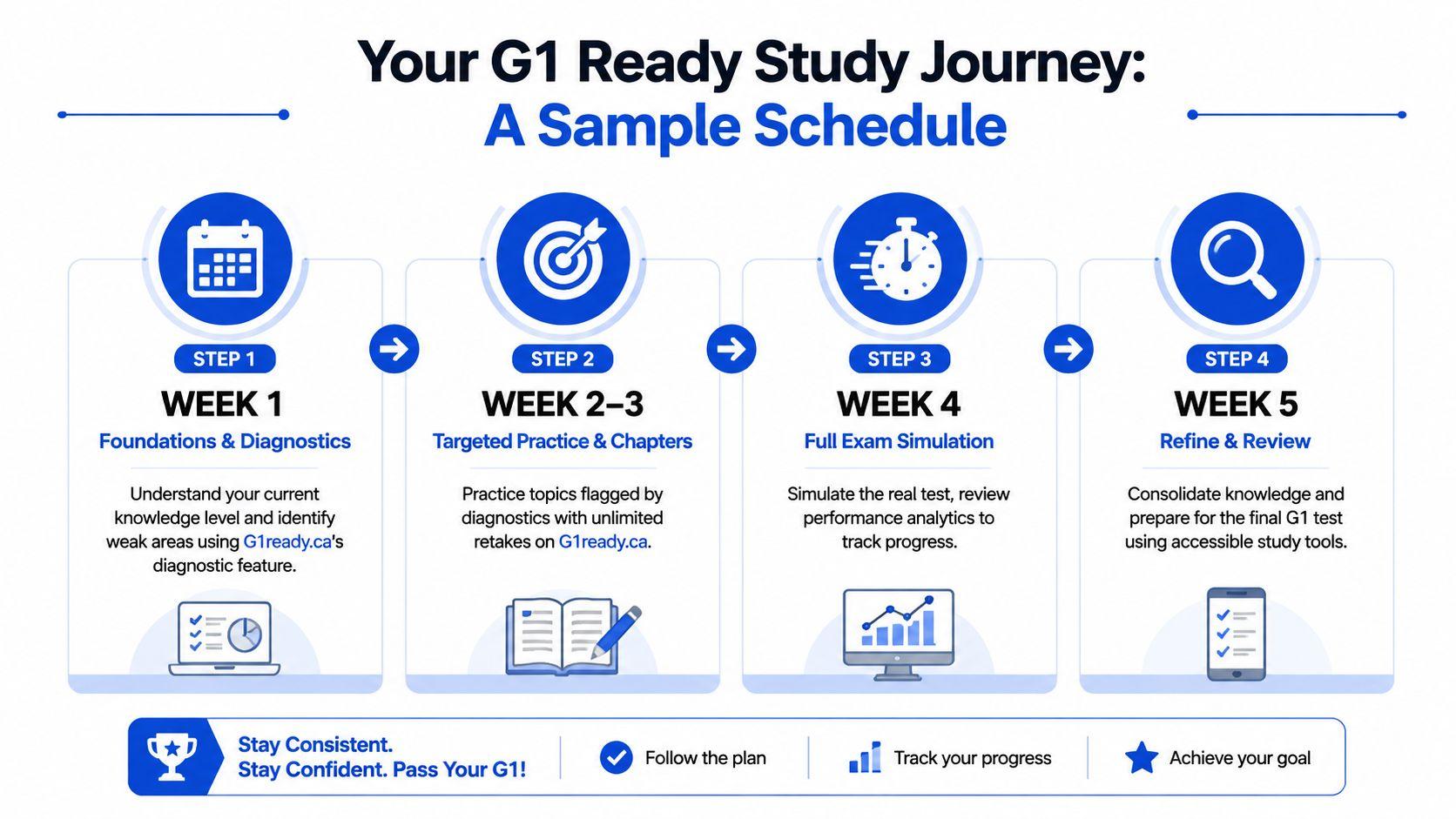
Start with orientation, not pressure. Read through the handbook to build a mental map of the material. Don't chase perfection yet. You're learning the territory.
Near the end of that first stretch, take a diagnostic. The point isn't to impress yourself. It's to find out whether signs or road rules need more attention.
The middle of the schedule
A useful study routine maps reading directly to practice. A guide on studying for the G1 test notes a common question about how to handle the 2025–2026 MTO Driver's Handbook updates on vulnerable road users, and points learners toward high-yield chapters 3 to 6 for more focused preparation. That's a smart way to reduce overwhelm, especially if you're busy or returning to driving after years away.
Here's a practical weekly pattern:
Part of schedule Main task Why it helps Early phase Read handbook chapters Builds understanding before drilling Mid phase Match quizzes to the chapter you just read Reinforces memory while the rule is fresh Later phase Full practice exams Builds stamina and decision speed Final phase Revisit weak topics only Prevents wasted review time
A day-by-day routine can stay simple:
- Reading block: take one handbook section at a time and note any rule that feels unclear.
- Quiz block: answer topic-specific questions tied to that reading.
- Error review block: write down the exact confusion, not just the correct answer.
- Light review later: revisit signs or rules that keep blending together.
If you want a more structured format, this G1 test study timeline lays out a ready-to-use sequence that fits learners who prefer a calendar rather than a loose checklist.
Final review before test day
The last stretch should feel narrower, not heavier. Don't start collecting brand-new resources. Use the same tools that already exposed your weak points.
A good final review looks like this:
- Re-test weak categories: especially the ones you've missed more than once.
- Use mixed exams sparingly: enough to stay comfortable, not so much that you burn out.
- Review signs separately from rules: that keeps your prep balanced.
- Keep sessions calm and short: test readiness comes from accuracy, not panic.
That's also the point where one platform can be useful if it combines several formats in one place. G1ready.ca offers practice exams, topic quizzes, diagnostic testing, explanations, and mobile-friendly review, which makes it practical for learners who want one organised workflow rather than scattered tabs.
Tips to Maximize G1ready.ca for Efficient Learning
Tools only help if you use them deliberately. Many learners click through practice questions quickly, see a score, and move on. That feels productive, but it often hides the same repeating mistake.
Use feedback, not just scores
When a question includes an explanation, pause and read it. The value isn't only in knowing that you were wrong. The value is seeing the rule behind the answer.
A simple approach works well:
- After each wrong answer: note whether the issue was knowledge, confusion, or rushing.
- After each quiz set: look for patterns instead of reacting to one bad question.
- After a stronger result: don't stop reviewing. Check whether the improvement happened across topics or only in the area you practised most.
Strong prep comes from pattern recognition. Weak prep comes from random repetition.
Study in short bursts throughout the day
Mobile-friendly tools are useful because they let you study when you're fresh, not only when you finally get home. A few focused minutes on signs during a break can be more effective than a tired late-night cram session.
Try rotating your use:
- Morning: quick sign review.
- Afternoon: a short quiz on one rules topic.
- Evening: review mistakes and explanations.
That rhythm keeps the material active in memory without making every session feel heavy.
Conclusion and Next Steps
The right G1 license study material doesn't overwhelm you with options. It gives each option a purpose. Use the handbook to learn, quizzes to sharpen recall, and practice exams to test balance across both parts of the exam. Keep your sessions steady, and treat wrong answers like clues rather than setbacks.
Start small. Pick your first reading block, choose a diagnostic, and mark out your next few study sessions. A calm, structured routine usually beats last-minute intensity.
If you want one place to begin, G1ready.ca offers practice tests, targeted quizzes, and study guides that can fit neatly into the kind of structured routine outlined above.