You're probably here because left turns still feel uncertain. Maybe you're studying for the G1 test, or maybe you've been reading the handbook and noticed that left turns seem simple until you picture a real intersection with pedestrians, oncoming cars, and someone waiting behind you.
That feeling is normal. For many new drivers in Ontario, a left turn is the moment where rules, timing, and confidence all have to work together. The good news is that the left turn rules Ontario drivers need for the G1 test are consistent once you break them into a few clear habits.
The Most Challenging Turn for New Drivers
You pull up to a green light. You need to turn left. Cars keep coming toward you, a pedestrian steps into the crosswalk, and the driver behind you seems impatient. Nothing about that moment feels easy when you're new.
That's why left turns deserve extra attention when you study. They ask you to judge speed, watch several directions at once, and follow right of way rules without guessing. New drivers often know the basics, but they freeze when the intersection gets busy or rush because they feel pressured.
A common example is the unprotected left at a normal green light. You move into position, wait for a gap, then start wondering if the approaching car is far enough away. If you hesitate too long, traffic behind you builds up. If you go too soon, you create risk.
Practical rule: If you're not certain the path is clear, wait. A short delay is safer than a rushed turn.
The best drivers don't treat left turns like a gamble. They treat them like a checklist. Check the light. Check oncoming traffic. Check pedestrians. Check the lane you'll enter. Then move only when the turn is clearly safe.
That mindset helps in two places at once. It helps on the road, and it helps on the G1 test, where many questions are built around the exact points people confuse in real life.
The Golden Rule of Left Turns Right of Way
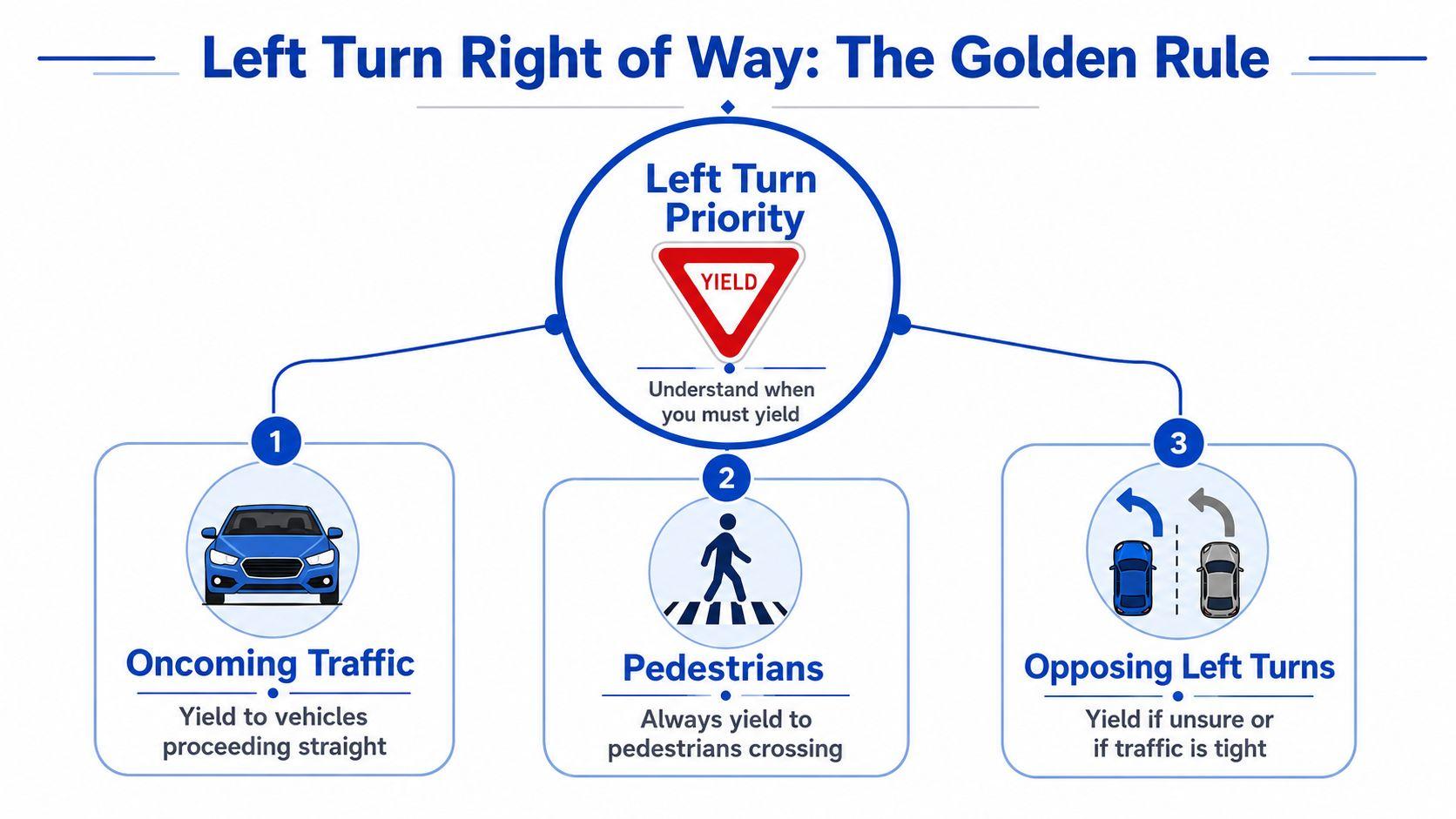
The most important idea in all left turn rules Ontario drivers need to know is simple: when you turn left, you usually yield first.
New drivers sometimes assume that entering the intersection gives them some kind of claim to the turn. It doesn't work that way. The turning driver carries the main responsibility to make sure the turn can be completed safely.
What the law expects from you
According to Section 141(5) of the Ontario Highway Traffic Act, a driver in an intersection shall not turn left across the path of an approaching vehicle unless they have afforded a “reasonable opportunity” for that vehicle to avoid a collision, establishing that left-turning vehicles do not possess inherent right-of-way over oncoming traffic, as discussed in this Ontario right-of-way guide and reflected in the linked discussion of Section 141(5).
That legal wording matters because it explains the heart of the rule. If you turn left in front of someone coming straight through, you can't defend the decision by saying you thought they would slow down. You must leave them a reasonable opportunity to avoid a collision. In practice, that means waiting for a clearly safe gap.
You also yield to pedestrians crossing the street you want to enter. On the road, this often catches new drivers off guard because they focus on the oncoming lane and forget the crosswalk.
A simple way to think about it
If you want a memory tool for test day, use this:
- Oncoming traffic goes first unless you have a protected signal.
- Pedestrians go first when they're lawfully crossing.
- You go last when your turn would cross another road user's path.
That doesn't mean a left turn is always difficult. It means your first job is observation, not movement.
If you have to “hope” the gap is big enough, it probably isn't.
This rule also makes defensive driving easier. Instead of asking, “Can I squeeze through?” ask, “Is every conflict point clear?” That phrasing slows your thinking in a good way. It keeps you from treating a left turn like a race.
On the G1 test, many wrong answers are built around a driver assuming they have priority because the light is green. A green light does not automatically give a left-turning driver the right-of-way over oncoming traffic. That's the trap.
Decoding Left Turn Signals Protected vs Unprotected Turns
Not all green lights mean the same thing. This is one of the biggest sources of confusion for learners, and it shows up often in G1-style questions.
A left turn can be protected or unprotected. If you mix those up, you'll either wait when you could go, or worse, go when you should wait.
Solid green and green arrow are not the same
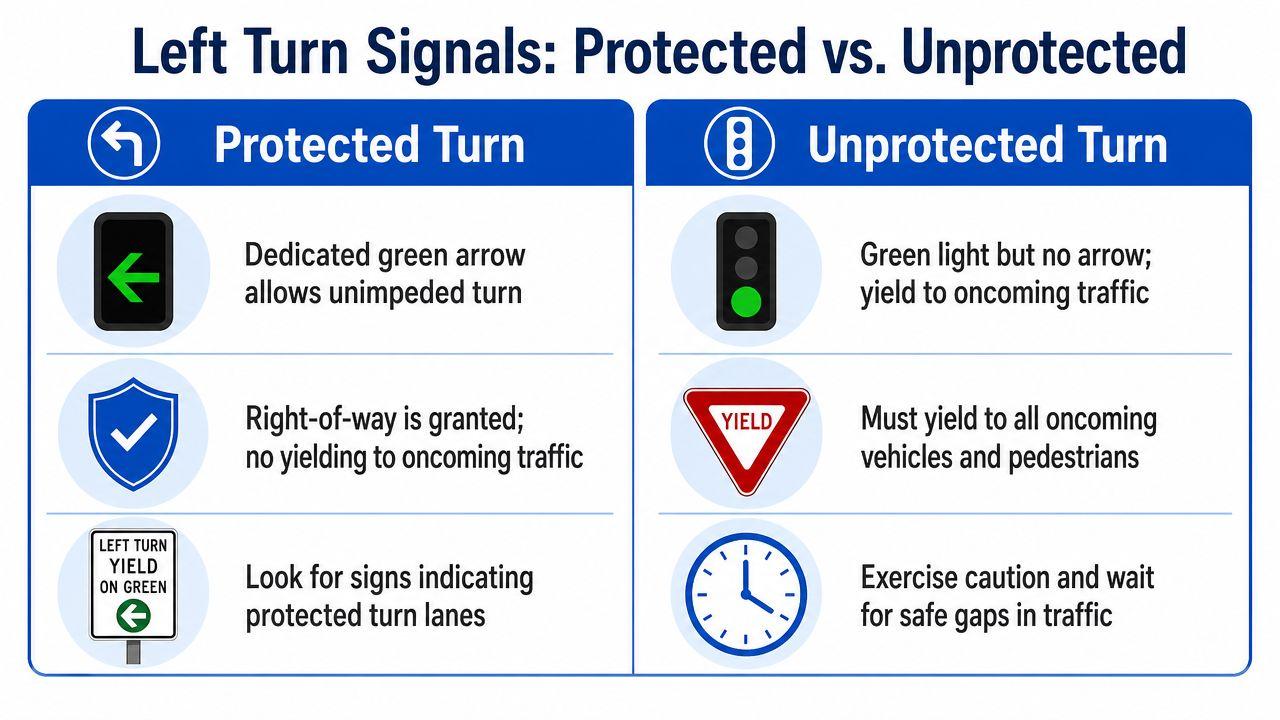
A solid green light usually means your left turn is unprotected. At a green light when turning left in Ontario, drivers must yield to all oncoming traffic and pedestrians and may only proceed when every lane they are crossing is completely free of vehicles and obstacles, a rule that defines an unprotected left turn, as explained in this Ontario road rules guide and in this discussion of unprotected left turns.
That means a plain green circle does not say, “Go ahead and turn.” It says you may turn left if the way is clear.
A green arrow is different. It indicates a protected left turn. In plain language, that means traffic control is giving you a separate chance to turn. Oncoming traffic that would conflict with your turn is being held. You should still scan before moving, but you do not treat it the same way as a regular green light.
A quick comparison helps:
Signal Type of turn What you do Solid green Unprotected Yield and wait for a safe gap Green arrow Protected Turn when safe after checking the intersection
How to answer this on the G1 test
The test likes to ask about the difference indirectly. It may describe a driver facing a green light and ask who has the right-of-way. If there's no arrow, the correct thinking is yield first.
Watch for these clues:
- “Green light” only means don't assume protection.
- “Green arrow” means the turn is specially controlled.
- “Pedestrians crossing” means the turn still waits.
- “All lanes clear” matters on wider roads because you must cross each lane safely.
A lot of students lose marks because they remember “green means go” too literally. For left turns, that shortcut fails. The better rule is this: a solid green gives permission to proceed only when it's safe, while a green arrow is the clearer sign that your turn is being protected.
Proper Lane Position and Turn Execution
Knowing right-of-way isn't enough. You also need to place the car properly and turn into the correct lane with control.
A clean left turn starts before you reach the intersection.
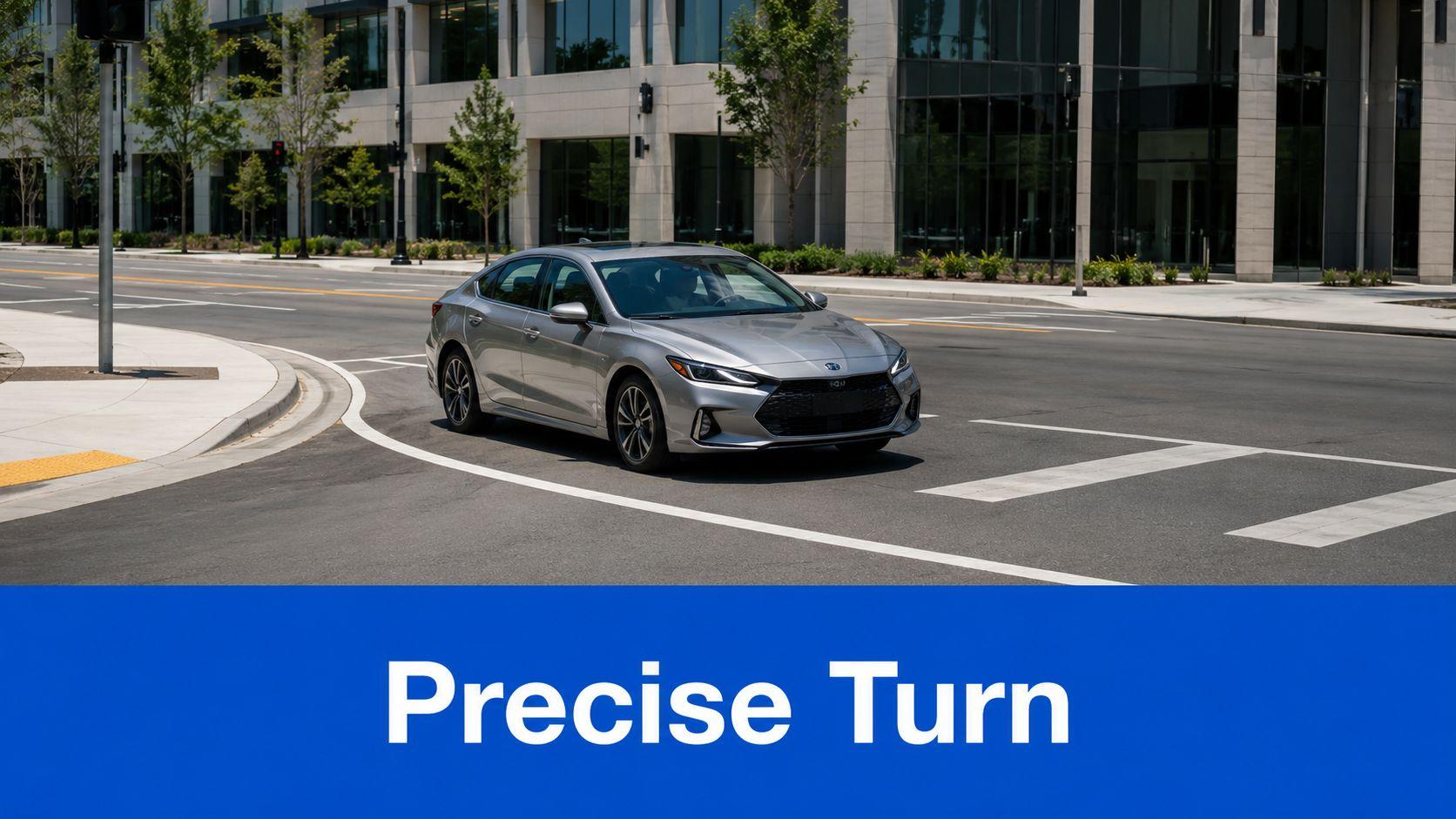
Before you enter the intersection
The Official MTO Driver's Handbook recommends signaling 30 metres before the turn at lower speeds and 150 metres at higher speeds to give other motorists time to respond, as set out in the MTO guidance on changing directions.
That signal timing matters on the G1 test because it's one of the few exact distances learners are expected to remember. It also matters in real driving because early signaling gives other drivers and cyclists time to react.
Use this approach sequence:
- Signal early. Don't wait until you're already at the intersection.
- Move into the far left lane in your direction when it's clear.
- Check mirrors and blind spots before changing position.
- Stop smoothly if needed and keep the car properly aligned in the lane.
One habit from the handbook is especially important. Don't sit waiting with your steering wheel already turned left. Keep the wheels straight until you can complete the turn. If another vehicle hits you from behind, turned wheels can push your car into oncoming traffic.
Keep your car ready, but keep your wheels straight until the path is clear.
If pavement markings or special turn lanes are posted, follow them closely. Start from the marked lane and stay within the intended path of the turn.
How to complete the turn smoothly
A good left turn is controlled, not sharp. You're not cutting across the corner, and you're not drifting wide.
Focus on three things:
- Entry lane: start in the correct left-turn lane.
- Path through the intersection: steer in a smooth arc.
- Exit lane: enter the proper lane on the road you're joining.
Many learners improve once they watch the movement. This demonstration helps show the spacing and timing involved:
A simple lane reminder is useful here:
Stage Goal Approach Get into the left lane early Wait Stay straight and keep scanning Turn Enter the appropriate lane on the new road
If your turn feels rushed, you probably started the decision too late. Slow the process down earlier. Signal, position, scan, then turn.
Navigating Special Left Turn Scenarios
Some left turns are straightforward. Others are where new drivers start second-guessing themselves. These are the situations worth studying carefully because they show up both on the road and on the G1 test.
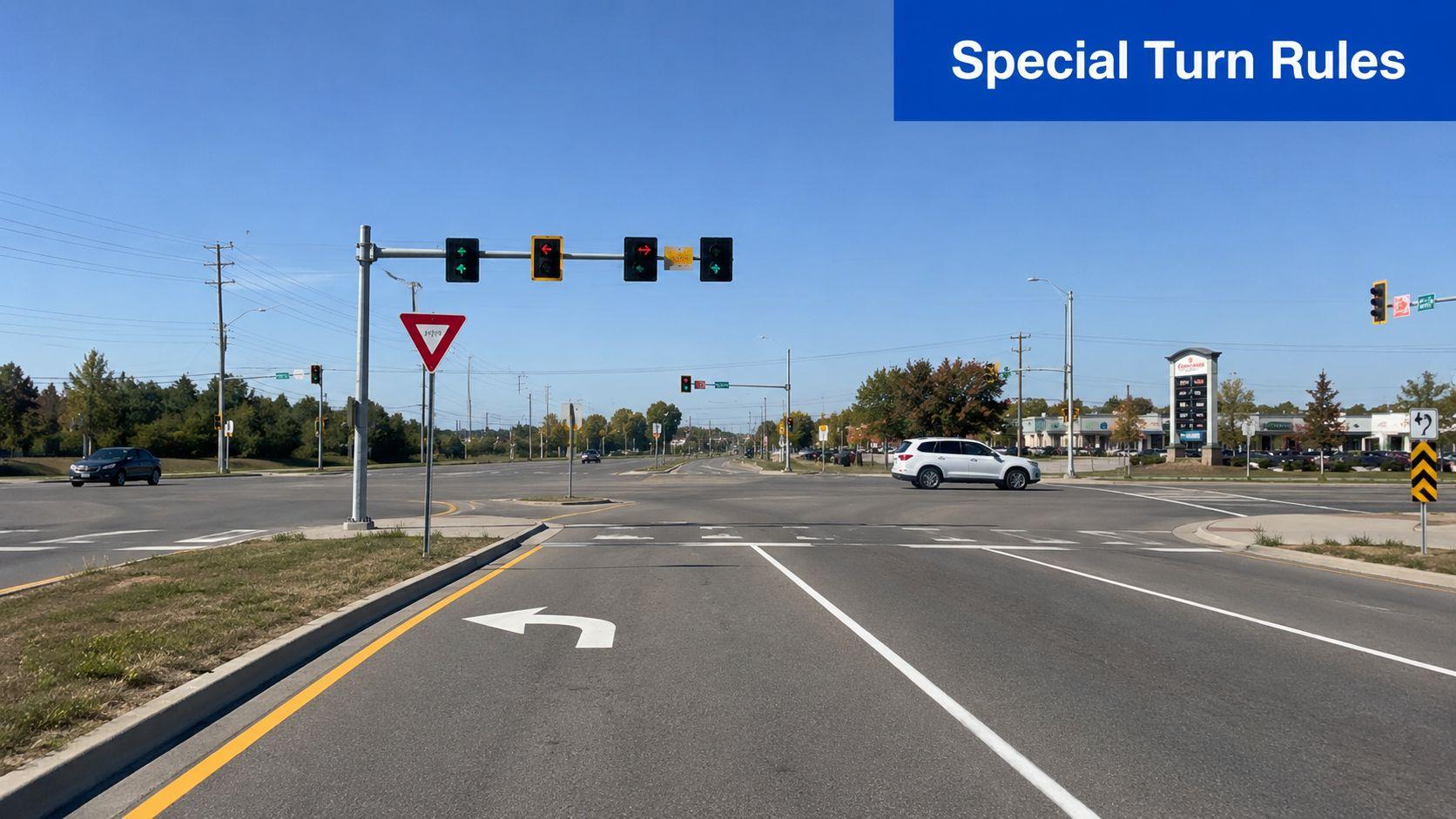
When a left turn on red is legal
In Ontario, a left turn on a red light is legally permitted only when transitioning from a one-way street to another one-way street, contingent upon five specific technical conditions: both streets are one-way, a complete stop is made, yielding to all traffic and pedestrians, no sign prohibits the turn, and the turn does not start from a two-way street, as outlined in this explanation of Ontario's one-way-to-one-way red-light exception.
This rule is easy to overgeneralise, so keep it tight in your memory. It is not a general left-on-red rule. It is a narrow exception.
Use this checklist before even considering the turn:
- Street check: You must be turning from a one-way street onto another one-way street.
- Full stop: Stop first at the proper point before any movement.
- Yielding check: Pedestrians, cyclists, and vehicles already moving through the intersection go first.
- Sign check: If a sign prohibits the turn, you must not turn.
- Two-way warning: If your turn starts from a two-way street, the exception doesn't apply.
On the G1 test, this is often asked in a way that tries to lure you into forgetting one of those conditions. Usually the trap is the starting street. If it's two-way, the answer is no.
Other situations that confuse new drivers
Two vehicles facing each other and both turning left can also be confusing. The Ontario driver's handbook says they should turn to the left of each other after yielding to pedestrians and oncoming traffic. In practice, that means each vehicle passes in front of the other in an orderly way rather than trying to swing behind.
Multi-lane left turns need discipline. If road markings assign a left-turn lane, start there and stay in that turning path. Don't drift across lanes during the turn just because the road opens up.
At stop-controlled intersections without traffic lights, the same mindset still helps:
- Stop fully first
- Yield based on who is already there and who may conflict with your path
- Turn only when your route is clear
The unusual left turn isn't solved by confidence. It's solved by checking the exact conditions.
Centre turning lanes can also confuse beginners. Treat them as transition space for turning movements, not as a lane for regular travel. Enter carefully, keep scanning, and don't assume other drivers will use the lane correctly.
Common Left Turn Mistakes to Avoid
Most left turn errors come from pressure, not lack of intelligence. The driver feels rushed, tries to be polite to the cars behind, or assumes an approaching vehicle is farther away than it is.
Ontario law puts the main duty on the turning driver. Under Section 141(5) of the Highway Traffic Act, a driver turning left at an intersection must yield the right-of-way to any vehicle approaching from the opposite direction. Misjudging a gap is not an excuse. The law places the primary duty on the turning driver to ensure the turn is safe before proceeding, as explained in this discussion of left-turn obligations under Ontario law.
The errors that lead to bad decisions
Here are the mistakes I see learners make most often:
- Rushing because of traffic behind: The cars behind you don't decide when it's safe. You do.
- Watching only one hazard: Some learners stare at oncoming cars and miss the pedestrian entering the crosswalk.
- Turning the wheels early while waiting: That creates risk if another vehicle bumps you from behind.
- Cutting the corner: This happens when the driver turns too sharply and doesn't follow a proper arc.
- Drifting into the wrong lane: A left turn should finish with lane discipline, not a scramble to correct afterward.
Quick corrections that keep you safe
Each mistake has a practical fix.
For pressure from behind, use a mental sentence: “I turn when the path is safe, not when the driver behind me wants me to.” That one thought prevents a lot of poor decisions.
For scanning problems, use a repeatable visual order:
- Oncoming traffic.
- Crosswalk and sidewalk area.
- The lane you will enter.
- A final check before moving.
For lane control, slow the steering input. Most wide or messy turns happen because the driver starts too late and then oversteers to compensate.
Good left turns look almost boring. That's what you want.
If you ever feel trapped in the intersection as the signal changes, don't panic and don't jerk the car through. Stay calm, keep checking for traffic movement, and clear the intersection only when it can be done safely.
G1 Test Prep Left Turn Practice Questions
If you want to do well on left turn questions, don't memorise isolated phrases. Study the pattern behind them. The test asks whether you understand who yields, what a signal really means, and when a special exception applies.
How to study left turn questions
A strong review session usually focuses on three buckets:
- Right-of-way questions: Who must yield at a regular green light?
- Signal questions: Does a solid green mean the same thing as a green arrow?
- Special-case questions: When is a left turn on red legal in Ontario?
For extra practice in the same style as the official exam, many learners use Ontario driving test questions for G1 study.
When you answer a question wrong, don't just note the right option. Ask what detail fooled you. Was it the signal type? The lane? The one-way street condition? That habit improves your judgment faster than blind repetition.
Practice questions
1) You are at a green light and want to turn left. There is no green arrow. What must you do?
A. Turn immediately because the light is green
B. Yield to oncoming traffic and pedestrians, then turn when safe
C. Move forward because cars behind you have priority
D. Turn before the crosswalk fills
Correct answer: B
A solid green for a left turn is generally an unprotected turn. You must wait until oncoming traffic and pedestrians no longer conflict with your path.
2) When is a left turn on a red light allowed in Ontario?
A. From any street if traffic is light
B. Only from a two-way street to a one-way street
C. Only from a one-way street to another one-way street, after stopping and yielding
D. Whenever there is no pedestrian nearby
Correct answer: C
This is the narrow exception many learners miss. Both streets must be one-way, you must stop completely, you must yield, and no sign can prohibit the turn.
3) While waiting to turn left at an intersection, how should your front wheels be positioned?
A. Turned left so you can move quickly
B. Turned right to avoid blocking traffic
C. Straight ahead until you can complete the turn
D. Any position is fine if the signal is on
Correct answer: C
Keeping the wheels straight reduces the risk of being pushed into oncoming traffic if another vehicle hits you from behind.
4) What does a green arrow for a left turn mean?
A. The turn is protected
B. You still yield exactly as on a solid green
C. You may turn only if no one is behind you
D. Pedestrians never have priority
Correct answer: A
A green arrow indicates a protected turn. You should still look before moving, but it is different from a regular green light.
5) You are turning left onto a multi-lane road. What lane choice is safest and most correct?
A. Any lane that looks open
B. The lane farthest from the centre
C. The corresponding lane for the turn path
D. The lane with the fastest traffic
Correct answer: C
Good lane discipline matters during and after the turn. Don't swing wide or drift across lanes just because there's space.
6) Two vehicles from opposite directions are both waiting to turn left in the same intersection. What should they do?
A. Each should turn to the left of the other after yielding as required
B. The larger vehicle goes first
C. Both should reverse and try again
D. One driver must always wave the other through
Correct answer: A
This is a handbook detail that many learners forget. It's a practical rule for organising simultaneous left turns.
A final tip for test day: if a question includes a left turn and you're unsure, look for the answer that involves yielding, checking, stopping, or waiting for a clear path. Left turn questions usually reward patience, not aggression.
If you want more Ontario-specific practice before test day, G1ready.ca offers free G1 practice exams with instant feedback, targeted quizzes, and realistic question formats that help you build confidence one topic at a time.