
You're probably here for one of two reasons. You're studying for your G1 and keep seeing demerit points pop up in practice questions, or you already drive and want to stop mixing up what counts as a ticket, what counts as a conviction, and what affects your record.
That confusion is normal. Many new drivers hear people say they “lost points” after a ticket, as if every driver starts with a full bucket that slowly drains away. In Ontario, that's not how it works. If you want to do well on a demerit point quiz, and more importantly understand what the rules mean in real life, you need the mechanics to feel simple.
That Sinking Feeling Understanding Driving Penalties
You check your mirror and see flashing lights behind you. Your stomach drops. Even if you know you weren't doing anything reckless, your brain starts racing through every possibility. Was your speed a little high. Did you miss a sign. Did you forget something small that now feels huge.
That reaction tells you something important. Driving rules don't feel abstract when they might affect your licence, your confidence, or your next test. For a new G1 applicant, the pressure can feel even heavier because many rules sound similar until you see how they work in an actual situation.
A lot of fear around penalties comes from half-understood advice. One person says points come off your licence. Another says every ticket means suspension. Someone else says demerit points only matter for experienced drivers. None of that gives you a clear mental model.
Practical rule: Calm drivers make better decisions when they know the system, not when they memorise random warnings.
Think of this article as a driving lesson, not a lecture. The goal isn't to scare you into memorising punishments. It's to help you recognise how Ontario treats different offences, how points build up, and why a good demerit point quiz should test understanding instead of guesswork.
If you can connect the rule, the conviction, and the consequence, the topic becomes much easier. That's the point where most learners stop feeling intimidated and start feeling prepared.
What Are Ontario Demerit Points Really
Many learners use the phrase “losing points,” but Ontario's system works in the opposite direction.
The biggest misunderstanding
You start at zero. Demerit points are added to your record after certain traffic convictions, not taken away from some starting total. Official Ontario guidance explains that drivers start at zero and gain demerit points upon conviction. It also distinguishes between novice and fully licensed drivers, and notes that warning letters are used before a suspension threshold is reached, which is why the system works as a behaviour signal as well as a penalty system, as noted in this Ontario demerit point explanation video.
A simple way to think about it is a report card. You don't begin with perfect marks that teachers subtract from. You build a record based on what happens over time. Good driving keeps the record clean. Convictions add warning signs to it.
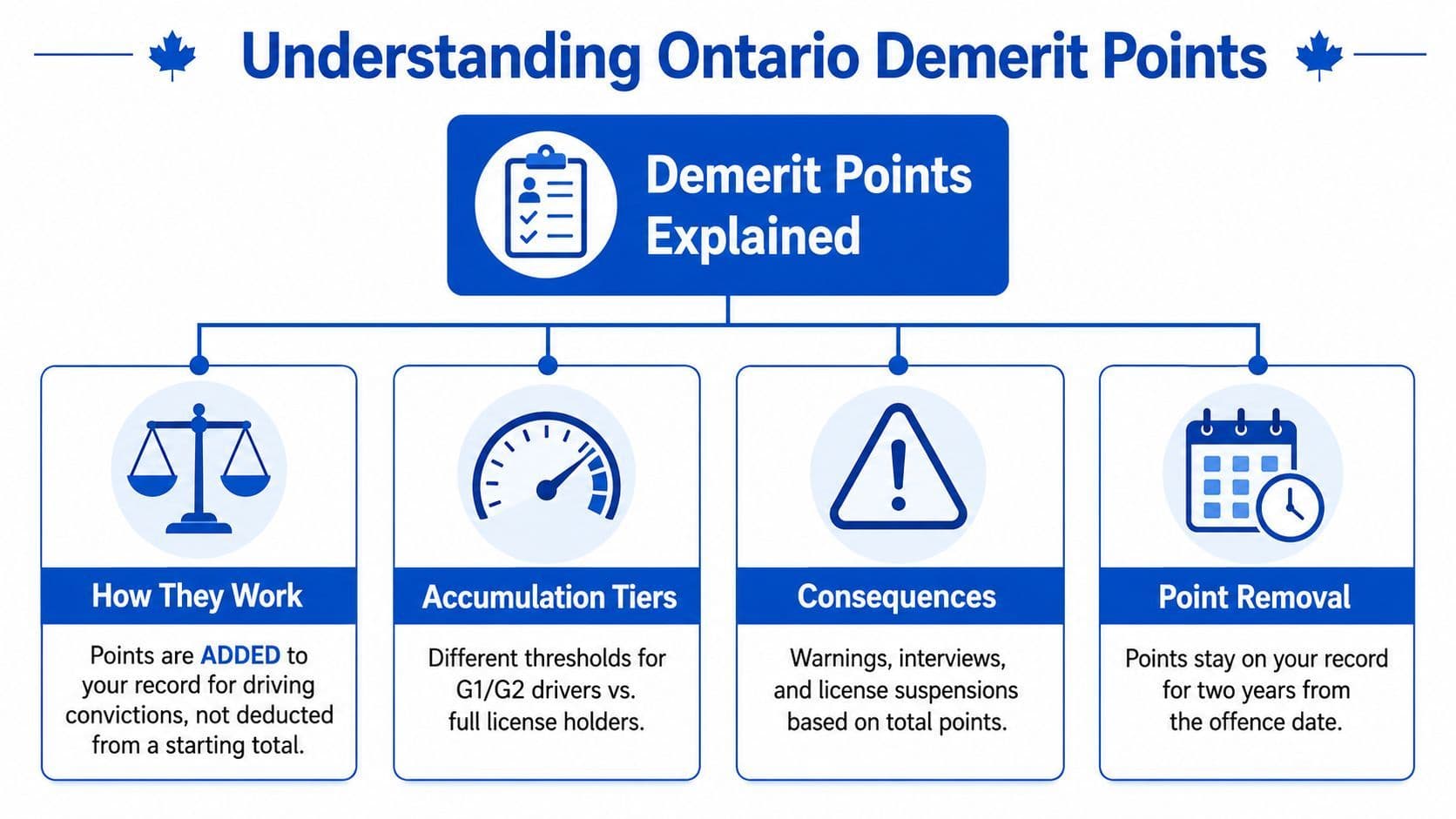
That matters because a demerit point quiz often tries to trick you with the old myth. If a question asks whether points are deducted or accumulated, accumulated is the right way to think about it.
Why novice drivers need extra clarity
Ontario does not treat every driver the same. Novice drivers and fully licensed drivers face different consequences, and that's where many practice pages oversimplify the topic.
If you hold a G1 or G2, you're still in the graduated licensing system. The rules are tighter because the province expects newer drivers to build judgement carefully. If you want a clean overview of that system, this guide on Ontario graduated licensing helps put demerit rules in context.
A strong mental model looks like this:
- Start from zero: Your record is clean until a conviction adds points.
- Separate the licence types: G1 and G2 drivers don't face the same thresholds as a full G driver.
- Treat points as signals: They show repeated risky behaviour, not just one bad moment.
- Read quiz wording closely: Many wrong answers are built around the “you lose points” myth.
The safest way to answer any demerit-point question is to ask, “Who is the driver, what was the conviction, and what gets added to the record?”
Once you've got that framework, the numbers and thresholds stop feeling random.
How Demerit Points Are Assigned and What They Mean
A demerit point quiz gets much easier when you stop trying to memorise isolated facts and start noticing the pattern. Lower-risk speeding offences carry fewer points. More severe speeding offences carry more.
How to read a demerit point table
Ontario's demerit system scales with the seriousness of the conviction. For speeding, the point value rises as the amount over the limit rises. For fully licensed drivers, a warning letter is triggered at 6 points, an interview at 9, and a 30-day suspension at 15. The same source also notes that speeding 16 to 29 km/h over the limit is 3 points, while speeding 50 km/h or more is 6 points, which shows how the penalties increase with risk, according to this summary of Ontario fines, limits, and demerit points.
That pattern matters more than rote memorisation. If a quiz asks you about a higher-speed offence, you should expect a higher point value.
Ontario demerit points by offence
Here's a compact reference table using the verified speeding examples.
Demerit Points Common Offences 1 point Speeding 15 km/h or less over the limit 2 points Speeding 16 to 29 km/h over the limit 3 points Speeding 30 to 49 km/h over the limit 6 points Speeding 50 km/h or more over the limit
This is a good example of why wording matters. If a question says “a little over the limit,” that isn't enough. You need the exact range.
What the totals mean in practice
Now connect offence points to licence consequences.
For a novice driver, the thresholds are stricter. A smaller total can become a much bigger problem because Ontario expects G1 and G2 drivers to show safer, more consistent judgement.
For a fully licensed driver, the point total acts more like an escalating warning system. First comes a warning letter, then a more serious intervention, then suspension if the total keeps climbing.
Use this logic when you study:
- First question: What conviction happened.
- Second question: How many points does that offence add.
- Third question: What class of driver are we talking about.
- Fourth question: Has the total reached a warning or suspension level.
Don't study demerit points as separate trivia. Study them as a chain: offence, conviction, points, consequence.
That chain is what most learners miss. Once you practise it a few times, a demerit point quiz starts to feel much more predictable.
Take Our Ontario Demerit Point Quiz
Try this like a low-pressure check-in, not a final exam. The point isn't perfection. It's to see whether you can apply the rules in realistic situations.

If you want more Ontario-style practice after this, you can use this road rules practice test for extra review.
Quiz questions
1. Which statement is correct about Ontario demerit points?
A. Drivers start with a full set of points and lose them
B. Drivers start at zero and gain points after certain convictions
C. Drivers get points only after a second ticket
D. Demerit points apply only to G drivers
2. A fully licensed driver reaches 6 demerit points. What happens at that stage?
A. Automatic lifetime ban
B. Warning letter
C. Road test cancellation
D. Vehicle impoundment
3. A speeding conviction for 50 km/h or more over the limit adds how many demerit points?
A. 1
B. 2
C. 3
D. 6
4. Which driver group faces suspension at a lower point total?
A. Fully licensed drivers
B. Novice drivers
C. Both groups at the same total
D. None of the above
Here's a quick video if you want another format before checking your answers.
5. Why do demerit-point questions trip up many learners?
A. Because the rules are based only on intuition
B. Because quiz questions often mix up convictions, point totals, and licence class
C. Because demerit points never affect new drivers
D. Because every ticket has the same consequence
Answer key and explanations
1. Correct answer: B
Ontario drivers start at zero. Points are added after certain convictions. This is the foundation of the whole system.
2. Correct answer: B
For a fully licensed driver, reaching that total triggers a warning stage, not an automatic suspension. That's why you should think of the system as progressive.
3. Correct answer: D
This is one of the easiest values to mix up because learners often assume all speeding tickets are treated the same. They aren't.
4. Correct answer: B
Novice drivers face stricter thresholds. If a question gives you a G1 or G2 scenario, slow down and read carefully.
5. Correct answer: B
Most mistakes happen when learners answer too quickly. They recognise part of the rule but miss whether the question is asking about the offence, the point value, or the licence class.
Smart Strategies to Avoid Demerit Points
The smartest way to avoid demerit points starts before you ever get behind the wheel. It begins with accurate recall. Ontario's official G1 knowledge test requires at least 16/20 correct in each of its two sections, which means confusion about fines, limits, and penalty rules can cost you quickly, as explained in this overview of Ontario fines, limits, and demerit-point test prep.
Study the way the test is marked
General driving intuition helps on the road, but it doesn't always help on the written test. The test rewards exact knowledge. If you vaguely remember that speeding leads to points but can't identify the right range or consequence, you're leaving marks on the table.
Try these study habits:
- Use targeted practice: Don't rely only on mixed quizzes. Spend time on fines, signs, and penalties as their own categories.
- Review missed questions twice: The first review fixes the answer. The second review fixes the reason.
- Say the rule aloud: Many learners remember better when they hear themselves explain it.
Driving habits that prevent costly mistakes
Knowledge is your first defence, but habits matter too. A careful driver builds routines that reduce rushed decisions.
Consider a few practical ones:
- Check the posted speed early. Many mistakes happen because drivers assume the limit instead of confirming it.
- Leave extra time. When you're late, even simple choices get sloppy.
- Drive with commentary in your head. Not constantly, but often enough to notice signs, lane changes, and speed shifts.
If you want to strengthen that mindset, this guide to an Ontario defensive driving course is a useful next read.
A clean record usually comes from ordinary habits done consistently, not from heroic last-second reactions.
Master the Rules with G1ready.ca
A good demerit point quiz does more than ask for a number. It checks whether you understand how Ontario thinks about driving behaviour, conviction records, and licence stages. That's the actual skill behind the questions.
If you're still mixing up point totals, offence ranges, and novice versus full-licence consequences, practice needs to be more focused. Random review won't always fix a specific blind spot. Purpose-built study tools can.

One option is G1ready.ca, which offers registration-free Ontario practice exams, targeted quizzes on specific rule categories, exam-style simulations, immediate explanations, and progress tracking so learners can spot weak areas and keep practising with structure.
That kind of practice is useful because demerit-point mistakes are rarely random. Usually, the learner understands one part of the rule but not the full chain. Better feedback helps you catch exactly where your thinking went off course.
The goal isn't to memorise isolated answers. It's to build the kind of confidence that carries from the written test into real driving decisions.
If you want more structured practice, G1ready.ca gives you Ontario-focused G1 quizzes, exam-style practice, and instant explanations that make tricky topics like demerit points much easier to understand.


