
Your first Ontario insurance quote can feel like a punch to the stomach. Parents see it too. A teen gets a licence, starts looking at a used car, then the actual cost of driving shows up all at once.
That's usually when people start asking about an ontario defensive driving course. They want to know if it helps with insurance, whether it can protect a licence after a mistake, and if it makes someone safer behind the wheel. Those are the right questions.
The short answer is yes, but only if you choose the right kind of course for the right reason. In Ontario, one course can be useful for insurer recognition, another can be used as a compliance tool, and another may be a smart refresher if you haven't driven in a while. If you're still learning the road rules, it also helps to build your foundation first with practical Ontario driving study guides so the course material makes more sense when you start.
Your Guide to Ontario Defensive Driving Courses
A defensive driving course teaches you to spot risk early, leave room for other drivers' mistakes, and make calmer decisions when traffic gets messy. That sounds simple, but on Ontario roads it matters every day. Merging traffic, winter conditions, left turns across busy intersections, and constant distraction all punish drivers who react late.
What surprises many families is that the term covers more than one type of training. Some people mean Beginner Driver Education, which is part of Ontario's structured path for new drivers. Others mean a driver improvement or defensive driving course taken after tickets, court issues, or employer requirements. Some want a skills refresher before driving more often.
Why your goal matters first
The best course for a new G1 or G2 driver isn't always the best course for someone trying to deal with licence risk. Ontario treats these categories differently. If your goal is insurer recognition, you need to pay attention to whether the school and program are officially recognized for that purpose. If your goal is compliance or remediation, you need the course that fits that requirement, not just the cheapest class you find online.
That's the trade-off many miss. They shop by price first, then realise later the certificate doesn't do the job they needed.
Practical rule: Decide the outcome before you pick the school. Insurance, court-related compliance, and skill building are not the same purchase.
What good course decisions usually look like
A practical decision usually starts with one of these situations:
- New driver planning ahead: You want proper training, safer habits, and the best chance of insurer recognition.
- Driver with a recent issue: You need a course that helps with compliance or supports licence retention.
- Returning or nervous driver: You don't need a label as much as a structured reset on scanning, spacing, speed control, and road judgement.
Parents often ask me which matters most. My answer is usually the same. The course matters, but the fit matters more. The right ontario defensive driving course gives you a clear reason for taking it, a realistic training format, and a certificate that lines up with your goal.
Understanding What a Defensive Driving Course Is
In Ontario, a defensive driving course is less like one single product and more like a category of training. The easiest way to understand it is to compare it to first-aid training. Workplace first aid, CPR for childcare, and wilderness first aid all teach safety, but they serve different jobs. Driving courses work the same way.
Ontario notes that driver improvement courses or defensive driving courses may be required in some cases to help drivers avoid losing their licence, and the province treats them as distinct from government-approved beginner driver education programs, as explained on the Government of Ontario approved driving schools page.
The three common course types
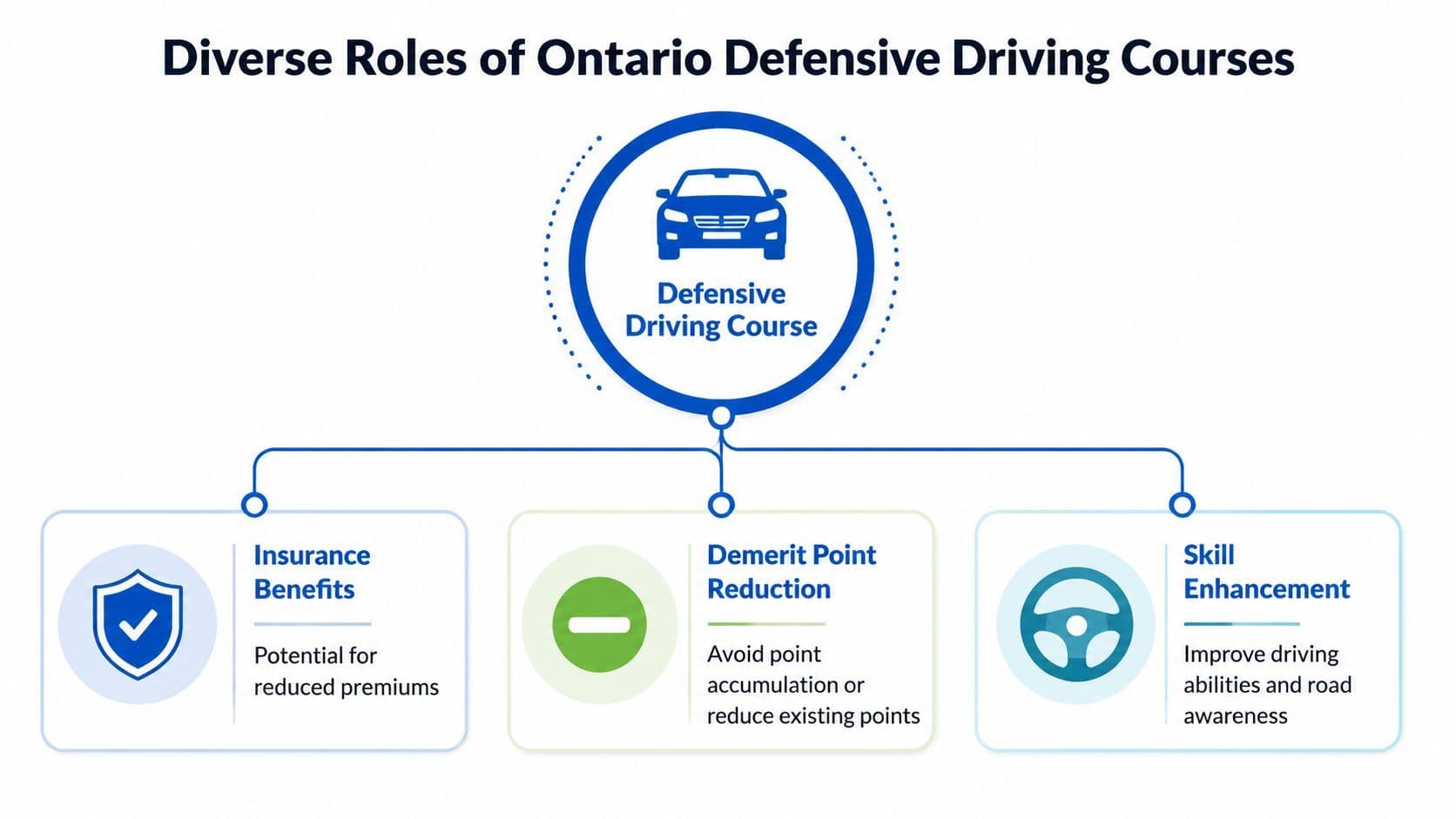
Here's how the category usually breaks down in practice:
- Beginner Driver Education for new drivers: This is the structured route for beginners. It combines classroom or online theory with in-car instruction and fits into Ontario's graduated licensing framework.
- Driver improvement or compliance-focused courses: These are usually taken because a driver needs remedial training, licence support, workplace compliance, or documented retraining.
- Voluntary refreshers: These suit drivers who want to rebuild confidence, update their habits, or adjust to Ontario traffic expectations after time away from driving.
A lot of confusion comes from assuming all three are interchangeable. They aren't.
What each one is really for
If you're a new driver or a parent of one, the key question is whether the course is part of a recognized beginner pathway. If you've had a problem on your record, the key question changes. You need to know whether the course is accepted for the requirement you're dealing with. If you're rusty, then the right course is the one with strong instruction and clear practical content.
The course isn't “good” or “bad” in the abstract. It's either the right fit for your situation or it isn't.
That's why I tell students not to buy based on marketing words alone. “Defensive driving” sounds reassuring, but the useful detail is in the course category, approval status, delivery format, and what documentation you receive at the end.
The mistake that wastes the most time
Drivers often enrol first and verify later. That can lead to two problems. First, the certificate may not be recognised for the purpose they had in mind. Second, they may complete a course heavy on theory when what they really needed was coached in-car correction.
A proper ontario defensive driving course starts with clear purpose. That one decision affects every other step.
The Real Benefits of Completing a Course
A parent usually notices the benefit first. Their teen starts leaving a proper following distance, checks mirrors before braking, and stops making rushed lane changes near intersections. An adult driver coming back after a ticket or a close call sees it differently. The drive feels less reactive and more controlled.
That difference matters because the value of an ontario defensive driving course depends on your reason for taking it. If your goal is an insurance discount, course recognition matters. If you need retraining for court, work, or a record issue, the certificate and provider matter. If you want to reduce risk for yourself or your family, the teaching quality matters most.
Insurance and recognised training
Families often assume any course with "defensive driving" in the title will help with insurance. That is where many people waste money. Insurers usually care more about whether the training fits Ontario's recognised beginner education route than about the course name itself.
Before paying, confirm three things:
- Is the school approved for beginner driver education? If insurance recognition is your goal, start there.
- What proof of completion do you receive? Your insurer or broker may want a specific record, not a generic certificate.
- Does the training include the pieces tied to your goal? Some drivers need theory only. Others need in-car instruction for the course to be useful.
If you need a quick refresher on how training fits into the licensing process, this guide to Ontario graduated licensing shows where course choices connect to the bigger path.
Retraining that actually helps
Drivers sometimes ask whether a course will remove demerit points. It usually will not. The practical benefit is different. A good course gives you documented retraining and a chance to correct habits before they lead to another ticket, a collision, or a workplace problem.
That matters in the situations where someone else is reviewing your judgment. Employers, courts, and compliance programs want evidence that the driver addressed the issue seriously. A certificate on its own is not magic, but retraining from the right provider can support your file and, more importantly, reduce the chance of repeating the same mistake.
Safer habits show up every day
According to 2024 data, Ontario police laid thousands of distracted driving charges. That is enough to make one point clear. Ordinary lapses in attention are still one of the biggest preventable risks on Ontario roads.
A strong course deals with that risk in a practical way. It teaches scanning routines, space management, speed control, hazard prediction, and attention discipline. Those are not abstract classroom ideas. They are the habits that help a new driver spot a stale green light, give a cyclist more room, or avoid following the car ahead too closely in heavy rain.
A driver with a routine usually makes fewer costly mistakes than a driver who relies on confidence alone.
That is why the benefit lasts beyond the certificate. The right course can help you save money, satisfy a requirement, or improve a record. The bigger payoff is that it changes how you drive when the road gets busy, your phone lights up, or the car behind you starts pushing you to hurry.
Comparing Online and In-Person Driving Courses
Format matters more than people think. Two drivers can take courses with similar names and walk away with very different results because the learning environment changed everything. One driver needs flexibility and does well alone. Another needs an instructor to stop bad habits in real time.
Head-to-head course comparison
Feature Online Course In-Person Course Scheduling Usually easier for shift workers, students, and busy families Fixed dates and class times require more planning Pacing Lets you move through theory at your own pace Keeps everyone moving together, which helps some learners stay accountable Instructor access Often more limited or delayed, depending on provider Easier to ask questions on the spot and get clarification immediately Learning style fit Better for independent learners who read carefully and stay focused Better for learners who benefit from discussion, live examples, and direct correction Comfort level Can reduce stress for nervous learners who dislike classrooms Helps drivers who focus better in a structured setting away from home distractions Practical value Strong for theory review if the content is well organised Strong for students who need coached judgement, not just information Certification process Usually handled digitally and may feel faster administratively Often feels more guided because staff walk students through the process Best fit Busy adults, self-directed learners, confident readers New drivers, anxious learners, parents wanting more visible structure
What works well online
Online courses work best when the student already has decent study habits. If you can sit down, pay attention, and finish modules without rushing, online learning can be efficient. It also helps families who are juggling school, work, sports, and shared vehicle schedules.
But online training has a real weakness. It's easy to click through information without changing behaviour. A driver may understand a hazard question on screen and still follow too closely on the road the next day.
What works well in person
In-person learning is usually stronger for students who need correction, repetition, and immediate feedback. Good instructors can hear uncertainty in the questions students ask. They can also catch the misunderstanding behind the question, which is often more important.
Choose the format that matches how you actually learn, not the format that sounds most convenient.
That said, in-person isn't automatically better. Some classrooms move too slowly for motivated learners, and some students shut down in group settings. If a learner gets tired or embarrassed in class, the information doesn't stick.
A practical way to decide
Use this simple test:
- Pick online if you're organised, comfortable learning independently, and mainly need flexibility.
- Pick in person if you hesitate under pressure, need live explanation, or know you learn better by asking questions.
- Pick based on purpose if the certificate needs to satisfy a specific insurer, employer, or compliance requirement. In that case, approval and documentation matter more than format.
The right format is the one that helps you finish the course and drive differently after it.
How to Find an Approved School and Enroll
A parent usually calls with the same concern. They found a course that looks good, the price seems fair, and the schedule works, but they are not sure whether it will count for the reason their teen or family member is taking it. That question should come first, not last.
Your goal should decide the school you choose. A driver looking for recognized beginner education needs something different from a driver completing a court, employer, or insurance-related requirement. If you start with the goal, the enrollment process gets much simpler and you avoid paying for a course that does not give you the right paperwork.
Ontario's broader road safety system combines education, enforcement, and licensing rules. Ontario's Official Road Safety Annual Report (PDF) also refers to beginner driver education research showing that while collision outcomes were mixed, drivers who did not complete BDE had suspension rates for careless or court-related offences that were twice as high. That matters because good training is not just about passing a test. It can improve judgment and reduce the kind of mistakes that create legal and insurance problems later.
What approved means in practice
Approval has to match the purpose of the course.
For a new driver, that usually means confirming the school offers recognized training in the category you need and that completion will be recorded or documented properly. For a driver taking a course to satisfy an outside requirement, approval can mean something more specific. The insurer, employer, court, or program administrator may only accept certain providers or certain certificate wording.
This is the mistake I see most often. People shop by price first, then ask about recognition after they have paid.
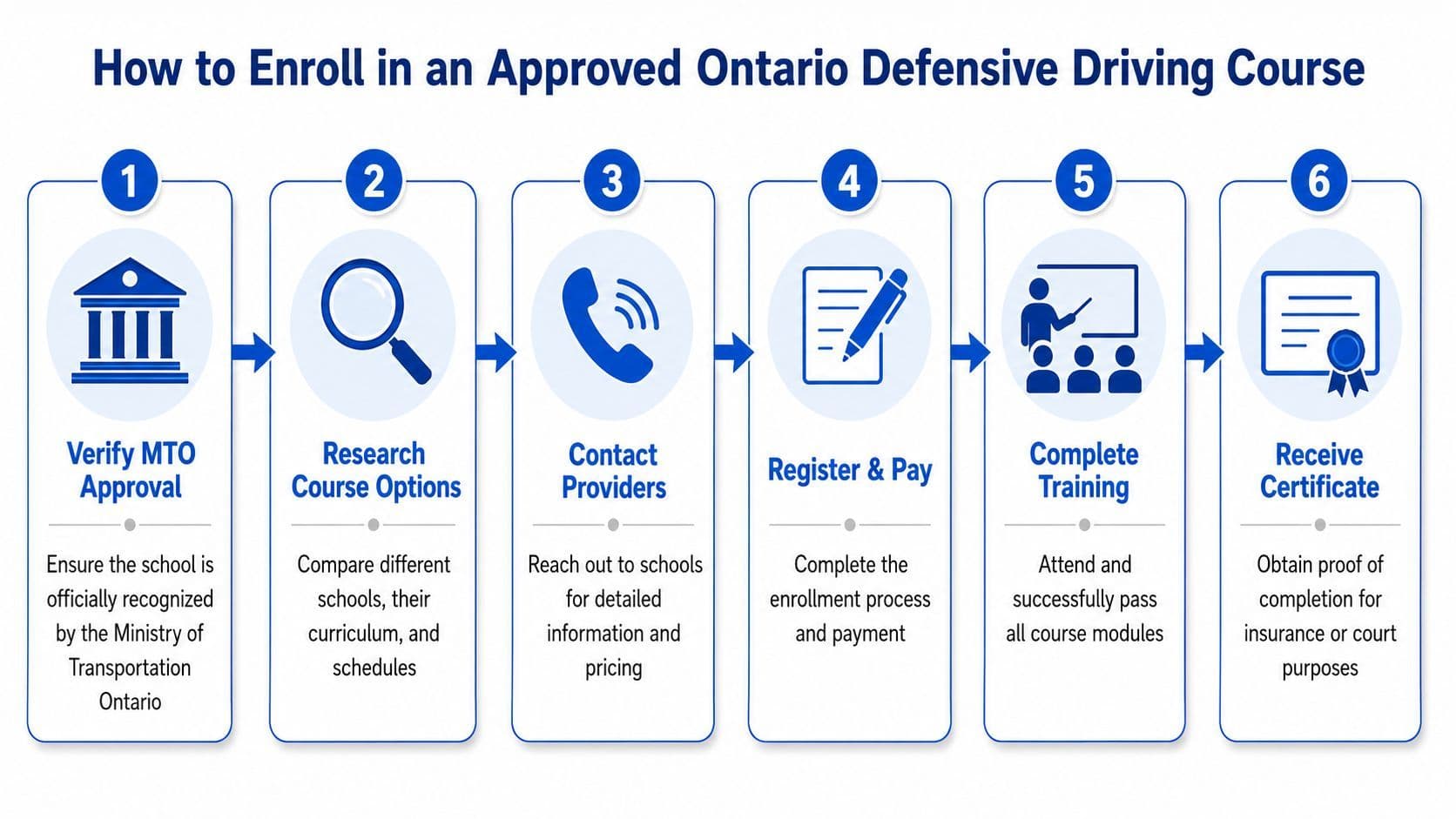
Before you register, verify these four points:
- School status: Confirm the provider is recognized for the training you need.
- Course type: Ask whether it is beginner education, defensive driving, refresher training, or a driver improvement course.
- Proof of completion: Find out exactly what certificate, receipt, or record you will receive.
- On-road training: Ask whether in-car lessons are included, optional, or sold separately.
How enrollment usually works
Once the school is confirmed, enrollment is usually simple. You provide contact details, licence information if the driver already has it, and your preferred schedule. Some schools let you complete everything online. Others still use phone booking for in-car lessons, vehicle assignments, or weekend availability.
Ask practical questions before paying, especially if your schedule is tight or the course is tied to a deadline.
- How are lessons booked and changed? This matters for families balancing work, school, and vehicle access.
- What happens if a student misses a class or arrives late? Rescheduling rules vary a lot.
- When is the certificate issued? Some schools send it digitally right away, while others have processing delays.
- What extra fees exist? Road test use, missed lesson fees, and weekend bookings are common add-ons.
- What support is available if a student struggles with a skill? For example, a nervous beginner may need extra coaching on manoeuvres such as parallel parking for the Ontario driving test.
Do not enroll until the school can clearly explain the certificate, the lesson format, the schedule, and every fee.
A good school makes this easy. A weak school stays vague.
The right ontario defensive driving course is the one that matches your reason for taking it, gives you valid documentation, and teaches in a way the driver will effectively absorb. That is how you save money, avoid administrative headaches, and get safer results on the road.
What You Will Learn Inside the Course
Good defensive driving training isn't a pile of road rules. It's a decision-making system. The strongest courses teach drivers how risk builds, where it starts, and how to interrupt it before a close call turns into a collision or charge.
Ontario defensive driving content is often built around a four-part hazard model covering law, the driver, the vehicle, and the environment, and many courses finish with a knowledge evaluation that may require a passing mark such as 80%, according to the IHSA Defensive Driving G Class Driver course overview.aspx).
The four parts that shape the course
Here's what that usually means in plain language:
- Law: Right of way, speed choices, lane rules, signs, and legal responsibilities.
- Driver: Attention, scanning, fatigue, emotions, distraction, and decision-making.
- Vehicle: Braking limits, tire grip, visibility, maintenance, and how the car responds.
- Environment: Weather, lighting, traffic flow, road surface, work zones, and pedestrians.
This structure works because crashes rarely come from only one thing. A driver may be slightly tired, driving a poorly maintained car, in wet weather, while hurrying through a familiar route. Defensive driving teaches you to read those layers together.
What the practical lessons focus on
Instructors usually spend a lot of time on habits that sound basic but decide real outcomes. Mirror checks. Space cushion. Smooth braking. Speed selection before the turn, not during it. Looking far enough ahead to avoid late panic decisions.
If you're preparing for core manoeuvres as part of your broader driving development, skills such as parallel parking practice in Ontario make more sense when paired with defensive principles like slow setup, observation, and escape space.
Testing and completion expectations
Many students worry about the final test more than they need to. If you pay attention, take notes, and don't rush through the material, the evaluation is usually manageable. The test is there to confirm understanding, not just attendance.
If a student struggles, the underlying issue is often not intelligence. It's pacing. People skim. They memorise a phrase without understanding the traffic situation behind it. The students who do best are usually the ones who treat the course as applied driving, not school trivia.
Frequently Asked Questions
Some concerns come up in almost every conversation about an ontario defensive driving course. These answers are the practical version.

Does a defensive driving course remove demerit points
Not in the simple way many drivers hope. A course can be useful as part of compliance, retraining, or licence-risk management, but you shouldn't assume it automatically wipes points off your record. Always verify the exact purpose of the course before registering.
Will an insurance company accept any certificate
No. Insurer recognition depends on the kind of program completed and how it fits Ontario's recognised beginner education framework. Ask your insurer or broker what documentation they want, then confirm the school issues exactly that.
Is online training enough
Sometimes yes, sometimes no. If you're disciplined and mainly need theory, online can work well. If you're nervous, rusty, or making repeated judgement errors, live instruction usually gives better correction.
What if I already know how to drive
That can help, but it can also get in the way. Experienced drivers often carry habits they don't notice, such as late braking, poor scanning, or casual phone use at red lights. A course is often most useful when it exposes the habits you've normalised.
Knowing how to move a car isn't the same as driving defensively.
How should I choose my course
Start with the outcome. Insurance-related beginner training, court or compliance issues, and general skill improvement are three different decisions. Once that's clear, compare school approval, format, instructor support, and the completion record you'll receive.
Start Your Driving Journey with Confidence
A good ontario defensive driving course does two jobs at once. It helps protect your practical interests, such as insurance recognition or licence-related requirements, and it builds habits that keep you safer when the road gets busy, slippery, or unpredictable.
For new drivers, the smartest move is to treat defensive driving as part of a longer learning path. Strong road habits start before the first serious lesson. They start when you understand signs, right of way, space management, and the logic behind Ontario traffic rules. That foundation makes every later lesson easier, whether you take beginner training, in-car instruction, or a refresher course after years away from regular driving.
If you're getting ready for the Ontario licensing process, start with G1ready.ca. It gives you a practical, structured way to study the rules of the road, practise with realistic questions, and build the knowledge base that makes future driver training more effective.


