
You're probably looking for one solid thing you can trust. A G1 practice test book. Something you can hold, highlight, and work through without guessing whether it matches the actual Ontario test.
That instinct makes sense. When learners walk into a bookstore or start scrolling online, they usually want structure more than anything else. They want to know what to study, what matters most, and how to avoid paying for a rewrite because they prepared the wrong way.
The stakes are real. Ontario's G1 knowledge test is a 40-question written exam with 20 road-sign questions and 20 rules-of-the-road questions, and you need 16 correct answers in each section to pass. The province also charges $158.25 for the G1 package and $15.75 for a rewrite if you fail, according to Ontario's new driver licensing page. That's why the idea of a dependable study book is so appealing.
The catch is that the perfect G1 practice test book usually isn't a single physical book anymore. In 2026, the most effective version of that “book” is often a structured system that combines official material, realistic practice, and quick feedback.
The Search for the Perfect G1 Practice Test Book
A lot of learners start in the same place. A parent wants to help their teen study. A newcomer to Ontario wants a guide that feels organised. Someone who hasn't taken a written test in years wants a resource that feels more dependable than random quiz sites.
So they search for a G1 practice test book and expect a simple answer.
What they're really looking for is control. They want a study tool that feels complete, not scattered. They don't want to piece together the handbook from one source, signs from another, and mock tests from somewhere else. They want one resource that tells them, “Study this, then this, then test yourself.”
Practical rule: If a study resource makes you feel more confused after using it, it's not organised well enough for test prep.
That's why physical books still appeal to people. A book feels finite. You can see your progress. You can dog-ear pages, circle mistakes, and revisit weak areas. For many learners, that lowers stress.
But there's a difference between a resource that feels comforting and one that prepares you efficiently.
Why the book idea still matters
The book itself isn't the problem. The structure behind it is valuable. Good learners usually do better when they have:
- A clear sequence that moves from rules to signs to full practice.
- A dependable source they can return to when they're unsure.
- A repeatable routine instead of last-minute cramming.
The problem starts when people assume any printed G1 prep book must be accurate, current, and complete. Some are decent. Some are thin collections of recycled questions. Some don't explain mistakes at all.
What most learners actually need
Individuals don't need more pages. They need a study system that helps them identify weak spots early, especially in the topics that commonly decide whether they pass or fail.
That's where the modern version of the practice book starts to pull ahead. It keeps the structure people want, but removes a lot of the guesswork.
Understanding the G1 Book Landscape
When people say “G1 practice test book,” they usually mean one of two different things. Mixing them up causes a lot of wasted study time.
The official handbook
The first category is the Official MTO Driver's Handbook. This is the core study source. The Ontario Ministry of Transportation says it's the book to use to study for a G1 licence and the standard source for knowledge-test preparation, as shown on the Official MTO Driver's Handbook page.
That matters because the handbook is the curriculum. It tells you the rules, signs, and driving principles Ontario expects you to know. If you skip it and study only practice questions, you're memorising answers without learning the logic behind them.
The handbook is strongest when you need to understand:
- Road rules such as right-of-way and speed-related rules
- Traffic signs and what each shape, colour, and symbol means
- Test language that tends to be direct but rule-based
Its weakness is format. The handbook teaches. It doesn't behave like a mock exam.
Third-party prep books
The second category is the third-party practice book. These are built to feel more like test prep. They usually include multiple-choice questions, answer keys, and topic-based review.
That can help, especially for learners who need repetition. But these books are still study aids, not the official source.
A third-party book is useful when it does three things well:
- It follows the handbook closely.
- It separates signs from rules in a realistic way.
- It explains why an answer is correct, not just which option to pick.
A practice book should train judgment, not just memory.
Why this distinction matters
A lot of frustration comes from expecting one book to do both jobs perfectly. The handbook gives authority but not enough test simulation. A prep book gives question practice but may not have the same authority or update cycle.
That's why learners often do best when they treat the “G1 book” as a category, not a single object. One resource teaches the rules. Another helps you apply them.
Ontario-based practice platforms also align their tests to the handbook and the 2026 DriveTest format, as noted on the handbook page above. That tells you where the market has moved. Learners still want the structure of a book, but more and more of that structure now lives in interactive study tools rather than on static pages.
Books vs Online Practice A Head-to-Head Comparison
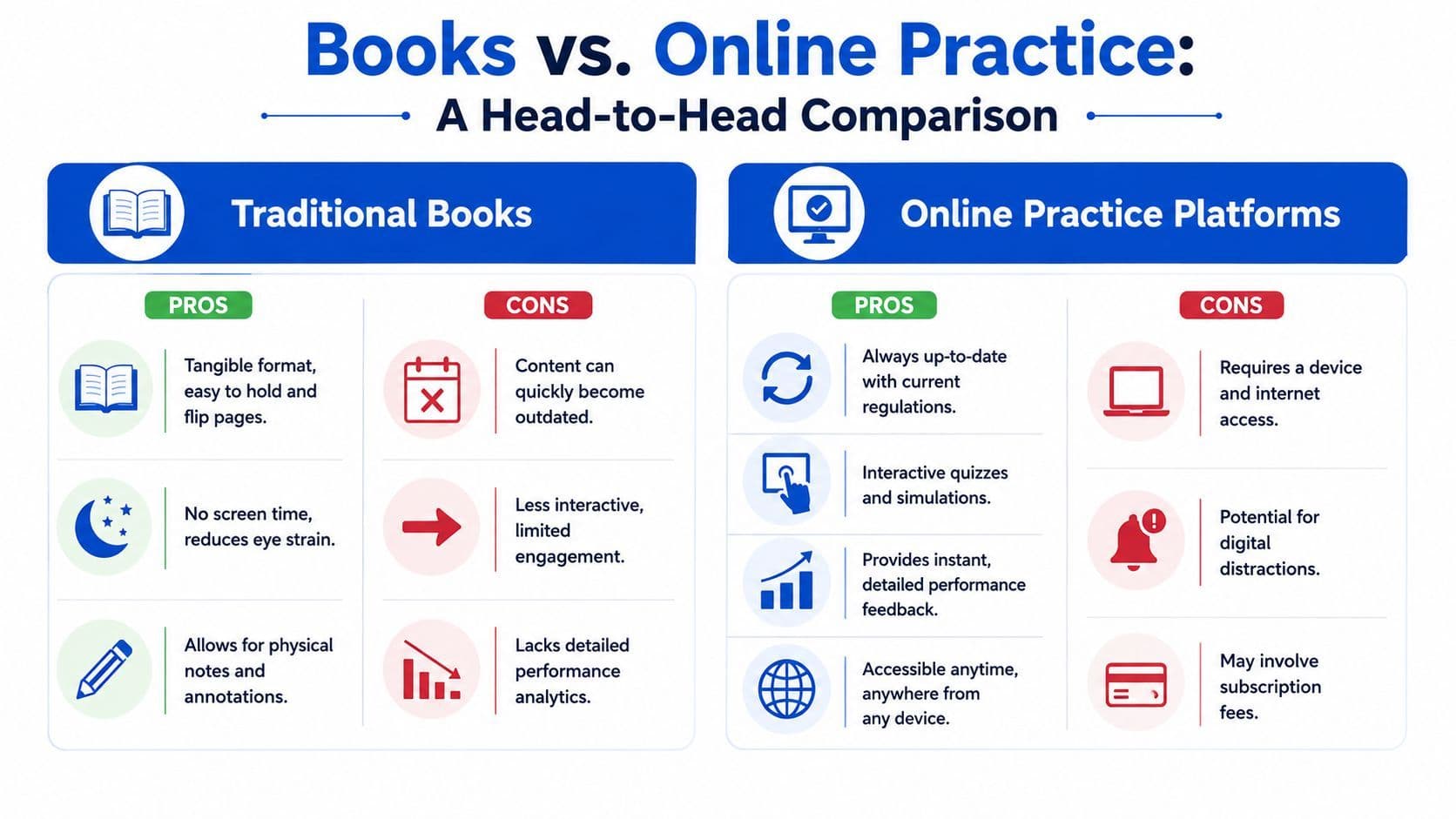
A traditional book still has a place. I've seen learners do well with a handbook, a notebook, and steady review. But a comparison of books and online practice shows the trade-offs are clear.
Where books still work well
Printed study material has a few practical advantages that shouldn't be dismissed.
- Physical focus: A book reduces screen fatigue and keeps notifications out of the way.
- Easy annotation: Many learners remember material better when they underline, highlight, or write in the margin.
- Predictable study sessions: A book encourages slower, more deliberate review.
For some people, that's enough. If you're disciplined and good at self-correcting, a book can still be useful.
Where books start to fall short
The biggest weakness is that a printed resource can go stale. That matters because many learners searching for a G1 practice test book aren't really looking for more questions. They need clarity on which Ontario rules changed recently, and a lot of practice material online gets recycled without explaining what changed or why it matters on test day, as described in this discussion of the gap in G1 study content.
That same issue can affect printed books even more. Once a book is printed, it stays that way.
Other limitations show up quickly:
Study factor Traditional book Online practice Content updates Slower to refresh Easier to keep current Answer feedback Often brief or missing Usually instant and more detailed Variety Limited to what's printed Broader question rotation Progress tracking Manual Built-in on many platforms Convenience Good offline Good across devices
What online tools do better
Online study tools usually win on efficiency. Not because they're digital, but because they remove friction.
If you miss a sign question in a book, you have to check the key, find the related page, and decide whether that mistake was a one-off or a pattern. Online tools can show you the mistake immediately and keep your weak topics grouped together.
Learners improve faster when they review mistakes while the question is still fresh.
That doesn't mean every website is good. Some just shuffle low-quality questions and call it practice. But a well-built online platform can function like an updated, interactive practice book with better feedback and less administrative work.
The honest verdict
If you like studying on paper, keep a book in the mix. But don't rely on a static resource alone if you want realistic repetition, clearer explanations, and a better way to spot weak areas before test day.
For most learners now, the strongest setup isn't book versus online. It's official handbook knowledge supported by dynamic practice.
How to Spot a High-Quality G1 Study Resource
Most study tools look useful at first glance. The cover says “updated,” the questions look familiar, and the format seems close enough. That's not a strong standard. A good G1 resource needs to do more than look legitimate.
Ontario's G1 knowledge test is a 40-question multiple-choice exam based on the MTO Driver's Handbook, and candidates must score at least 80%, which means 32 correct answers. Practice resources are most useful when they focus on high-yield topics like traffic signs, speed limits, right-of-way, and collision reporting, as stated in the Ontario handbook print source.
That gives you a practical filter.
What to check before you commit
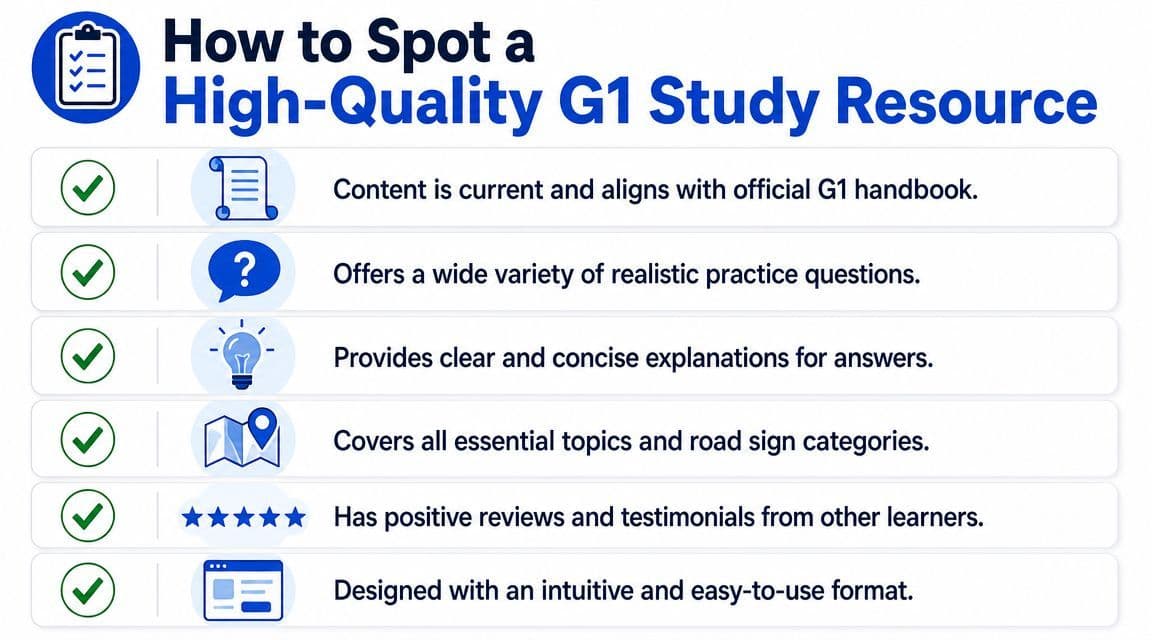
Use this checklist whether you're choosing a physical book, a printable guide, or an online question bank.
- Current alignment: The content should clearly follow the official handbook, not generic driving trivia.
- Balanced coverage: It should prepare you for both signs and road rules, not overfocus on one.
- Realistic wording: Questions should feel like test questions, not like riddles or casual blog quizzes.
- Useful explanations: If you get something wrong, the answer should explain the rule behind it.
- Topic depth: Signs, speed limits, right-of-way, and reporting rules should show up repeatedly.
- Clean format: If the layout is confusing, your attention goes to navigation instead of learning.
Warning signs of a weak resource
A poor study tool often reveals itself quickly.
- Random question order with no logic: That makes review harder than it needs to be.
- No rationale for answers: If it only gives the right option, you won't fix bad habits.
- Overly broad “driver safety” content: The G1 is rule-based. Generic safety talk won't carry you.
- Outdated phrasing: If the wording feels old or inconsistent, treat the material cautiously.
Quick check: Open any sample section and ask, “Does this resource teach me the rule, or only test my recall?”
The standard I use
If a learner brings me a study aid, I want to see whether it helps them make fewer repeat mistakes. That's the test. A polished cover doesn't matter. A giant claim on the front doesn't matter. If the resource can't help you correct misunderstanding in the core handbook topics, it's not doing the job.
Creating an Effective Study Plan with a Book
A book can still anchor a strong study routine if you use it systematically. The key is not to read passively. Reading page after page without retrieval practice feels productive, but it usually isn't.
The better method is to pair reading with immediate self-testing and written error review. That takes more effort, but it works.
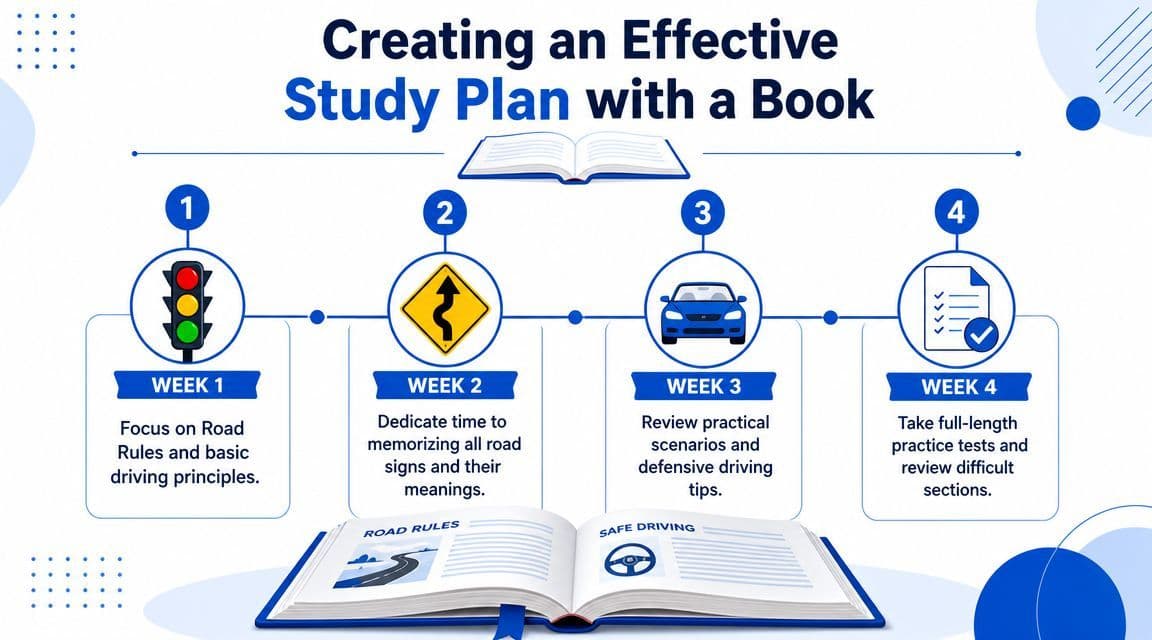
A simple four-week framework
You don't need an elaborate schedule. You need one that's repeatable.
Week 1
Read the road-rules sections carefully. Don't rush through them. Write down any rules that are easy to confuse, especially right-of-way situations and speed-related details.
Week 2
Shift your focus to signs. Study them in clusters rather than as isolated images. Warning signs, regulatory signs, and pavement-related signs are easier to remember when grouped by meaning.
Week 3
Mix the material. Go back and forth between rules and signs so your brain has to switch contexts. That's closer to how recall works under test conditions.
Week 4
Do full mock sessions. No peeking, no checking answers halfway through, and no stopping every few minutes. Review every wrong answer afterward and write out the rule in plain language.
How to make a book-based system more effective
A lot of learners read the handbook once and then jump straight into practice questions. That's too loose. A stronger process looks like this:
- Read a short section
- Test yourself on that exact topic
- Mark every miss in one notebook
- Review the pattern, not just the answer
- Retest the weak topic later
If you want a more detailed approach to pacing your prep, this guide on how to study for the G1 test gives a practical structure you can adapt to either paper or digital practice.
The hidden cost of book-only studying
The downside isn't that books are ineffective. It's that they make you do all the management yourself. You have to time sessions, track weak topics, check whether your errors repeat, and decide what to review next.
That's manageable for organised learners. For busy learners, it often means they spend too much time managing study and not enough time studying.
Printable Practice Tests The DIY G1 Test Book
Some learners don't want to stare at a screen, but they also don't want to depend on a static prep book. That's where printable practice tests make sense.
Think of it as building your own G1 practice test book. Instead of buying one fixed question set, you print focused quizzes, staple them by topic, and create a binder that matches how you learn.
This hybrid method works well for people who want to write by hand, study away from their phone, or review mistakes at a kitchen table with a parent or instructor.
Why the hybrid method is useful
A DIY printed set gives you a few advantages:
- Fresh material: You can print updated question sets instead of relying on one old batch.
- Flexible organisation: Keep separate sections for signs, rules, and mixed practice.
- Better review habits: Circle uncertain questions, then revisit them later without losing the paper trail.
A practical starting point is a 100-question G1 practice test that you can use as a printable base for mixed review.
How to build it properly
Don't print random pages from multiple places and hope it comes together. Keep it organised.
Use one section for road signs, one for rules, and one for full mixed tests. Add an answer log at the back with the question topic beside each mistake. After a few sessions, you'll know whether your problem is sign recognition, rule confusion, or rushing.
That's the part many learners miss. The paper itself isn't the advantage. The advantage is having a study record you can learn from.
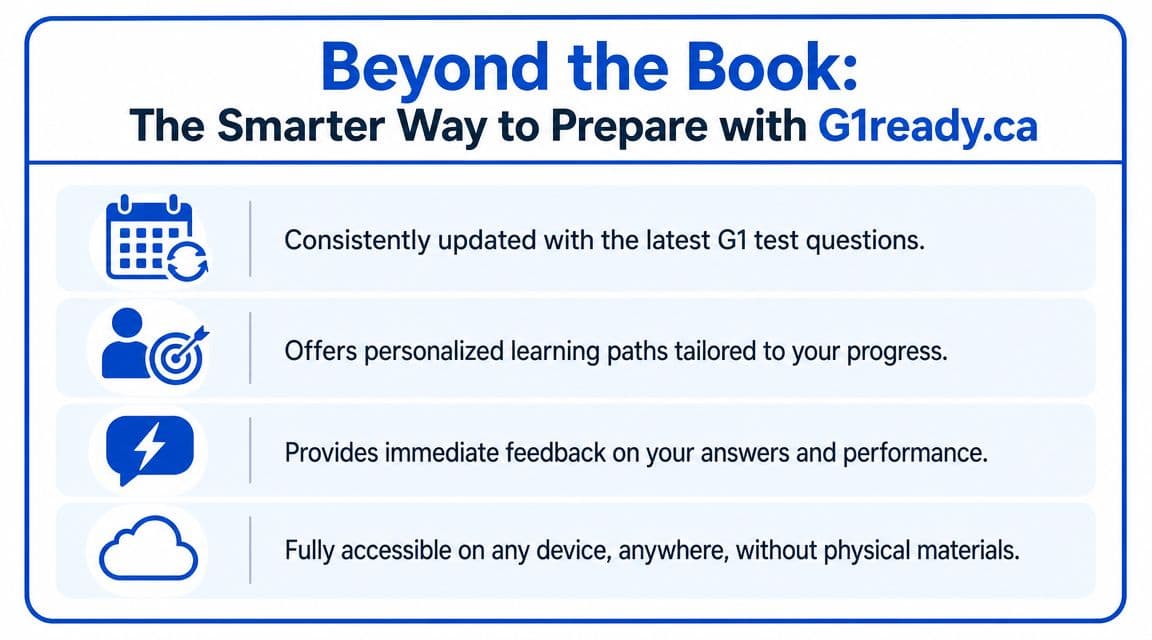
Beyond the Book The Smarter Way to Prepare with G1ready.ca
At some point, most learners hit the same wall with physical study materials. They've read enough. They've highlighted enough. What they need now is repetition with feedback.
That's where a digital practice platform starts to make more sense than a traditional G1 practice test book. Not because paper is outdated, but because the weak points of paper are predictable. It's harder to keep current, harder to personalise, and harder to track.
What changes with a modern study tool
A stronger online tool behaves like the evolved version of a workbook.
Instead of just showing a question and an answer key, it can:
- Give immediate explanations while the mistake is still fresh
- Track performance by topic so weak areas stand out
- Allow unlimited retakes without reusing the exact same study flow
- Work across devices so practice fits into short gaps during the day
That matters because most learners don't fail for lack of effort. They fail because their effort isn't targeted enough.
One practical example
G1ready.ca tests are built around that more modern approach. The platform offers handbook-aligned practice in formats like targeted quizzes, mixed tests, a diagnostic test, marathon practice, and a realistic exam simulator. It also includes immediate feedback, hints, explanations, and progress tracking, which addresses the parts a physical book usually can't handle on its own.
That doesn't mean you have to abandon books completely. A lot of learners still like reading rules on paper first. The smarter move is to use the book for foundation and a responsive tool for repetition, correction, and test simulation.
Use paper to learn the rule. Use practice to prove you know it.
The better way to think about the book idea
The phrase “G1 practice test book” still points to something useful. It points to the need for structure, trust, and a clear path. But in practice, the most effective version of that resource is no longer always a printed object.
It's a study system that stays close to the handbook, gives realistic questions, explains mistakes, and helps you keep working on the areas that still need attention. For many Ontario learners, that's a more efficient fit than relying on a static prep book alone.
If you want a structured way to prepare without piecing everything together manually, G1ready.ca offers a practical study option with handbook-aligned practice tests, targeted quizzes, and feedback that helps you correct mistakes as you go.


