
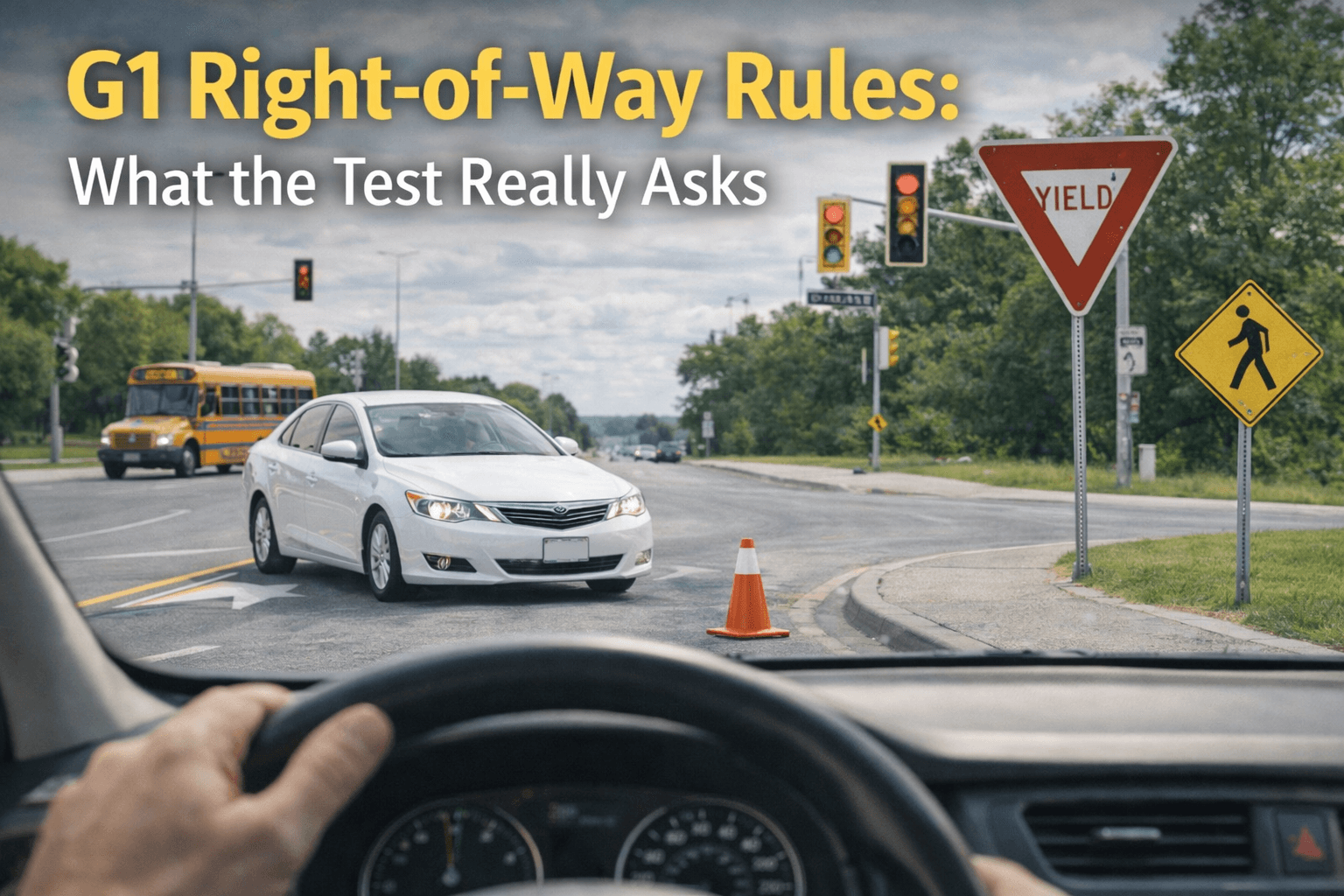
Right-of-way questions cause more confusion on the G1 test than almost any other topic. The rules themselves are not complicated when explained in isolation. But the test does not ask about rules in isolation. It presents scenarios where multiple vehicles, pedestrians, and traffic controls interact, and you need to determine who goes first.
These questions require you to think through situations rather than recall memorized facts. A question might describe four vehicles arriving at an intersection under specific conditions and ask which one has the right to proceed first. Getting the answer right means understanding how right-of-way principles apply to real situations.
This guide breaks down exactly how the G1 test asks about right-of-way and how to work through these questions systematically.
What Right-of-Way Actually Means
Right-of-way determines who gets to proceed first when multiple road users want to occupy the same space. It is not about who is more important or who got there first in every case. Specific rules govern different situations.
Having right-of-way means you have priority to proceed. Other road users should yield to you. But having right-of-way does not guarantee safety. The other driver might not yield, either through ignorance or inattention. Defensive driving means being prepared even when you technically have priority.
Yielding right-of-way means you must wait for others to proceed before you go. You stop or slow down and let the road user with priority complete their movement. Only after they clear the space do you proceed.
The G1 test expects you to know who has right-of-way in various situations. But it also expects you to understand that right-of-way is about safety, not about winning. A question might ask what you should do even when you have right-of-way, and the correct answer involves caution rather than insisting on your priority.
Four-Way Stop Intersections
Four-way stops generate more G1 test questions than any other right-of-way scenario. These intersections have stop signs on all four approaches, requiring every vehicle to stop before proceeding.
The basic rule is simple: the first vehicle to come to a complete stop goes first. If you arrive at a four-way stop and another vehicle is already stopped, that vehicle has right-of-way. Wait for them to proceed, then go when clear.
The test gets more complex when vehicles arrive simultaneously. When two vehicles stop at the same time, the vehicle on the right has right-of-way. If you are at a four-way stop and another vehicle to your right stops at the same moment you do, yield to them.
What about vehicles across from each other? When two vehicles facing each other stop simultaneously, the one going straight has priority over the one turning left. The left-turning vehicle must yield because their path crosses the other vehicle's lane.
The trickiest four-way stop questions involve three or four vehicles arriving together. Work through these systematically. Identify which vehicle is to the right of which. The vehicle with no one to their right who arrived simultaneously goes first. Then the next vehicle proceeds, and so on.
Test questions often present diagrams showing vehicle positions at four-way stops. Study the diagram carefully before answering. Identify where each vehicle wants to go and apply the rules in order: first to arrive goes first, ties go to the vehicle on the right, straight traffic beats left turns when facing each other.
Uncontrolled Intersections
Uncontrolled intersections have no signs or signals telling anyone to stop or yield. These exist in residential areas and rural roads where traffic volumes are low enough that permanent controls are unnecessary.
At uncontrolled intersections, yield to any vehicle already in the intersection. If you approach and another vehicle is crossing, wait for them to clear before you proceed.
When two vehicles approach an uncontrolled intersection at the same time from different directions, the vehicle on the right has right-of-way. This mirrors the four-way stop rule for simultaneous arrivals.
The test might describe an intersection without mentioning signs or signals. Pay attention to what the question does not say. If no stop sign, yield sign, or traffic light is mentioned, assume the intersection is uncontrolled and apply these rules.
Speed differences can affect uncontrolled intersection scenarios. A vehicle traveling faster will reach the intersection first even if they were farther away when both vehicles started. Think about who will actually arrive first based on the scenario described, not just who is closer at the moment the question describes.
T-Intersections
T-intersections occur where one road ends at another, forming a T shape. The road that ends is the stem of the T, and the road that continues through is the top of the T.
Vehicles on the through road generally have right-of-way over vehicles on the terminating road. If you are on the road that ends, you must yield to traffic on the cross street before turning.
When the through road has a yield or stop sign, normal sign rules apply. But when neither road has signs, the general principle favors the through road because traffic there is already moving with an established flow.
T-intersection questions on the G1 test often involve a vehicle wanting to turn from the terminating road onto the through road. The correct answer typically involves yielding to traffic already on the through road.
Yield Signs
Yield signs require you to slow down and give right-of-way to traffic on the road you are entering. You do not necessarily have to stop, but you must be prepared to stop if traffic is present.
When approaching a yield sign with no other traffic in sight, you can proceed without stopping as long as you have slowed enough to verify the way is clear. The key is being prepared to yield, not stopping for the sake of stopping.
When traffic is present on the road you are joining, you must wait for a safe gap before proceeding. You do not have right-of-way at a yield sign. Everyone else does.
Test questions might ask about the difference between yield signs and stop signs. At a stop sign, you must come to a complete stop regardless of traffic conditions. At a yield sign, stopping is only required when traffic requires it.
Pedestrian Right-of-Way
Pedestrians have significant right-of-way protections in Ontario. The G1 test asks multiple questions about when drivers must yield to people on foot.
At marked crosswalks, pedestrians have right-of-way. When someone is waiting to cross at a crosswalk, you must stop and let them cross. Do not wave them across or try to direct their movement. Simply stop and wait for them to complete their crossing.
Unmarked crosswalks exist at every intersection, even when no painted lines are present. The area where a sidewalk would extend across the road is legally a crosswalk whether marked or not. Pedestrians have right-of-way at these locations too.
When turning at an intersection with a green light, you must yield to pedestrians crossing the street you are turning onto. Your green light gives you permission to turn, but pedestrians in the crosswalk have priority over your turn.
School crossings with crossing guards require you to stop when the guard signals. The guard's authority overrides normal traffic flow.
Questions about pedestrian right-of-way test whether you understand that drivers must actively watch for and yield to people on foot. The correct answer almost always prioritizes pedestrian safety.
Emergency Vehicles
Emergency vehicles with activated lights and sirens have absolute right-of-way. This supersedes all other right-of-way rules.
When you see or hear an emergency vehicle approaching from any direction, pull to the right side of the road and stop. Remain stopped until the emergency vehicle passes and you can safely re-enter traffic.
If you are in an intersection when you become aware of an approaching emergency vehicle, clear the intersection first, then pull over. Do not stop in the middle of the intersection where you block the emergency vehicle's path.
On one-way streets where pulling right might not clear a path, pull to whichever side creates the clearest route for the emergency vehicle. The goal is getting out of their way, not following a rigid rule about which direction to move.
Test questions about emergency vehicles usually have a clear correct answer: yield immediately and completely. The test wants to confirm you understand that emergency response takes absolute priority.
Entering Roadways From Private Property
When exiting a driveway, parking lot, or other private property onto a public road, you have no right-of-way. Zero. You must yield to all traffic and pedestrians on the road you are entering.
This rule catches some test takers off guard. They assume normal right-of-way rules apply, like yielding to vehicles on the right. But when you are leaving private property, you yield to everyone regardless of their direction or position.
Pedestrians on the sidewalk you cross to exit a driveway have right-of-way over your vehicle. Vehicles approaching from either direction on the road have right-of-way. You wait until everyone clears before proceeding.
Questions about this scenario test whether you understand that public roadways have priority over vehicles emerging from private property. The answer involves yielding and waiting, not asserting any right to proceed.
Funeral Processions
Funeral processions have right-of-way once the lead vehicle enters an intersection. If the hearse or lead car enters on a green light, the following vehicles may continue through even after the light changes to red.
Do not cut into the middle of a funeral procession. Do not pull out in front of vehicles displaying funeral flags or following a hearse. Allow the entire procession to pass before proceeding.
This rule appears less frequently on the G1 test than other right-of-way scenarios, but knowing it prevents you from missing a question about an uncommon situation.
How the Test Presents These Questions
G1 test questions about right-of-way typically take one of several forms.
Diagram questions show an intersection with vehicles in various positions. The question asks which vehicle should proceed first or what a specific vehicle should do. Study the diagram, identify all relevant factors, and apply the rules systematically.
Scenario questions describe a situation in words. You might read about approaching a four-way stop where another vehicle arrived just before you. The question asks what you should do. Visualize the scenario, identify who has priority, and select the answer that reflects proper yielding.
Rule questions ask directly about right-of-way principles. Who has right-of-way at an uncontrolled intersection? What should you do when an emergency vehicle approaches? These test your knowledge of the rules themselves rather than application to complex scenarios.
"What if" questions add complications to standard scenarios. What if two vehicles arrive at a four-way stop simultaneously and both want to turn left? Work through the scenario step by step rather than trying to recall a memorized answer for every possible combination.
Working Through Tricky Questions
Some right-of-way questions seem designed to confuse you. A systematic approach helps you find correct answers.
First, identify the type of intersection or situation. Is it controlled by signs or signals? Uncontrolled? A driveway entrance?
Second, identify all road users involved. How many vehicles? Any pedestrians? Emergency vehicles?
Third, determine arrival order if relevant. Who stopped first? Who arrived simultaneously?
Fourth, apply the appropriate rule. First to arrive goes first. Ties go to the right. Through traffic beats entering traffic. Pedestrians have priority in crosswalks. Emergency vehicles override everything.
Fifth, verify your answer makes sense. Would following this answer result in safe, orderly traffic flow? If your answer would cause a collision, reconsider.
The Safety Principle Behind Right-of-Way
The test wants you to understand that right-of-way rules exist to prevent collisions, not to determine winners and losers on the road.
Having right-of-way does not mean charging ahead without looking. The correct answer to some questions involves proceeding cautiously even when you have priority. Defensive driving assumes other people might make mistakes.
Yielding right-of-way is not losing. It is cooperating with a system designed to keep everyone safe. Questions that present yielding as the correct answer are testing whether you prioritize safety over ego.
When two answers both seem reasonable, the one emphasizing caution and yielding is usually correct. The test rewards safety-conscious thinking.
Ready to practice right-of-way scenarios before your test? G1 Ready CA offers practice tests with realistic intersection questions that build your ability to work through these situations. For a comprehensive review of all traffic rules tested on the G1, check out the complete road rules guide to make sure you have every topic covered.


