In Ontario, the first fee many learners see is the G1 knowledge test fee of $100 CAD, but that's only the beginning of the full licensing path. To reach a full G licence, many learners also need to budget for the G2 road test at $65 CAD and the full G licence at $90 CAD, for a total of $255 CAD.
That's where families often get tripped up. A parent plans for the first visit, a teen studies for the written test, and everyone assumes the hard part is just passing. Then the next fee appears, then another, and the original budget no longer matches reality. I see this confusion all the time with first-time drivers and newcomers.
Government fee language can make this feel more complicated than it is. The good news is that once you break the process into stages, it becomes much easier to plan for. You don't need to memorise policy terms. You just need to know which payment belongs to which step, what can change for international licence holders, and how to avoid paying more than necessary.
Your First Step in Budgeting for a Driver Licence
Individuals search for a driver license test fee because they want one number. That makes sense. You're trying to answer a practical question: how much money do we need to bring, and what should we expect next?
The problem is that licensing doesn't work like a single-event purchase. It works more like a sequence. You start with the written test, move to the first road test, then finish with the final licensing stage. If you only budget for the first payment, the later steps can feel like surprise charges even when they're part of the normal path.
Start with the full journey, not just the first visit
A better way to plan is to ask a different question. Instead of “What is the test fee?” ask “What will it cost to go from beginner to fully licensed?” That shift keeps you from underestimating the expense.
Practical rule: Budget for the whole licensing path before booking the first test, not just for the first day at the test centre.
This matters even more if your family is scheduling lessons, setting aside money month by month, or trying to line up road test timing with school and work. When the budget is clear, the process feels calmer.
Keep your planning tied to milestones
I usually tell students to divide the process into three money checkpoints:
- Starting point: The written knowledge stage.
- Middle stage: The first road test that moves you forward.
- Final stage: The last step to full licensing.
If you're already thinking ahead to the final road test, this Ontario G road test booking guide helps you understand the later stage of the process in plain language.
Parents often feel relieved once they see the full map on paper. It turns a vague “licence cost” into something you can plan for.
The Full Cost of an Ontario Driver Licence Breakdown
The clearest way to understand the Ontario driver license test fee question is to stop treating it as one fee. Ontario's graduated system has multiple mandatory payments across the path to full licensing.
Why the first fee doesn't tell the whole story
The public conversation often centres on the G1 starting point, because that's the first payment learners make. But the full cost is higher than that first step alone. According to the verified Ontario fee information provided, the G1 knowledge test fee is $100 CAD, the G2 road test fee is $65 CAD, and the full G licence fee is $90 CAD, bringing the full path to $255 CAD. The same verified data states that 68% of first-time drivers underestimate that total and only 32% correctly identify the full licensing cost before starting their G1 studies.
That pattern is easy to understand. The first fee is visible. The later fees are less top-of-mind until the learner reaches those stages. Families aren't careless. They're often just seeing the process one step at a time.
When learners only budget for the first test, the later mandatory fees feel unexpected even though they're part of the normal licensing path.
Ontario graduated licensing fee breakdown
Here's the fee structure from the verified Ontario data in a simple table.
Fee Component Cost (CAD) What It Covers G1 knowledge test $100 The first step in the licensing process, focused on written knowledge G2 road test $65 The next mandatory road test stage Full G licence $90 The final licensing step to reach a full G Total $255 The combined cost of the full graduated licensing path
This table is the number most families need. Not because every payment happens on the same day, but because the total is what determines whether your plan is realistic.
A separate note for international licence holders
This is one of the biggest areas of confusion. Verified data states that 74% of newcomers to Ontario incorrectly assume they pay the same G1 test fee as Canadian residents, and that they may face added processing costs on top of the standard fee structure. The same verified information notes that this detail is omitted by 89% of online prep platforms.
For some international licence holders, the verified data says there may be an international processing fee of $150 CAD plus the standard $100 CAD G1 fee, for a total of $250 CAD, and some people with temporary permits may also face an additional $40 CAD temporary licence validation fee. If you're a newcomer, don't assume your payment structure will match a local teen applying for a first licence.
That's why I always recommend checking your own status before test day. Your fee path may be different from your classmate's, neighbour's, or cousin's.
Understanding Test Retake Fees
Failing a test feels discouraging. It also changes the money side of the process, because a retake means another payment before you can move on.
Why retakes matter financially
Ontario learners often focus on the posted fee for the next required test. What they miss is that every extra attempt can push the total cost higher than the original budget. That's why preparation isn't just academic. It's financial.
For the written test, a retake usually means going back through the booking and payment process again. For road tests, the impact feels heavier because the test itself is a larger event. You may need another booking, another instructor session, another use of a vehicle, or another day off work or school. Even when the government fee is the main concern, the practical cost around that fee can grow quickly.
How to think about a second attempt
I don't tell students this to scare them. I tell them because calm preparation saves money. A failed attempt doesn't mean someone is a bad driver or a poor student. It usually means they needed more practice in a few specific areas.
Use this approach if a retake becomes necessary:
- Pause and diagnose: Don't rush to rebook without understanding what went wrong.
- Fix one weakness at a time: Written-test errors often come from sign recognition or rule wording. Road-test errors usually come from habits, observation, or timing.
- Treat practice as fee protection: Every extra study session is cheaper than repeating the process unprepared.
A second attempt is easier to handle when you know exactly why the first one didn't work.
The lowest-cost path is usually the smoothest path. That's why passing the first time matters so much, especially for families juggling multiple expenses at once.
How to Pay Your Fees and What Documents to Bring
Knowing the driver license test fee is only half the job. The other half is showing up ready to complete the transaction and application without getting turned away.
A simple test day checklist
Bring your payment method, your identification, and your patience. Test centres can feel busy, and a missing document creates more stress than the test itself.
Use a checklist like this before you leave home:
- Payment ready: Bring a payment method accepted at the test centre. If you're unsure which methods are available on your test day, confirm before you travel.
- Original identification: Bring original documents, not copies. If a document proves identity or legal name, it needs to be the original document.
- Matching information: Make sure the name on your documents is consistent, especially if you use multiple surnames or have recently changed your name.
- Appointment details: Keep your booking information easy to access so you're not searching for it at the counter.
If you want a plain-language checklist of identification basics, this guide to G1 test documents is a useful starting point.
What newcomers should check before they go
Newcomers often face the most uncertainty at the payment desk. Verified data notes that 74% of newcomers wrongly assume the same G1 fee rules apply to everyone, and that added processing charges may apply to international licence holders.
That means your preparation should include more than studying signs and rules. It should include confirming whether your immigration or licence status changes the documents or fees required in your case. If you hold an out-of-country licence, don't rely on a friend's experience unless their status matches yours closely.
A smooth test day usually comes down to one simple habit. Check the paperwork before you check your knowledge.
How to Save Money and Avoid Extra Charges
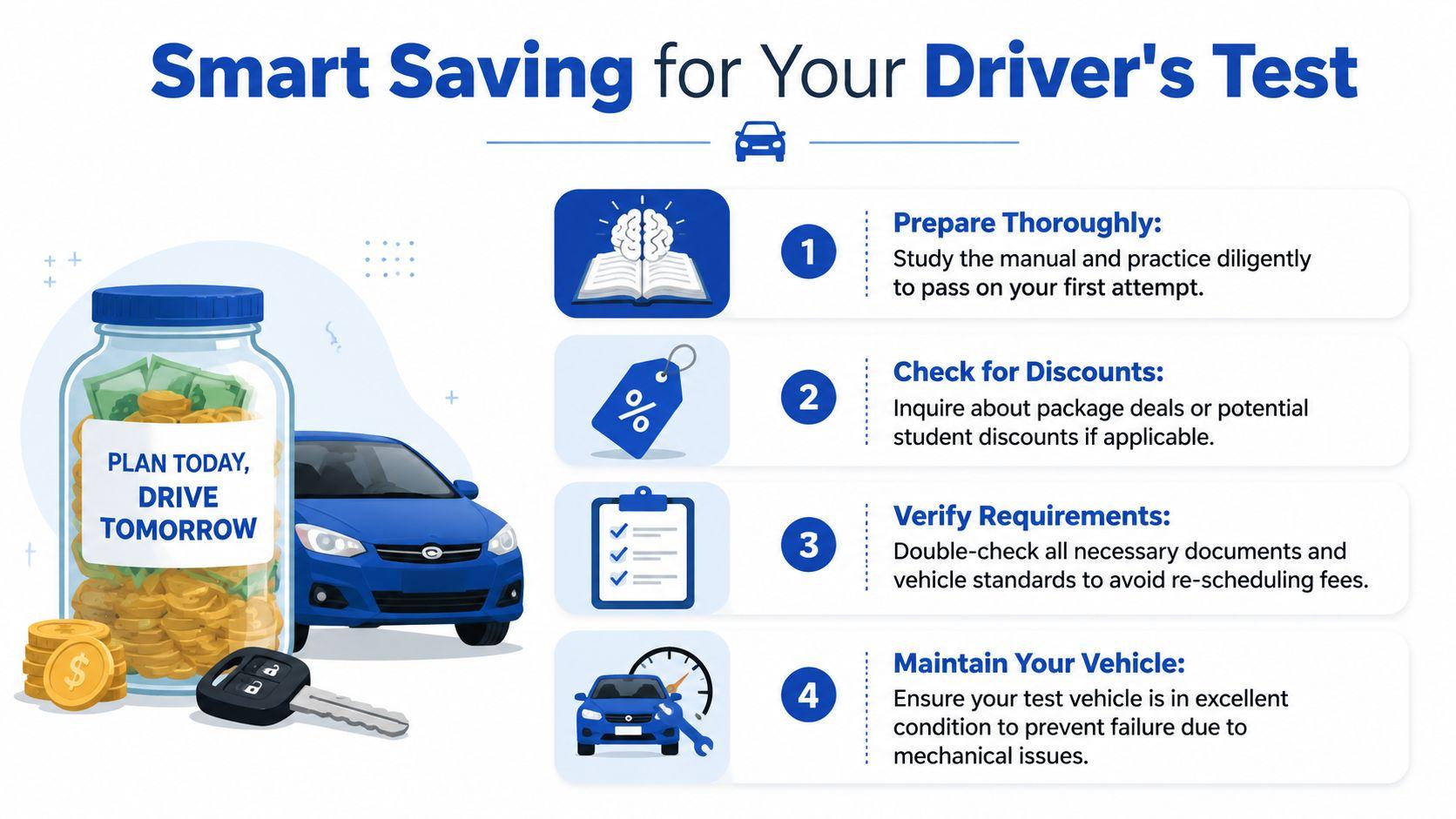
The most reliable way to keep licensing affordable is to avoid paying twice for the same step. Most extra cost comes from preventable mistakes, rushed bookings, weak preparation, or showing up without what you need.
The cheapest licence is usually the one you earn smoothly
Preparation may not feel like a money strategy, but it is. If you study thoroughly, practise consistently, and arrive organised, you lower the chance of retakes, rebookings, and wasted trips.
One practical option for written-test prep is G1ready.ca, which offers registration-free practice exams, targeted quizzes, a simulator-style test experience, and immediate explanations for answers. Used properly, a tool like that can help learners spot weak areas before they pay for the official test.
Four habits that prevent unnecessary spending
- Study the official rules carefully: Don't rely on memory from friends or social media summaries. Road rules are specific.
- Practise under test conditions: Timed practice helps with nerves and reduces careless mistakes.
- Check your documents the night before: A missed ID item can cost you a trip and force a rebooking.
- Use a test-ready vehicle: For road tests, make sure the vehicle is clean, legal, and in working order.
If you're approaching the road-test stage, this Ontario G2 driver's test guide can help you understand what to practise before spending money on an attempt you're not ready for.
Good preparation doesn't remove all nerves. It does remove a lot of avoidable cost.
How Ontario Fees Compare to Other Places
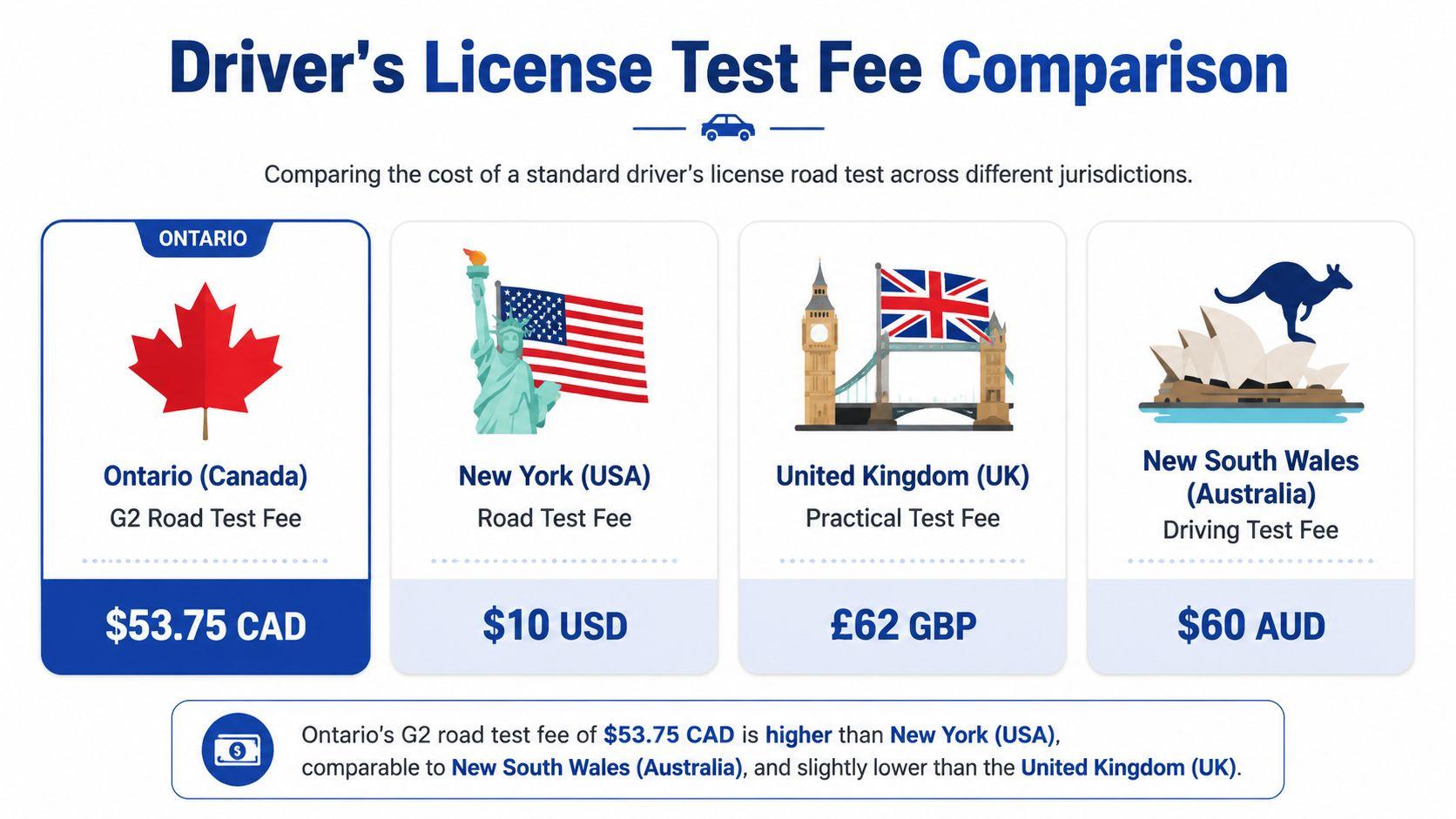
Ontario isn't the only place where learners try to make sense of a driver license test fee. Different jurisdictions structure these charges in very different ways, and that comparison helps explain why fee questions can seem so confusing.
Ontario and California use different fee logic
California provides a useful contrast because it clearly separates core licence fees from test-related fees. The official California DMV fee schedule lists the behind-the-wheel retest fee at $9, the standard Class C driver licence original or renewal fee at $46, and a separate $37 fee for replacing a licence or changing driver licence or ID information, as shown on the California DMV licensing fees page.
That structure tells you something important. In California, the licensing system itemises the base transaction and the re-exam fee more distinctly. Ontario, by comparison, is often understood by learners as a staged path where attention tends to stay on the first payment instead of the full sequence.
A broader comparison source also notes that California's $46 licence fee is lower than some other U.S. jurisdictions and that state licence costs range from $10 in Missouri to $89 in Washington, with California's $9 behind-the-wheel retest fee equal to about 19.6% of its standard Class C fee, according to the 2026 state-by-state driver's licence cost comparison.
Why this comparison helps
The point isn't that one system is better. The point is that fee design changes by jurisdiction. Some places make the split between testing and licensing very obvious. Others leave learners to piece the stages together themselves.
That's why Ontario families benefit from looking at the entire path up front. Once you understand that a licence is a chain of costs rather than one single fee, the process becomes much easier to budget for and much less frustrating.
If you're getting ready for the written stage and want a straightforward way to practise before paying for your test, G1ready.ca offers Ontario-focused G1 practice exams, targeted quizzes, and exam-style prep that can help you study with a clearer plan.