
Your test is booked, or maybe you're still hovering over the booking page, wondering if you're ready. That feeling is normal. Failing the G2 drivers test is rarely due to a lack of basic steering ability. Instead, individuals struggle because the test demands steady habits under pressure, and nerves expose every shortcut.
The good news is that the G2 test is learnable. If you understand what the examiner is checking, why certain habits matter, and how one mistake can spill into several parts of the scoresheet, the whole process feels much more manageable. Think of it less as a bag of random manoeuvres and more as a consistency test.
G2 Eligibility and Licence Rules
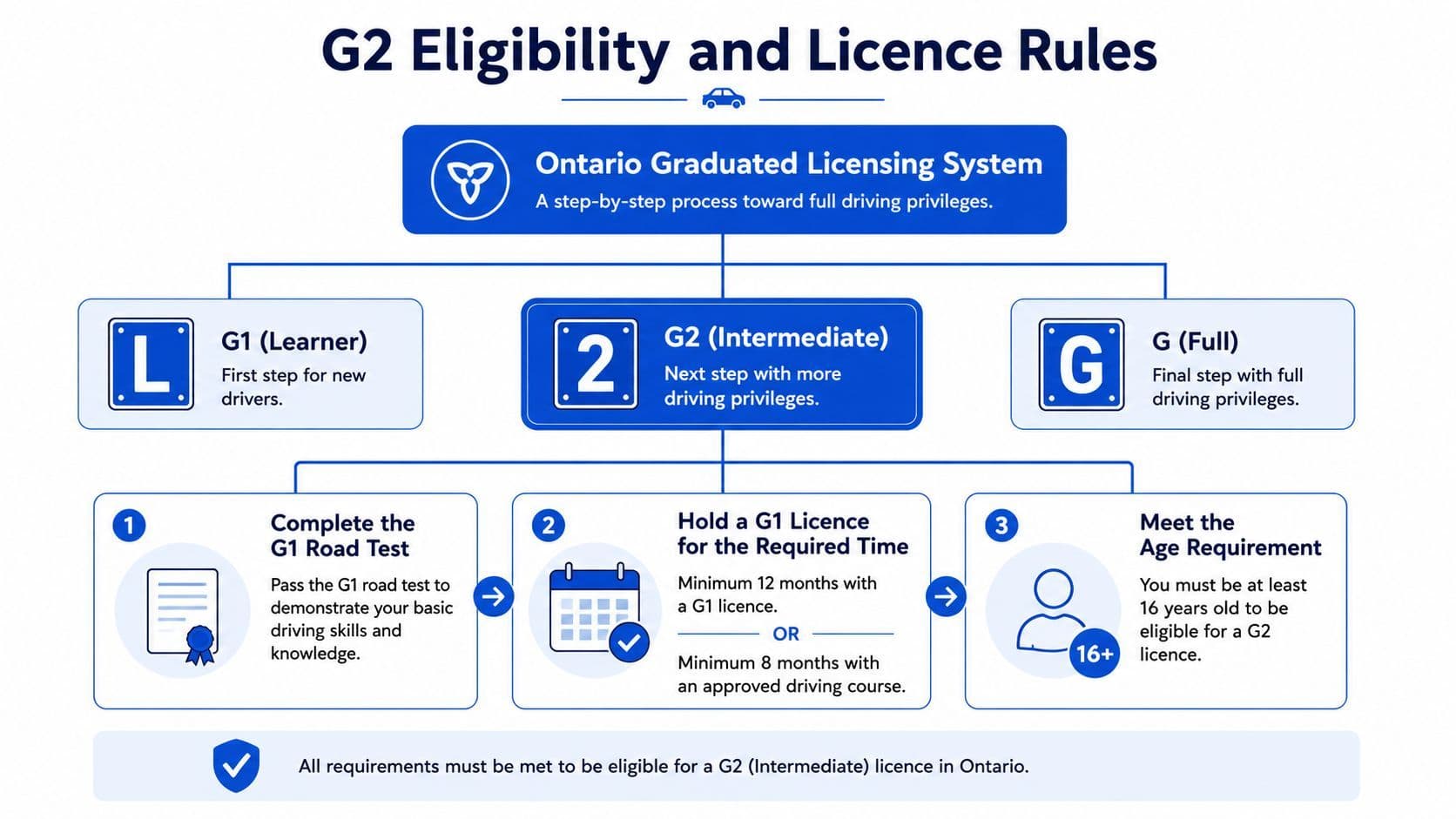
A G2 licence sits in the middle of Ontario's graduated licensing system. You start with G1, move to G2, and then work toward a full Class G licence. Ontario's official handbook explains that this staged system exists because new drivers are more likely than experienced drivers to be involved in serious or fatal collisions, which is why the province doesn't move people straight from beginner status to full privileges in one jump. You can review that in the Ontario government's Level Two road test handbook page.
Where the G2 fits
With a G1, you're still driving under learner rules. A G2 gives you more independence, but it doesn't mean the province considers your training complete. It means you've shown enough control, observation, and judgment to drive with fewer restrictions while you keep building experience.
That's the right way to look at the G2 drivers test. It isn't just a hoop to jump through. It's the checkpoint between supervised beginner driving and the final full-licence stage.
If you want a simple summary of the booking prerequisites and stage progression, this guide to Ontario G2 test requirements is a useful companion.
The highway declaration matters
Many learners get confused here. The Ontario handbook notes that the Level Two road test includes an expressway-driving component. To take that portion, you must complete and sign a Declaration of Highway Driving Experience confirming that, in the three months before the test, you've driven on a freeway or a highway with a speed limit of at least 80 km/h at least several times, and you must state the average trip length. The handbook gives examples such as under 5 km, 5 to 15 km, or over 15 km on the declaration form.
That requirement exists for a reason. Highway driving demands different habits than neighbourhood driving. You need to judge closing speeds, merge smoothly, keep lane position steady, and make decisions earlier.
Practical rule: Don't treat the highway declaration as paperwork only. If you haven't had real higher-speed practice recently, your test day stress will rise fast.
A quick eligibility check
Before you even think about a date, make sure the basics are in place.
- Age requirement: You must meet Ontario's minimum age requirement for the licensing system.
- Stage requirement: You must already hold the licence stage that allows you to attempt the G2 road test.
- Waiting period: You need to complete the required holding period before moving forward.
- Vision and legal status: Your licence must be valid, and any required vision or identification checks must be satisfied through the normal licensing process.
- Highway experience declaration: You need to be ready to sign it to reflect real recent driving.
A lot of test anxiety comes from uncertainty. Eligibility is the first thing to settle because it turns a vague plan into a clean checklist.
Booking Your G2 Test and What to Bring
Booking feels simple until one missing document or vehicle issue ruins the day. I've seen learners practise well, drive well, and still lose the appointment because they showed up with a problem that had nothing to do with skill.
Book the test without surprises
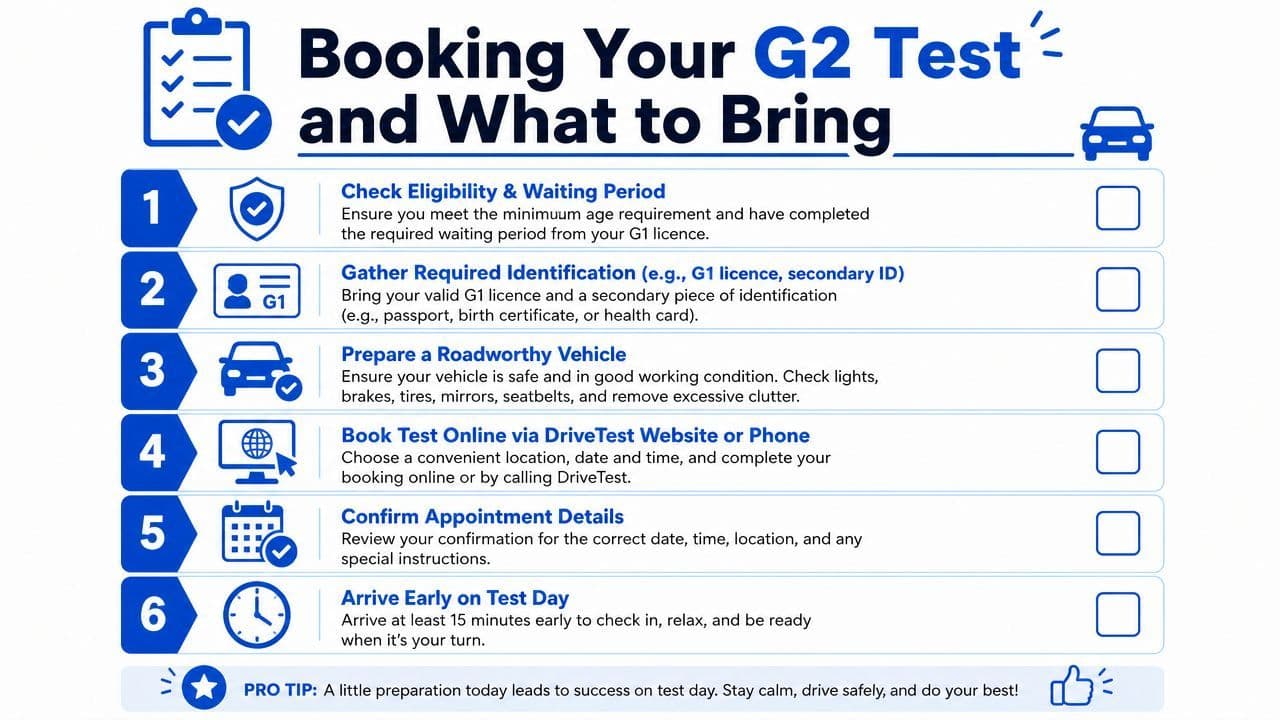
Start with the official DriveTest booking system. Choose your location carefully, confirm the appointment details twice, and save the confirmation in more than one place. A screenshot on your phone is helpful, but don't rely on that alone if your battery is unreliable.
When you book, keep one question in mind. Can you practise in that exact area enough to feel ordinary there? A test centre isn't just a pin on a map. It comes with its own lane markings, traffic flow, turning patterns, and parking lot layout.
What to bring on test day
Bring more than you think you'll need. That removes the chance of a preventable problem.
- Your valid licence: This is the first thing staff will need to see.
- Any booking confirmation details: Printed or saved clearly on your phone.
- Vehicle documents: Bring what's required for the car being used, including the documents that show the vehicle is properly registered and insured.
- Glasses or contact lenses if you need them: If you drive with corrective lenses, test day is not the day to forget them.
Arrive early enough that you can settle your breathing, park properly, and do a final vehicle check without rushing.
Make sure the vehicle is test ready
Examiners are evaluating your driving, but the vehicle must also be safe and lawful for the road test. Do your inspection the day before, then repeat a quick version on the morning of the test.
A useful pre-test check includes:
Item What to confirm Lights Headlights, brake lights, turn signals work properly Windshield Clean, no view-blocking damage Tires Look properly inflated and roadworthy Horn Works when pressed Brakes Feel normal, no warning signs Mirrors Clean and adjusted Seatbelts Working and accessible Dashboard No obvious problem that suggests the car isn't roadworthy Fuel Enough for the trip and possible delays
Small mechanical distractions create big mental distractions. If the steering feels odd or a light is burnt out, you won't drive your best even if the test still proceeds.
A Detailed Breakdown of the G2 Road Test
Calmness often follows understanding the flow. The G2 drivers test is easier to handle when you stop treating it like a mystery and start seeing it as a sequence of familiar tasks.
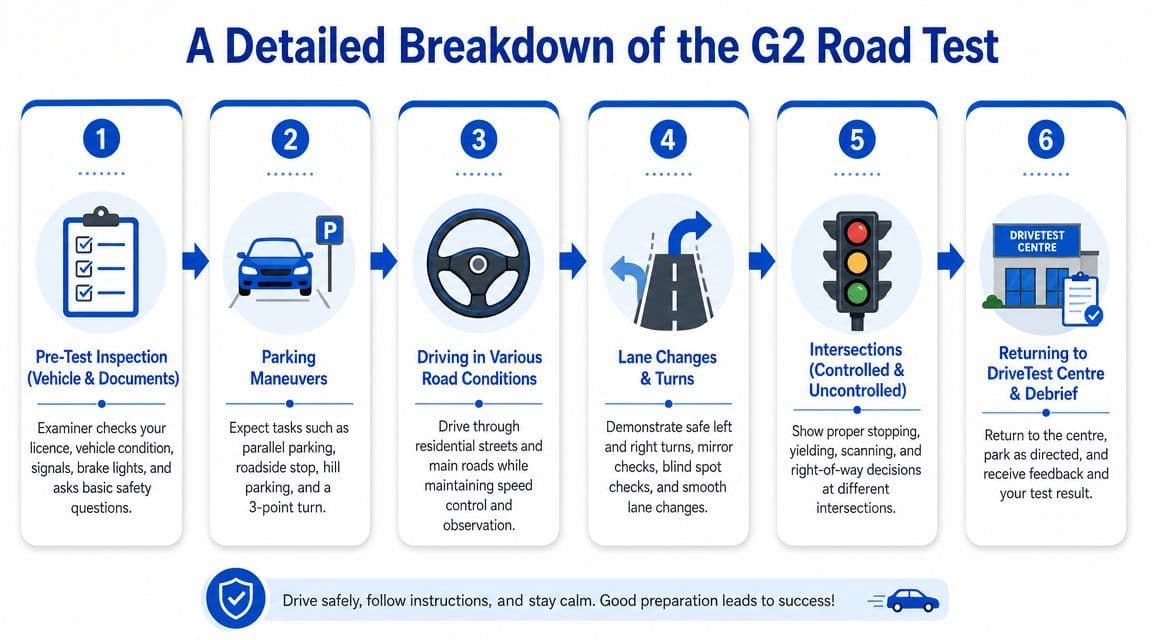
A common Ontario scoresheet framework breaks the exam into seven graded sections: Start, Backing, Driving Along, Intersections/Railroad Crossing, Turns, Parking, and Stop/Park/Start on a Grade. Ontario sources also note that the test is typically about 20 to 30 minutes on city streets, and that one weak habit can affect several sections of the test at once. You can see that summary in this Ontario G2 licence test guide and scoresheet overview.
To get your bearings first, look at the flow below.
How the test is structured
The seven sections tell you something important. The examiner isn't checking one isolated trick at a time. They're watching whether your observation, control, lane position, and legal compliance stay reliable from the first movement to the final park.
That means your habits matter more than your memory. You don't pass because you remembered parallel parking but forgot to check around the car properly before moving. You pass because your routines stay intact under normal road pressure.
A simple way to think about the route is this:
- Start the vehicle and move off safely
- Drive on ordinary roads with proper speed and positioning
- Handle intersections and right-of-way decisions
- Complete required manoeuvres such as parking or a turnabout
- Return and finish under control
What happens during the drive
Early in the test, the examiner may confirm basic vehicle functions and make sure you can begin safely. That first minute matters because it sets the tone. Mirror setup, seat position, seatbelt use, and a calm scan before moving all signal that you're organised.
You'll usually spend most of the test in normal traffic. That means left turns, right turns, stops, starts, lane changes when required, and steady speed control. The examiner isn't looking for drama. They want boringly safe decisions.
Later in the route, you may be asked for parking-related tasks or a grade-related stop and start. These aren't separate from the rest of the drive. The same habits carry through: check, signal if needed, control speed, and keep the vehicle positioned properly.
For a visual walk-through, this video gives a useful sense of pacing and what a learner may encounter during a typical test route.
If you're also trying to understand what changes later in the licensing path, this overview of Ontario G2 highway restrictions helps place the road test in the bigger picture.
Why consistency matters more than one perfect move
This is the part many learners miss. A single weak habit can spread across the scoresheet. If your blind-spot checks are incomplete, that can affect lane changes, turns, and parking. If you roll a stop, that can hurt you anywhere the route includes stop-controlled areas or a railroad crossing.
One poor routine doesn't stay in one box. It follows you through the route.
That's why cramming manoeuvres alone doesn't work well. The stronger strategy is to practise a repeatable sequence for every movement: mirror, signal, blind spot, speed control, smooth steering, and legal completion of the action. Once that sequence becomes automatic, the test feels far less chaotic.
Understanding the G2 Scoring and Common Failures
People often ask whether the examiner is looking for one big mistake or lots of little ones. In practice, both matter. A dangerous action can sink a test quickly, but many learners run into trouble because they collect deductions across several categories without realising it.
What the examiner is really measuring
The scoresheet categories tell you that the test is about behaviour patterns, not isolated tricks. The examiner wants to know whether you can observe properly, follow the law, control the vehicle, and stay predictable to other road users.
That's why two learners can both complete a parallel park, but only one leaves the examiner comfortable. One driver scanned properly, approached at the right speed, and kept the vehicle under control throughout. The other got into the space but looked rushed, missed checks, or corrected too late.
Common trouble areas include:
- Rolling stops: The car never fully settles before moving again.
- Missed blind-spot checks: Especially before lane changes, pulling away, or moving toward the curb.
- Poor speed choice: Driving too fast for the setting, or so slowly that it creates uncertainty.
- Late decisions: Turning, braking, or changing lanes at the last second.
- Weak lane position: Drifting too wide, too tight, or failing to centre the vehicle well.
How mistakes pile up
A learner may think, “I only forgot one shoulder check.” The examiner may see something broader: incomplete observation before changing position on the road. That same habit can appear again on a turn, on a merge, and while parking.
Here's how that cascade works in real life:
Habit problem Where it shows up Incomplete observation Starting, lane changes, turns, parking Rolling instead of fully stopping Stop signs, controlled intersections, crossings Steering too late Turns, parking, recovery after lane changes Poor speed control School areas, business streets, approach to turns Rushing under pressure Nearly every section of the route
Instructor's note: If one habit appears three times in practice, assume it will appear under stress on test day too.
That's why “almost good enough” is risky. The G2 test rewards steady routines more than last-second saves.
Why location changes the experience
Test difficulty isn't perfectly uniform across Ontario. A publicly compiled table of DriveTest centre results reports a G2 failure rate as low as 7% in Kenora, which equals a 93% pass rate, while Brampton is listed at 53% failure. The same source shows several northern and eastern Ontario centres below 30% failure, including Sault Ste. Marie, Espanola, Sudbury, Dryden, Winchester, Thunder Bay, Kapuskasing, Bancroft, Belleville, and North Bay. It also lists Bancroft at 79% pass and 21% failure. You can review those figures in this table of Ontario DriveTest pass and failure rates by centre.
Those numbers don't mean one examiner is “easy” and another is “mean.” They suggest that local traffic conditions, road design, and route characteristics shape the experience. A busy urban centre gives you more chances to deal with tight timing, heavy traffic, and complex intersections. A quieter centre may reduce that load.
Your job isn't to hunt for magic. It's to understand the environment where you'll test and practise for that environment properly.
How to Practice for Your G2 Test
You stop cleanly at a sign, then forget the shoulder check before turning right. A minute later, you drift a little wide on a lane change because your mirror routine was rushed. On the G2 test, that can feel like several random mistakes. In practice, it usually comes from one weak habit showing up in different places.
That is the right way to prepare. Build habits, not isolated tricks. The examiner is not just watching whether you can park or turn once. They are checking whether your observation, speed control, and decision-making stay steady from start to finish.
Build practice around repeatable habits
Short, focused sessions work better than long drives with no clear goal. A 30 to 45 minute drive with one priority is easier to learn from because you can spot patterns while they are still fresh.
A simple weekly routine might look like this:
- One city-street session: Practise full stops, speed selection, lane position, and left and right turns.
- One manoeuvre session: Work on parallel parking, backing in, three-point turns, and hill parking in a quiet area.
- One mock-test session: Drive a full route with simple examiner-style directions and minimal conversation.
This structure matters because the G2 test links skills together. If your stop is rushed, your scan is usually rushed too. If your scan is rushed, your turn often becomes less controlled. One habit can trigger deductions in more than one part of the test.
For parking practice, use the same setup each time so you can compare one attempt to the next. Cones, driveway lines, or a parked car on a quiet street can give you reliable reference points. If parallel parking still feels inconsistent, follow this step-by-step guide to parallel parking for the driving test and repeat the same sequence until it becomes automatic.
Use your supervising driver like a coach
A helpful supervising driver does more than fill the passenger seat. They should watch for repeated behaviours and name them clearly.
For example, if you miss a blind spot check before a lane change, then again before pulling away from the curb, treat that as one issue with observation routine. Fixing that one issue can clean up several parts of your drive at once.
Ask them to watch only a few categories at a time:
- Observation: mirror use, shoulder checks, scanning at intersections
- Rule application: full stops, right-of-way choices, signal timing
- Vehicle control: braking pressure, steering, speed consistency
That kind of feedback is easier to act on than “just relax” or “drive with more confidence.” Confidence usually shows up after enough correct repetitions.
Practise decisions, not just movements
Many learners can perform a manoeuvre in an empty lot, then struggle on a real road because the hard part is not the steering. It is choosing the right moment, checking the right areas, and keeping the car positioned properly while traffic changes around you.
A useful exercise is to say your decisions out loud during practice. Name what you see, what you expect, and what you plan to do next. “Parked car ahead, mirror check, shoulder check, signal left, move out with space.” That spoken routine connects your eyes, brain, and hands. It also makes hidden gaps obvious.
Refresh the rules before the road test
Road-rule knowledge still affects a practical test. Hesitation at a four-way stop, uncertainty about lane choice, or a late response to a sign often points to a rule that was never fully settled.
G1ready.ca offers Ontario practice exams and topic-based quizzes, which can help you review signs, right-of-way, and common rule errors before your test. Keep that review short and targeted. The goal is to sharpen your decisions on the road, not to cram like it is a written exam.
Practise until the routine feels boring. That is usually a good sign. Boring in practice often means dependable on test day.
Your G2 Test Day Checklist and Retest Process
Test day goes better when you remove decisions. The more you can settle the night before, the less mental clutter you carry into the car.
The day before and the morning of
Keep the day before simple. Don't cram a long stressful lesson late at night. Do a short drive if it helps you settle, then stop while you still feel sharp.
Use this checklist:
- The night before: Check your documents, confirm the location, and make sure the vehicle is clean enough for clear visibility.
- Sleep and routine: Get proper rest and eat something normal. An empty stomach makes nerves feel worse.
- Morning check: Confirm lights, signals, mirrors, windshield condition, and fuel.
- Arrival: Get there early enough to park, breathe, and avoid rushing.
- Before moving: Set your seat, mirrors, and wheel position exactly the way you practised.
When the examiner speaks, listen for the full instruction. If you don't hear it clearly, ask politely for it to be repeated. That's better than guessing.
If you make a small mistake, keep driving properly. Many learners turn one error into several because they mentally quit before the route is over.
If you pass
You'll be told the result and given the next steps for your temporary licence documentation. Take a moment to enjoy it. Passing means you demonstrated safe, workable driving habits under evaluation.
Then keep practising. A new G2 licence gives freedom, but it also gives you more responsibility with less supervision.
If you don't pass
Failing feels personal, but treat it like feedback. Read the scoresheet carefully and look for patterns, not just isolated marks. If the same type of deduction appears in several places, that's the first issue to fix before a retest.
Your next steps are straightforward:
- Review the examiner feedback calmly
- Identify the one or two habits that repeated
- Practise those habits in context, not in isolation only
- Rebook when your driving is more stable, not just when your schedule is free
A retest isn't starting over. It's another attempt with better information.
Next Steps After Passing Your G2
Passing your G2 is a real milestone. You've moved out of the beginner stage and into the part of licensing where independent driving starts to become everyday life.
Use the G2 stage well
The best drivers use this period to widen their experience. Drive in rain. Drive at night with an experienced mindset. Drive on unfamiliar roads. Practise calm parking in busy lots and patient lane changes in heavier traffic.
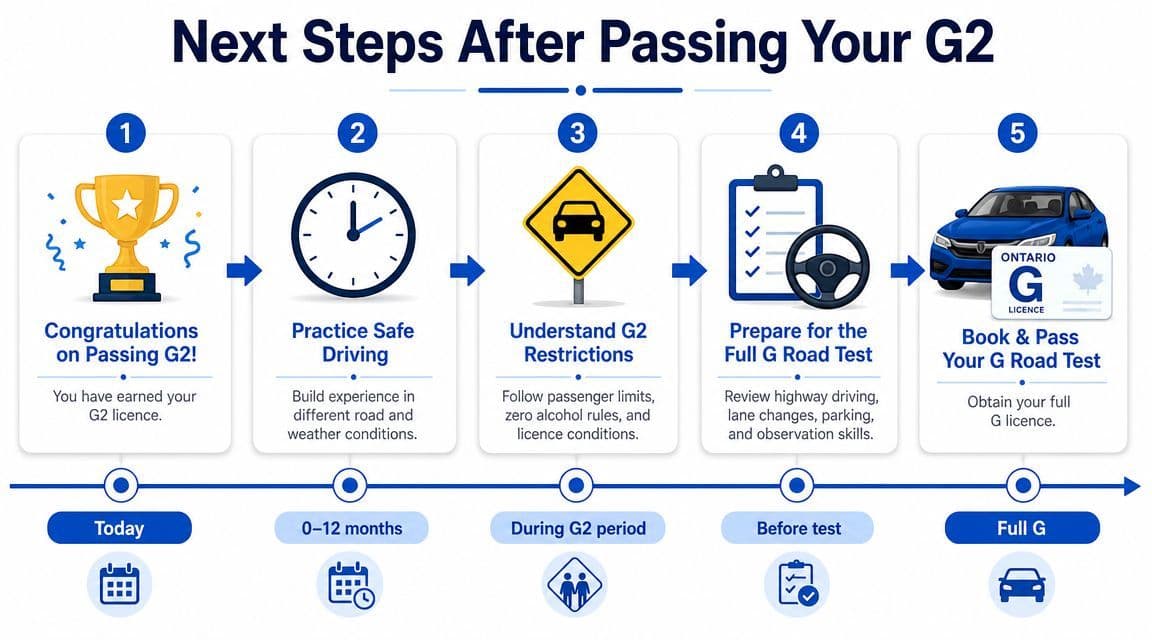
Don't confuse passing with finishing. The habits that got you through the G2 drivers test need to keep strengthening, not fading.
Start preparing for the full G early
The full G stage asks for a broader level of confidence and road experience. That means the smartest move is to build those habits now instead of waiting until your next booking.
Keep your driving varied and deliberate:
- Practise higher-speed roads regularly
- Stay strict about observation habits
- Keep stops complete and legal
- Avoid lazy shortcuts that creep in once the test is over
If you treat your G2 period as advanced practice instead of a victory lap, the final road test becomes much less intimidating.
If you want extra help with the rule side of driving while you prepare for road-test decisions, G1ready.ca offers Ontario practice tests and topic-based review that can help reinforce signs, right-of-way, and core handbook knowledge before you get behind the wheel.


