
You're probably here because the simple part was deciding you want your G1, and the messy part was everything after that.
You search for g1 knowledge test toronto, and suddenly you're juggling half-answers. One page tells you to study signs. Another talks about fees. A different one mentions DriveTest locations but not what happens when you arrive. If you're a teen in North York, a parent helping your child, or a newcomer trying to understand Ontario's system, that confusion feels familiar.
I've seen it many times. A learner shows up at a Toronto centre with the wrong ID, or without glasses, or with no idea how long the visit might take. Another learner studies only practice questions, then gets tripped up by wording on the actual test. The problem usually isn't ability. It's fragmented information.
This guide puts the process in one place, with a Toronto lens. You'll get the practical parts people usually have to piece together themselves, including what the test is, what to bring, what to expect at Toronto-area centres, what to study for city driving, and what happens after you pass.
Your First Step to Driving in Toronto
A lot of Toronto learners think the hard part is the test itself. Usually, the first real obstacle is getting organised enough to take it properly.
Take a common example. Someone lives downtown, doesn't own a car, and assumes everything can be booked online like other services. Then they realise the G1 process is tied to an in-person visit, identity checks, a vision screening, and whatever line happens to be waiting at the centre that day. That's when stress starts to build.
Toronto adds its own layer. You're dealing with busy roads, packed transit, different DriveTest centre vibes, and a city where a simple errand can take much longer than expected. If you pick the wrong location for your schedule, or arrive missing one document, your “quick stop” can turn into a wasted day.
The learners who feel calm on test day usually aren't smarter. They're just better prepared for the logistics.
That matters because your first visit isn't just an exam. It's part of your entry into Ontario's graduated licensing system. You need to know where to go, how to show up ready, and how to study in a way that makes sense for Toronto driving, not just generic memorisation.
If you approach it that way, the process becomes much simpler. You stop guessing. You start checking boxes.
What Is the Ontario G1 Knowledge Test
You arrive at a Toronto DriveTest centre, take a number, and sit down beside people doing the same thing for all kinds of reasons. A university student from North York. A newcomer to Canada. Someone who has put this off for years and finally decided to start. They are all there for the same first checkpoint. The G1 knowledge test.
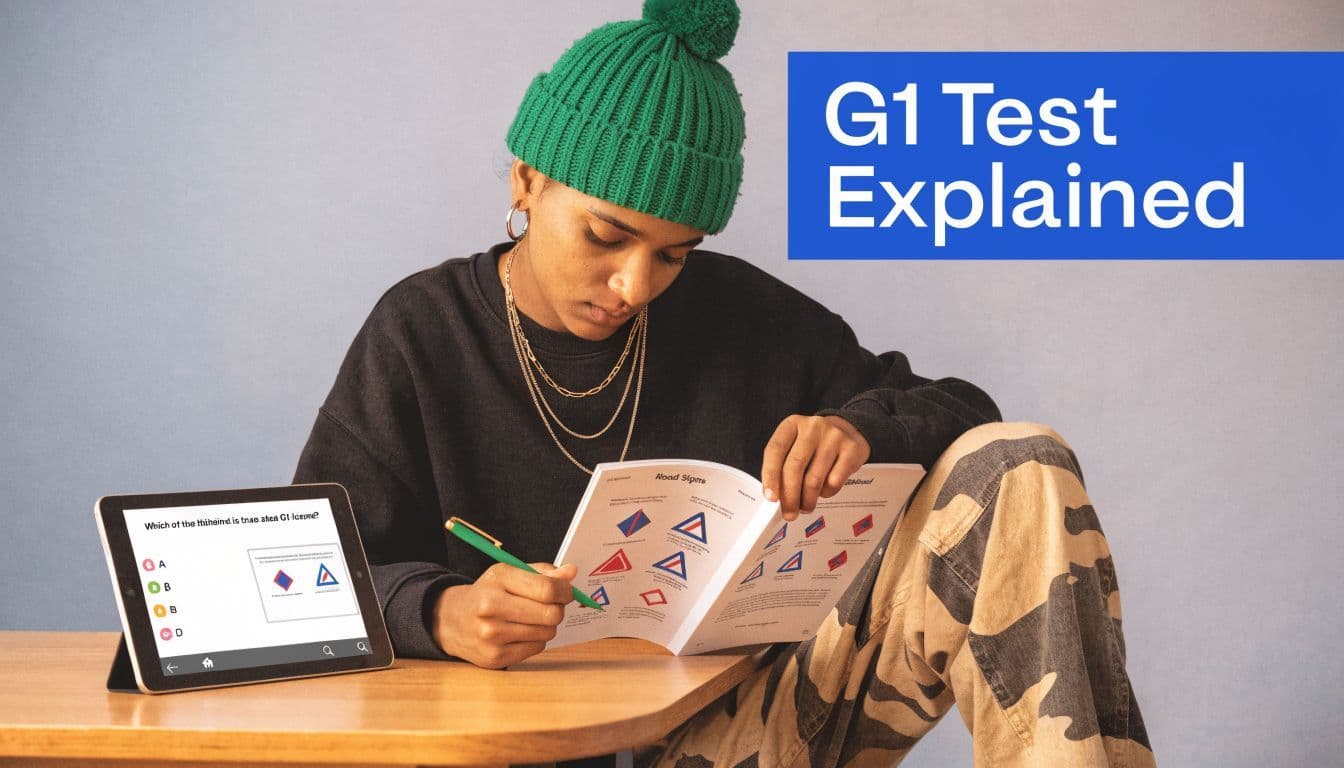
The Ontario G1 is a written test taken at a DriveTest centre. It checks whether you understand traffic signs and rules of the road well enough to begin learning under Ontario's graduated licensing system. In Toronto, that matters more than many learners expect. You are not preparing for quiet suburban driving alone. You are preparing for streetcars, crowded crosswalks, cyclists appearing at busy intersections, and fast decision-making on roads that rarely feel empty.
How the test is structured
The format is simple once you know the scoring rule. The G1 knowledge test has 40 multiple-choice questions, divided into two separate 20-question sections. One section covers road signs. The other covers rules of the road. You must answer at least 16 correctly in each section, which means an 80 percent pass mark in both parts, according to this breakdown of the Ontario G1 test format and fees.
That split is the part many Toronto learners misunderstand.
A strong score on signs does not rescue a weak score on rules. It works like passing two short quizzes on the same day, not one big quiz with room to make up marks in another area. If you miss too many rule questions about right-of-way, lane use, or safe following distance, the sign section cannot carry you through.
The same source says you have 30 minutes to complete the test. It also says the initial package fee is $158.25, which includes the knowledge test, your first road test attempt, and a five-year Ontario licence. If you need to rewrite the written test, the fee is $15.75.
For many people, the practical takeaway is simple:
- Study signs and rules separately. Treat them as two subjects.
- Aim for consistency, not streaks. Getting ten sign questions right in a row feels good, but it does not help if rule questions still feel fuzzy.
- Focus on city-relevant rules. In Toronto, topics like pedestrian right-of-way, turning at major intersections, and sharing space with transit matter a lot.
If you are still sorting out the overall process, including the paperwork you will need for test day, this guide to G1 test document requirements helps put the test in context.
For a quick visual explanation, this walkthrough helps many first-time learners settle their nerves before they go:
Why many learners fail the first time
Many first-time writers miss the mark because they prepare too narrowly. The failure rate is often cited as approximately 30 to 40 percent of first-time test-takers, according to Canadian Smart Drivers' summary of common G1 mistakes, which also points to weak preparation as a leading reason.
That fits what driving instructors see in Toronto. A learner memorizes a batch of app questions, feels confident, then gets slowed down by slightly different wording on test day. Another learner knows common signs but hesitates on questions about who yields, when to stop, or how to respond in a dense downtown traffic situation.
The test is not trying to trap you. It is checking whether your knowledge holds up when the wording changes.
That is an important difference.
If your study method is based on recognition alone, the actual test can feel unfamiliar very quickly. If you understand the rule behind the answer, you stay steady even when the question is phrased a different way.
Eligibility and Required Documents Checklist
A common Toronto test-day problem starts before the test screen even turns on. Someone gets to the counter after a long TTC ride, reaches for their documents, and realizes one ID is a photo on their phone or the names do not match exactly. The visit stops there.
That is why this step deserves care. For the G1, your road knowledge matters, but your paperwork gets you through the front door.
Who can apply
You can apply for a G1 in person at a DriveTest centre if you meet the age and identity requirements for an Ontario beginner licence. For many Toronto learners, a common point of confusion is not eligibility itself. It is whether their documents will be accepted together, especially for newcomers, international students, and temporary residents.
If your situation is not straightforward, review this plain-language guide to G1 test document requirements before you leave home. It can help you sort out document combinations while you are still at your kitchen table, not standing at a busy counter in Downsview or Metro East.
What to bring to the DriveTest centre
Bring two pieces of original identification. Do not bring photocopies, printed scans, or phone images. Staff need to confirm your legal name, date of birth, and identity details from original documents.
Use this checklist like a pre-drive mirror check. It is simple, but skipping one item can end the trip before it starts.
- Two original IDs: Original documents only.
- Matching legal name: Check spelling, order of names, and any middle names.
- Date of birth proof: Confirm that at least one document clearly shows it.
- Signature support: Bring documents that help verify your signature if needed.
- Payment method: You will pay as part of the visit.
- Glasses or contact lenses: Bring them if you wear them. A vision screening is part of the process.
Toronto learners often treat the G1 visit like an exam appointment. It is also an administrative check-in. Staff must review your identification, process your fee, and complete your vision screening before you can write. If one piece is missing, the whole visit slows down or ends.
Name matching causes more trouble than people expect. If one document shows a shortened version of your name and another shows your full legal name, do not assume the clerk will sort it out for you. Bring the documents that make your identity clear the first time.
Pack everything the night before.
A small folder works well. Put your two IDs, payment method, glasses, and any supporting paperwork in one place. Toronto mornings get rushed fast, especially if you are heading across the city and trying to arrive before the line builds.
A practical pre-departure routine looks like this:
- Lay out both IDs and check that they are original
- Compare the names and birth date on each document
- Pack your glasses or contacts
- Confirm how you will pay
- Leave extra travel time in case transit or traffic slows you down
If you show up with borderline paperwork, staff will follow the document rules closely. Being slightly over-prepared is the safer approach in Toronto, where a missed document can mean losing half a day to travel and waiting.
Toronto DriveTest Centres What to Expect
Toronto learners usually ask the same question in different ways. Which centre is easier? Which one is faster? Which one is less stressful?
For the G1 knowledge test, the better question is often which centre fits your day, your route, and your tolerance for waiting. The knowledge test is part of an in-person visit, so convenience matters more than people expect. If you're crossing the city on the TTC, one extra transfer can feel much worse after a long line.
If you want a quick location finder before comparing options, this Ontario G1 test locations page is a useful starting point.
How Toronto centres feel on the ground
Each Toronto-area centre has its own rhythm. Some are easier by transit. Some feel simpler if you're being dropped off. Some can feel crowded fast because Toronto moves a lot of learners through a limited number of sites.
Downsview is often convenient for people in the north end. It can be a practical choice if you want something more reachable from North York. The area can still feel busy, so arriving with buffer time helps.
Etobicoke works well for many west-end learners and for people coming by car. If someone is driving you there, the trip may feel easier than going across the city to another site. That convenience alone can lower stress.
Metro East is a familiar choice for many central and east-end residents because it's known and accessible, but that also means it can feel busy and transactional. You want your papers ready before you even reach the front of the line.
Port Union can make sense for Scarborough learners who'd rather avoid heading deeper into the core or across town. If your travel plan is simpler, your whole test day usually feels simpler.
For full G road tests, pass rates vary by centre. As a 2026 snapshot, Toronto Downsview is listed at 63 percent pass and Toronto Etobicoke at 65 percent pass on this Ontario DriveTest centre comparison. That data is for the road test, not the G1 knowledge test, but it still shows how much testing conditions can differ across locations.
A convenient centre is often the right centre. Long travel, rushed arrivals, and last-minute confusion hurt performance more than most people realise.
Toronto DriveTest Centre Comparison
Centre Location Address Key Notes Downsview Toronto area location Often practical for North York learners. TTC access can be workable. Plan for lineups and give yourself time. Etobicoke Toronto area location Popular with west-end residents. Often easier if someone is driving you there. Arrive organised. Metro East Toronto area location Common choice for central and east Toronto. Can feel busy. Have ID and payment ready before your turn. Port Union Toronto area location Useful for Scarborough learners. A simpler travel route can make the whole visit less tiring.
A few habits make any Toronto centre easier to handle:
- Go earlier in your day if possible: You'll usually be more focused, and delays won't spill into the rest of your plans.
- Carry only what you need: ID, payment, glasses, phone, and your essentials. Don't make the counter interaction messy.
- Assume there may be a wait: Bring patience, not a packed schedule.
- Use travel simplicity as a decision factor: The “best” centre on paper may be the worst one for your route.
A Smart Study Plan for Toronto Drivers
A generic study plan can get you part of the way. For g1 knowledge test toronto, I'd rather see learners study with city driving in mind from day one.
That doesn't mean the official test is different in Toronto. It means your understanding should be stronger in the areas that matter most on Toronto roads. Dense intersections, heavy pedestrian activity, cyclists, streetcars, lane changes in traffic, and construction all force you to apply the rules properly, not just recognise words on a screen.
Study for understanding, not just recall
The official handbook should be your base. It tells you what Ontario expects. But if you only read passively, a lot of information won't stick.
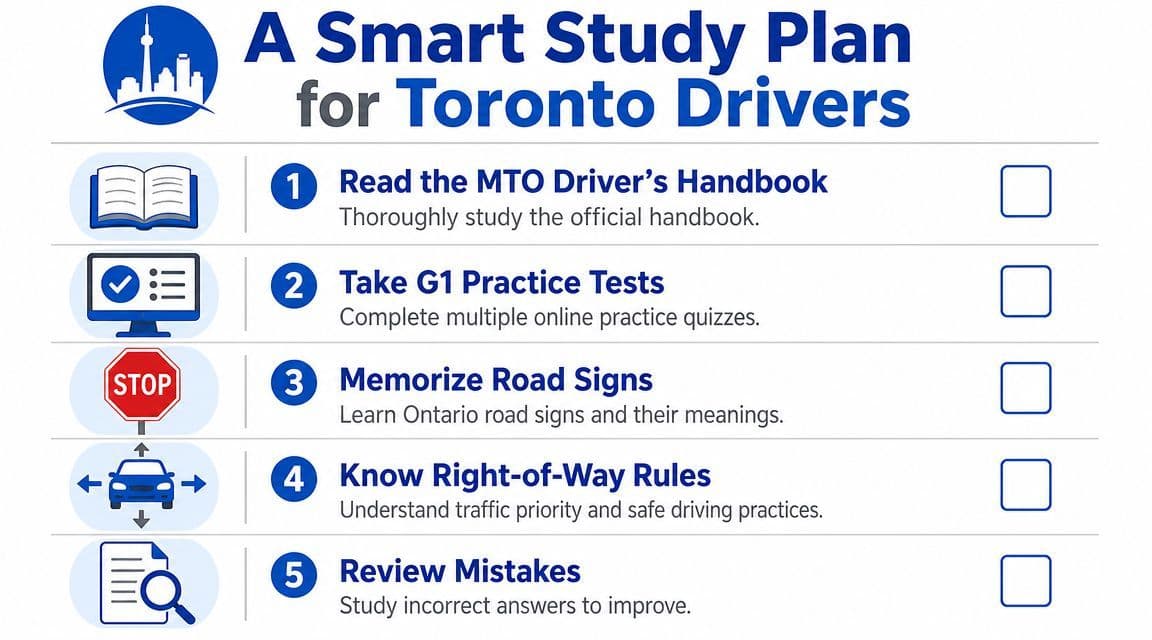
A better sequence looks like this:
- Read the handbook carefully so the official rules are familiar.
- Use practice tests to expose weak spots.
- Review every mistake instead of just chasing a higher score.
- Re-study the topic behind the mistake so you understand the rule.
- Repeat until both signs and rules feel balanced
One practical option is to combine the handbook with online practice tools that mirror the actual two-part format. For example, this guide on how to study for the G1 test pairs well with structured practice, and G1ready.ca offers Ontario G1 practice tests with targeted quizzes, mixed exams, and immediate answer explanations.
What Toronto learners should focus on
Urban drivers need more than sign memorisation. A deeper understanding of merging, blind spots, and intersection behaviour matters, especially in city traffic, as explained in this Ontario rules and scenario-based practice resource.
Here's where I tell Toronto learners to slow down and think harder:
- Merging: Not just the definition. Think about short gaps, fast decisions, and checking mirrors without drifting.
- Blind spots: In Toronto, this isn't abstract. Cyclists, scooters, and fast lane changes make blind-spot awareness a live issue.
- Intersection behaviour: Crowded downtown intersections demand patience and correct right-of-way judgment.
- Lane discipline: Construction, parked cars, and turning lanes make lane choice important earlier than beginners expect.
- Visibility decisions: Rain, glare, buses, and large vehicles can limit what you see, so rules around spacing and observation matter.
A weak study habit is memorising answers by pattern. A stronger habit is asking, “What would this look like on Bloor, Eglinton, Finch, or near a streetcar stop?” When the rule becomes visual, your recall improves.
If you can explain a rule in your own words and picture it on a Toronto street, you're studying at the right depth.
Try this simple weekly routine:
- One session for signs only
- One session for road rules only
- One mixed session under light time pressure
- One review session for wrong answers
- One short reset session on the hardest topics
That approach builds confidence without making studying feel endless.
Common G1 Test Mistakes to Avoid
Most G1 failures don't come from one dramatic mistake. They come from small, preventable errors that pile up.
Many first-time learners fail because they weren't prepared well enough. Earlier in this guide, the formal test facts showed a significant first-attempt failure rate and pointed to weak preparation as the main cause. In practice, that usually shows up in familiar patterns.
Study mistakes
Some learners rely on practice questions alone and never build a proper foundation. Others read the handbook once, too quickly, and assume they've “covered” it.
Watch for these traps:
- Memorising answer patterns: This works until the wording changes.
- Ignoring one section: Some people like signs and avoid road rules, or the reverse.
- Skipping review of wrong answers: If you don't learn why you missed it, the same mistake comes back.
- Studying only when you feel like it: Irregular study leads to shallow retention.
Test-day mistakes
Even prepared learners can lose marks through nerves and rushing. The good news is that these are fixable.
- Reading too quickly: Small words change the meaning of a question. Slow down.
- Overthinking easy questions: Your first well-reasoned instinct is often right.
- Letting one difficult question shake you: Move on and keep your focus.
- Arriving flustered: A stressful trip across Toronto can affect concentration before the test even starts.
A calm method works better than a clever one. Read each question carefully. If two answers look similar, look for the safer and more lawful choice, not the one that sounds familiar.
Don't treat every question like a trick. Most are checking whether you understand the basic rule clearly.
When learners ask me for one final habit before test day, it's this: do a short review, not a panic session. If you're cramming at the last minute, your brain usually feels fuller, not sharper.
You Passed Your G1 Test What Happens Next
Passing feels great, but many drivers immediately ask the same thing. What do I get today, and what am I allowed to do now?
What you receive after passing
After you pass the knowledge test and complete the in-person requirements, you'll be issued your temporary G1 licence paperwork at the centre. Your photo card licence arrives later by mail. Keep the temporary document safe and readable.
This is the point where a lot of families celebrate, which is fair. But the G1 is still a learner stage. It gives you permission to begin practising under Ontario's beginner rules, not to drive freely on your own.
Restrictions to take seriously
Your G1 comes with important conditions. The key ones to remember are:
- You must have a qualified accompanying driver in the vehicle
- That accompanying driver must sit in the front passenger seat
- You must maintain a zero blood-alcohol level
- You can't drive at certain late-night hours
- You can't drive on certain high-speed highways unless permitted under the rules
- Everyone in the vehicle must wear a seat belt
You'll also be working toward your next step. In Ontario's graduated system, drivers typically wait before taking the G2 road test, and completing an approved driver education course can shorten that timeline. What matters most right now is using the G1 period properly. Practise in calm conditions, build habits slowly, and don't rush into situations you're not ready for.
A careful learner usually becomes a smoother G2 candidate later.
If you're getting ready for the written exam, G1ready.ca gives you a practical way to study with Ontario-specific practice tests, targeted quizzes, and explanations for wrong answers so you can build confidence before heading to a Toronto DriveTest centre.


