
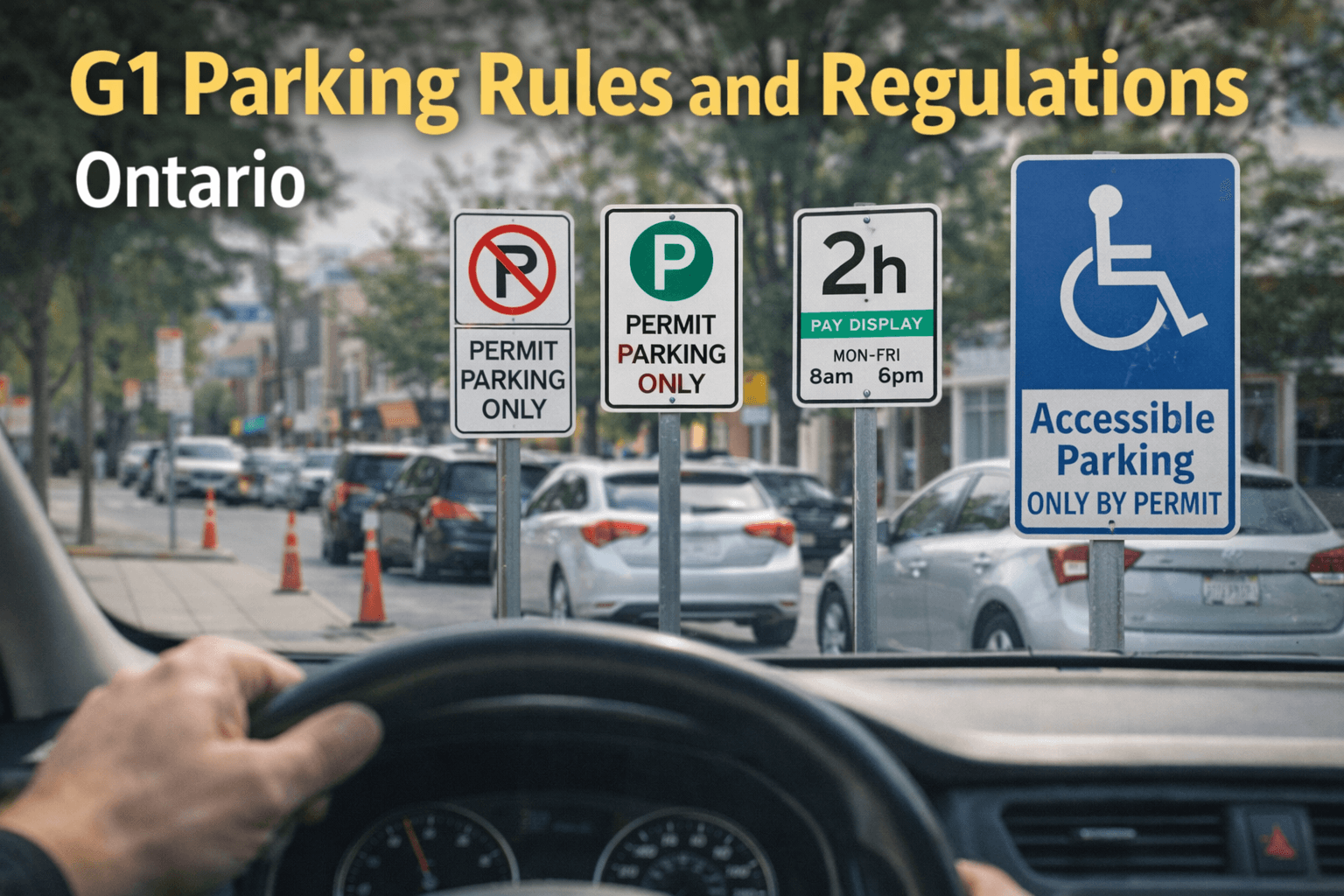
Parking questions on the G1 test catch people off guard. You spend most of your study time on dramatic scenarios involving right-of-way at intersections or what to do when emergency vehicles approach. Then the test asks how far from a fire hydrant you need to park, and suddenly you are guessing.
Ontario has specific parking regulations that determine where you can and cannot leave your vehicle. These rules exist to keep traffic flowing, maintain access for emergency services, and protect pedestrians. Breaking them results in tickets, towing, and the frustration of returning to an empty spot where your car used to be.
The G1 test includes questions about parking signs, distance requirements, and proper procedures for various parking situations. This guide covers everything you need to know.
No Parking vs No Stopping vs No Standing
Three different signs restrict what you can do with your vehicle, and confusing them is one of the most common parking-related mistakes on the G1 test. They look similar but mean very different things.
A "No Parking" sign means you cannot leave your vehicle unattended. You can stop temporarily to pick up or drop off passengers, and you can stop to load or unload goods. But you cannot park and walk away. The moment you leave the vehicle, you are violating the sign.
A "No Standing" sign is more restrictive. You can stop to let passengers in or out, but you cannot wait around and you cannot load or unload items. Standing means your vehicle is stopped with you inside but not actively picking up or dropping off passengers. If you pull over to wait for someone or to check your phone, you are standing, and that is prohibited under this sign.
A "No Stopping" sign is the most restrictive of all. You cannot stop your vehicle in that area for any reason except to obey traffic signals, signs, or a police officer's directions. No dropping off passengers, no loading, no waiting, nothing. Keep moving.
The test loves asking about the differences between these three signs. Remember the hierarchy: no stopping is strictest, no standing is in the middle, and no parking is least restrictive. Each one prohibits everything the less restrictive signs prohibit, plus additional actions.
Distance Requirements From Objects
Ontario law specifies minimum distances you must maintain between your parked vehicle and various objects. These numbers appear frequently on the G1 test.
Fire hydrants: Park at least 3 metres away from any fire hydrant. Firefighters need clear access to hydrants during emergencies. Blocking a hydrant delays response times and can result in significant fines. Some municipalities paint curbs red near hydrants as a visual reminder, but the 3-metre rule applies whether the curb is marked or not.
Intersections: Park at least 9 metres from an intersection if there are no signs or markings indicating otherwise. This distance maintains visibility for drivers approaching the intersection and keeps corners clear for turning vehicles.
Crosswalks: Park at least 3 metres from a crosswalk. Vehicles parked too close to crosswalks block drivers' views of pedestrians who are about to cross. This blind spot creates dangerous conditions where a pedestrian steps into traffic that cannot see them coming.
Stop signs: Park at least 3 metres from a stop sign to ensure the sign remains visible to approaching traffic. A vehicle parked directly beside a stop sign can obscure it from drivers who need to see it.
Railway crossings: Park at least 15 metres from a railway crossing. Trains require clear sight lines, and emergency vehicles responding to crossing incidents need space to work.
Memorize these distances because the test asks about them directly. A question might ask how far from a fire hydrant you must park and give you options like 1 metre, 3 metres, 5 metres, and 10 metres. Knowing the exact number gets you the point.
Parking Near Driveways and Access Points
Blocking access to private property or emergency routes violates parking rules even when no signs prohibit parking in that area.
Do not park in front of or within 1.5 metres of a driveway. Property owners need clear access to their own driveways. Blocking someone's driveway is a quick way to get ticketed or towed, often with an angry property owner watching it happen.
Fire routes must remain clear at all times. These designated lanes near buildings allow fire trucks to access structures during emergencies. Fire route signs mark these areas, and parking there results in immediate towing regardless of how briefly you intended to stop.
Loading zones are reserved for active loading and unloading of goods. You can stop in a loading zone to move items in or out of your vehicle, but you cannot park there for other purposes. Time limits usually apply even for legitimate loading activity.
Parking on Hills
Parking on an incline requires specific procedures to prevent your vehicle from rolling away. The G1 test asks about wheel positioning on hills because runaway vehicles cause serious accidents.
When parked facing uphill with a curb: Turn your front wheels away from the curb, toward the road. If your vehicle rolls backward, the wheels will contact the curb and stop the roll. After turning the wheels, let your vehicle roll back slightly until the front tire touches the curb, then apply the parking brake.
When parked facing downhill with a curb: Turn your front wheels toward the curb. If your vehicle rolls forward, the wheels will contact the curb and stop the roll.
When parked on a hill without a curb: Turn your front wheels toward the shoulder or edge of the road regardless of which direction you face. If the vehicle rolls, it will roll away from traffic rather than into the roadway.
Always apply your parking brake when parking on any hill, regardless of wheel position. The wheel turning provides a backup in case the parking brake fails.
The G1 test often presents scenarios describing a hill and asking which direction to turn your wheels. Visualize the situation and think about which way the vehicle would roll. Your wheels should direct a rolling vehicle away from traffic and toward something that will stop it.
Parallel Parking Rules
Parallel parking is the standard method for street parking in urban areas. Ontario has rules about how to do it properly.
Park within 15 centimetres of the curb when parallel parking. Leaving too much space between your vehicle and the curb narrows the roadway and can obstruct traffic. Your vehicle should be close to and parallel with the curb, not angled away from it.
Park in the direction of traffic flow. On a two-way street, your vehicle should face the same direction as traffic in your lane. Parking against traffic is illegal because it requires driving on the wrong side of the road to enter and exit the space.
Leave enough space between your vehicle and the vehicles in front of and behind you. Bumper-to-bumper parking makes it impossible for anyone to exit their space without hitting other vehicles.
When leaving a parallel parking space, signal and check for traffic before pulling out. Yield to approaching vehicles. You are entering the traffic flow, so traffic already moving has priority over your attempt to exit the space.
Accessible Parking
Accessible parking spaces are reserved for people with disabilities who display valid accessible parking permits. Using these spaces without authorization carries significant penalties.
Accessible parking spaces are marked with the blue wheelchair symbol painted on the pavement and on signs. These spaces are located close to building entrances to minimize the distance permit holders must travel.
Only vehicles displaying a valid accessible parking permit issued by the province can use these spaces. The permit must be clearly visible on the dashboard or hung from the rearview mirror.
Penalties for unauthorized use of accessible parking spaces are among the highest parking fines in Ontario. The fines far exceed typical parking tickets and can be several hundred dollars. Beyond fines, taking a space from someone who genuinely needs it is simply wrong.
Some accessible spaces include additional width or adjacent access aisles. Never park in these access aisles even briefly. Wheelchair users and people with mobility aids need this space to enter and exit their vehicles.
Parking Sign Time Limits and Conditions
Many parking signs include conditions that specify when restrictions apply. Reading these signs carefully prevents violations.
Time-limited parking appears in busy commercial areas. Signs might indicate "2 Hour Parking" or "30 Minute Parking" during certain hours. You can park for up to the indicated time but must move your vehicle before the limit expires. Returning later to the same spot often violates the spirit of these rules even if the letter of the rule is unclear.
Hour restrictions indicate when parking rules apply. A "No Parking 7 AM to 9 AM" sign means you can park there outside those hours but must be gone by 7 AM on days the restriction applies. Read carefully to determine whether restrictions apply daily, only on weekdays, or on specific days.
Seasonal restrictions appear in some areas. Winter parking bans prohibit overnight parking during snow removal season. These restrictions help plows clear streets efficiently.
Permit-only zones require residential parking permits issued by the municipality. Visitors and non-residents cannot park in these areas during restricted hours regardless of how much open space is available.
Parking Violations and Consequences
Understanding what happens when you violate parking rules reinforces why these rules matter.
Parking tickets carry fines that vary by municipality and violation type. Blocking a fire hydrant costs more than exceeding a time limit. Accessible parking violations carry premium fines. Tickets must be paid or contested within specified timeframes.
Towing happens when your vehicle creates a hazard, blocks emergency access, or accumulates multiple unpaid tickets. You pay the fine plus towing fees plus storage fees for each day your vehicle sits in the impound lot. Recovering a towed vehicle can cost several hundred dollars beyond the original ticket.
Repeat violations can lead to escalating consequences. Some municipalities boot vehicles belonging to owners with multiple unpaid tickets, immobilizing the vehicle until fines are paid.
Common Parking Questions on the G1 Test
Certain parking topics appear regularly on the G1 test. Expect questions about these areas.
Distance requirements from fire hydrants, crosswalks, and intersections come up frequently. Know the exact numbers: 3 metres from hydrants and crosswalks, 9 metres from intersections.
The difference between no parking, no standing, and no stopping signs appears on many tests. Remember the hierarchy and what each sign permits versus prohibits.
Hill parking scenarios ask which direction to turn your wheels. Visualize the situation and think about where a rolling vehicle would go.
Accessible parking questions might ask who can use these spaces or what penalties apply for violations. Valid permits are required, and fines are substantial.
Practical Parking Awareness
Beyond passing the test, parking rules matter for everyday driving once you get your license.
Read signs completely before leaving your vehicle. A quick glance might register "2 Hour Parking" while missing the "Mon-Fri 9 AM to 6 PM" restriction that means unlimited parking on weekends. Taking a few extra seconds to read the entire sign saves money and hassle.
Look for fire hydrants, crosswalks, and driveways before choosing a spot. An open space that seems perfect might violate distance requirements you did not notice at first glance.
When parallel parking, take your time to position your vehicle properly. Rushing leads to parking too far from the curb or at an awkward angle. Neither impresses anyone, and the angled version might earn a ticket.
If a parking situation seems questionable, trust your instinct and find another spot. The convenience of a borderline-legal space is not worth the ticket or tow.
Ready to test your knowledge of parking rules and other traffic regulations? G1 Ready CA provides practice tests that cover the full range of topics on Ontario's exam. For a broader look at all the rules tested on the G1, review the complete G1 road rules guide to make sure you have every topic covered before your test day.


