
You open the DriveTest portal, pick your nearest centre, and the calendar is grey for weeks. You refresh, switch months, try another location, and get the same result. That's where a lot of Ontario drivers get stuck with g road test ontario booking. They assume there are no options, when the problem is usually timing, location choice, or booking before they're ready.
The system is frustrating, but it isn't random. Drivers who get dates faster usually do three things well. They prepare their documents before they search, they stay flexible on centre choice, and they move quickly when a workable slot appears. That matters because a rare opening doesn't help if you still need to sort out eligibility, payment, or your test-day vehicle.
The Challenge of Booking Your G Road Test in 2026
You log in after dinner, check the nearest DriveTest centre, and find nothing useful for weeks or months. A lot of Ontario drivers stop there and assume every location is just as bad. That is usually the first mistake.
Starting with the closest centre is a common but often frustrating strategy. Busy locations get checked constantly, so the calendar can look dead even when other centres still have workable dates. If you only search by distance from home, you miss the basic reality of this system. Timing and location matter more than convenience at the first click.
The booking portal works more like a live inventory feed than a queue. Openings appear when someone cancels, when a centre releases more capacity, or when the system updates availability. Good dates can disappear in minutes. I have seen a usable slot show up, vanish during a second search, then reappear at a different centre later the same day.
That is why G1 and G2 prep affects booking success more than people expect. Drivers who already have their licence details, payment method, and test-day car plan sorted can act fast when a rare opening appears. Drivers who are still piecing things together often lose the slot while they hesitate. If you need a refresher on the licensing timeline, this guide to Ontario graduated licensing stages and requirements helps you confirm where you stand before the calendar opens up.
Use one rule at the start: search for the best realistic appointment, not the most familiar test centre.
A practical booking strategy in 2026 means widening your radius early, checking at times when cancellations tend to surface, and being ready to confirm immediately. That trade-off is simple. A longer drive to the test centre can save you weeks of waiting, and for many drivers that is the better deal.
Before You Book Confirming G Test Eligibility and Requirements
You finally spot an open G test date. It is close enough, soon enough, and at a centre you can reach. Then the booking stalls because your licence expiry is wrong, you are not yet eligible, or you still have no clear plan for the car. That is how people lose the few openings that matter.
The smart move is to get every requirement settled before you start searching. Timing and location choices only help if you can confirm a slot the moment it appears.
Confirm eligibility before you chase a date
Start with the licence itself. Make sure you are eligible for the G test based on your current stage and waiting period. Check the expiry date too. A test date that looks good on the calendar is useless if your licence will not be valid by then.
Then check the details you will enter during booking. Your licence number, expiry date, and payment card should all be ready before you log in. Small mistakes cost real opportunities because the portal does not hold a date while you sort them out.
If you need to confirm where you are in the process, review the Ontario graduated licensing stages and G test timeline before you search. It is much easier to widen your radius or grab a cancellation when you already know you meet the requirements.
Use this pre-booking check:
- Licence stage: You have completed the required wait time for the G test.
- Licence validity: Your licence will still be valid on the test date.
- Booking details: Your licence number and expiry date are accurate and easy to enter quickly.
- Payment method: You have an accepted card ready to go.
- Test type: You are booking the G road test, not the wrong class or stage.
One missed detail can turn a good opening into a wasted evening.
Set your car plan before the booking hunt starts
Vehicle planning is where many drivers lose momentum. They focus on the calendar first, then realize the only car they can use is unavailable on weekdays, due for repairs, or owned by someone hard to pin down. That matters because the best dates often appear at awkward times and at centres outside your usual area.
Before you book, decide exactly which car you will use and whether it can realistically get to more than one test location. A car that works for your local centre may be a poor choice for a farther one if highway driving, fuel range, or driver familiarity is an issue.
Item What to confirm Vehicle access You know which car you will use and who controls it Insurance and ownership The documents are current and easy to produce Basic condition Signals, horn, brakes, lights, tires, and seatbelts are working Dashboard issues No warning light or obvious problem you are planning to ignore Familiarity You have driven this vehicle enough to feel settled in it
That last point is the trade-off many guides skip. A borrowed car can help you keep an earlier booking. An unfamiliar borrowed car can also make a faster test date a worse choice. Different brake response, mirror setup, blind spots, and steering feel all show up at the wrong moment under pressure.
Book aggressively only after you can say yes to four things: you are eligible, your licence details are correct, payment is ready, and your car plan is realistic for the locations you may need to choose. That is what lets you act fast when a rare opening shows up, instead of watching it disappear while you scramble.
A Practical Guide to G Road Test Booking
You log in, finally see an opening two weeks away, and lose it while debating whether that test centre is too far. That is how a lot of Ontario drivers get stuck. The booking system rewards drivers who decide their timing and location strategy before they open the calendar.
Online booking gives you the best shot because it shows live availability and lets you act right away. The actual steps are simple. The hard part is avoiding slow decisions once a date appears.
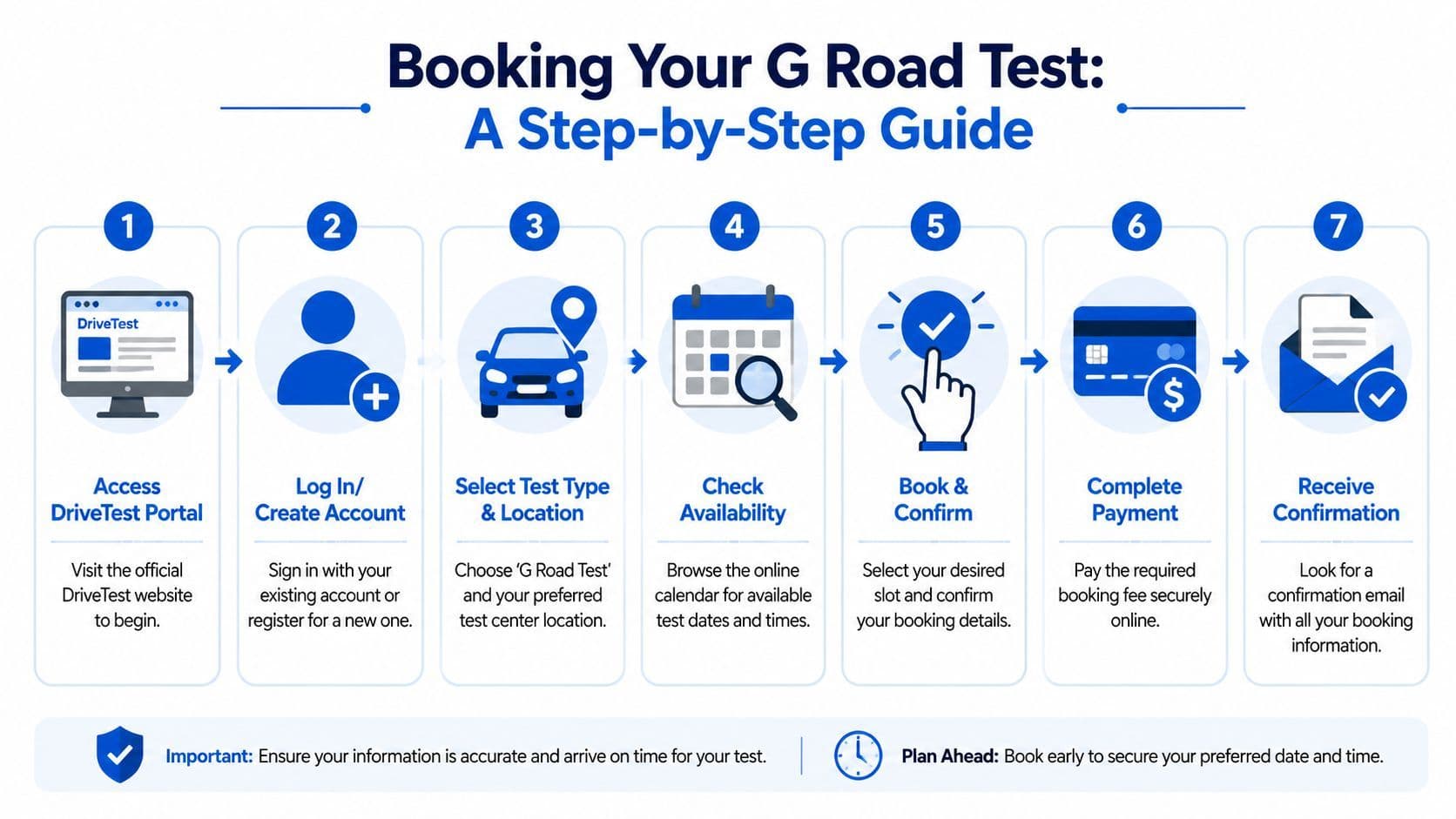
A clean booking routine looks like this:
- Go to the official DriveTest booking page.
- Choose the correct test type: Passenger vehicle class, then G road test.
- Enter your Ontario driver's licence details carefully.
- Search using centres you would genuinely accept, not placeholder locations.
- Scan dates with flexibility on both time and travel distance.
- Confirm the booking and save the confirmation as soon as payment goes through.
The centre choice is where strong bookings usually happen. Many drivers search one convenient location, see nothing useful, and stop there. A better approach is to build a short list of realistic centres in advance: your local site, one backup you can reach on a weekday morning, and one farther option you would still take if it cuts your wait meaningfully.
That trade-off matters. A closer test centre with a late date is not always the better option. A farther centre with an earlier opening can be the smarter pick if your highway comfort, vehicle plan, and practice schedule already support it.
Timing matters just as much. Openings often disappear because drivers start comparing every slot like they are booking a vacation. Treat the first workable date as valuable. If the date fits your eligibility, your vehicle plan, and your ability to practice in the days before the test, book it.
Drivers who prepared properly at the G1 stage usually handle this part better because they already know how quickly Ontario test availability can change. If you want to tighten up that earlier step, this guide to Ontario G1 test booking helps build the habits that carry over to road test booking.
Phone and in-person options
Phone and in-person booking still have a place, but they are backup methods, not speed methods.
Use them when you need help fixing a detail, confirming what the portal is showing, or dealing with a booking issue that is easier to explain to a person. Do not use them if your main goal is grabbing a rare early slot. In practice, the online calendar gives you the clearest advantage because you can see openings the moment they appear.
A few habits make a real difference:
- Book with a decision already made: Know your acceptable centres, days, and travel limit before you log in.
- Keep your search tight: Too many location choices slow you down.
- Accept good enough: A workable Tuesday at a less convenient centre often beats waiting months for the ideal Saturday nearby.
- Save proof immediately: Screenshot or download the confirmation page and keep the email.
The Ontario system does not reward perfect preferences. It rewards preparation, fast judgment, and a realistic view of how far you are willing to go for an earlier test.
Managing Fees Cancellations and Rescheduling
You finally get a decent test date after days of checking the portal. Then work changes your shift, your practice car needs repairs, or you realize your highway practice is not where it should be. At that point, the fee is only part of the decision. The bigger question is whether giving up that slot will set you back weeks or months.
What the fee actually means
For a G road test, expect to pay the booking fee shown in the DriveTest system at the time you confirm your appointment. The amount matters, but the slot usually matters more.
A booked test has real value because it gives you a position in a crowded system. In busy regions, that date can be harder to replace than drivers expect. Treat every appointment like something you may need to protect, not something you can casually swap out later.
The 48-hour rule matters, but timing matters more
Ontario says you must give at least 48 hours' notice to cancel a road test without losing your fee, according to Ontario's new drivers licence page. That is the hard rule.
The practical rule is stricter. If you know your car may not pass inspection, your licence details need correction, or you still are not ready for highway merges at full speed, make the change early. Waiting until the final two days usually leaves you with the worst combination. You risk the fee, and you give yourself fewer replacement options.
Ontario also notes on that same page that road test wait times vary by location and can be long in high-demand areas. Keep that in mind before you give up an acceptable date in a busy centre. A later rebooking can easily push you into a much worse part of the calendar.
Reschedule for a reason, not for a hope
I have seen drivers talk themselves into risky changes because they assume a better appointment will appear next week. Sometimes it does. Often it does not, especially if you are searching only in popular GTA centres.
Use a simple standard:
- Reschedule early when the problem is real. Car issues, missing practice, travel conflicts, or document errors are good reasons.
- Keep the appointment if the issue is only inconvenience. A less-than-ideal time or a longer drive is often worth accepting.
- Do not give up a solid slot for a maybe. Rare openings help only if you are ready to take them.
- Take failed attempts seriously. Rebooking after a failed test can cost more time than postponing a week or two to fix the actual weakness.
One pattern matters here. Drivers who built good habits during G1 prep usually handle this better because they understand that timing beats perfection. The same mindset applies now. Be ready early, so you can keep a decent date or grab a better one without scrambling.
Late changes usually cost more than the posted fee
The posted charge is easy to see. The hidden cost is lost momentum.
If you cancel late, you may lose your fee. If you reschedule too casually, you may lose a date that matched your work schedule, your instructor availability, or a stretch of good weather for final practice. If you rush into a test before you are ready, a failed attempt can create a much longer delay than a smart early reschedule.
That is why I tell new drivers to decide in advance what would justify moving the test. Make that call before emotions get involved. Once a conflict shows up, you want a rule, not a debate.
One last point. Do not build your plan around catching someone else's last-minute cancellation. That can still happen, but it is not a strategy you can count on. A stronger approach is to hold a workable booking, keep practicing, and only switch if an earlier date appears at a location you already decided you would accept.
How to Find an Earlier G Test Date in Ontario
If you want a faster appointment, stop thinking only about dates. Think about dates plus centres. That's the lever many applicants ignore.
A lot of drivers keep searching the same few busy GTA locations and then wonder why everything is slow and competitive. The better strategy is to decide how far you're willing to travel before you start searching. Once you do that, the booking system becomes a different game.
Location is a strategy, not a detail
The clearest reason to widen your search is the difference between centres. According to 2026 Ontario G road test pass-rate data, there is a 38-percentage-point gap between the highest and lowest reported centres, from Espanola at 93% to Oakville at 55%. The same data shows Bancroft at 87% and Brampton at 57%.
Here's a quick comparison:
DriveTest Centre Region Reported Pass Rate (%) Espanola Northern Ontario 93% Owen Sound Ontario 89% Bancroft Ontario 87% Toronto Etobicoke GTA 65% Toronto Metro East GTA 64% Toronto Downsview GTA 63% Brampton GTA 57% Oakville GTA 55%
Those numbers don't mean a quieter centre guarantees a pass. They do mean location affects the driving environment. Busy GTA centres tend to involve heavier traffic, more complex interchanges, and more interruptions. Smaller or quieter locations can offer a calmer test experience.
A two-hour drive to a better centre can be cheaper than paying for another attempt and waiting again.
That's why location choice should be part of your booking plan from the start. If you only search the toughest, busiest centres near home, you're narrowing both your availability and your odds.
What works better than endless refreshing
Checking repeatedly without a system usually leads nowhere. A better approach is structured flexibility.
Try this:
- Set a travel radius first: Decide what's realistic for you and your vehicle.
- Create a priority list: Put centres in order based on travel time, comfort, and likely test conditions.
- Search mid-week options seriously: Those slots can be more practical than weekends for both booking and test-day traffic.
- Be prepared to accept a good slot quickly: Delayed decisions kill opportunities.
- Practise near the booked centre if possible: A different location means different ramps, lane markings, and local traffic patterns.
Obsessive refreshing without a clear strategy is often ineffective. Another weak approach involves booking the closest difficult center because it feels familiar. Familiarity helps, but not if it keeps you stuck in a location with sparse openings and tougher road conditions.
There's also a practical trade-off. Travelling farther means more planning, fuel, and time off. For many drivers, that trade is still worth it because it can shorten the overall process and reduce stress on test day. If you're a parent helping a teen, or a newcomer trying to move through licensing efficiently, that kind of trade-off often makes more sense than waiting for the local perfect slot that never seems to come.
Your G Road Test Day Checklist and Avoiding Common Pitfalls
Getting the booking is only half the job. Plenty of drivers do the hard part, wait months, then lose the appointment over something simple and preventable.

A simple checklist for the morning of your test
Use a short routine, not a vague mental note.
- Bring your licence: Make sure your physical licence is with you, not in another wallet or bag.
- Carry vehicle documents: Have proof of insurance and ownership ready and easy to show.
- Inspect the car: Check lights, signals, horn, brakes, mirrors, tires, and fuel.
- Clean the interior: The examiner needs a safe, normal environment to enter and assess.
- Arrive with time to spare: Rushing into the parking lot puts you in the wrong frame of mind.
- Silence your phone: Remove distractions before the test starts.
A little last-minute practice can also calm nerves, especially for lower-speed manoeuvres and observation habits. If you want a quick refresher on one of the skills many learners still review before road tests, this guide to parallel parking for the Ontario driving test is handy.
Mistakes that ruin a hard-won booking
The first common mistake is bringing the wrong vehicle, or bringing the right vehicle in bad condition. A burnt-out light, obvious mechanical issue, or missing document can derail the appointment before you even leave the parking spot.
The second is arriving mentally scattered. Drivers miss simple examiner instructions when they're still stressed from traffic, parking, or being late. Give yourself a buffer so the test starts from a calm place.
The third is booking the wrong test type and not noticing until it's too late. This happens more than people admit. Always confirm that your appointment is for the G road test, not another class or stage.
A useful visual refresher can help if you like reviewing practical test expectations right before the day:
One more point matters. Don't treat the examiner's opening instructions as background noise. Listen carefully, ask for clarification if you didn't hear something, and focus on safe, steady driving rather than trying to impress anyone.
Calm, accurate driving passes more tests than dramatic confidence.
If you're still at the beginning of the process and want to pass the written test cleanly so you can move into road test planning without delays, G1ready.ca is a practical place to study. It offers Ontario-focused G1 practice tests, instant feedback, targeted quizzes, and a realistic simulator that helps you build confidence before booking pressure starts.


