
You open the Ontario Driver's Handbook, flip a few pages, and suddenly it feels bigger than it did five minutes ago. Road signs blur together. Right-of-way rules start sounding similar. Penalties, lane rules, emergency responses, speed decisions, all of it lands at once. For a nervous first-time driver, that feeling is normal.
Learners typically don't struggle because they're incapable of learning the material. They struggle because they don't yet know how the driving test questions ontario learners face are designed. The G1 isn't trying to trick you. It's checking whether you can recognise patterns, stay calm, and choose the safer rule when the road gets complicated.
That's why memorising random answers usually falls apart. You might remember one question exactly as you saw it, then freeze when the same idea appears in a slightly different form. A better approach is to learn the psychology behind the questions. Ask what rule the question is really testing. Is it checking hazard awareness, sign recognition, right-of-way judgment, or your understanding of legal responsibility?
Once you start studying that way, the handbook becomes less intimidating. The test starts to look organised instead of overwhelming. Confidence follows clarity.
Your First Step Toward a G1 Licence
A lot of new drivers start the same way. They read a few handbook pages, try a few practice questions, get several wrong, and immediately think, “I'm not ready for this.” That reaction makes sense, but it's usually based on the wrong conclusion.
Getting early questions wrong doesn't mean you're bad at driving theory. It usually means you haven't yet learned how Ontario frames the material. The test asks about signs, rules, and driving decisions in a way that rewards organised thinking. Once you know the patterns, your studying gets much easier.
I've seen nervous learners make the same mistake again and again. They study the easiest material first because it feels productive. They memorise a handful of obvious signs, skim over more confusing rules, then assume they're improving evenly. On test day, they discover too late that confidence in one area doesn't automatically carry into another.
You don't need a perfect memory. You need a calm method.
A better first step is to stop asking, “How many questions do I need to memorise?” and start asking, “What kind of decision is this question checking?” That shift changes everything.
Try looking at each question through one of these lenses:
- Sign meaning: What action does this sign require, warn about, or prohibit?
- Right-of-way: Who must wait, and why?
- Risk response: What is the safest action if traction, visibility, or control changes?
- Legal responsibility: What does Ontario expect you to know before you drive?
When you study that way, the handbook stops feeling like a pile of unrelated facts. It starts to feel like a map. And once you have a map, you're not guessing anymore.
Decoding the G1 Test Format and Scoring
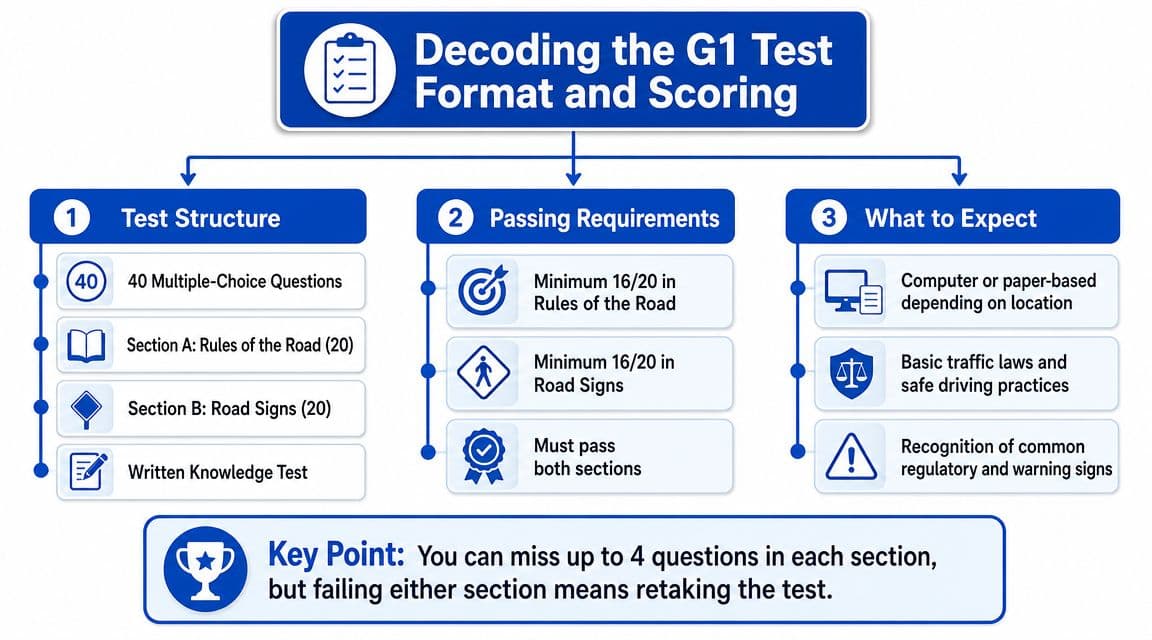
Before you worry about hard questions, get the structure clear in your mind. The Ontario G1 knowledge test is not one big score. It's a two-part exam, and both parts matter equally.
According to an Ontario-focused breakdown of the format, the G1 is a 40-question multiple-choice test split into 20 road-sign questions and 20 rules-of-the-road questions, and you must get at least 16 correct in each section to pass, which means an 80% pass mark in both halves rather than one combined score (Ontario G1 test format details).
Why the split matters
Many learners often misunderstand this point. They think, “If I do well overall, I'll pass.” But the test doesn't work that way.
If you're strong on signs but weak on rules, or the other way around, one section can pull you down by itself. That's why balanced preparation matters more than cramming your favourite topic.
Here's the practical effect:
- Road signs and rules are separate hurdles: You can't use one section to rescue the other.
- A good overall feeling can be misleading: You may leave the room thinking you did fine because many questions felt easy.
- Study time has to be divided on purpose: If you spend most of your time on signs because they feel more visual, you may leave dangerous gaps in road-rule knowledge.
Practical rule: Never finish a study session without touching both signs and rules at least briefly.
Learners who want a clearer walkthrough of the exam layout often find it helpful to review a dedicated guide to the Ontario G1 test format before they build a study routine.
Ontario G1 Test Structure at a Glance 2026
Component Number of Questions Minimum to Pass Road signs 20 16 Rules of the road 20 16
This table may look simple, but it should shape the way you practise. Don't ask only, “How many did I get right?” Ask, “Which half am I weaker in?” That's the question that leads to smarter study.
The Most Common G1 Question Categories
The two official halves are signs and rules, but learners usually improve faster when they break those broad areas into smaller patterns. That's because the test tends to reward recognition of question types.
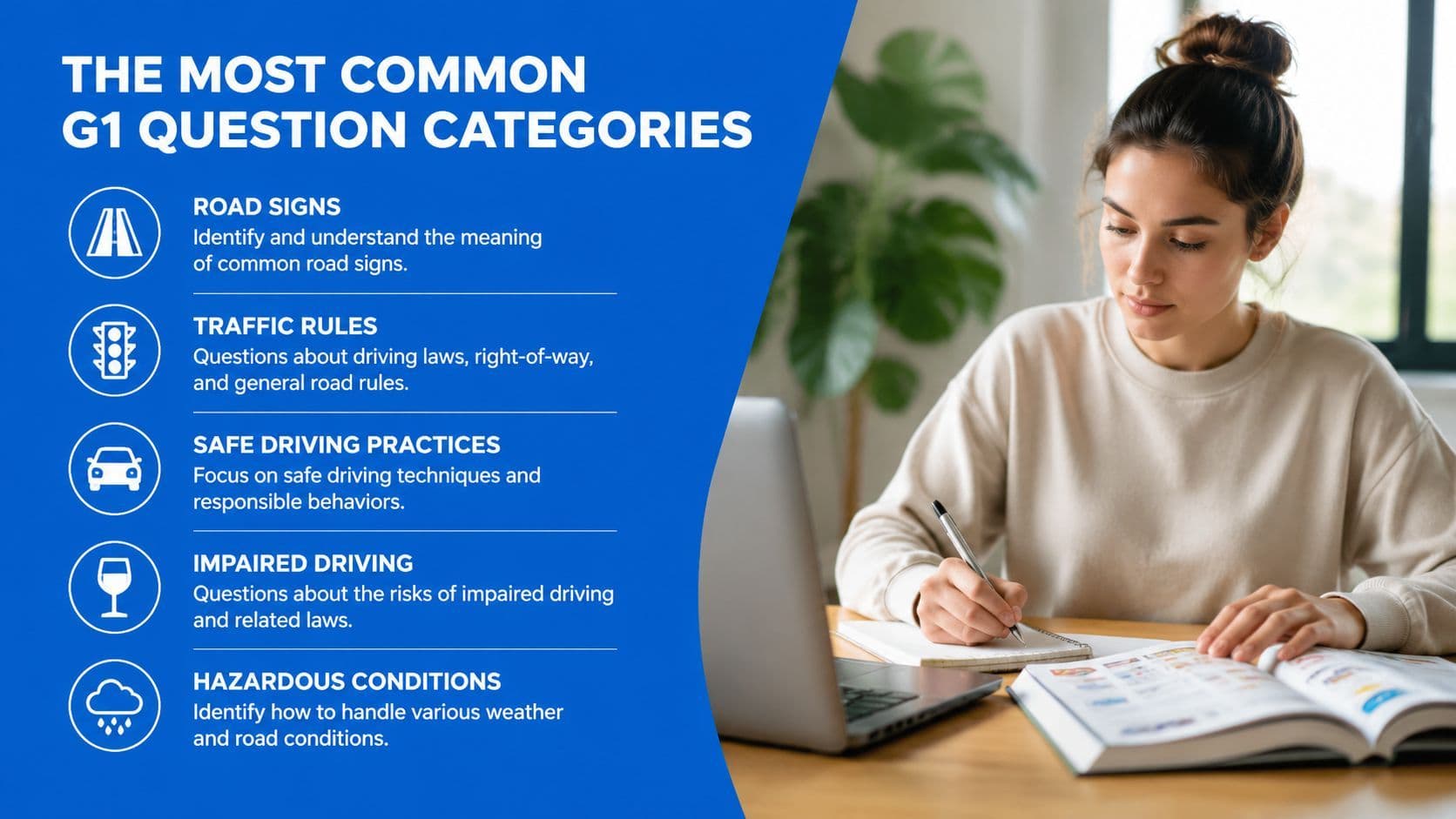
Individuals seeking driving test questions ontario often anticipate a giant list. Lists can help, but categories help more. Categories show you what the exam is trying to measure.
Questions that test recognition
Some questions are direct. They show a sign or name a sign and ask what it means. These are less about storytelling and more about instant recognition.
Common sign-based patterns include:
- Regulatory signs: These tell you what you must or must not do.
- Warning signs: These alert you to changing road conditions or upcoming hazards.
- Temporary or construction-related signs: These check whether you can adjust to unusual conditions.
- Lane-use and direction signs: These make sure you can interpret where traffic may move.
These questions feel easier because they're visual, but that can create overconfidence. Learners sometimes answer based on colour or shape alone and miss the exact instruction the sign gives.
Questions that test judgment
The G1 starts feeling less like a memory quiz and more like a safety test. The official Ontario sample knowledge questions come from the Ontario Driver's Handbook and use multiple-choice items that test applied rules, including judgment in situations such as skid recovery, safe lane changes, and speed choice under limited visibility (Ontario sample knowledge questions).
That matters because many “rules” questions are really asking, “Can you choose the safer action when conditions change?”
These often include:
- Right-of-way scenarios at intersections
- Lane-change decisions
- Safe responses to skids or loss of traction
- Speed selection when weather or visibility changes
- Defensive choices around other road users
A learner who only memorises wording may struggle here. A learner who understands the safety principle behind the rule usually does much better.
When two answer choices look similar, the safer and more controlled option is often there for a reason.
Later in your study routine, it helps to watch how these ideas appear in spoken explanations too, not just written ones:
Questions that test consequences
Another category catches learners off guard because it seems less dramatic. These questions ask about responsibility, consequences, and what the law expects from you as a driver.
They may cover topics such as:
- Penalties and legal obligations
- Rules connected to licence conditions
- What drivers must do in specific regulated situations
- Why some actions are dangerous even when they seem convenient
These questions matter because the G1 isn't only checking whether you can move a car. It's checking whether you understand that driving is regulated behaviour. Ontario wants new drivers to know both how to act on the road and why those actions matter.
If you keep these three buckets in mind, recognition, judgment, and consequences, the test starts to feel more predictable. Not easy, but predictable. That's a big difference when you're trying to calm test-day nerves.
Sample Driving Test Questions with Expert Explanations
Practice works best when you slow down and analyse the thinking behind each answer. Don't just mark a question right or wrong. Ask why the test writer included it.
Sample question on road signs
Question: You see a sign ahead that tells drivers a specific action is not allowed. What kind of sign is it most likely to be?
- A warning sign
- A regulatory sign
- A route marker
- A guide sign
Best answer: A regulatory sign
Why this matters: regulatory signs deal with rules that drivers must follow. If the sign is telling you not to turn, not to enter, or not to perform some other action, the test is checking whether you recognise that this is a rule, not a suggestion.
Why the wrong answers are weaker:
- Warning sign means caution about a hazard or condition ahead.
- Route marker helps identify roads or directions.
- Guide sign helps with navigation rather than legal control.
This type of question rewards precision. Learners often know the sign “looks official” but haven't yet sorted instruction signs from warning signs.
Sample question on judgment and road rules
Question: You want to change lanes, but another vehicle is already moving into the same space. What should you do first?
- Speed up and move over quickly
- Sound your horn and continue
- Yield the space and wait until the lane is clear
- Drift halfway into the lane to signal your intention
Best answer: Yield the space and wait until the lane is clear
This is a classic judgment question. The test isn't asking whether you know the words “lane change.” It's asking whether you understand space management and risk reduction.
The safest answer is the one that avoids forcing the issue. A rushed lane change turns uncertainty into conflict. A proper lane change happens only when the move can be completed safely and smoothly.
Wrong answers often sound active and confident. The right answer is often the one that reduces risk instead of asserting yourself.
Sample question on risk management
Question: If road conditions reduce visibility, what should guide your speed choice?
- The speed other drivers are using
- The posted limit only
- The condition of visibility and your ability to stop safely
- How close you are to your destination
Best answer: The condition of visibility and your ability to stop safely
This reflects the applied thinking found in official sample material. The test wants you to connect speed with actual conditions, not treat the posted limit as permission to drive at that speed in every situation.
The important idea is that safe driving is conditional. Good drivers adjust. They do not repeat the normal rule unthinkingly when the environment changes.
A useful way to study these question types is to review a bank of Ontario G1 test questions and answers and then write one sentence explaining the safety principle behind each answer. That extra sentence turns passive practice into active learning.
Here's a simple review habit that helps:
- Answer the question normally
- Check whether you got it right
- Name the category such as sign, right-of-way, or hazard response
- Explain the rule in your own words
- Note what tempted you if you chose the wrong option
That last part matters. Your wrong answers tell a story. Maybe you rush through wording. Maybe you confuse “must” with “should.” Maybe you choose assertive answers when the test wants the safest answer. Once you see that pattern, your studying becomes much more efficient.
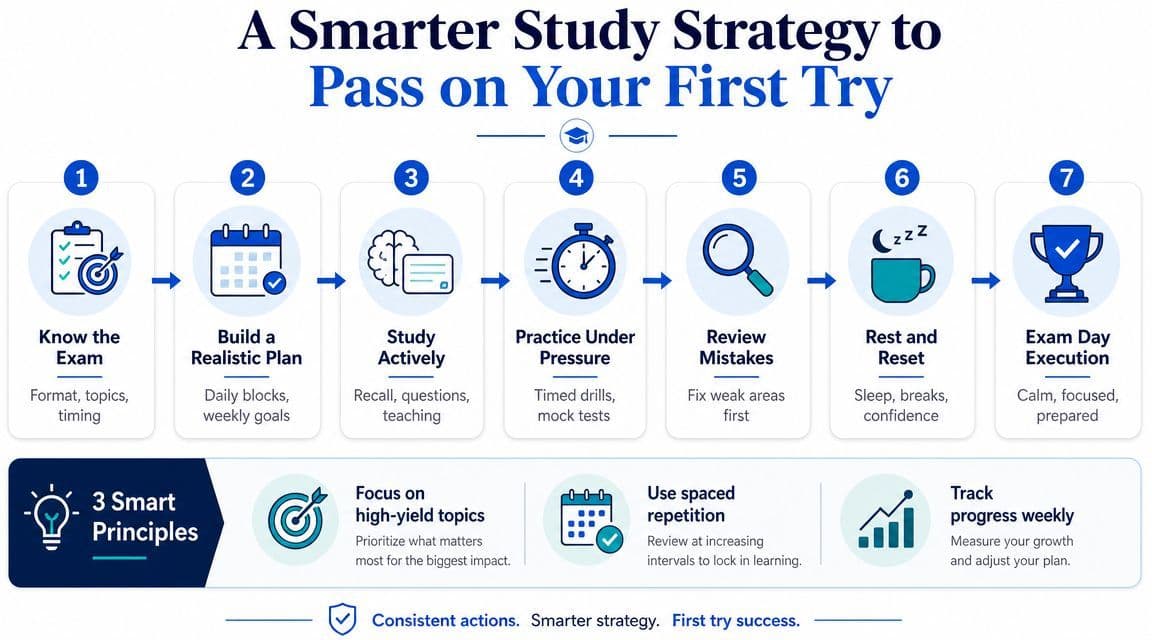
A Smarter Study Strategy to Pass on Your First Try
A lot of learners still prepare the hard way. They hunt for as many sample questions as possible, repeat them until the answers look familiar, and hope familiarity turns into mastery. It usually feels productive at first. Then a new question appears with different wording, and confidence drops.
That happens because the G1 is built from the Ontario Driver's Handbook and uses multiple-choice questions that assess applied rules and defensive-driving decisions, not just memorisation. Official sample questions focus on cause and effect, including situations involving skids, lane changes, and visibility, which is why immediate-feedback practice is so useful (Ontario handbook sample question style).
Why memorising feels good but fails later
Memorising gives you quick wins. You recognise a question. You remember the answer. It feels like progress.
The problem is that memorisation often skips the reason behind the answer. If the wording changes, your memory may not transfer. Applied understanding does transfer.
Here's the difference:
- Memorising asks: “What was the answer last time?”
- Understanding asks: “What rule makes this answer safest?”
- Memorising breaks under variation: a different phrasing can throw you off.
- Understanding holds up under pressure: even when the question changes, the principle stays the same.
That's why diagnostic practice works better. It doesn't just expose what you know. It exposes where your thinking goes off track.
A practical way to study smarter
Use a loop, not a cram session.
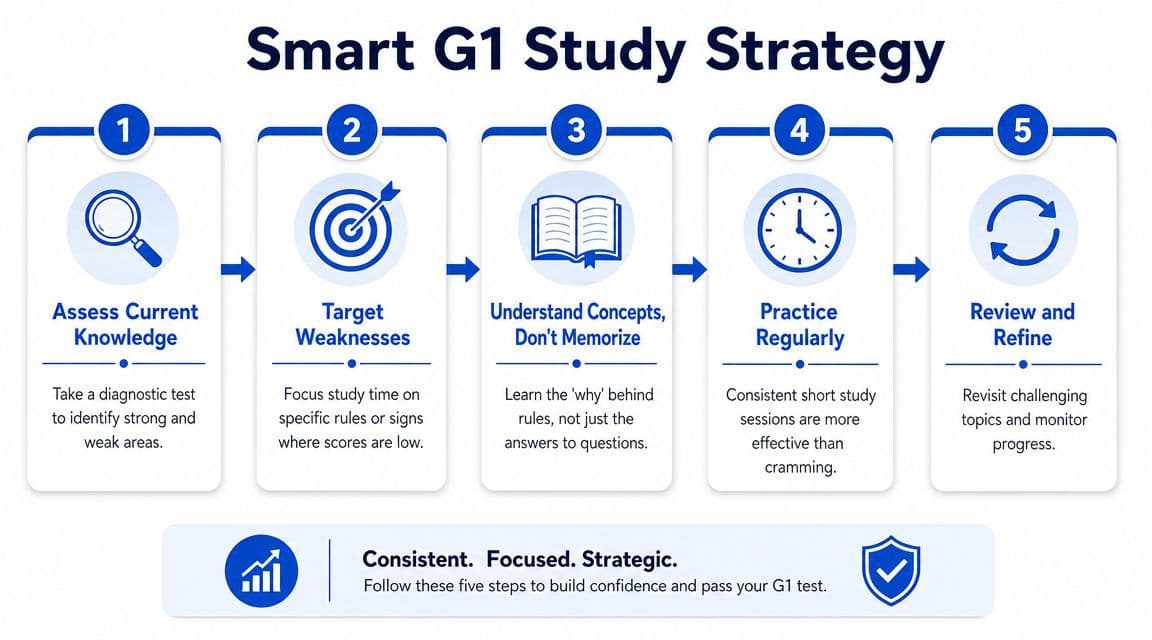
Start with a mixed practice set. Don't worry about your score yet. Your job is to find weak spots. Then sort mistakes into themes. Are you missing signs because they look similar? Are right-of-way questions making you second-guess yourself? Are hazard-response questions exposing gaps in your understanding of safe decisions?
From there, study in focused cycles:
- Run a diagnostic first: Let your errors reveal where attention is needed.
- Review one weak topic at a time: Signs and rules need different kinds of concentration.
- Use immediate explanations: Correcting the misunderstanding right away helps the lesson stick.
- Retake after a short break: This checks whether you learned the concept or just remembered the screen.
- Mix topics again later: Real test conditions don't separate every idea neatly in your mind.
One practical option is G1ready.ca, which offers diagnostic tests, targeted quizzes, mixed practice, a simulator format, immediate feedback, and progress tracking. Used properly, tools like that help learners study by pattern and weakness instead of repeating random questions.
Study until you can explain the answer calmly. That's a better sign of readiness than getting lucky on one quiz.
If you're supporting a teen driver, this approach also makes coaching easier. Instead of saying “You keep getting these wrong,” you can say, “You're strong on signs, but your lane-change decisions need more work.” That kind of feedback is specific, calm, and fixable.
G1 Test Day Logistics and FAQs
Knowing the logistics lowers stress. A lot of test-day anxiety comes from uncertainty, not lack of preparation.
What to expect at the centre
Ontario learners should expect to take the written knowledge test in person at a DriveTest centre, not online. One Ontario practice resource also notes that there is no time limit on the written test, which helps many nervous learners settle down and read carefully (Ontario G1 test day basics).
That means your test-day focus should be simple:
- Arrive prepared: Know you'll be writing in person.
- Read carefully: No time limit means you don't need to rush.
- Stay section-aware: Keep your attention balanced rather than assuming one strong area will carry you.
- Treat nerves as normal: Most first-time writers feel them.
If you want a practical walkthrough before you go, this guide on what to expect on G1 test day can help you picture the process more clearly.
Common questions learners ask
How much does the G1 package cost?
The listed G1 test package fee is $158.25 in the Ontario practice resource cited above.
Can I take the G1 test online?
No. The same source says applicants must take it in person at a DriveTest centre.
Is there a time limit on the written knowledge test?
The same source says there is no time limit.
What happens if I fail?
You can rewrite. The same source says there is no mandatory waiting period to rewrite.
How much is the rewrite fee?
The same source lists the rewrite fee at $16.
Is the test offered only in English?
No. The same source says it is available in up to 32 languages, including Ojibwe, Oji-Cree, and Mohawk.
For many first-time drivers, that last point brings real relief. Ontario's system is structured, but it also allows many learners to access the test in a language that helps them show what they know.
If you've studied the rules, practised the patterns, and learned from your mistakes, test day doesn't need to feel mysterious. It's one step. A meaningful one, but still just one step.
If you want structured practice before heading to the DriveTest centre, G1ready.ca gives Ontario learners a simple way to work through exam-style questions, identify weak spots, and build confidence with repeated practice and clear explanations.


