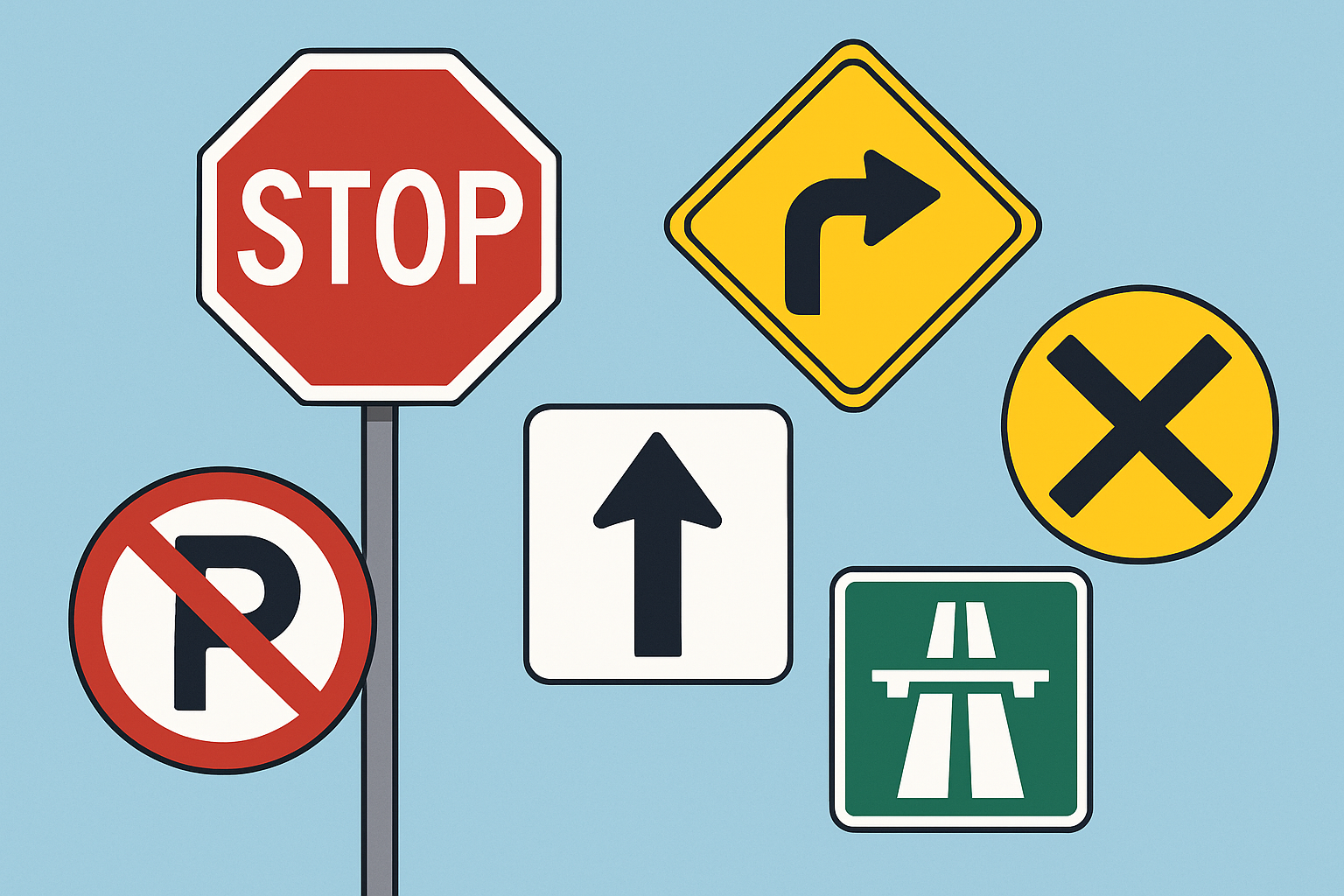
You're probably staring at a test date, a stack of handbook pages, and a phone full of random practice questions, wondering why this still feels messy. That's normal. Most Brampton learners don't need more motivation, they need a tighter plan that treats the G1 practice test Brampton search as two separate jobs, road signs and rules of the road, plus the local logistics that can wreck a good day if you ignore them.
If you want to pass on the first try, stop chasing a single overall score. The Ontario G1 exam is scored in two checkpoints, and Brampton uses the same provincial standard as every other DriveTest centre in Ontario, including the centre at 59 First Gulf Blvd, Unit 9. That means your prep has to be built around the 80% per-section threshold, not a vague feeling that you “did pretty well.”
What the G1 Knowledge Test Tests in Brampton
The night before the test, a Brampton teen usually makes the same mistake. They keep drilling road signs because those feel visual and easy, then they hope the rules section will sort itself out on test day. That is the wrong move, because the Ontario G1 knowledge test is built as two parallel checkpoints, not one blended mark.
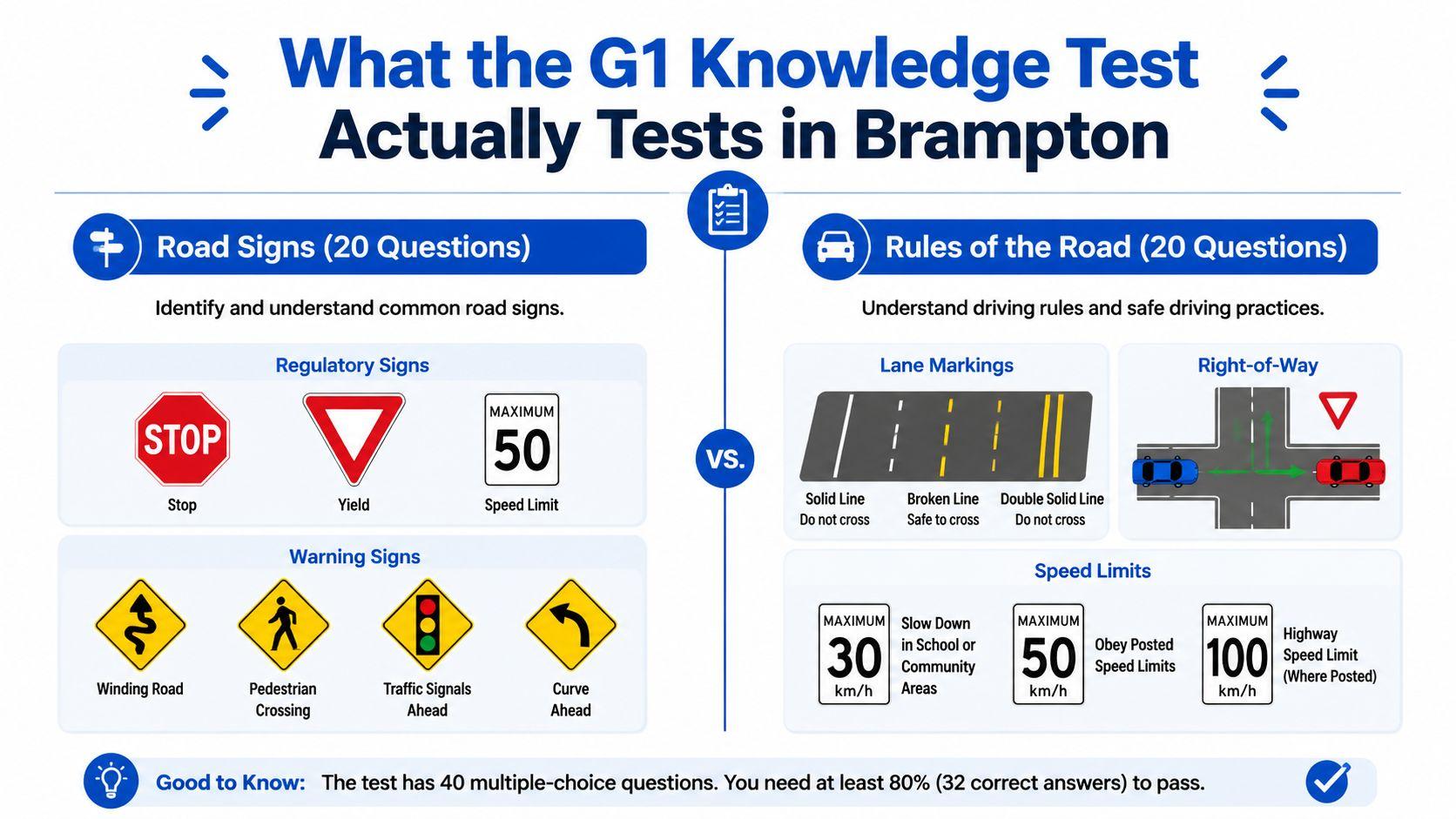
The scoring model is the whole game
The exam has 40 multiple-choice questions, split into 20 road-sign questions and 20 rules-of-the-road questions. To pass, you need at least 16 out of 20 in each section, which is 80% per section. A strong total does not rescue a weak subsection. If you miss too many signs, you fail even if your rules score is solid DriveIQ Canada on the Ontario G1 fail rate and exam structure.
That structure matters in Brampton because the same provincial standard applies at every DriveTest centre in Ontario, including 59 First Gulf Blvd, Unit 9. I tell learners to treat prep as two separate projects, one for signs and one for rules. If one side is lagging, that is the side that needs work.
Practical rule: stop asking, “Am I ready overall?” Ask, “Can I clear 16/20 on signs and 16/20 on rules on the same day?”
Brampton adds a logistics layer people ignore
Brampton learners also need to plan around the test centre, the trip there, and the stress that comes with a busy day. If you show up rushed, you start the exam already behind. That is avoidable.
Build your study loop around the score that matters. Do a full signs block, then a full rules block, then retest the weaker section until both sit at or above the 80% per-section threshold. That is the tight loop that works. A vague overall score does not tell you where you are leaking marks.
Treat the handbook as the base, then use practice tests to expose the weak side. When your signs and rules scores both hold steady, you are ready to book with confidence.
Where to Find Realistic G1 Practice Tests in Brampton
Most Brampton learners don't need ten different websites. They need a small stack of tools that match the handbook, give instant feedback, and separate signs from rules. Anything that can't do those three things is just noise.
Free online practice, handbook, apps, and paid courses
The official Ontario Driver's Handbook should be your base layer. Use it for definitions, right-of-way logic, road signs, and anything you keep missing. It's slow, but it's the source of truth, so it deserves a real read, not a skim.
Free online practice platforms are what turn reading into recall. A good one mirrors the test structure, gives immediate corrections, and lets you drill the section that's weak. For a Brampton learner, that matters more than flashy graphics or long question banks.
Mobile apps are useful for dead time, the bus ride, waiting between classes, or ten minutes before bed. They're not a replacement for serious review, but they're handy if they let you practise in short bursts. Paid in-person or school-based courses are worth considering if you need structure, but only if they push you through review, not just lectures.
One option in this category is G1ready.ca, which offers diagnostic and simulator-style practice that fits the Ontario format. I'd use that kind of tool as the main practice layer, then keep the handbook open beside it.
What each option is good for
- Handbook: best for learning the rule behind the answer, weak for speed on its own.
- Free practice platform: best for repeated drills and instant correction.
- Mobile app: best for quick refreshers when you're not at a desk.
- Paid course: best if you need a teacher to force a study rhythm.
My recommendation: use the handbook first, then a realistic practice platform second, then an app only as a filler tool. Don't reverse that order.
The point is not collecting resources. The point is building a routine that makes the G1 practice test Brampton search useful. Pick one serious practice source, one source of truth, and one mobile backup. That's enough.
How to Use G1ready.ca for a Realistic G1 Practice Test Routine
A lot of learners click around practice questions like they're scrolling social media. That's why they stay shaky. Use the platform like a coach, not a quiz toy.
Start with a diagnostic, then drill the weak side
Begin with a diagnostic test to expose your baseline on both sections. Don't judge yourself by the total score. Judge yourself by the side that fell under 80%, because that's the side that can still fail you.
If signs are the problem, stay there until the section feels automatic. If rules are the problem, drill rules until the logic starts to look familiar instead of random. The platform's immediate feedback and hints matter here because they help you correct the mistake while the question is still fresh.
Move from drills to full simulations
Once both sections are stable, switch to mixed tests that keep the same 20/20 structure and timing pressure. That's when the practice starts resembling the exam. A full simulator should feel slightly uncomfortable. If it feels too easy, you're probably just recognising patterns, not mastering the material.
Classification is the step many test-takers skip. After every miss, tag it as a rule type, sign type, or scenario type. Then re-test only that weak cluster until it stops hurting your score. That's how you turn a loose review session into a focused improvement loop.
Keep the routine mobile and repeatable
The platform's mobile-friendly setup is useful because Brampton learners don't always study at a desk. You can do a short diagnostic on the GO bus, then review misses at home before bed. That keeps the habit alive without making prep feel like a full-time job.
The routine is simple, and it should stay simple. Test, identify weakness, drill the weakness, retest. That cycle is the difference between “I studied a lot” and “I passed.”
A 14-Day G1 Study Schedule That Fits Around School or Work
A weak G1 plan wastes time because it treats everything as one pile. Split the prep into two parallel jobs, signs and rules, then add the Brampton layer on top, the route to the centre, the timing, and the calm you need on test day. That is how you stop guessing and start studying with a purpose.
The Ontario study guidance points to roughly 10 to 15 hours for many learners, with a tighter method able to compress prep into about 6 to 10 focused hours if the review loop is strict SafePass Driving Ontario G1 study guide. Use that as the ceiling, not the goal. The target is simple, get each section to the 80% line, then keep drilling the side that still falls short.
For the full timeline, use the G1 test study timeline guide as your broader roadmap, then run this 14-day loop around school, work, or both.
A simple 14-day roadmap
Day Focus Tool Target Score 1 Handbook read-through, signs Ontario handbook Understand key sign types 2 Handbook read-through, rules Ontario handbook Understand right-of-way basics 3 Second pass on weak chapters Ontario handbook Fewer confused answers 4 Diagnostic test Practice platform Baseline for both sections 5 Sign drills Practice platform Push signs toward 80% 6 Rules drills Practice platform Push rules toward 80% 7 Mixed practice Simulator Aim for 18+ on both sections 8 Review misses Handbook plus notes Fix repeated errors 9 Timed mixed test Simulator Stay near or above 80% 10 Timed mixed test Simulator If still under 16/20, pause and rebook 11 Weak-cluster re-drill Practice platform Lift the worst topic 12 Weak-cluster re-drill Practice platform Tighten the second weakest topic 13 Final handbook review Handbook Clean up repeat misses 14 Light review and rest Short quiz only Arrive calm and fresh
Two checkpoints that stop wasted effort
By day seven, you should know where you stand. If both sections are already at 18+, stop pushing at the same pace and shift into maintenance. Review the misses, then sleep properly. More grinding after that just burns energy you need on test day.
By day ten, the line gets sharper. If either section is still under 16/20, do not talk yourself into being ready. Rebook and keep drilling. Guessing your way through the final stretch is how nervous learners bleed points on simple questions.
Straight advice: review every miss against the handbook chapter before you move on. That is the habit that changes scores.
The routine stays the same the whole way through. Test, label the miss, drill the weak cluster, then retest until that side clears the 80% threshold. That tight loop fits school, work, and the kind of scattered schedule most Brampton learners live with.
Brampton DriveTest Logistics on Test Day
A solid study plan still falls apart if test-day logistics are messy. Brampton traffic is busy, the centre can back up, and a bad arrival plan drains focus before the test even starts.
Know the centre, the fee, and the flow
The Brampton DriveTest centre is at 59 First Gulf Blvd, Unit 9. Plan the route the night before, then add time for parking, transit delays, and the walk to the entrance. If you are taking a bus, build in extra cushion. If family is dropping you off, do not assume the curb will be easy or quiet.
You need to be at least 16 years old, pass a vision test, and pay $159.75 CAD for the knowledge exam, vision test, and initial G1 licence issuance G1 test things to bring and fee details. Bring valid ID and proof of age. A school card or a screenshot is not enough, so do not count on either one.
The process on site is simple. Check in, complete the vision screening, then take the computer-based test. Your result appears on screen when you finish, so you know right away whether you passed.
Appointment or walk-in
If you can book an appointment, do it. A set time cuts down uncertainty and keeps the day under control. Walk-in gives you flexibility, but at a busy Peel Region centre it can turn into a long wait.
Mid-morning on a weekday is usually calmer. Saturday is the day I would avoid if you have any other choice. A shorter queue does not make the test easier, but it does make the day less draining, and that matters.
Use G1ready.ca's test location guide to sort out your arrival plan before test day. Do that work early, not in the parking lot.
Common G1 Pitfalls That Cost Brampton Learners the Pass
A lot of learners fail for reasons that feel small in the moment. They aren't small. They're habits that break the score when the questions get reworded.
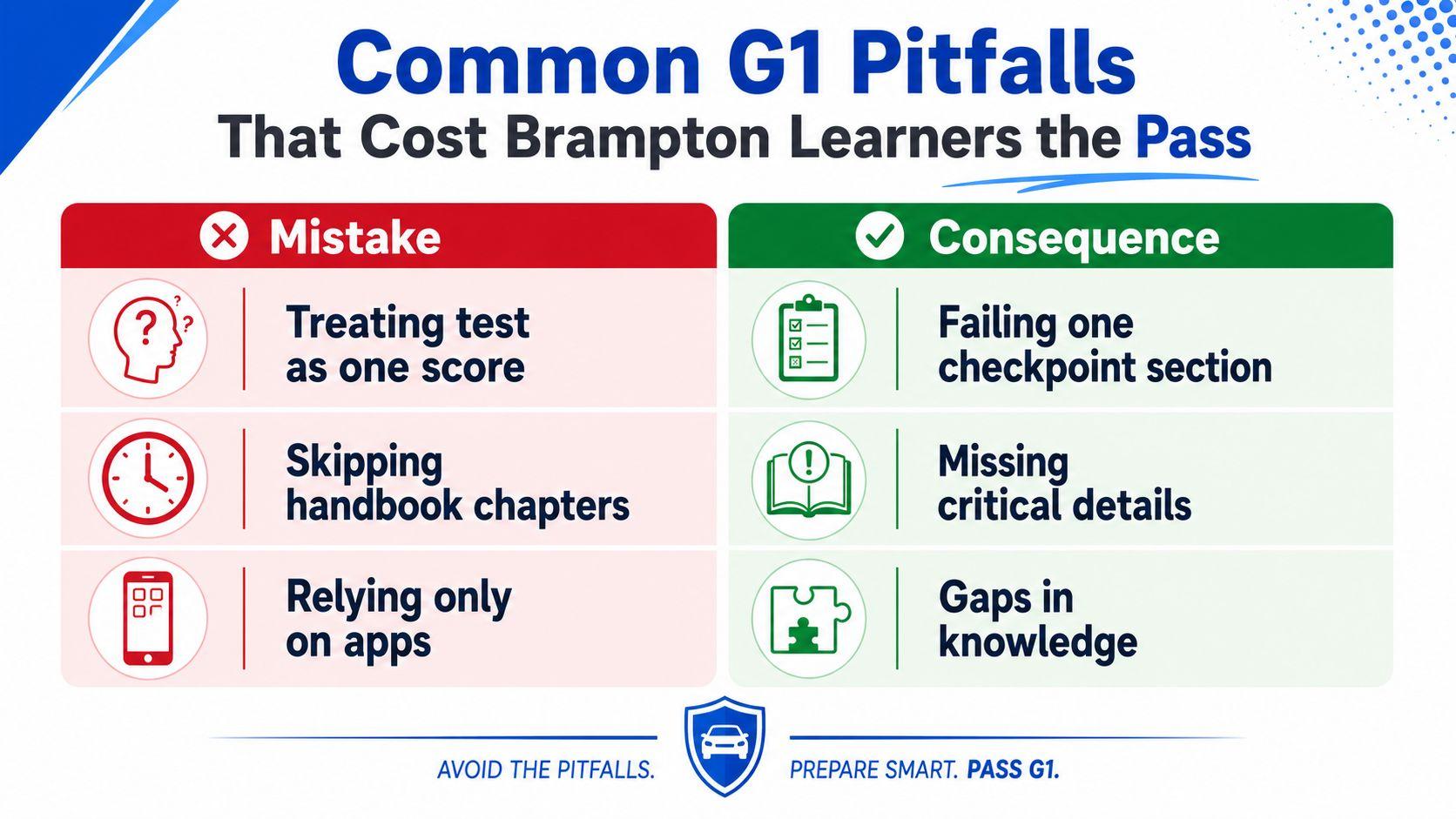
The mistakes that look harmless
Treating the test as one average score is the first trap. It makes people over-study their stronger side and ignore the weaker one, which is exactly how they end up failing one section while feeling “pretty good” overall. The fix is obvious, but people resist it. Track signs and rules separately.
Memorising answer patterns is the second trap. It works until the official wording changes just enough to expose the fact that the learner never understood the rule. If you can't explain why an answer is right, you don't know it yet.
Skipping the review phase is the third trap, and it's the one I see most often. Learners finish a test, glance at the score, and move on. They should be tagging each miss and drilling only that weak cluster until it stops showing up. That's the most effective work in the whole process.
What to stop doing on test day
- Stop chasing a feeling of readiness: use the 80% per-section threshold instead.
- Stop ignoring obscure signs: if a sign exists in the handbook, it can show up on the test.
- Stop using apps only for random quizzes: random practice without review just creates familiar mistakes.
- Stop rushing the screen: read the full question before you click.
The test doesn't reward confidence by itself. It rewards clean recall, especially on the section you kept avoiding.
Time pressure can also trip people up. They click too fast because they're nervous, then they miss a detail in the wording. Slow down just enough to read properly, and you'll usually gain more than you lose.
G1 Test Day Checklist and Brampton FAQs
The night before, keep the prep boring. Boring is good. Boring means you've already done the work.
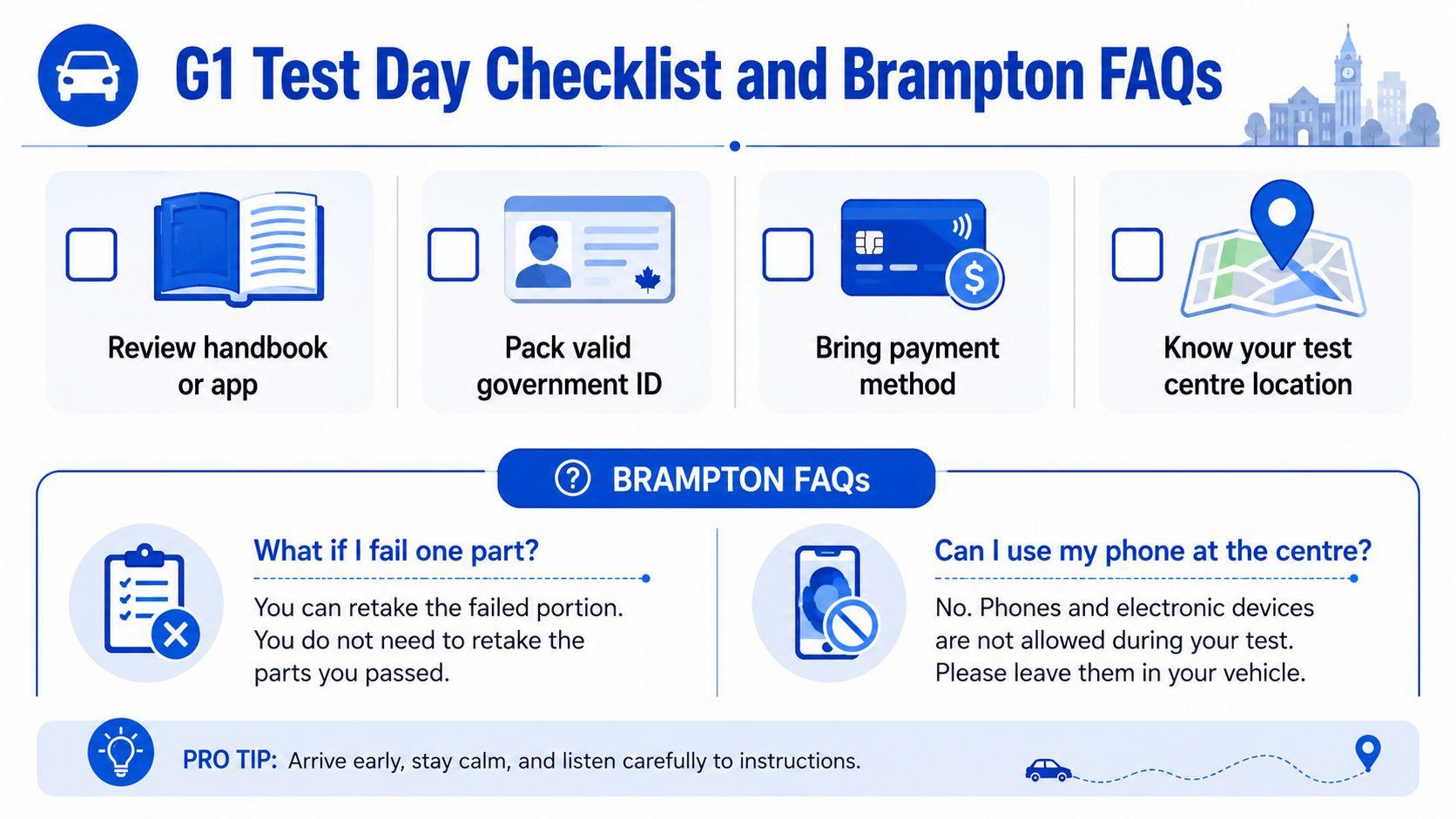
Your checklist for the morning
- Review the handbook or app lightly: don't cram, just warm up the recall.
- Pack valid government ID: bring the originals, not photos.
- Bring payment ready: have the exam fee, vision test, and first licence issuance covered before you leave home.
- Confirm your route to the centre: know how you're getting to 59 First Gulf Blvd, Unit 9.
- Do a short warm-up: one quick practice set is enough, not a marathon.
FAQ for the questions people ask most
If you miss one section, the test is not a pass. The G1 is marked separately, so a strong score on signs does nothing for weak rules, and the reverse is true as well. That is why you have to track signs and rules as two separate jobs, not one vague “I'm doing fine” score.
Failing means paying again and coming back for another attempt. That is exactly why the last review cycle matters before test day, not after.
Ontario does offer G1 test language options, and learners can ask about translated support where it is available. That matters for newcomers and multilingual families who understand the material better in another language.
The G1 licence still comes with restrictions after you pass, so do not treat the paper as a full licence. It is the learner stage, not the finish line.
Walk in with a clear standard. Aim for 80% per section, check your weak section one last time, and keep the morning routine simple. That is the cleanest way to give yourself a real shot at passing on the first try.
A CTA for G1ready.ca. If you want a cleaner shot at passing the first time, open a diagnostic, drill the weaker section, and finish with a timed simulator tonight.