
You're probably here because the word points keeps coming up, and it seems to mean two different things. One person says you can “lose points” on a road test. Another warns you about “demerit points” after a ticket. If you're new to driving in Ontario, that sounds like the same problem in two different outfits.
It isn't.
A first-time driver might worry about stalling at a stop sign during a test, then later worry that one ticket will ruin their licence. Those are real concerns, but they belong to two separate systems. One applies when an examiner is judging your driving on test day. The other applies after you're licensed and convicted of traffic offences. Once you separate those two ideas, the whole driver test point system becomes much easier to understand.
Understanding Your Driving Record from Day One
The day you get your G1, you don't just receive a licence card. You begin building a driving record.
For many new drivers, that idea feels heavier than expected. A teen driver may think, “What if I mess up my first road test?” A newcomer to Ontario may wonder, “If I get one ticket, do points go on my licence right away?” A parent helping a new driver often asks both questions at once.
The confusion usually starts because people use the same word for very different situations. They talk about “points on the test” and “points on the licence” as if they're interchangeable. They're not. One is about performance during an exam. The other is about convictions attached to your official record.
A simple way to think about it is this. Test scoring answers the question, Did you drive safely enough today to pass? Demerit points answer a different question, Have you built a pattern of traffic offences that puts your licence at risk?
That distinction matters from the start of graduated licensing. If you're still learning how Ontario's stages work, this guide to Ontario graduated licensing explained helps place G1, G2, and G rules in the right order.
Practical rule: A road test result and a demerit point record may both affect your progress, but they do it in different ways.
Once you know which system you're dealing with, the questions get easier to answer. A failed lane change on a road test doesn't automatically become demerit points. A traffic conviction doesn't mean you “failed” some invisible test. Each system has its own purpose, its own consequences, and its own way of judging your driving.
Demerit Points vs Test Errors Two Separate Systems
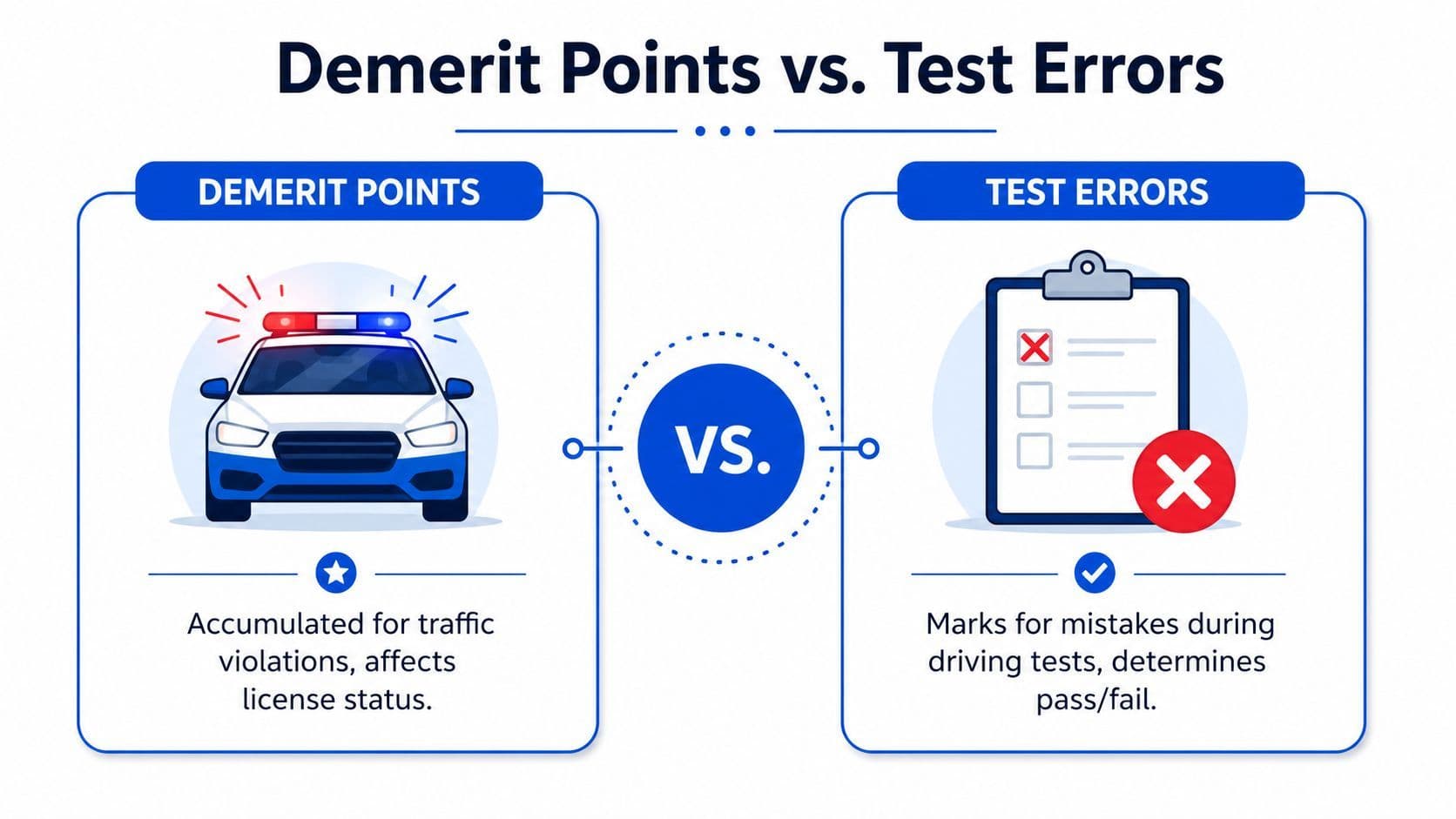
The most common misunderstanding in the driver test point system is mixing up demerit points with test errors.
The concept is similar to school. A road test score is like the mark on one exam. Your demerit record is like your transcript. One tells you how you performed on a specific day. The other follows you over time.
What test errors actually do
During a road test, the examiner is watching how you handle real traffic situations. They note mistakes, unsafe habits, hesitation, poor observation, and serious actions that create danger. Those notes help determine whether you pass or fail that test.
They do not become demerit points on your licence just because the examiner wrote them down.
If you roll slightly through a stop, forget a shoulder check, or park poorly, the examiner may mark errors. Enough errors, or one dangerous action, can lead to a failed test. But that result stays within the testing process.
What demerit points actually do
Demerit points belong to your official driving record after a traffic conviction. They're part of the province's way of tracking unsafe driving behaviour over time. That's why drivers, especially novice drivers, need to take tickets seriously even if the incident seemed minor at the time.
To see how clearly these two systems can be separated, look at California's published rules. Their system gives most traffic violations 1 point, while more serious offences such as DUI and hit-and-run carry 2 points, and their driving test uses a separate scoring method with specific critical errors, including driving 10 mph over or under the speed limit without justification in the California DMV driving test criteria.
Why first-time drivers mix them up
Part of the problem is language. Driving instructors might say, “You lost marks there,” while friends say, “Don't get points on your licence.” To a beginner, both sound like penalties attached to a mistake behind the wheel.
They're really different in three important ways:
- Timing: Test errors happen during an exam. Demerit points matter after a traffic conviction.
- Purpose: Test scoring judges competence for licensing. Demerit points track ongoing legal trouble.
- Consequence: Test errors affect pass or fail. Demerit points can lead to warnings, interviews, or suspensions depending on your licence class.
When you hear “points,” ask one question first. “Are we talking about my road test, or my licence record?”
That one question clears up most of the confusion.
If you keep the school analogy in mind, you'll make better decisions. You'll prepare for road tests by practising observation, speed control, and lane discipline. You'll protect your record by treating tickets and convictions as separate, long-term issues.
Ontarios Demerit Point System for Licensed Drivers
Ontario's demerit point system matters after you're licensed and convicted of traffic offences. This is the record many drivers mean when they say, “I've got points on my licence.”
The important detail is convicted. A ticket by itself isn't the same as a conviction. The official consequences attach to the record once the legal process results in one.
What demerit points are for
Demerit points are meant to identify drivers who repeatedly break traffic laws or commit more serious offences. They don't measure one nervous road test. They measure what happens after you're already driving under a licence and a court process or payment results in a conviction.
For novice drivers, that distinction matters even more because the province treats new drivers more strictly. A G1 or G2 driver has less room for error than a fully licensed G driver.
A clean driving record isn't only about avoiding suspension. It also shows that you can follow the rules consistently once nobody is sitting in the passenger seat grading you.
Why novice drivers feel the impact faster
A fully licensed driver may be able to absorb a smaller problem without immediate suspension. A novice driver often can't. That's why a single poor decision can create bigger consequences early in the graduated system.
If you're teaching a new driver, many families often get caught off guard. They assume “it was just one ticket,” without realising that novice licensing is built around tighter tolerance for risky behaviour.
Ontario Demerit Point Thresholds by Licence Class
The exact thresholds and consequences depend on the licence class and the offence, so drivers should always confirm current rules with official Ontario sources. The table below shows the practical difference in how Ontario treats novice and fully licensed drivers.
Points Accumulated Action for G1 & G2 Drivers Action for Fully Licensed G Drivers Lower point totals Stricter consequences begin sooner for novice drivers Lower totals may trigger concern but usually allow more room before severe action Moderate accumulation Ministry action can escalate quickly, including interviews or suspensions depending on the offence history Drivers may face warning letters or interviews before suspension High accumulation Novice drivers face a serious risk of suspension and licence setback Fully licensed drivers may face suspension if the record shows continued offences
What drivers should do after a ticket
A ticket creates stress because people jump straight to the worst-case scenario. Slow down and handle it in order.
- Read the offence carefully. Don't rely on memory or what someone else says it means.
- Check your licence class. G1 and G2 drivers need to be especially careful because novice rules are tighter.
- Watch the conviction stage. The record impact follows the conviction, not the emotional shock of receiving the ticket.
- Order your driving record if needed. If you aren't sure what's on file, verify it through official channels.
The mistake that causes the most trouble
Many drivers focus only on the fine. They ask, “How much will this cost?” when the more important question is often, “What will this do to my record?”
That's the smarter way to think about demerit points. The money stings once. Record consequences can stay relevant much longer.
A useful comparison comes from California's point structure, where published guidance explains that point records can remain on a driving record for 3 to 10 years, and suspension thresholds can be triggered by repeated accumulation over 12, 24, or 36 months in this summary of California DMV point rules. Ontario has its own rules, but the lesson is universal. A pattern matters more than one anxious moment behind the wheel.
How Penalties Are Scored on Your G1 and G2 Tests
Many learners expect a neat numerical system and are surprised. The G1 knowledge test and the G2 or G road tests aren't scored the same way.
The G1 knowledge test is pass or fail
The written G1 test isn't a demerit system. It's a knowledge check. You answer questions on road signs and rules of the road, and your result is whether you passed each required part.
If you're preparing for the road test stage after your G1, this breakdown of the G2 driver's test helps you understand what the examiner wants to see on the road.
Road test scoring is about errors and safety
On the G2 and G tests, examiners usually don't talk in terms that feel like a classroom grade. They observe your driving and record mistakes. Some are smaller errors. Others are serious enough to show unsafe driving.
The main idea is simple. Examiners want proof that you can drive safely, consistently, and independently.
They pay close attention to things like:
- Observation habits: checking mirrors, scanning intersections, and doing shoulder checks when required
- Speed control: staying appropriate for the road and conditions
- Lane discipline: choosing the correct lane and holding position properly
- Decision-making: yielding when needed, stopping properly, and responding calmly to traffic
Small mistakes can add up. One dangerous mistake can outweigh a lot of otherwise decent driving.
Three ways to avoid common scoring errors
The most useful road test advice is practical, not dramatic.
- Make your observation visible: Don't just move your eyes. Turn your head enough that the examiner can clearly see your checks at intersections, lane changes, and turns.
- Hold steady speed: Many learners drift above or below the proper speed because nerves take over. Practise reading the road, checking the speedometer briefly, and settling the car instead of correcting in big jumps.
- Practise manoeuvres before test day: Parking, three-point turns, and roadside stops shouldn't feel new when you're under pressure. Repetition reduces panic.
What usually worries learners too much
New drivers often obsess over one imperfect moment, such as a wide turn or awkward park. Those can matter, but what fails more people is a pattern of poor observation or a safety issue that tells the examiner they can't trust your judgment.
That's good news, because it means improvement is very trainable. You can practise scanning, timing, lane changes, and calm decision-making long before test day.
How to Check and Manage Your Demerit Points
If you've had a ticket, or you just want certainty, the smartest move is to check your official record instead of guessing. Friends often give confident answers that turn out to be wrong.
The document people usually need is a driver's record abstract from ServiceOntario. That's the formal way to review what appears on your driving record.
How to get your record
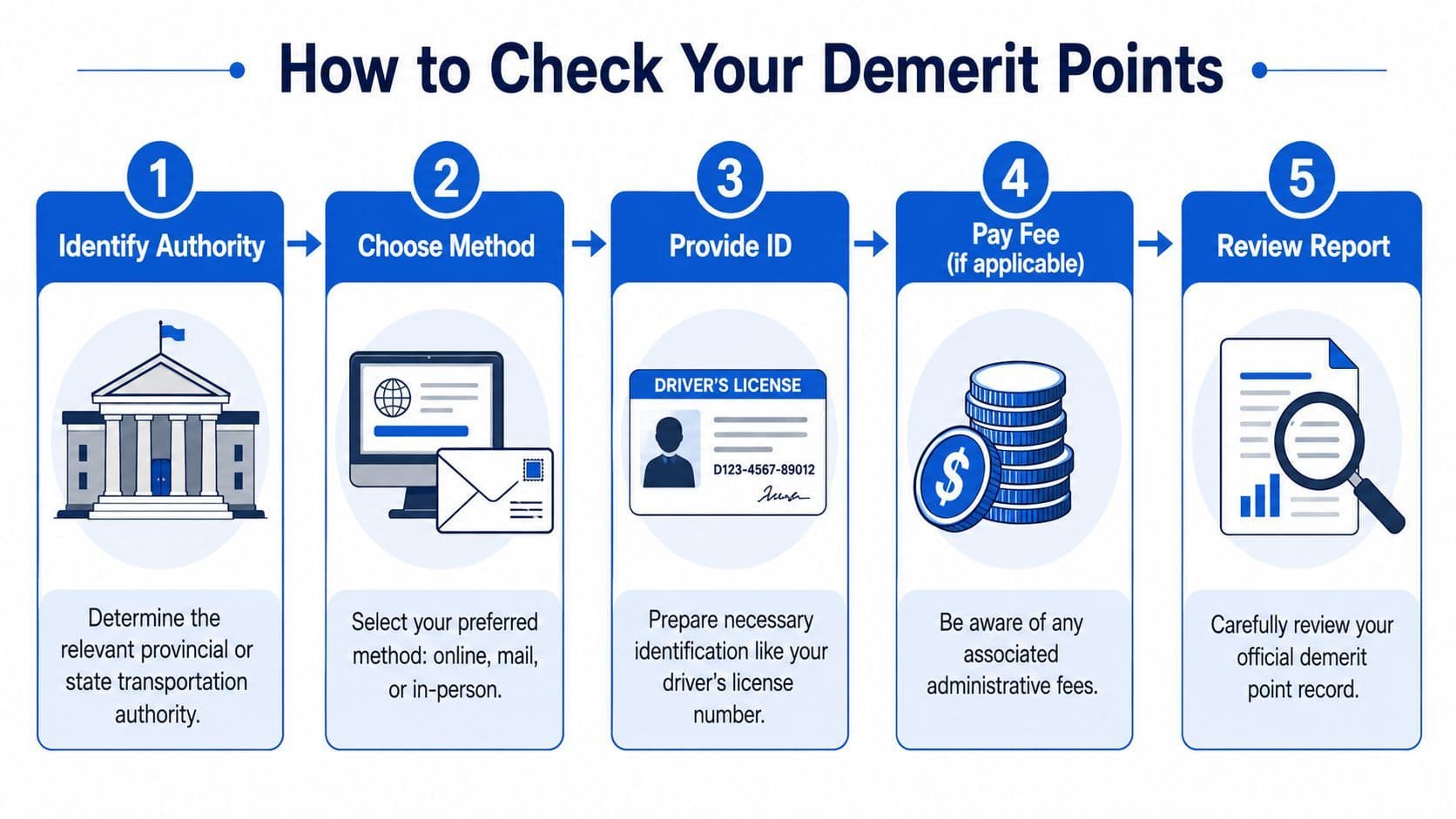
ServiceOntario offers different ways to request driving record information. The exact process can change, but the basic path usually looks like this:
- Confirm what record you need. Ask for the driver's abstract or other official driving record document that fits your situation.
- Choose your method. You may be able to order online, visit in person, or submit by mail.
- Have your identification ready. Your licence details and personal information need to match the official record.
- Review the record carefully. Don't just glance at it. Check names, dates, convictions, and any licensing actions.
A defensive driving mindset still matters even though it doesn't erase points. This overview of an Ontario defensive driving course can help drivers build safer habits going forward.
To see the general process in a visual format, watch this quick overview:
A myth that causes a lot of confusion
Many drivers ask if they can take a course to “remove” demerit points. In Ontario, that idea causes trouble because people delay dealing with the actual issue while assuming a course will clean up the record automatically.
The safer mindset is this:
- Courses help skills: They may improve judgment, awareness, and future driving choices.
- Official records come from official channels: If you want to know your status, check the record itself.
- Convictions matter: The legal outcome is what shapes the record.
One practical habit that saves stress
Check your record when something changes, not months later when you're applying for work, renewing insurance, or booking a major driving step. That keeps surprises small.
For G1 test prep, one practical option is G1ready.ca, which offers Ontario-focused practice exams, topic-based quizzes, and a test simulator aligned with the G1 handbook. That won't manage demerit points for you, but it can help you build the rule knowledge that prevents preventable mistakes early on.
Frequently Asked Questions About Driver Points
Do demerit points affect insurance?
Insurance companies are usually more interested in the conviction history behind the points than in the points alone. In plain language, the ticket and offence record often matter more than whether a driver is focused on the point total.
That's why a driver can be technically obsessed with points and still miss the bigger problem. The smarter question isn't only “How many points is this?” It's also “What conviction will show on my record?”
Can you get demerit points from a parking ticket?
Parking tickets are generally treated differently from moving traffic offences. Drivers usually worry about licence points when the larger issue is whether the incident involved a conviction tied to active driving behaviour.
If you're unsure, don't rely on what people say in a group chat. Check the offence type on the ticket and verify your record through official channels.
Can out-of-province tickets follow you home?
They can create complications. Ontario drivers should assume that an offence outside the province may still matter, especially if it involves a serious traffic violation. That's one reason experienced drivers don't treat cross-border or out-of-province driving as a loophole.
The safest habit is to drive as if your record matters everywhere, because it often does in practical terms.
What happens if a G2 driver is suspended?
For a G2 driver, suspension is a bigger setback than many people realise. It doesn't only interrupt driving. It can disrupt work, school, family responsibilities, test timelines, and confidence behind the wheel.
A suspension can also complicate your progress through graduated licensing. For novice drivers, that's why prevention matters so much. Careful driving, attention to the rules, and fast action after any ticket are far easier than recovering after a suspension.
If you're supporting a new driver, keep the priority simple. Learn the rules thoroughly, practise until safe habits feel normal, and never assume a small offence will stay small.
If you're getting ready for your Ontario knowledge test, G1ready.ca offers free practice tests and study tools that mirror the G1 format and help you build confidence before test day.


