You're probably sitting in Kitchener with your handbook open, a practice quiz on your phone, and that same annoying thought looping in your head, what matters on the G1? You've got a morning free, the DriveTest centre is open, and you're one solid week of serious study away from walking through those doors without guessing. Good. That's enough time if you stop treating this like a trivia game and start treating it like a test with a very specific score line, a very specific format, and very specific local logistics.
Where You Stand Right Now
You're not behind. You're just at the point where the handbook starts looking bigger than the problem, and that's normal. The Ontario G1 prep pile feels huge until you strip it down to the parts that decide whether you pass: road signs, rules of the road, and whether you can stay calm long enough to answer both cleanly.
The real situation for a Kitchener learner
I've watched plenty of first-time drivers walk into the DriveTest centre thinking they need to memorise every line of the book. They don't. They need to recognise the test shape, stop wasting time on random quizzes, and build a repeatable routine that gets them comfortably above the pass line.
This guide is built for first-time drivers, newcomers to Ontario, parents helping teens, and busy learners who need something they can follow after work, between classes, or after dinner. A local focus matters because the Ontario test format is only half the story. The other half is what happens when you show up in Kitchener, check in, and sit down in front of the screen with a real attempt in front of you.
Practical rule: If you can explain the format clearly and finish practice runs without second-guessing every sign, you're close enough to book. If you still freeze on common road rules, you're not ready yet.
The goal here isn't confidence for its own sake. It's a pass that holds up under pressure, in a real local test centre, on a real day, with no surprises. That's the difference between “I think I know this” and walking out with the result you wanted.
What the G1 Knowledge Test Actually Tests
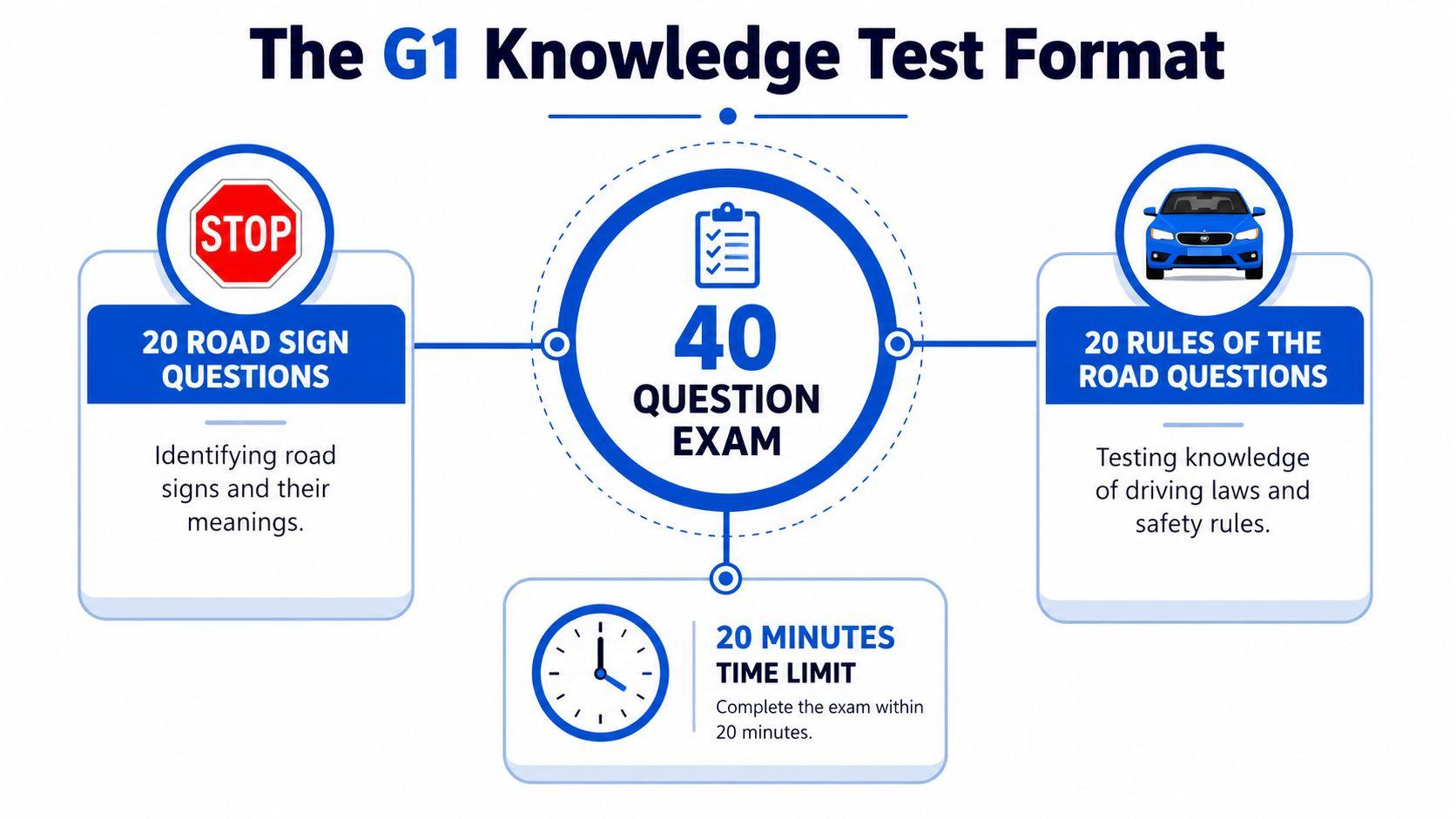
The Ontario G1 knowledge test is blunt. It's a 40-question written exam, split into 20 road-sign questions and 20 rules-of-the-road questions, and you need at least 16/20, or 80%, in each section to pass, according to Ontario G1 practice test guidance. That independent scoring is the part people ignore at their own risk. You can be strong in one section and still fail the test if the other section slips.
What each section feels like
The road-sign side is straightforward in theory and ruthless in practice. You're not being asked to write essays about signs, you're being asked to identify them fast and correctly. If you hesitate between a warning sign and a regulatory sign, that hesitation turns into a wrong answer.
The rules-of-the-road section is where many learners get clipped by wording. Terms like right-of-way, demerit points, and highway merging sound familiar after a few study sessions, but they still trip up newcomers and ESL learners because the vocabulary is doing part of the work. The rule isn't just knowing what to do, it's understanding the English used to describe the situation.
One section can't rescue the other. Treat signs and rules like two separate tests sharing the same screen. Pass both, or you don't pass.
If you're studying in Kitchener, keep one thing front and centre. The test doesn't reward vague understanding. It rewards exact recognition, exact reading, and exact recall under time pressure. That means practice has to look like the actual test, not a casual scroll through flashcards.
Using G1ready.ca to Build Real Exam Readiness
The smartest way to use G1ready.ca is not as a random quiz machine. Use it as a sequence. Start with the diagnostic, because a diagnostic shows you where you're weak before you waste time pretending every topic needs equal attention.
A tighter study ladder that actually works
First, take the diagnostic and stop obsessing over the score. Its job is to expose weak areas. Then move into targeted quizzes on signs and rules, because short drills fix specific gaps faster than broad, unfocused repetition.
After that, switch to mixed tests. People find out whether they really know the material or just know it in topic chunks. Mixed practice forces your brain to jump between signs and rules the way the official test does.
The final step is the simulator or marathon mode. That's where you train your attention span and your pacing, which matters more than most learners admit. If a practice run feels tiring, good, that's the point. You want the test to feel like a familiar routine, not a fresh mental sprint.
The platform's immediate feedback, hints, and explanations matter because every wrong answer should become a corrected answer before the session ends. Progress tracking helps you see whether one topic is still dragging you down. If a section keeps wobbling, don't guess your way through it. Rework it until the pattern stops.
An Ontario knowledge test at Kitchener-area DriveTest centres is handled as a walk-in knowledge test, not a pre-booked appointment, and the official exam is a two-part computerized test with 40 multiple-choice questions total. That means your prep should be simple, fast, and repeatable, because the test-day process itself doesn't reward overcomplication, according to Kitchener G1 test logistics guidance.
Use the questions to train your reading, not just your memory
Some learners blast through practice and still miss easy questions because they read too fast. Slow down on wording that changes the whole answer. A single “except” or “best” can flip the correct choice.
The platform works best when you use it to correct habits, not just collect right answers. If you can explain why the wrong choice is wrong, you're learning. If you only remember the letter, you're gambling.
A Realistic One to Two Week Study Schedule
A staged prep loop, read the MTO handbook, take a timed simulation, review every wrong answer against the handbook, and repeat until scores stabilise at 18/20 or higher in both sections, typically takes about 6 to 10 focused hours of study, according to Ontario G1 study guidance. That is not a huge time commitment, but it does need structure. Random bursts do not beat a steady plan.
If you want a clean way to pace that work, use this G1 test study timeline guide as your reference point, then keep your own schedule tight and realistic. The goal is simple, build recognition, fix weak spots, then confirm the same result more than once.
A sample 10-day rhythm
Use this as a working schedule, not a fantasy calendar.
Day Activity Time Target Score 1 Read the handbook and take a diagnostic 45 to 60 minutes Baseline only 2 Topic quiz on signs 30 to 45 minutes Identify weak signs 3 Topic quiz on rules 30 to 45 minutes Identify weak rules 4 Review every wrong answer 30 to 45 minutes Fix the misses 5 Mixed practice test 30 to 45 minutes Balanced performance 6 Handbook review and targeted drills 45 minutes Fewer repeat errors 7 Timed simulator run 30 minutes Watch pacing 8 Review weak sections again 30 to 45 minutes Clean up gaps 9 Second simulator run 30 minutes 18/20 or higher in both sections 10 Light review only 20 to 30 minutes Stay steady
Keep the early days heavy on correction, not speed. If you miss a sign type on Day 2, drill that exact category again on Day 4 and Day 8 until it stops showing up in your errors. A clean schedule is boring. That is exactly what you want before a G1 test.
If your simulator scores are still bouncing around, do not book yet. Stable performance matters more than one lucky run. The target is consistency, and once your scores settle, you are no longer guessing. At that point, use the G1 test study timeline to sanity-check whether your pace is ready for a test booking.
If you need more than one solid practice session to feel calm, that is normal. If you are still missing the same sign type three days in a row, you are not ready to pay for a real attempt.
How to judge readiness without kidding yourself
Look for consistency. One good score can be a fluke. Two or three solid runs in a row tell you the material has stuck.
If you are juggling work, classes, or family duties, do not chase long marathons every day. Short, focused sessions beat tired cramming. Keep the handbook open next to your practice history and review only what your wrong answers point to. If the same topics keep tripping you up, slow down and fix them before you book the test.
What the Kitchener DriveTest Visit Actually Looks Like
The Kitchener DriveTest experience is usually simpler than people imagine, but it still feels tense if you don't know the sequence. You arrive, check in at the counter, show your identification and any required paperwork, handle the fee, and then wait to be seated at a computer. The local process is a walk-in knowledge test, so don't build your day around a pre-booked slot.
What to bring and what to expect
Bring your original government-issued identification, proof of residency, and any required forms you've been told to carry. Don't show up with copies and hope for the best. The counter staff want clean, correct documents that settle the file quickly.
The experience itself is unglamorous. You'll likely spend part of the visit waiting, then you'll sit down at a computer and work through the questions one by one. When you finish, the score screen appears right away, which is the moment everyone either exhales or stares at the result for a second longer than they should.
For local planning, keep the official location information close and check the current DriveTest details before you go, especially if you're trying to avoid a long wait or a wasted trip. The practical side of getting to the right place matters just as much as the practice itself, and the local location info on G1ready.ca's test locations page is useful for that exact purpose.
Language support and newcomer pressure
If English isn't your first language, don't pretend that vocabulary won't affect you. It will. The test is not just a driving knowledge check, it's a reading check too, and that's why plain-language practice helps.
You don't need to memorise polished definitions. You need to know what the question is asking. That's why targeted, plain-English practice beats a pile of mixed questions when you're still building confidence.
Costly Mistakes Kitchener Test-Takers Make
The worst failures aren't dramatic. They're small, repeatable, and avoidable. A learner misses a sign because two symbols look similar. Another one blanks on right-of-way because the wording feels slippery. Someone else knows the rule but rushes the screen and taps the first option that looks familiar.
The errors that keep showing up
Sign confusion is the classic one. Yield, merge, and lane-end signs are not the same thing, and if you've only ever looked at them casually, they blur together. Fix it by drilling signs in small sets until you can say what each one means before the question finishes loading.
Reading errors are just as damaging. Some learners know the rule but miss the detail that changes the answer. Read the wording twice if needed, then answer the question asked, not the one you expected.
Rushing kills more good attempts than bad memory does. The 20-minute pacing used in some Ontario practice formats exists for a reason, it trains you not to panic when the screen keeps moving, and one Ontario practice format uses 40 questions in 30 minutes to mirror that pacing, according to Ontario practice test pacing guidance.
Fix the habit, not just the answer. If you keep missing the same type of question, slow down and drill that pattern until it stops feeling unfamiliar.
There's another problem that hits newcomers hard. Words like demerit points and highway merging may be easy in concept but awkward in English. That's why the fix is plain-language repetition, not more random guessing. A structured quiz routine beats “I'll just try a few more questions” every time.
The answer isn't to study more hours blindly. It's to study the right pieces, in the right order, and with enough repetition to make the question style feel boring.
Your Test Day Checklist and What Comes Next
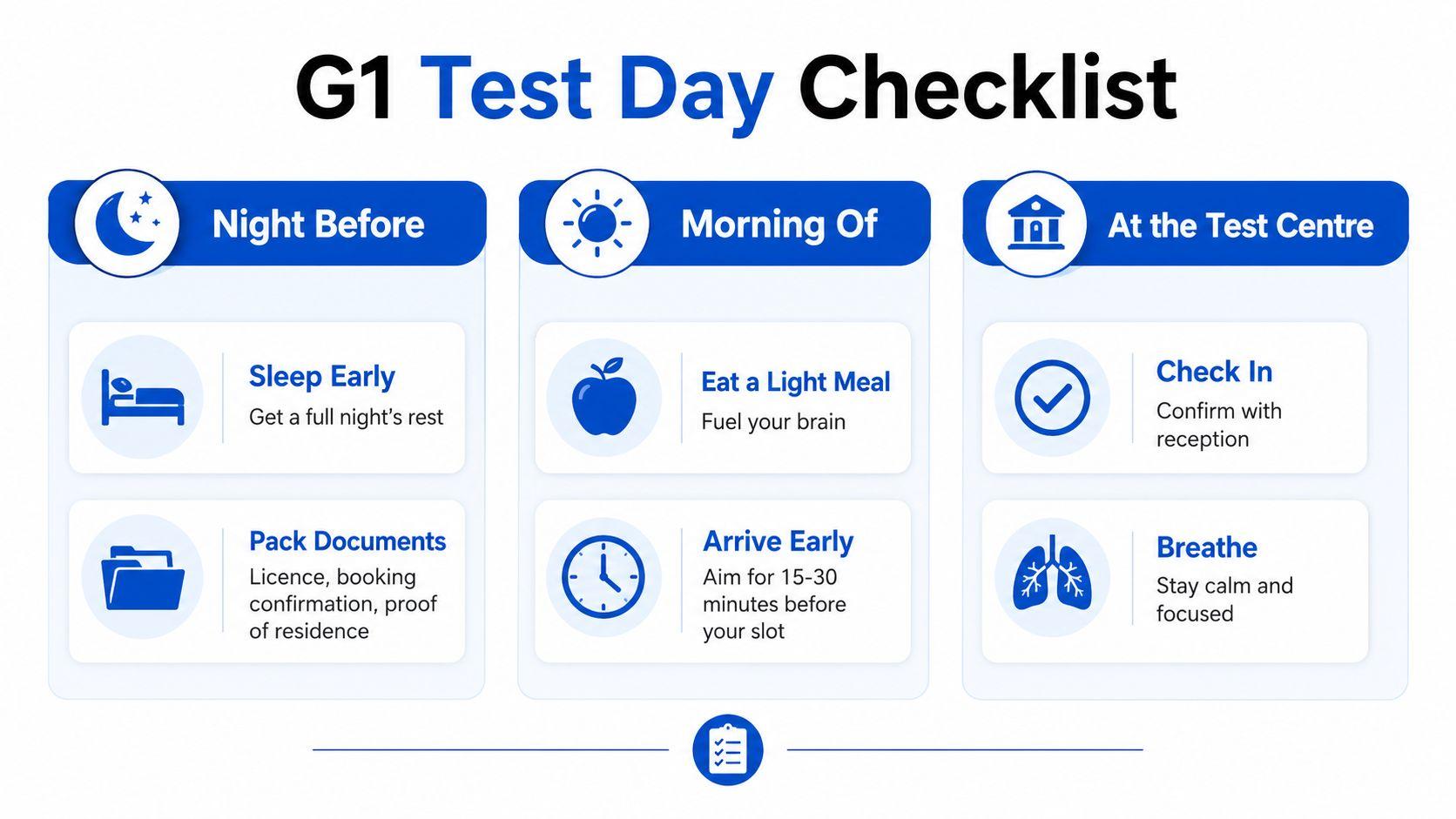
The night before matters. Put your documents together, check the route to the DriveTest centre, and stop cramming brand-new material. Sleep beats panic review. The morning of, eat something light, leave early, and keep your head clear.
Screenshot-ready checklist
- Sleep early: Get a proper night's rest so your reading doesn't slow down.
- Pack documents: Bring your identification, booking confirmation if you have one, and proof of residence.
- Eat a light meal: Don't arrive hungry and distracted.
- Arrive early: Get there before the rush settles in, especially if you are dealing with walk-in traffic and parking in Kitchener.
- Check in cleanly: Have your paperwork ready at the counter.
- Breathe before you start: You do not need a perfect mood, just a steady one.
A strong Ontario G1 preparation benchmark is an 80% minimum passing score on each section in exam-style practice materials. Keep that standard in your head. If your practice results are below that mark, do not force the booking. Use the benchmark as a go or no-go line, not as a confidence trick.
If you pass, the next step is simple. Treat the G1 as the start of a process, not the finish line. If you do not pass, use the same routine again, but aim it at the weak section first instead of starting over from zero.
If you want a structured place to practise before you go back to DriveTest, use G1ready.ca and follow the staged routine until your scores stop wobbling. Then book your attempt with confidence, walk in prepared, and stop gambling on luck.