
If you're searching for the Driving Test Centre Etobicoke, there's a good chance you're already feeling two pressures at once. You need a test date, and you know Etobicoke isn't the kind of centre where you can show up underprepared and hope things work out.
That concern is reasonable. Etobicoke is a busy GTA location, and candidates usually feel the difference right away in the traffic flow, lane pressure, and decision speed the roads demand. The good news is that this centre rewards organised preparation. If you know how to book smartly, arrive with the right documents, and practise the manoeuvres that matter most in a dense urban setting, you can walk in calm and give the examiner a clean drive.
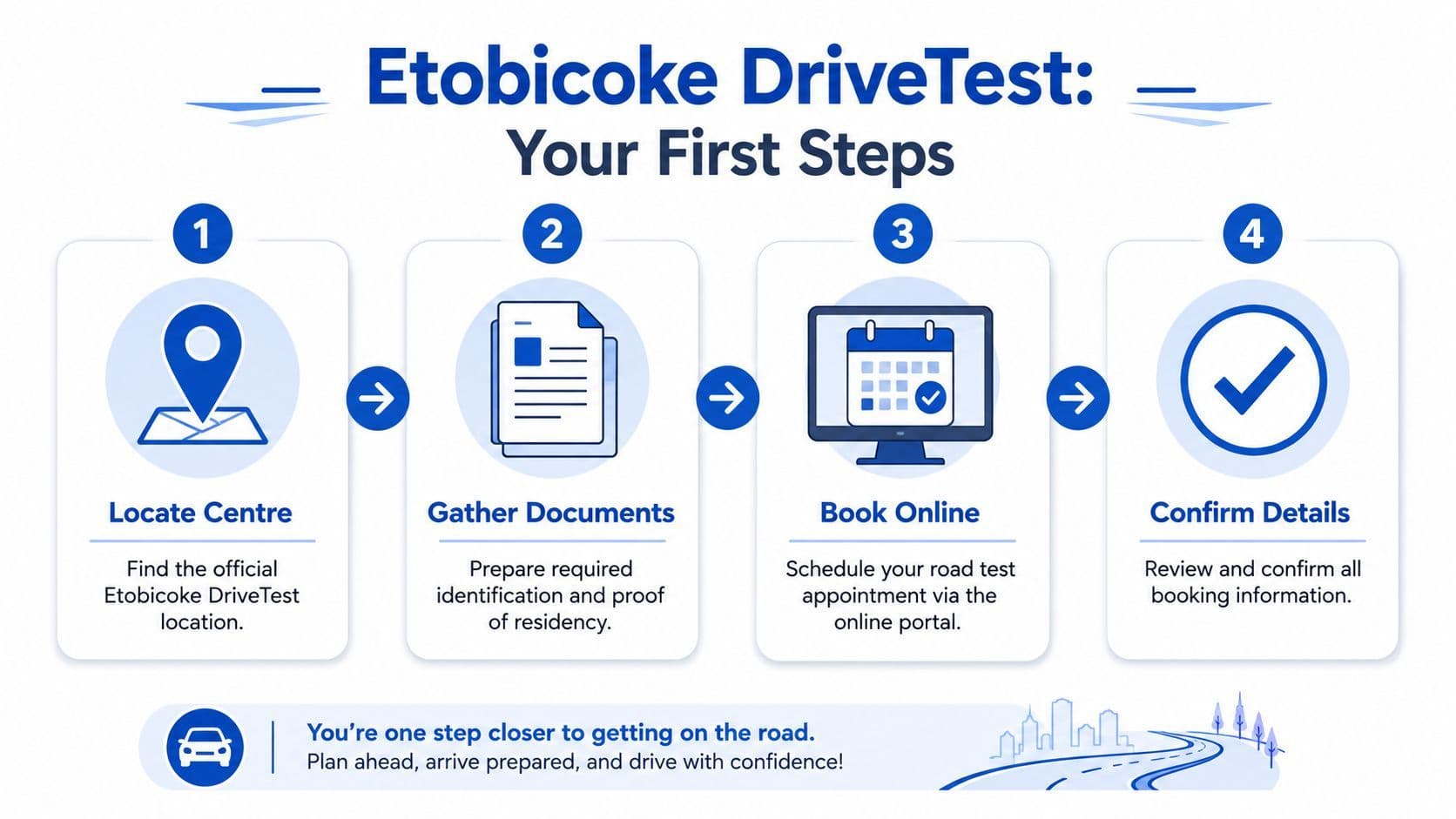
Your First Step Locating and Booking Your Etobicoke Test
Applicants don't struggle with the actual online form. They struggle with timing. They check once, see a late date, and assume that's all that's available. At a busy GTA site, that's often the wrong move.
The Etobicoke DriveTest centre is at 5555 Eglinton Ave W, Etobicoke, ON, M9C 5M1, and its status as a major GTA testing site means appointment availability can be scarce. Ontario has encouraged drivers to use online booking and consider off-peak times because demand changes by location and time, as noted in this Etobicoke DriveTest centre overview.
How to book without wasting weeks
Use a simple process:
- Choose the correct test class first. Make sure you're booking the road test you need, whether that's G2 or G.
- Search specifically for Etobicoke. Don't assume nearby GTA centres are equivalent. Route pressure and traffic conditions can feel very different.
- Check repeatedly, not once. Busy centres often change as cancellations open up.
- Accept a workable date, then keep looking. It's usually better to hold a spot than wait for the perfect one.
If you want a refresher on the booking flow itself, this guide to Ontario G road test booking steps helps clarify how to move through the process cleanly.
Practical rule: Book the first reasonable appointment you can get. Optimise later. Don't leave yourself with no slot at all.
Peak time versus off-peak time
This choice has a real trade-off. Peak periods may give you more realistic practice conditions if you've trained in heavier traffic. They also increase the chances of delays, congestion, and rushed decision-making. Off-peak appointments can mean a more predictable flow, but they can also expose speed-control problems because the road feels easier than it is.
A useful way to decide is to match the appointment to your strongest driving environment.
Booking choice What works What can hurt you Peak traffic Good for drivers confident with lane pressure and short-gap decisions Easy to get overwhelmed by congestion Off-peak timing Better for staying calm and following instructions clearly Drivers sometimes get sloppy with speed and scanning
What actually helps you get a better date
Candidates waste time refreshing randomly. A better approach is more deliberate:
- Check at different times of day. Availability shifts.
- Stay flexible on weekdays. Narrow availability windows usually make booking harder.
- Keep documents ready before you book. Last-minute scrambling leads to mistakes.
- Plan your car early. Don't secure a date and then realise you still need a suitable vehicle.
The booking itself is only the first gate. At Etobicoke, getting a date matters, but being ready for the date matters more.
The Pre-Test Checklist What You Must Bring
A surprising number of road tests go wrong before the examiner evaluates a single turn. The candidate arrives tense, can't find the right document, or brings a vehicle with an avoidable issue. That's preventable.
Treat your pre-test checklist like part of the exam. Organisation matters because it removes stress, and less stress usually means cleaner driving.
Documents that should already be in your hand
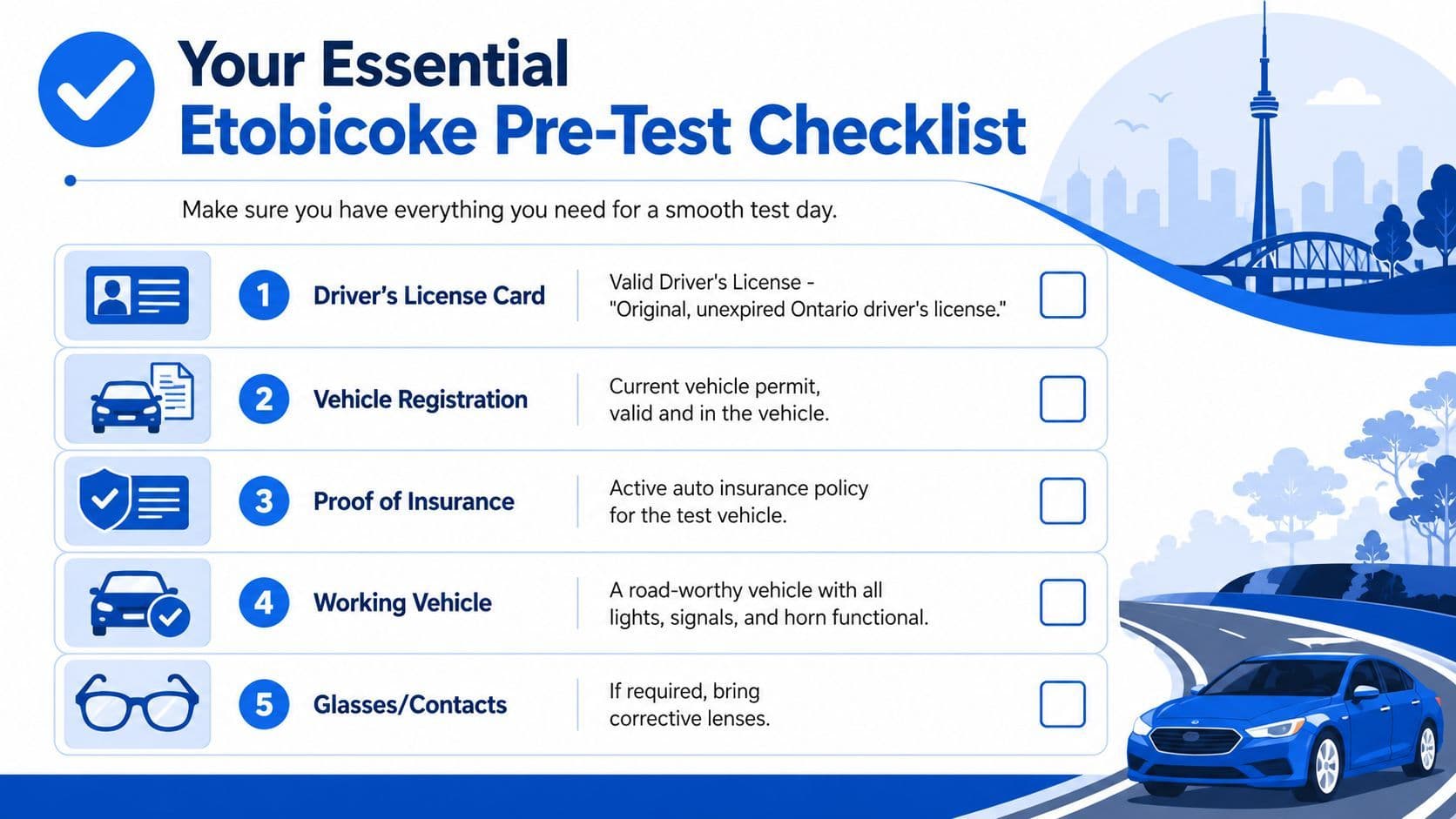
Bring the basics in original, usable form. Don't rely on memory. Put everything together the night before.
- Your valid Ontario driver's licence. Check that it's current and physically with you.
- Vehicle registration. Make sure the permit is in the car and easy to reach.
- Proof of insurance. It should be active and match the vehicle you're using.
- Corrective lenses if required. If your licence condition requires them, wear them.
- Any booking details you want handy. Even if you can access them digitally, keep the information organised.
For a broader document refresher, this breakdown of what documents you need for Ontario driving-related testing is a useful cross-check.
Vehicle condition matters more than people think
The examiner is not looking for a luxury car. They are looking for a car that is roadworthy, predictable, and legal.
Check these items carefully:
- Signals and brake lights: Test them with another person before you leave.
- Horn: Use it briefly to confirm it works.
- Windshield and mirrors: Clean enough for clear visibility.
- Interior: Remove clutter that could interfere with driving or examiner access.
- General drivability: If the car feels unreliable, don't gamble on it.
A clean, simple, familiar vehicle is usually better than a newer vehicle you haven't practised in much.
Rental cars and driving school cars
These can work well if they're properly insured, roadworthy, and familiar to you. The problem isn't the source of the car. The problem is using a car that changes your reference points at the last minute. If your parallel parking setup, brake feel, or mirror angles are different from what you practised, you'll notice it under pressure.
A good pre-test routine is simple. Gather documents. inspect the car. Sit in the driver's seat and confirm your mirrors, seat, steering position, and comfort before test day. That makes the start of the exam feel routine instead of chaotic.
Why Etobicoke Is a Challenging Test Centre
Etobicoke has a reputation, and this time the reputation lines up with publicly reported data. One Ontario pass-rate comparison placed Toronto Etobicoke at a 47% pass rate for the full G road test and 51% for the G2 road test, which puts it among Ontario's lower-performing centres in that dataset, as reported in this Ontario DriveTest pass-rate comparison.
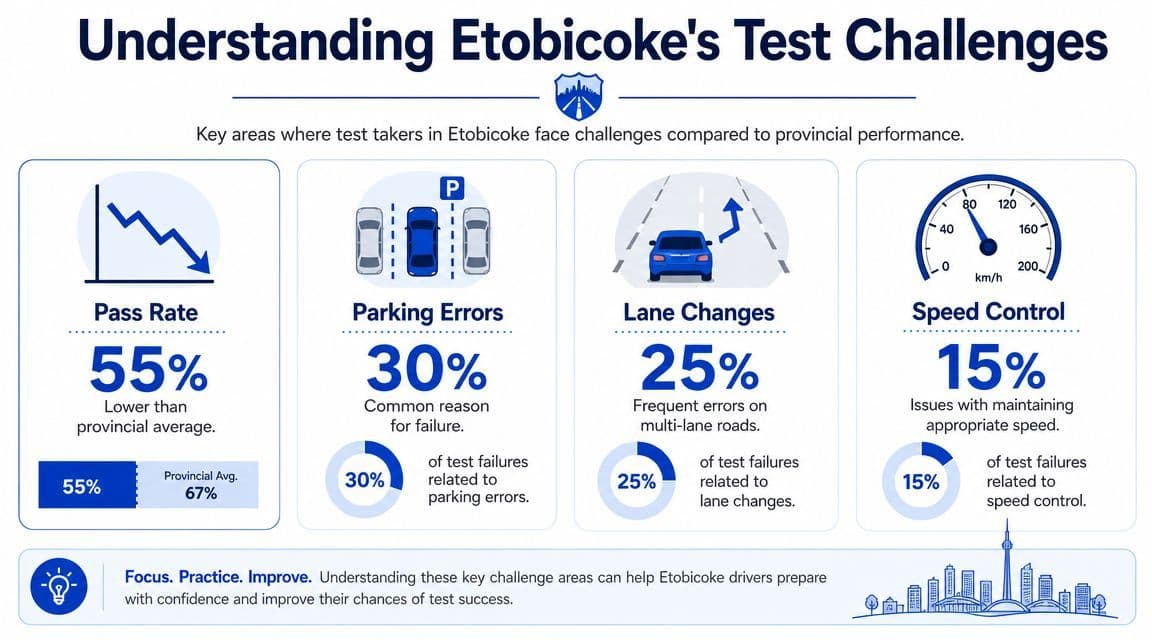
That statistic shouldn't discourage you. It should sharpen your preparation. At a centre where outcomes are less forgiving, each minor error matters more because mistakes tend to arrive in clusters. One rushed lane change leads to poor positioning. Poor positioning creates a late turn. Late turns raise stress, and stress ruins scanning.
Why the roads feel harder here
The challenge is not random. It comes from the road environment. Centres like Etobicoke, with failure rates near half in reported comparisons, expose candidates to more challenging merges, heavier intersection management, and stricter speed control requirements than rural centres, according to this Etobicoke route analysis video discussing traffic density and test difficulty.
In practice, that usually means:
- More lane decisions in less time
- Busier intersections where observation must be obvious
- Speed changes that punish hesitation and overcorrection
- Heavier traffic that makes small habits visible
What the pass-rate data really means for you
The wrong takeaway is, “Etobicoke is unfair.” The useful takeaway is, “Etobicoke is precise.”
Here's the distinction:
Mindset Result Trying not to fail Hesitation, overthinking, late reactions Driving with a repeatable system Better observation, cleaner lane control, calmer decisions
If you prepare for Etobicoke as if every turn, merge, and mirror check counts, you usually drive better everywhere else too.
Candidates who pass here usually don't look flashy. They look settled. They check mirrors early, control speed smoothly, choose lanes with purpose, and avoid giving the examiner any reason to wonder what they're about to do next.
Mastering the Skills for Etobicoke's Roads
The roads around the Driving Test Centre Etobicoke don't reward improvisation. They reward habits. If your scanning, lane changes, and parking routine are automatic, pressure drops fast.
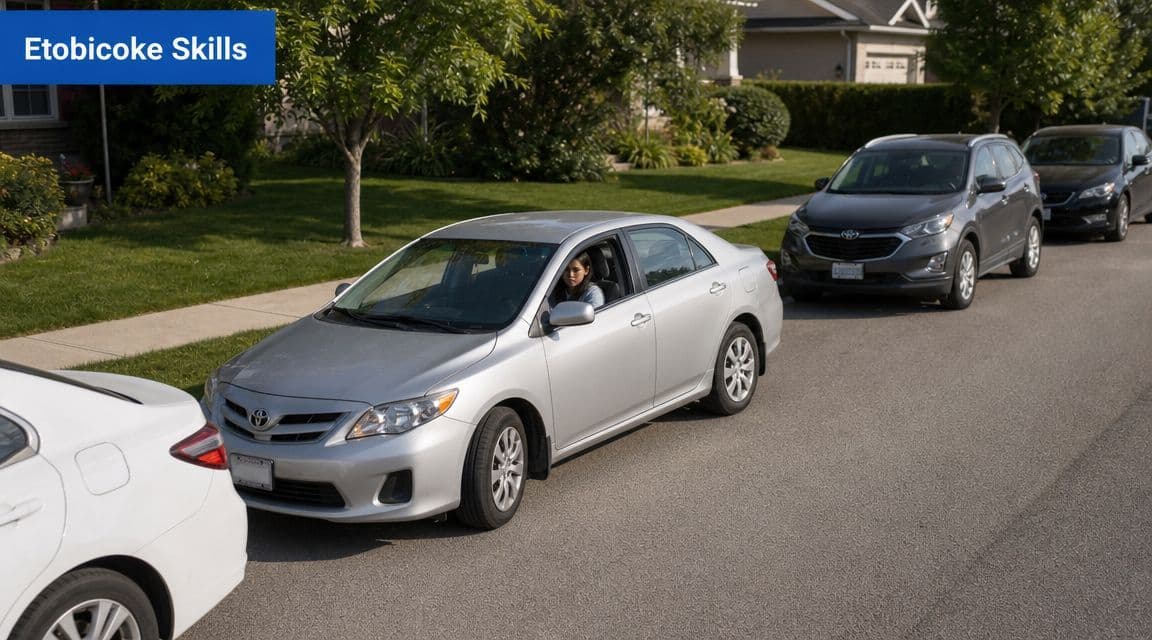
A lot of candidates practise “driving around.” That isn't enough here. Practise specific actions on purpose, then repeat them until they feel plain and uneventful.
Highway merges need early decisions
Etobicoke-area testing pressure often shows up before the merge itself. The mistake happens earlier, when the driver waits too long to assess traffic.
Use this sequence every time:
- Check mirrors early. Don't wait until the lane is ending.
- Build speed on the ramp. A timid merge creates more problems than a confident one.
- Shoulder check at the commitment point. Make it clear and timed to the lane entry.
- Enter smoothly, then stabilise. Don't merge and keep drifting mentally.
What doesn't work is creeping up the ramp and hoping someone makes space. What works is matching traffic as closely as conditions allow, then entering decisively.
Intersections reward discipline
Large intersections test more than right-of-way knowledge. They test whether you can stay organised while multiple things happen at once.
Focus on these habits:
- Lane choice before the intersection. Late corrections look unsafe.
- Scanning left, centre, right. Especially after the light changes.
- Steady steering through the turn. Wide or cut turns stand out immediately.
- Finishing the turn into the proper lane. Don't treat that as optional.
If you need extra work on tight-space control, this guide to parallel parking for the Ontario driving test is a practical add-on for your training sessions.
The examiner doesn't need perfection. The examiner needs to see that you notice hazards early and respond in a controlled way.
A good home practice drill is to narrate your decision points out loud with a supervising driver. Say the lane, speed zone, mirror check, and hazard. It sounds simple, but it forces your eyes and hands to work together.
Here's a useful visual walkthrough before a practice session:
Parking drills must be boringly repeatable
Parking errors usually come from inconsistency, not lack of knowledge. The fix is repetition in one vehicle.
Run these drills in a quiet area:
- Parallel parking: Use the same setup points each time.
- Three-point turns: Keep steering controlled and observations visible.
- Roadside stop and emergency stop: Signal, position, stop smoothly, secure the car properly.
- Uphill and downhill parking if assigned in practice: Build the habit so you don't hesitate if asked to explain or perform related positioning.
One more practical point. A learner preparing for road tests can also use G1ready.ca for Ontario rule review and location lookup features when checking DriveTest details and brushing up on handbook-based knowledge before in-car practice. It won't replace road practice, but it can support the theory side of preparation.
Navigating Test Day From Arrival to Start
Test day usually feels longest in the parking lot. You've already done the hard work, but now your attention can drift into nervous habits. The fix is to treat the morning like a routine, not an event.
Arrive early enough that you can park, breathe, and organise yourself without rushing. You want a few quiet minutes in the car to adjust your seat, mirrors, and mindset. You do not want to jog into the centre holding loose papers and guessing where to go.
What the first part of the visit feels like
A typical sequence goes like this. You arrive, park properly, and check in with your documents ready. Then you wait for your turn while trying not to replay every practice drive you've ever had.
Keep your focus narrow:
- Licence ready
- Vehicle documents ready
- Phone silenced or put away
- Mirrors and seat already set before the examiner arrives
Once the examiner comes out, the interaction is usually straightforward. They'll verify information and check the vehicle basics they need to see. That may include signals, brake lights, and horn. This part isn't meant to surprise you. It's a quick confirmation that the vehicle is suitable for the road test.
How to make a strong first impression
You don't need to be chatty. You need to be composed.
A calm candidate usually does three things well right from the start:
Good test-day habit Why it helps Listens fully to instructions Prevents rushed, half-heard decisions Moves deliberately Shows control instead of panic Keeps observation visible Makes your awareness easy for the examiner to assess
When the examiner gets into the car, your job is simple. Be safe, be predictable, and make your observations easy to see.
If you make a small mistake in the opening minutes, don't assume the test is over. Many candidates spiral after one imperfect moment. The better response is immediate recovery. Reset at the next intersection. Follow the next instruction cleanly. Keep driving the present moment.
After the Test Interpreting Results and Planning Next Steps
The last few minutes can feel strangely quiet. You return to the centre, park, and wait for the result. At that point, there are only two useful responses. Learn from a pass, or learn from a fail.
If you pass, follow the examiner's instructions, complete the required steps for your temporary licence documents, and keep driving with the same habits that got you through the test. Passing isn't proof that you'll never make mistakes. It means you showed the level of safe, controlled driving required that day.
If you don't pass, keep the result in perspective. One published dataset reported a 53% failure rate for the G test at Etobicoke, and the practical lesson from that kind of result is clear: failing is a common outcome there, and successful re-testing depends on using the examiner's scoresheet to identify and rehearse the exact manoeuvres that cost marks, as noted in this Etobicoke full G pass and failure rate summary.
How to use the scoresheet properly
Don't just glance at it and file it away. Work through it with purpose.
- Identify the repeated pattern. Was it speed control, observation, lane position, or rushed turns?
- Match each issue to a drill. Turn a vague weakness into a repeatable practice task.
- Use the same test vehicle if possible. Removing variables helps.
- Rebook when you can practise with intent. Don't rush back in without changing anything.
A failed road test at Etobicoke doesn't tell you that you can't drive. It tells you where your current habits broke down under pressure. That's useful information. Drivers improve fastest when they treat feedback as a training plan, not a verdict.
If you're preparing for any stage of Ontario licensing, G1ready.ca gives you a practical place to study the rules, practise test-style questions, and get organised before your next DriveTest appointment.


