You're sitting in the driver's seat, maybe practising for your G1, maybe thinking about your first solo trip to school, work, or the shops. Traffic feels manageable until you hear a siren somewhere behind you. Suddenly the simple question becomes stressful. Do you stop right away? Do you keep moving? What if you're at a red light? What if there's no room?
That moment trips up a lot of new drivers because the basic rule sounds simple, but real roads aren't simple. Cars box you in. Intersections create pressure. Highways give you speed but less thinking time. The good news is that emergency vehicle rules follow a few clear patterns. Once you understand those patterns, the right choice becomes much easier on test day and on the road.
Why Mastering Emergency Vehicle Rules Is Critical
A new driver's first reaction to a siren is often hesitation. You hear it, you check your mirrors, and for a second you freeze because you don't want to make the wrong move. That reaction is normal. The road feels crowded, the sound feels urgent, and you know someone may need help quickly.
This is one reason emergency vehicle rules matter so much. They aren't just test material. They are part of a system that lets paramedics, police officers, firefighters, and roadside responders reach people without delay. In Ontario, paramedic transports per 100,000 residents increased by 38.3% between 2010 and 2019, a rise that outpaced population growth according to research on paramedic transport trends in Ontario. That means drivers are sharing the road with emergency response vehicles in a busier, more demanding environment.
Why this matters to a learner
When traffic is light, moving over sounds easy. In real life, you may be beside a bus, approaching a junction, or boxed in by parked cars. A good driver doesn't panic in those moments. A good driver follows a sequence.
Practical rule: Your job isn't to disappear instantly. Your job is to become predictable, create space, and avoid blocking the emergency vehicle.
That's also why this topic shows up so often in G1-style questions. The test wants to know whether you understand right-of-way under pressure, not just whether you've memorised a sentence from the handbook.
The mindset that helps
Treat a siren like a cue to slow your thinking down, even if the emergency vehicle is speeding up. Scan your mirrors. Check where the vehicle is coming from. Look for the safest way to clear its path.
If you build that habit now, you won't feel trapped by the question. You'll recognise the pattern and act calmly.
Decoding the Signals What Lights and Sirens Mean
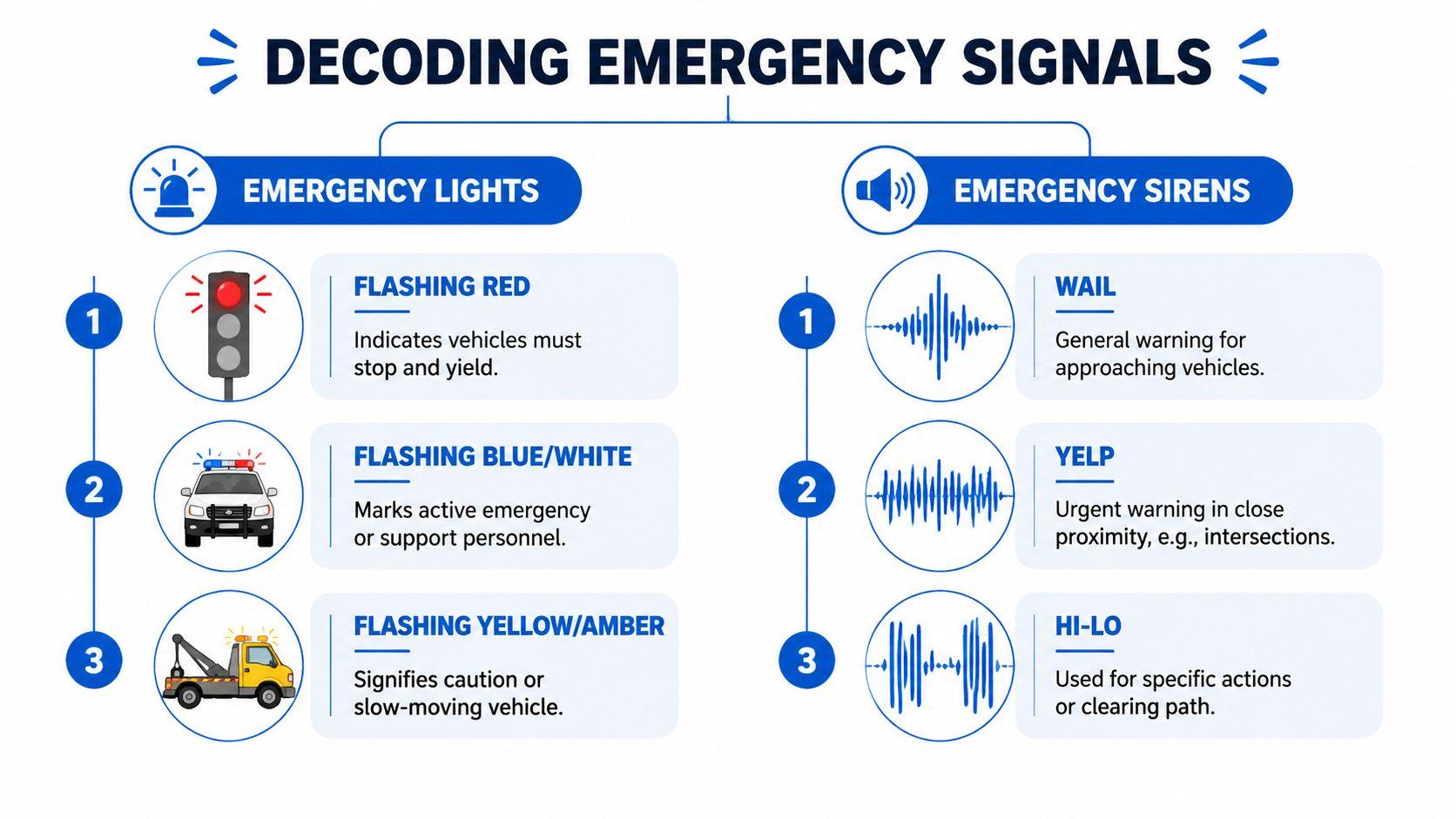
Emergency signals are a language. Lights tell you that a vehicle needs attention. Sirens tell you that the situation is active and urgent. When you read both together, you can respond faster and more confidently.
Start with what you can see
Flashing lights are your first clue, especially before you hear where a siren is coming from.
- Flashing red lights: These signal an emergency response vehicle that needs priority. Think police, fire, or ambulance.
- Red and blue combinations: In Ontario's roadside enforcement context, the Move Over law specifically targets stopped vehicles showing intermittent red lights or red and blue combinations.
- Amber or yellow lights: These usually mean caution rather than emergency passage. Tow trucks and road service vehicles often use them. You still need to react carefully because they may be stopped on the shoulder or moving slowly.
If you're also reviewing visual road cues, it helps to study emergency signals alongside Ontario road signs practice material, because the test often mixes signal recognition with right-of-way decisions.
Then listen for urgency
Sirens aren't all used the same way in practice. You might hear a longer wail from farther away or a quicker pattern near an intersection. For a new driver, the exact name of the siren matters less than the response it demands.
Here's the simple rule: if you hear a siren and identify an emergency vehicle approaching, start planning how to yield safely.
Don't wait until the vehicle is directly behind your bumper. Early awareness gives you safer options.
Read the whole scene, not one detail
A learner's common mistake is locking onto one signal and ignoring the rest. For example, you might notice flashing lights behind you but miss that traffic beside you leaves no safe room to brake sharply. Or you hear a siren but can't yet see the vehicle, so you stop in an awkward place too soon.
Use a quick mental check:
- Locate it: Front, rear, cross street, or shoulder.
- Judge the path: Is it trying to pass you, cross your lane, or enter the road?
- Choose space: Right edge, full stop, or careful forward movement if an intersection blocks you.
The key distinction learners need
A moving emergency vehicle with lights and siren asks for a clear path. A stopped responder vehicle with activated lights, such as a police cruiser or tow truck on the roadside, triggers the separate Move Over duty covered later.
Those are related rules, but they are not the same situation. On the G1 test, that difference matters.
Your Legal Duty How to Respond on the Road
When an emergency vehicle approaches with active signals, your response has to be calm, quick, and orderly. Most learners remember “pull right and stop,” but under pressure they skip the steps that make that move safe.
The standard response sequence
Use this order whenever traffic conditions allow:
- Stay calm and check mirrors. Confirm where the vehicle is coming from.
- Signal your intention. Let nearby drivers know you're moving right.
- Move toward the right-hand edge of the road. Do this smoothly, not sharply.
- Stop clear of the intersection. Don't block cross traffic or force the emergency vehicle to guess your next move.
- Wait until it passes. If more than one emergency vehicle is coming, stay put until the route is clearly open.
For rule review beyond this topic, many learners pair this with Ontario G1 road rules study notes so the right-of-way rules stay connected in one study session.
What “pull to the right” actually means
It doesn't mean diving for the curb without thinking. It means moving as far right as is safe for the road you're on.
On a residential street, that may be close to the curb. On a wider road, it may mean the right side of your lane or the rightmost lane if you can move over safely. If cyclists, parked cars, or pedestrians are present, leave room and don't create a second hazard while trying to solve the first one.
Remember: A smooth, visible move is better than a sudden, panicked one.
What not to do
Some mistakes are especially common with new drivers:
- Stopping in the middle of the lane without checking behind: This can trap the emergency vehicle and confuse everyone else.
- Accelerating to stay ahead of the siren: That keeps you in the way longer.
- Following too closely after it passes: Drivers sometimes chase the cleared path. That's unsafe and can create another emergency.
- Freezing when boxed in: If traffic is dense, keep looking for the first safe chance to yield instead of making a rushed move.
In heavy traffic
Heavy traffic changes the timing, not the principle. You still need to yield. What changes is that you may need a few extra seconds to do it safely.
Look for small openings. Signal early. Let the emergency vehicle see that you understand what's happening and are cooperating. Predictability helps responders more than erratic movement.
A good instructor often says the same thing in different words: don't compete for space with an emergency vehicle. Give space, show your plan, and get out of the path.
Navigating Complex Scenarios Intersections and Highways
In this situation, many learners lose confidence. The rule sounds easy when you're driving on a straight, open road. It feels much harder when you're pinned at a red light or surrounded by fast traffic on a multi-lane highway.
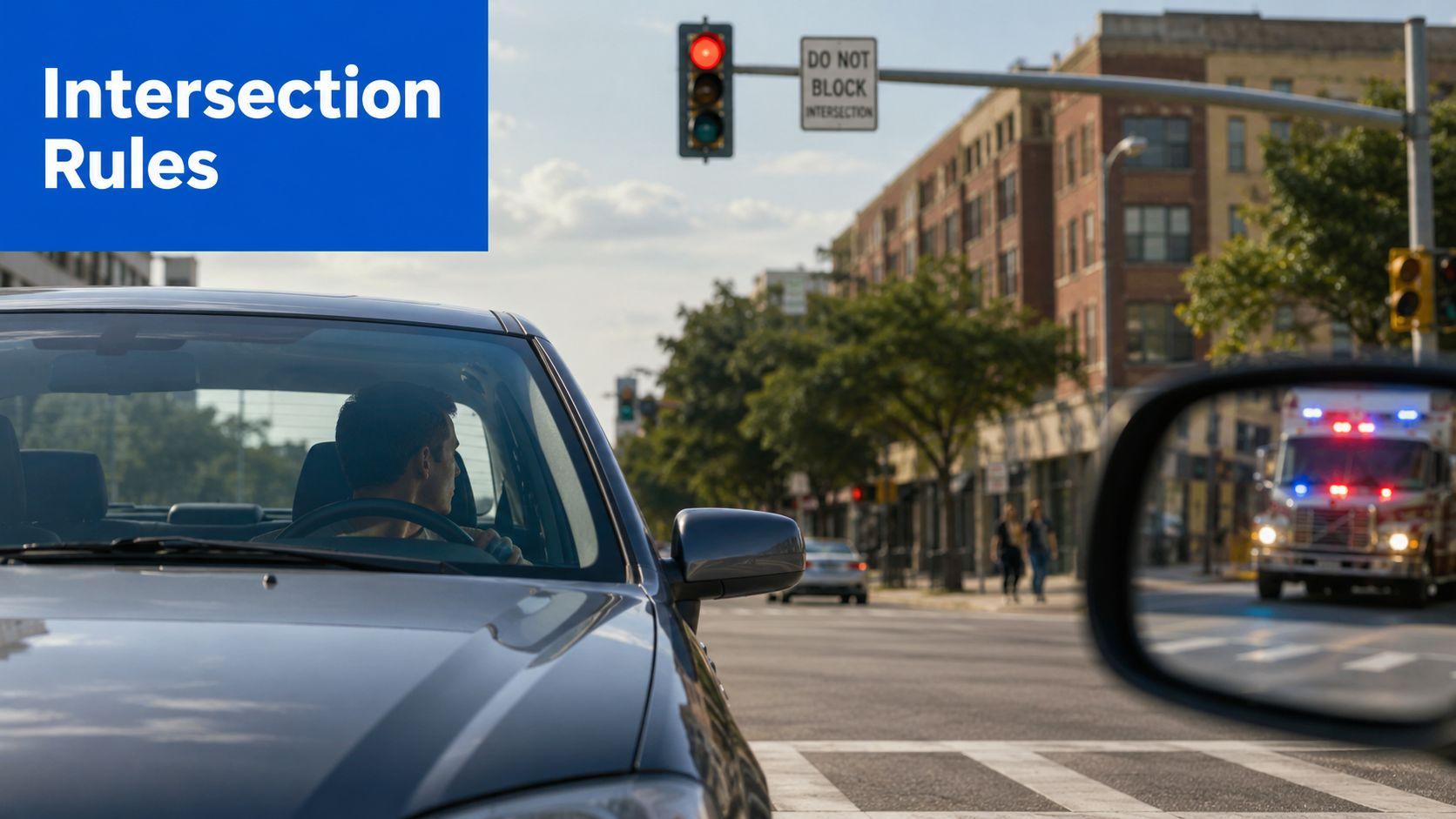
That confusion is real. A 2025 DriveSmart Ontario survey found that 42% of drivers were confused about emergency vehicle procedures at intersections, a gap noted alongside official guidance that doesn't fully spell out the “wait for green, then move forward before pulling right” sequence on the Ontario guidance about driving near emergency vehicles.
When you're already at a red light
Suppose you're the first car at a red light and an ambulance arrives behind you. Your instinct may be to creep into the intersection immediately. That can be risky if cross traffic still has the right-of-way.
The safer sequence is usually this:
- Stay aware of the signal. Don't launch into cross traffic.
- Wait for a legal opening. If the light changes or traffic control allows movement, go forward carefully.
- Then pull right and stop as soon as it's safe.
This is the “in-between” scenario many handbooks compress too much. The goal is still to clear the path. You just can't create a fresh collision by forcing your way through a red.
When you're in the middle of the intersection
This one feels stressful because stopping immediately seems obedient, but it can be the wrong choice.
If you are already in the intersection when you notice the emergency vehicle, keep moving through it. Then pull over to the right and stop when you're clear. Stopping inside the intersection blocks the exact area emergency drivers often need most.
If you're already committed to the intersection, complete that movement first. Then yield from a safer position.
A short visual explanation can make this easier to remember:
What changes on multi-lane highways
Highways make learners think they must always change lanes immediately. That isn't always possible. What matters is creating a usable path without making a sudden, dangerous move.
If an emergency vehicle is approaching from behind on a highway:
- Check mirrors quickly and continuously.
- Move right if you can do so safely.
- Avoid abrupt lane changes.
- Don't stop in a live lane unless traffic conditions leave no safer option.
The same common-sense principle applies on busy expressways. Smooth movement beats dramatic movement. If you're in the left lane and can safely move right, do it. If traffic is tightly packed, slow in a controlled way and create space so lanes can open.
A useful test-day shortcut
When a G1 question gives you a tricky location, ask yourself one thing: What action clears the emergency vehicle's path with the least added danger?
That question usually points you to the right answer. At an intersection, that often means finishing the movement you've already started before yielding. On a highway, it means opening a lane rather than slamming on the brakes.
Ontario's Move Over Law and Penalties
You are driving past a traffic stop on the shoulder. The police cruiser is stationary. Its lights are flashing. No siren is chasing you from behind, but the law still requires you to act.
That is the part many new drivers miss.
Ontario's Move Over law applies to stopped emergency vehicles and tow trucks with activated lights. The rule is simple in principle. Give the people working on the roadside more space and more time. If it is safe, move into a lane that is not right beside them. If you cannot change lanes safely, slow down and pass carefully. On roads with a speed limit of 80 km/h or more, that means slowing to 60 km/h when passing, as noted in OPP West guidance on Ontario's Move Over law and enforcement.
A good way to remember this is to separate two situations in your mind. A moving emergency vehicle with sirens needs a clear path through traffic. A stopped emergency vehicle or tow truck needs a safety buffer around it. Different situation, different response.
That distinction shows up in test questions. A G1-style question may describe flashing lights on the shoulder without mentioning a siren. That is your clue that the Move Over law applies. If you want extra practice spotting those wording differences, these Ontario driving test practice questions on emergency vehicle scenarios can help you rehearse them.
What happens if you do not move over
Ontario treats this offence seriously because roadside workers are exposed to passing traffic at close range. According to Section 159 guidance in this Ontario Move Over law toolkit, a first offence can lead to a fine from $490 to $2,000 and three demerit points.
Repeat offences can carry steeper consequences.
Guidance summarized in this Ontario Move Over law penalty summary notes that a second offence within five years can bring higher fines, possible jail time, and a possible licence suspension.
Penalties for violating the Move Over Law in Ontario
Penalty First Offence Second Offence (within 5 years) Fine $490 to $2,000 $1,000 to $4,000 Demerit points 3 demerit points 3 demerit points Jail possibility Not specified in the first-offence fact provided Up to 6 months Licence consequences Not specified in the first-offence fact provided Possible suspension for up to 2 years
One last point matters for real driving, not just the test. You do not get credit for making a risky lane change at the last second. If moving over is unsafe because traffic is packed, the correct response is to slow down and pass with care. The law expects judgment, not panic.
Bottom line: If you see a stopped emergency vehicle or tow truck with activated lights, create space if you safely can, slow down, and pass carefully every time.
G1 Test Prep Checklist and Practice Questions
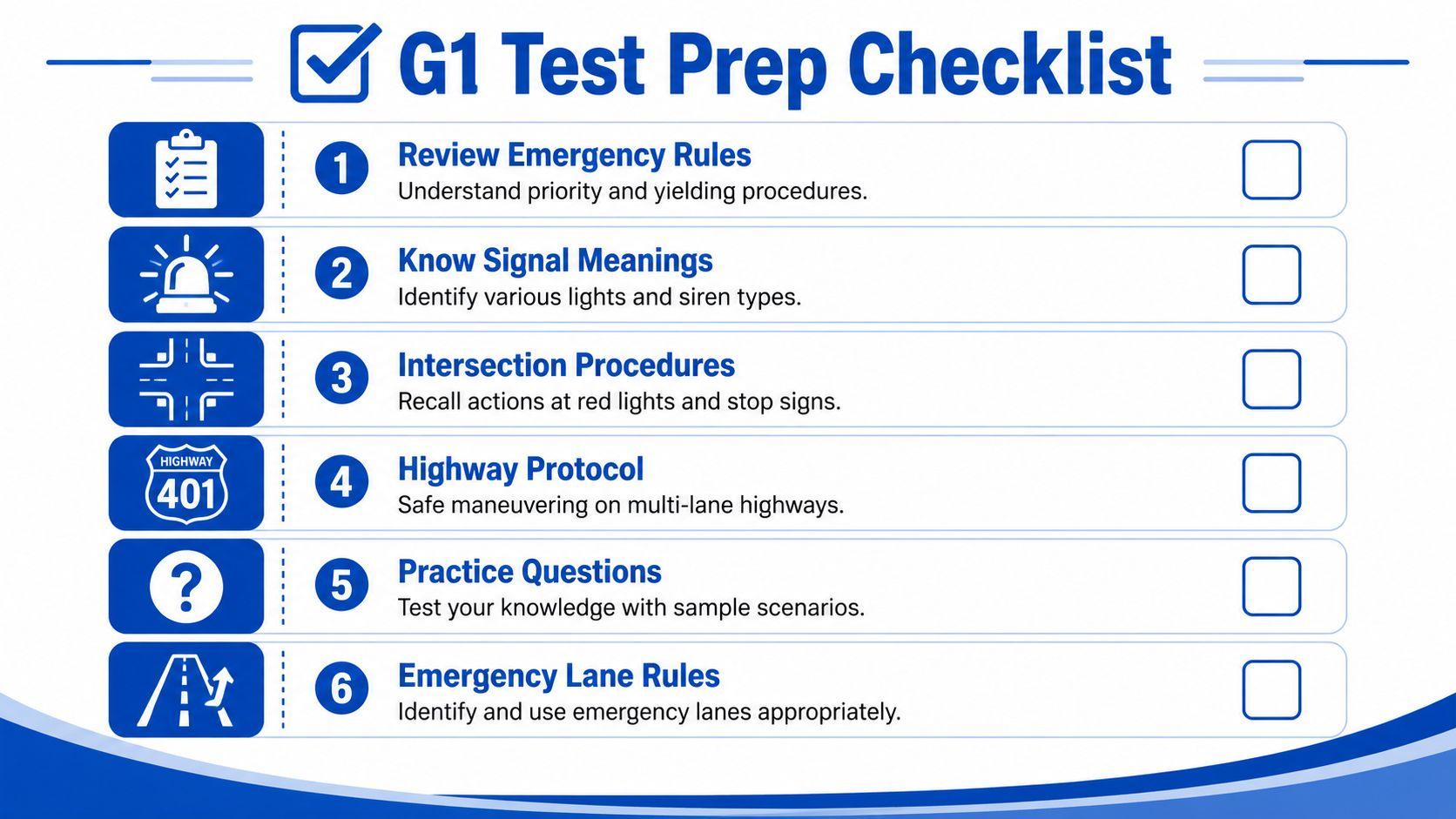
Knowledge sticks better when you turn it into a repeatable checklist. Before your G1, you want the rules in a form you can scan quickly, then test with realistic scenarios.
Last-minute checklist
- Know the main response: Hear or see an approaching emergency vehicle, move right when safe, and stop clear of the way.
- Read the whole road: Don't stare only at the flashing lights. Check mirrors, nearby traffic, cyclists, and the shoulder.
- Handle intersections carefully: If you're blocked by a red light, don't force your way into danger. If you're already in the intersection, clear it first.
- Treat highways differently from city streets: Open a path with smooth lane movement. Don't make a panic stop in fast traffic.
- Remember stationary responder rules: A stopped vehicle with activated emergency or tow lights triggers the Move Over duty, not the same response as a moving siren.
- Practise with test-style questions: Repetition helps you recognise patterns faster. For extra drills, some learners use Ontario driving test practice questions, and G1ready.ca also offers registration-free practice exams aligned with the Ontario handbook.
Practice questions
1. You hear a siren and notice an ambulance approaching from behind on a normal city street. What should you do first?
A. Speed up to stay ahead of it
B. Check mirrors and move right when safe
C. Stop immediately where you are
D. Turn left at the next side street
Correct answer: B
You need awareness before action. Checking mirrors tells you where the ambulance is and how to create space safely. Stopping instantly in place can block the lane.
2. You are already in the middle of an intersection when you hear a fire truck approaching. What should you do?
A. Stop in the intersection
B. Reverse out of the intersection
C. Continue through, then pull right and stop
D. Turn whichever way looks fastest
Correct answer: C
If you're already committed, clear the intersection first. Emergency vehicles often need that space open.
The best answer usually avoids both panic and obstruction.
3. You are first at a red light and an emergency vehicle arrives behind you with lights and siren. What is the safest general approach?
A. Drive through the red light into cross traffic at once
B. Stay frozen until the emergency vehicle turns away
C. Wait for a safe legal opening, move forward, then pull right
D. Exit your vehicle and wave it past
Correct answer: C
This is the intersection stalemate many learners struggle with. The aim is to help without creating a collision.
4. You pass a stopped tow truck with activated lights on an Ontario roadway. What does the Move Over law require?
A. Honk and continue at normal speed
B. Speed up and pass quickly
C. Slow down and move to a non-adjacent lane if safe
D. Stop beside the tow truck
Correct answer: C
That's the roadside protection rule. It applies even though the vehicle is stationary.
5. After an emergency vehicle passes, what should you avoid doing?
A. Checking traffic before rejoining flow
B. Following closely behind it through cleared traffic
C. Waiting until the path is clear
D. Returning to your lane smoothly
Correct answer: B
Some drivers try to use the gap created by the emergency vehicle. That's unsafe and can interfere with response work.
Driving with Confidence and Care
Emergency vehicle rules become much easier once you stop seeing them as isolated facts. They're really one safety principle used in different situations. Recognise the signal, read the road, clear the path, and don't create a second hazard while trying to help.
That mindset helps with the G1 because many questions are designed to test judgment, not just memory. It also helps in real traffic, where conditions are rarely neat and predictable. A calm driver who understands the rule behind the rule will usually make the safer choice.
If you're new to Ontario roads, give yourself credit for learning this properly. These situations feel intense at first, but they don't have to feel overwhelming. With practice, you'll hear the siren, assess the scene, and know what to do.
If you want more Ontario-specific G1 practice, G1ready.ca provides mobile-friendly study tools, including targeted quizzes, mixed tests, and exam-style practice built around the current handbook.