

The best time to take your driving test in Ontario is usually Tuesday to Thursday between 9:00 a.m. and 11:00 a.m. Personal readiness matters most, but that mid-week, mid-morning window usually gives you a cleaner drive than rush hour, lunch buildup, evenings, or weekends.
If you're staring at the DriveTest booking page right now, refreshing dates and wondering whether timing makes a difference, the short answer is yes. In Ontario, test timing isn't just about convenience. It affects traffic density, how rushed the area feels, and how much extra mental load you carry before you even start the car.
A lot of advice online stays vague. It says things like “book in the morning” or “avoid busy times” without talking about how Ontario road tests feel in the GTA, in busy suburban centres, or in smaller cities. The smarter approach is to pick a slot that matches both road conditions and your own strongest driving hours.
Your Guide to Booking the Perfect Road Test Slot
Ontario doesn't give you much room for last-minute planning. New drivers must hold a G1 for at least 12 months, or 8 months with approved beginner driver education, which means your road test is something you plan well ahead of time, not something you squeeze in randomly (Ontario G1 waiting-period overview).
That long runway is frustrating when you're eager to move on, but it creates one advantage. You can use the waiting period to aim for a stronger appointment instead of taking the first awkward slot you see. That's one of the most practical ways to approach the question of the best time to take driving test Ontario students ask all the time.
Use the waiting period as leverage
A smart booking plan usually looks like this:
- Work backward from eligibility. Know the first date you can legally test.
- Prioritise your preferred window. Mid-week and mid-morning should be your first target.
- Match the test to your strongest driving time. If you always drive well at a certain time of day, don't ignore that.
- Leave room for a lesson close to test day. A warm-up drive helps more than many realize.
Practical rule: Don't treat booking as a separate task from training. Your calendar, your lesson schedule, and your test slot should support each other.
The timing itself matters, but only up to a point. A quiet road won't fix poor mirror checks, late shoulder checks, weak lane discipline, or hesitant turns. On the other hand, a prepared driver in a sensible time slot usually gives themselves the calmest possible conditions to show what they already know.
That's the real mindset to carry into booking. You aren't hunting for a magical appointment that guarantees a pass. You're choosing a slot that removes avoidable pressure.
The Real Secret Weapon Your Own Preparedness
Most students spend too much energy trying to find the perfect date and not enough asking a harder question. If the examiner asked for a lane change, a three-point turn, parallel parking, and a controlled stop right now, would your driving still look calm and consistent?

What ready actually looks like
Being ready doesn't mean “I drove fine yesterday.” It means your habits hold up repeatedly without coaching.
A prepared G2 candidate can usually do the following without a running commentary from an instructor:
- Control speed smoothly in school zones, residential streets, and busier roads
- Check mirrors and blind spots naturally instead of only when reminded
- Park accurately without panic corrections
- Handle right and left turns with proper lane position
- Read hazards early so nothing feels sudden
If you're still guessing your next move at busy intersections, timing isn't your problem. Repetition is.
One practical way to tighten weak areas is to pair your in-car practice with focused review. If you're working toward the G2, this G2 road test guide lays out the skills and expectations you should already be meeting before you book.
Timing can help but it can't rescue weak habits
I've seen students book what looked like an ideal slot, then struggle because their driving was still inconsistent. I've also seen students pass in less-than-ideal conditions because their fundamentals were organised and reliable.
A quiet road helps you show your skill. It doesn't create the skill.
Ask yourself these questions before you commit to a date:
Readiness check If the answer is no Do you drive the full lesson without repeated correction? Keep practising before booking Can you recover calmly from a small mistake? Build more real-road experience Have you practised the exact manoeuvres tested? Focus on those first Does your usual lesson time feel natural and alert? Try to book near that time
A good test slot lowers stress. Your preparation does the heavy lifting.
Decoding the Best Day and Time for Your Test
Ontario road-test demand is high. The province handles hundreds of thousands of driver examinations each year across 39 DriveTest locations, and appointment shortages are common, especially in busier metro areas (Ontario road-test demand and DriveTest network overview). That matters because the test centre atmosphere, local traffic flow, and appointment availability all affect how smooth your test day feels.
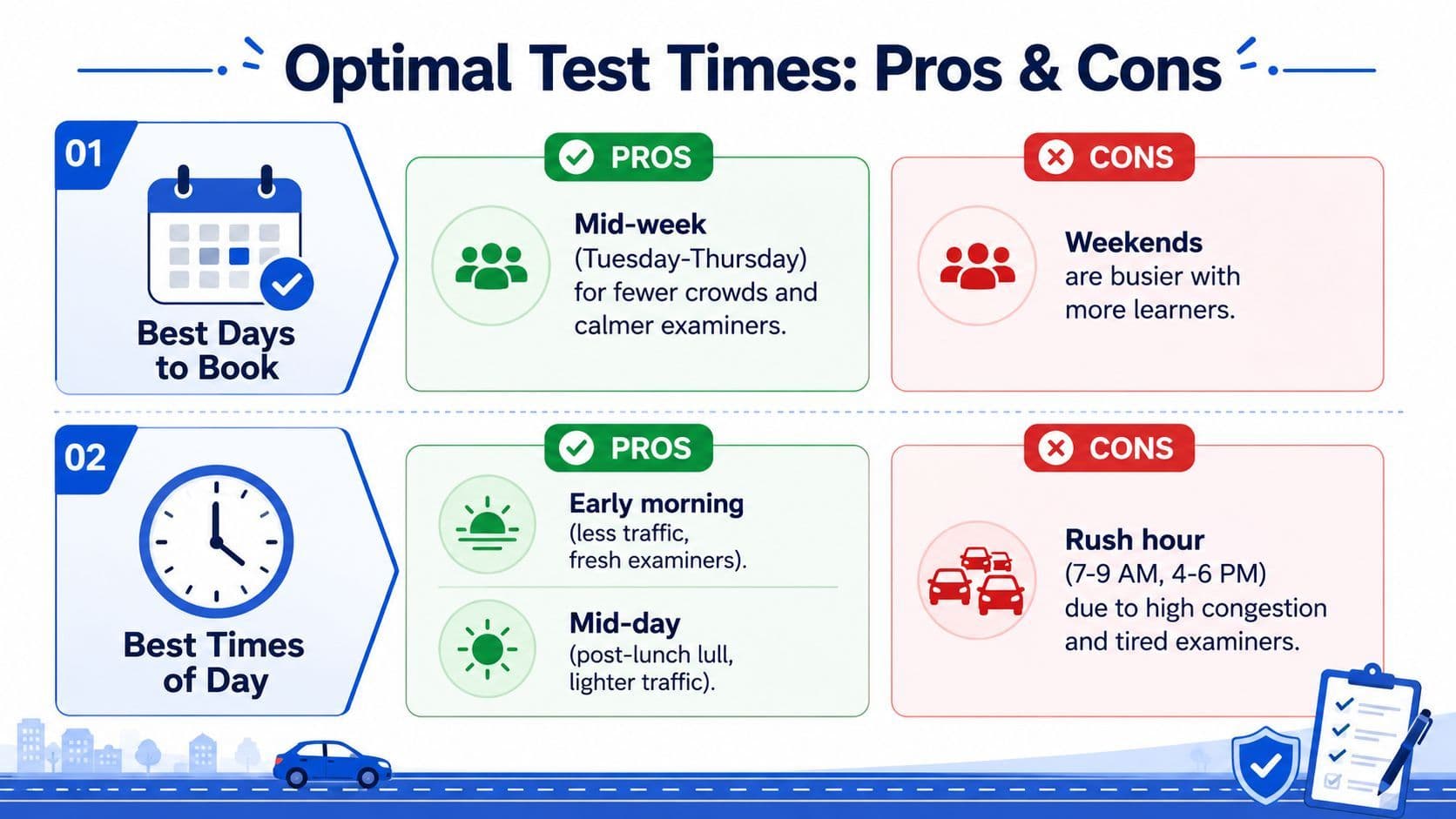
The visual below captures the basic trade-offs.
Why mid-week usually works better
Tuesday through Thursday is the most practical target for many Ontario learners.
Mondays can feel choppy. Roads are settling back into weekday rhythm, and test centres often feel busier from the start. Fridays bring a different kind of pressure. Traffic patterns can become less predictable as people leave early, run errands, or start the weekend mood earlier than you expect.
Mid-week tends to be steadier. That's why instructor guidance often points students toward Tuesday to Thursday and earlier in the day when possible, especially in areas where commuter traffic stacks up quickly.
In large centres around the GTA, this matters even more. You might be perfectly capable of passing in heavier traffic, but if you can choose a steadier period, you should.
Why 9:00 to 11:00 a.m. is the sweet spot
The most defensible time window is 9:00 a.m. to 11:00 a.m. Driving instructors regularly recommend it because it falls after the morning rush and before lunch-period congestion starts building (mid-morning Ontario road-test guidance).
That window helps in a few practical ways:
- You avoid the sharpest commuter surge. Early-morning lane pressure can make every merge and left turn feel more loaded.
- You still drive in realistic conditions. The roads aren't empty, which is good. Examiners want to see real decision-making.
- You reduce mental overload. Lower traffic density means fewer simultaneous decisions competing for your attention.
A short video can help you think about booking and test-day strategy more clearly.
Time slots that usually create more pressure
Not every “morning test” is equal. A slot that's too early can still throw you into thick commuter traffic. A late-morning or midday appointment can run into lunch traffic, delivery vehicles, school-related movement, and busier commercial areas.
Here's a simple way to understand it:
Time period What it often feels like Rush-hour morning More congestion, tighter gaps, more stress 9:00 to 11:00 a.m. Balanced traffic, clearer decisions Lunch-adjacent period More stop-and-go movement in many areas Late afternoon Commuter buildup returns Evenings and weekends Less ideal for many learners due to crowding and variability
Book a time that gives you enough traffic to demonstrate skill, but not so much that every decision becomes harder than it needs to be.
Navigating Seasons and Ontario Weather
Students often ask for a single best season. That sounds sensible, but it usually leads to bad advice.
There isn't one perfect season
Seasonal guidance for Ontario road tests is often generic and sometimes contradictory. Some people say summer is easiest because the roads are dry. Others say winter is better because routes can feel quieter. Neither claim helps much on its own.
Summer can give you dry pavement and better visibility, but it can also bring more pedestrians, cyclists, construction, and generally busier road activity. Winter can reduce some road activity in certain areas, but now you may be dealing with snowbanks, reduced traction, dirty lane markings, and lower visibility.
Spring and fall often look like a compromise, but Ontario weather can change quickly. A mild morning can turn into rain, glare, wind, or sloppy road conditions by the time your test starts.
Choose familiar conditions over internet myths
The more useful advice is simpler. Book your test as close as possible to your usual lesson time and in a season you've practised in extensively (Ontario instructor guidance on familiar lesson timing and seasonal practice).
That approach works because familiarity cuts down surprises.
If you've done most of your lessons on dry suburban roads in late morning, don't force a winter afternoon slot because someone online said it's “easier.” If you've practised throughout colder months and know how to manage reduced grip, winter may not bother you at all.
Familiar conditions usually beat theoretically ideal conditions.
Think in trade-offs, not myths:
- Choose summer if you've practised around pedestrians, cyclists, and construction and don't get flustered by activity.
- Choose winter only if you've trained enough to stay smooth in reduced traction and visibility.
- Choose shoulder seasons if you're comfortable adjusting to mixed conditions.
The best season is the one where your skills already feel normal.
Mastering the Booking System Tactics for Finding a Slot
Knowing your ideal window is one thing. Getting it is another.
Book strategically instead of reactively
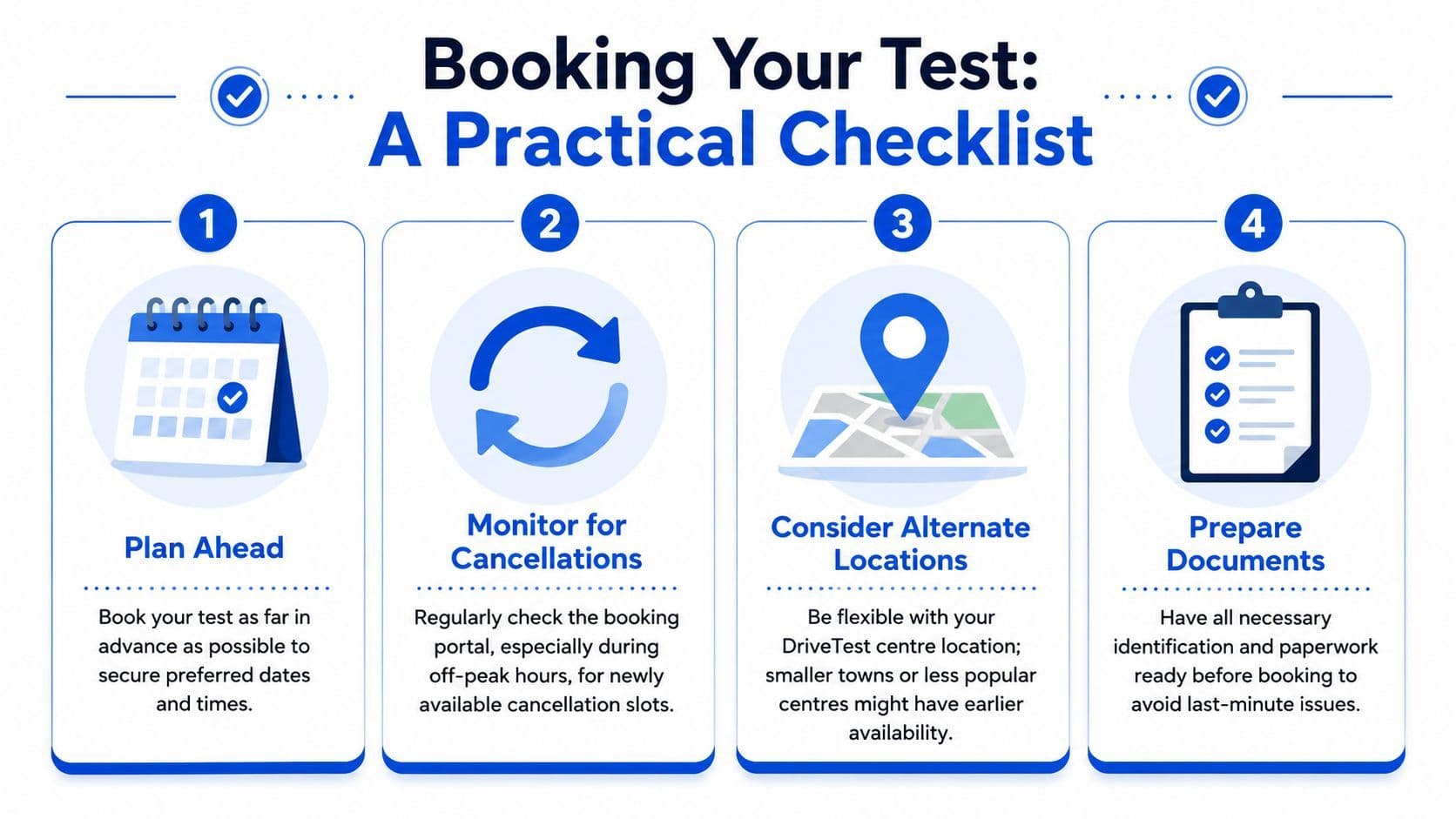
Because Ontario handles a very high volume of road tests, strong appointments disappear fast. If you're serious about getting a favourable slot, act early and stay active. The combination of heavy booking demand and common shortages means checking for cancellations isn't optional. It's one of the most useful habits you can build.
A practical system looks like this:
- Book first, optimise second. Secure any workable date once you're ready, then keep checking for a better one.
- Check the portal regularly. Cancellations happen, and better times can appear unexpectedly.
- Stay organised. Keep your licence details, availability, and preferred centres written down so you can move quickly.
- Avoid emotional booking. Don't grab a bad slot in a panic if it clashes with your strongest driving time.
If you're trying to move an appointment forward, this Ontario road test booking guide explains the process of watching for earlier dates and handling the booking system more efficiently.
How to think about location choices
The centre matters almost as much as the time.
A metro-area DriveTest location can expose you to denser traffic, more complex lane setups, and faster-changing conditions. A smaller location may feel calmer, but you still need to be comfortable with the route style there. Don't choose a centre only because someone says it's “easy.” Choose one you can practise around.
Use this location filter before booking:
Question Why it matters Have you driven in that area before? Familiar roads reduce hesitation Does the area include highway elements for your test type? You need route-specific practice Are the intersections unusually complex? Complexity adds pressure if unfamiliar Can you get a lesson there beforehand? A local warm-up helps settle nerves
One more practical point. Don't wait until the night before to sort out paperwork, vehicle readiness, or travel time to the centre. Booking the right slot won't help if you arrive flustered.
Checklists for Different Driver Profiles
The right booking strategy changes depending on who you are, how you practise, and what stresses you out most.

New teen driver
If school, family schedules, and lessons all need to line up, keep your plan simple.
- Book around consistent practice. Don't let a random available date interrupt your learning rhythm.
- Choose a school-day pattern if possible. Mid-week often keeps your routine steadier than a weekend scramble.
- Use family support well. Get extra supervised drives on the same kinds of roads you'll likely see on test day.
Nervous test-taker
Nerves don't always mean you're unprepared. They usually mean your routine needs to be tighter.
Try this checklist:
- Pick the calmest realistic slot. Mid-week, mid-morning is often the least mentally noisy option.
- Drive at the same time repeatedly before test day. Familiarity lowers anxiety.
- Practise your weaker manoeuvre until it feels boring. For many learners, that's parking. If that sounds like you, review parallel parking tips for the Ontario driving test and then repeat it in a quiet area until the sequence feels automatic.
- Build a pre-test routine. Same sleep pattern, same meal timing, same warm-up drive.
Newcomer to Ontario
If you already have driving experience from another country, don't assume local road habits will automatically transfer.
Focus on these:
- Practise local expectations. Ontario examiners watch for observation habits, lane discipline, and rule-based consistency.
- Learn the test area. Road markings, intersection design, and speed transitions may differ from what you're used to.
- Avoid the busiest urban core unless you've trained there. Dense city driving is manageable, but only if it isn't new to you.
Your ideal booking plan should fit your actual driving life, not someone else's.
If you're still building your confidence before booking, G1ready.ca offers Ontario-focused practice tools for the written side of licensing, including topic-based quizzes, full practice tests, and exam-style study support that can help you tighten your foundation before moving on to the next stage.


