
You're probably in one of two spots right now. Either you've booked your G1 test and feel that low-grade stress of not knowing what the questions will really look like, or you've tried a few practice questions and realised the test is less about “common sense” than it first seemed.
That's normal. Most learners don't struggle because they're bad drivers. They struggle because they study in the wrong order. They read a lot, do random quizzes, get a few wrong, and then don't know what to fix next.
A good Ontario driving quiz helps most when you use it with a purpose. One quiz should tell you where you stand. Another should isolate a weak topic. Another should help you practise under pressure. If you use each format for the right job, studying gets simpler and far less frustrating.
Your Essential Guide to the Ontario Driving Quiz
Many learners treat an Ontario driving quiz like a scorecard. They take one, see a result, and either feel relieved or discouraged. That misses the true value.
A quiz is a study tool first. It shows you what you recognise quickly, what you confuse under pressure, and which topics still feel fuzzy. That matters because the G1 test checks both factual knowledge and your ability to choose the right answer among options that can sound similar.
The fastest way to build confidence is to stop asking, “How many quizzes should I do?” and start asking, “What is this quiz helping me learn?” That small shift changes everything.
Practical rule: Don't use every quiz the same way. Use one to diagnose, one to drill, and one to simulate the real test.
Here's where people usually get tripped up:
- They overfocus on one topic: A learner might get comfortable with road signs but neglect rules of the road.
- They memorise patterns instead of meaning: That works for a few repeat questions, but it falls apart when wording changes.
- They ignore mistakes they “almost” got right: Those are often the exact errors that come back on test day.
A calmer approach works better:
- Start with a baseline quiz.
- Find your weak spots.
- Practise those weak spots on purpose.
- Finish with realistic full-test practice.
If you do that, the Ontario driving quiz stops feeling like a mystery and starts working like a map. You'll know what you're improving, why it matters, and what to practise next.
How a Practice Quiz Mirrors the Real G1 Test
The actual G1 knowledge test feels intimidating mostly because many learners don't know its structure. Once you understand how it's built, practice becomes more focused.
What the official test is really checking
Ontario's G1 knowledge test is a 40-question multiple-choice exam divided into 20 road-sign questions and 20 rules-of-the-road questions, and you need at least 16 correct in each section to pass, which reflects the common 80% pass mark per section, as outlined on the official Ontario sample knowledge test page.
That detail matters more than most learners realise.
If the test were scored as one combined total, you could make up for a weak area by doing very well in another. But that isn't how this exam works. A strong result in signs won't protect you if your rules section is shaky, and the reverse is true as well.
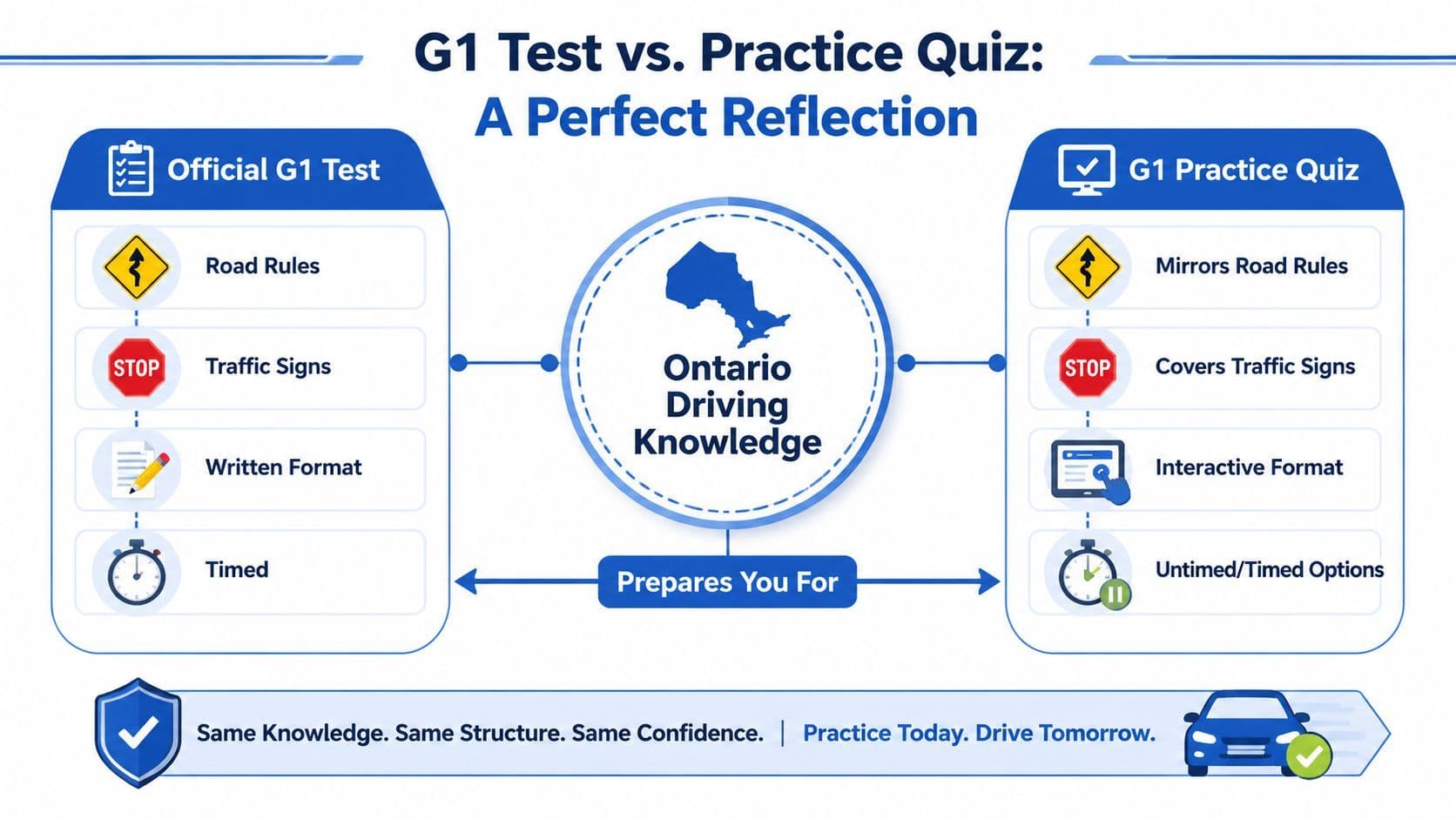
That's why a useful practice quiz shouldn't just throw mixed questions at you. It should reflect the way the official test separates skills. Sign recognition is one skill. Applying road rules is another. Both need direct practice.
Why realistic quizzes matter
When a quiz mirrors the exam properly, it does more than test memory. It trains your pacing, your attention, and your judgement. You start to recognise the difference between a question that asks for simple sign meaning and one that asks you to apply a rule in a situation.
A realistic quiz also exposes a common mistake. Learners often think, “I'm doing fine overall.” But when the questions are split the way the actual test is split, they can see whether one category is still dragging them down.
The most useful practice doesn't just tell you whether you're right. It tells you whether you're ready under the same logic the real test uses.
If you want to see that structure laid out clearly, this G1 test format guide is a practical reference.
A good Ontario driving quiz should mirror the exam in four ways:
- Question style: It should use multiple-choice questions that make you distinguish between similar-looking answers.
- Topic balance: It should cover signs and rules in a way that prevents one topic from being ignored.
- Scoring logic: It should help you judge readiness by section, not just by a general feeling.
- Test feel: It should prepare you for the mental shift from casual studying to formal answering.
Once you study with that structure in mind, test prep becomes less random. You stop “hoping” you're ready and start checking whether you're ready in the way Ontario tests.
Finding the Right Quiz Format for Your Study Style
Not every Ontario driving quiz should feel the same. Different formats solve different problems, and choosing the right one can save a lot of wasted effort.
Some learners need an honest starting point. Others already know their weak spots and need repetition. Some know the material fairly well but freeze when the test feels official. Those learners don't need more random questions. They need the right type of quiz.

Choose the format that matches your stage
A diagnostic quiz is for the beginning. Take it before you try to polish anything. It gives you a rough picture of what you already know and what you only think you know. This is especially helpful for newcomers to Ontario who may already know how to drive but need to adapt to local rules and sign meanings.
A targeted quiz is for repair work. Use it when you keep missing one type of question, such as sign shapes, right-of-way, or rule-based scenarios. This format keeps you from wasting time on topics you've already handled reasonably well.
A full mixed practice test is for consolidation. It helps you move from isolated facts to broader recall. That matters because the actual test doesn't group your mistakes kindly. It expects you to switch between topics without warning.
A simulator is for realism. It's useful when you know the content but still feel nervous. A simulator pushes you to answer in a more test-like rhythm, with less second-guessing and less casual clicking.
A marathon quiz is for endurance. Some learners know the material in short bursts but lose focus over a longer session. This format helps you practise staying sharp when your concentration starts to drift.
Study cue: If you keep saying, “I knew that, I just got confused,” you probably need more simulator-style practice, not more reading.
G1ready.ca Quiz Formats at a Glance
One example is G1ready.ca, which offers diagnostic, targeted, marathon, mixed practice, and simulator-style preparation in one place. That kind of variety is useful because it lets learners match the quiz type to the exact problem they're trying to solve.
Quiz Format Best For Focus Diagnostic First study session Finding knowledge gaps quickly Targeted Repeated weak areas Drilling one topic at a time Mixed Practice Test Mid-stage review Switching between topics smoothly Marathon Building concentration Staying accurate over a longer session Exam Simulator Final preparation Recreating a more test-like experience
A simple way to choose is to ask one question before every study session: “What am I trying to improve today?” If the answer is “find weaknesses,” choose diagnostic. If it's “fix sign mistakes,” choose targeted. If it's “see whether I can handle pressure,” choose simulator.
That's a smarter way to use an Ontario driving quiz than just taking whichever one appears first.
How to Use Quiz Feedback to Study Smarter
A lot of learners finish a quiz, look at the result, and move on. That's the slow way to study.
The faster way is to treat every wrong answer as a clue. The score matters less than the pattern behind it. If you keep missing the same kind of question, your issue usually isn't memory alone. It's confusion about a rule, a sign, or the wording style.
Turn every wrong answer into a lesson
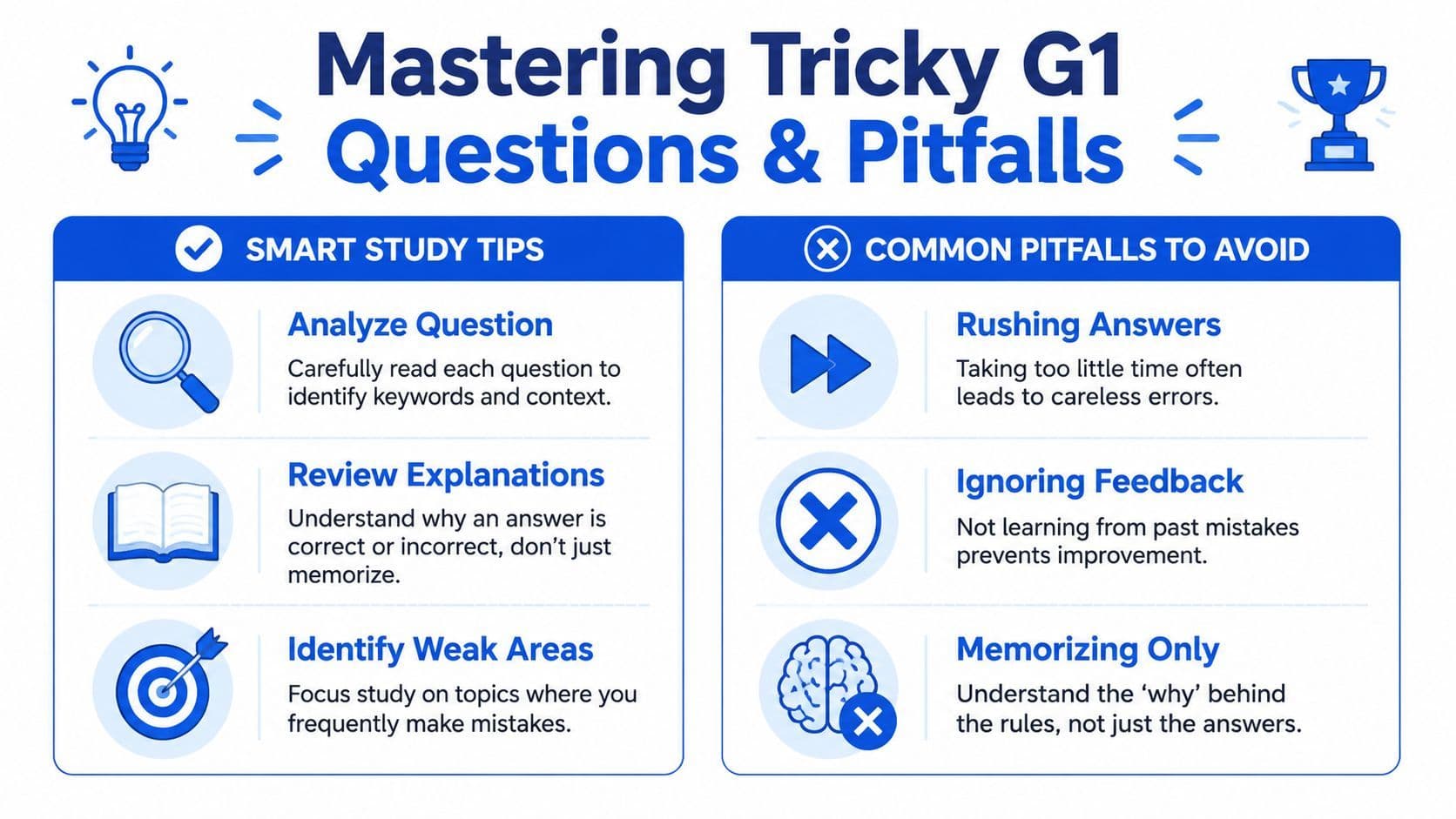
When you review a quiz, don't stop at “correct” or “incorrect.” Ask yourself three things:
- What did the question really ask? Sometimes the trap is in one key word.
- Why did my chosen answer seem right? This shows what confused you.
- What rule or sign meaning settles it clearly? That's the part to remember.
If a platform gives explanations, hints, or topic breakdowns, use them. A learner who reviews carefully often improves faster than a learner who does only more questions.
A tool like a G1 diagnostic exam guide can help. It encourages you to read your results by topic instead of treating the outcome like a pass or fail moment.
Build a simple feedback loop
Keep the process plain. After each quiz, write down only a few notes:
- The topic you missed.
- The mistake you made.
- The rule you need to remember next time.
For example, if you confuse warning signs with regulatory signs, don't just write “study signs.” Write something more exact, such as “I rushed and looked at colour before shape” or “I didn't notice the question asked what the sign warns about, not what action it orders.”
Here's a short visual walkthrough that reinforces that review mindset:
Review is where confidence comes from. Not from getting everything right immediately, but from knowing exactly why you got something wrong and fixing it.
That's how quiz feedback becomes a study system instead of a simple result screen.
Sample G1 Questions and Common Pitfalls to Avoid
The hardest G1 questions usually aren't hard because the rule is obscure. They're hard because the wrong answer sounds reasonable at first glance.
Question traps that catch careful people
Sample question 1
You approach an intersection and the answers include choices that all sound cautious. One says to proceed if you're confident. Another says to wait until the way is clearly safe.
The trap is the answer that sounds experienced or assertive. Many learners pick it because it feels practical. The safer answer is usually the one built around yielding and certainty, not confidence.
Sample question 2
You see two similar signs in practice. Both seem to involve caution, but one is a warning sign and the other gives a direct instruction.
The common error is noticing only the symbol and ignoring the purpose. Ask yourself, “Is this sign warning me about a condition ahead, or telling me exactly what I must or must not do?” That question often clears up the confusion.
A sign question gets easier when you stop memorising pictures alone and start sorting signs by job.
Sample question 3
A question asks what you should do first in a situation. Several options may be partly correct.
Learners often choose an answer that includes a good action, but not the first action. The word “first” matters. On the G1 test, sequence words can completely change the answer.
How to think through tricky wording
When a question feels slippery, slow down and do this:
- Spot the keyword: Look for words like first, must, safe, or except.
- Separate similar answers: If two options look almost right, ask what makes one more complete or more rule-based.
- Choose the safest lawful action: On many rule questions, the correct answer is the one that combines safety with clear compliance.
A strong Ontario driving quiz helps here because it lets you practise this kind of thinking repeatedly. You stop reacting to familiar-looking options and start reading questions with better discipline.
That's the skill that carries over to the actual test.
Your Step-by-Step G1 Study Plan Using Quizzes
A simple plan works better than an ambitious one you won't follow. If you want your Ontario driving quiz practice to feel organised, use this sequence.
1. Start with a diagnostic test
Take one at the beginning without trying to game the result. You want a clean picture of where you're weak. If signs are fine but rule questions are shaky, that tells you where your effort should go.
2. Drill weak topics with targeted quizzes
Don't keep doing mixed sets if one topic keeps causing trouble. Isolate the problem and work on it directly. Short, focused sessions usually beat long unfocused ones.
3. Shift to full-length mixed practice
Once your weak areas improve, begin mixing topics together. This helps you switch attention quickly and reduces the shock of seeing different question types in one sitting.
4. Finish with a simulator
Use a realistic test mode near the end of your preparation. This helps you practise staying calm, reading carefully, and handling test pressure without rushing.
Final coaching note: If you have limited time, don't study everything equally. Put your effort where your mistakes keep repeating.
If you want a simple framework for structuring those sessions, this guide on how to study for the G1 test is a useful starting point.
The main thing is consistency. A short session with a clear purpose beats random cramming. When you use quizzes in the right order, you build familiarity, then accuracy, then confidence.
If you want one place to begin that process, G1ready.ca offers Ontario G1 practice tools in several formats, so you can move from diagnostic review to targeted drills and test-style practice without guessing what to do next.


