

You're probably at the stage where the keys feel familiar, but the test still feels foggy. You can drive around the neighbourhood. You can park on a decent day. You know the basic routine. But when someone says, “Do more G2 practice,” that advice often isn't clear enough to help.
That's where many learners lose momentum. They practise driving, but they don't practise the test.
A useful G2 practice test isn't an online quiz or a random drive with a parent. It's a structured road-test rehearsal built around Ontario's licensing system and the way an examiner watches your choices. Ontario's graduated licensing system was introduced in 1994, and first-time drivers must pass the G1 knowledge test before moving on, which is why G2 preparation is tied so closely to applying handbook rules in real time, not just handling the car (Ontario G2 and graduated licensing overview). If you need a practical overview of what the road test looks like, this guide to the G2 driver's test is a helpful starting point.
Introduction
Most learners think of G2 practice tests as something vague. Go out, get hours in, maybe repeat a few parking drills, and hope that experience turns into readiness. Sometimes it does. Often it doesn't.
The reason is simple. The G2 road test doesn't just ask whether you can move the vehicle safely from one street to another. It asks whether you can apply road rules under pressure, in the right order, with the kind of observation an examiner expects to see. That's a different skill from relaxed everyday driving.
A strong practice routine makes that pressure familiar. It turns mirror checks into habits, right-of-way decisions into quick judgments, and manoeuvres into repeatable sequences instead of panic moments. That's what good G2 practice tests are for. They help you rehearse the exact kind of thinking the road test demands.
Practical rule: If your practice session doesn't feel organised enough to expose mistakes, it probably isn't close enough to the real test.
What a G2 Practice Test Actually Is
A G2 practice test is a simulated road test. It is not an online multiple-choice quiz. It is not a casual drive to the store. It is a planned session where you drive as if an examiner is already in the passenger seat.
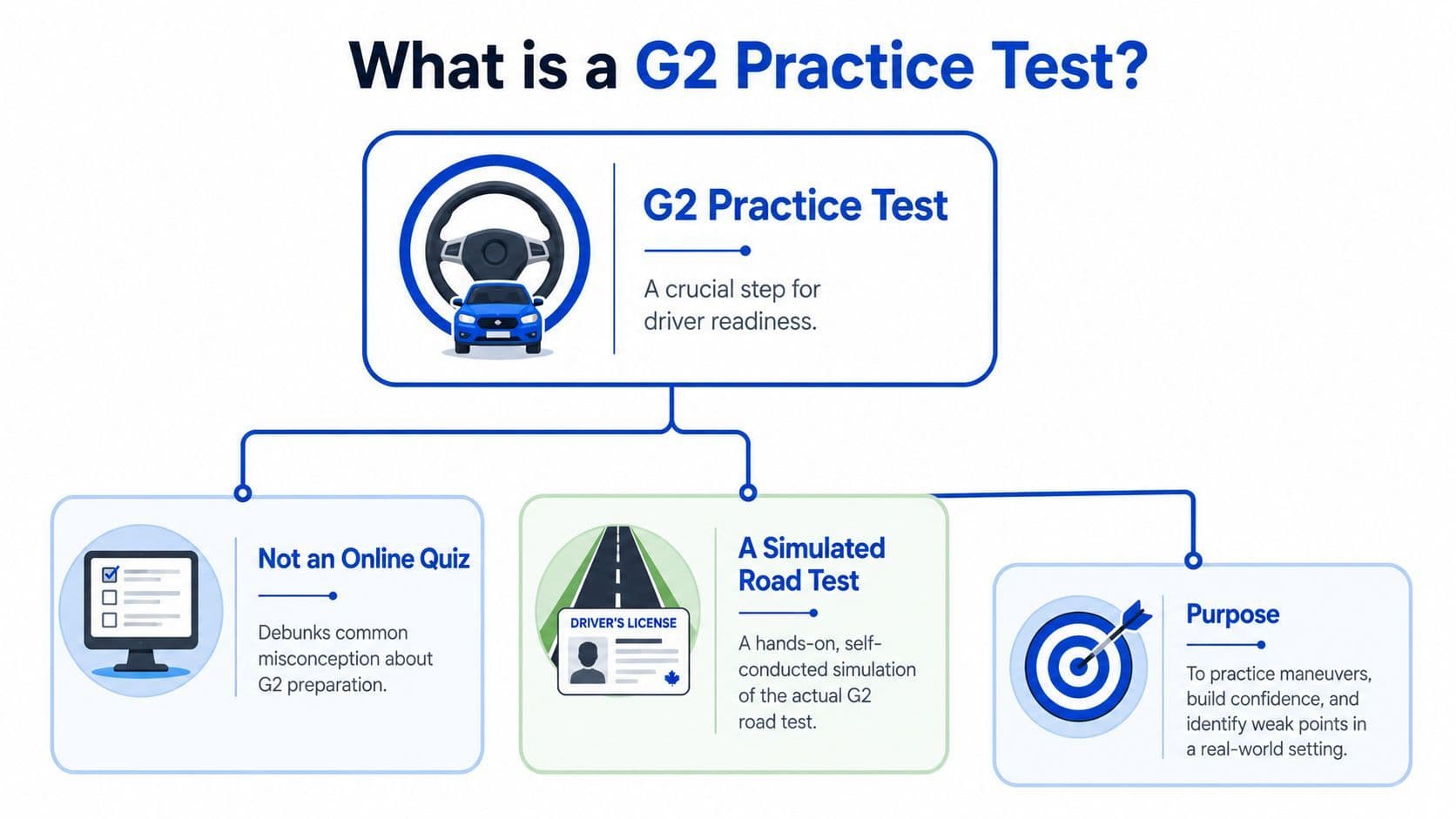
Ontario's licensing structure is the reason this matters. The province's graduated system requires first-time drivers to pass the G1 knowledge test before the G2 road test, so G2 preparation is really about carrying handbook rules into live traffic decisions, not treating the road test like a completely separate challenge (Ontario G2 test requirements and licensing context).
Why random driving doesn't prepare you well
A learner can spend plenty of time behind the wheel and still be unprepared. I see that when drivers are comfortable on familiar roads but fall apart when they need to do simple things in sequence. They check mirrors late. They signal after they've already started moving. They stop fully, but too far forward. They know the rule, but they don't apply it cleanly.
That happens because random driving rewards comfort. A test rewards consistency.
Public guidance on Ontario's G2 road test also points to a specific scoring structure. The test is organized around 7 scored skill domains: start, backing, driving along, intersections or railroad crossings, turns, parking, and stop or park or start on a grade. Errors that endanger others or break traffic law can lead to an automatic fail, which is why practice has to teach fault recognition under examiner-style scoring, not just general confidence behind the wheel (Ontario G2 scoring domains and automatic-fail context).
What to include in a real practice session
A proper simulation should include these elements:
- A clear route with residential roads, stop signs, turns, lane changes, and parking opportunities.
- A mock examiner who gives short instructions instead of coaching throughout the drive.
- A scoring mindset where mistakes are noticed as they happen, not brushed off.
- A rule-based focus on right-of-way, observation, speed choice, and signalling order.
Think of it as a rehearsal, not a lesson.
The learner who says, “I can do that when I'm relaxed,” is often the same learner who misses it when someone is watching.
If you want G2 practice tests to work, stop asking, “Did I drive today?” Start asking, “Did I practise the decisions the examiner will score?”
How to Run an Effective Test Simulation
The most effective simulations are simple, repeatable, and a little uncomfortable. That last part matters. If every practice drive feels easy, you're not testing enough.
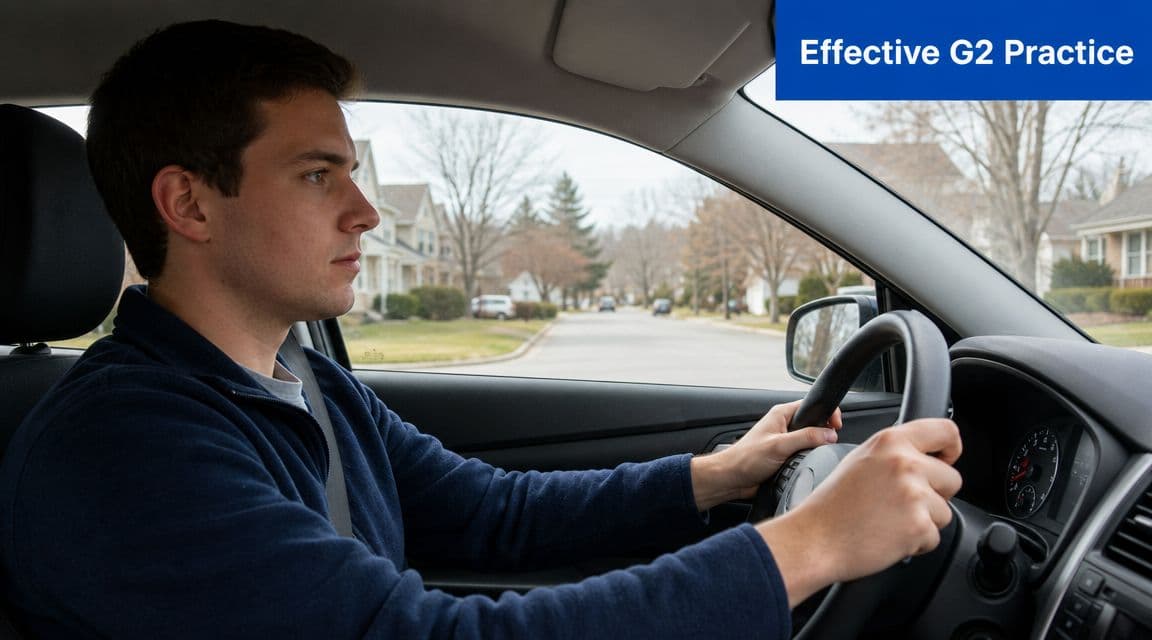
Use a mock examiner instead of casual supervision
Ask a parent, guardian, instructor, or experienced G driver to act like an examiner. Their job is not to teach while you drive. Their job is to give short directions, stay mostly quiet, and write down what they observe.
A useful mock examiner should look for things like:
- Observation habits such as mirror use, blind-spot checks, and intersection scanning
- Control quality including smooth braking, steering, and lane position
- Rule application such as complete stops, proper yielding, and speed adjustment
- Manoeuvre execution during parking, backing, and turning
That shift changes everything. Casual supervision makes the drive feel safe. Examiner-style observation makes your habits visible.
Build pressure on purpose
Choose a route that forces you to do more than one kind of task. Include neighbourhood streets, intersections, a busier road if you're ready for it, and at least one parking challenge. Don't spend the whole session repeating your favourite manoeuvre.
Then add commentary driving. Say what you're doing as you do it. “Checking mirrors.” “Scanning left, centre, right.” “Signal on.” “Blind spot clear.” This sounds awkward at first, but it exposes hesitation quickly. If you can't describe the rule you're applying, you may not be applying it early enough.
A strong simulation usually follows this rhythm:
- Start cold by getting in and driving without a warm-up lap.
- Take directions only from the mock examiner.
- Finish the route fully even after mistakes.
- Review immediately while the details are fresh.
This video gives a useful visual reference for road-test-style driving practice:
After the drive, spend a short block of time on review. Don't just say “parking needs work.” Be more exact. Was the issue setup, steering timing, observation, or speed control? Specific feedback creates better next sessions.
Coach's note: One clean correction repeated properly is worth more than a long drive full of vague effort.
Mastering the Most Common G2 Failure Points
A learner pulls away cleanly, parks well, and still fails. In my experience, that result usually comes from rushed decisions at ordinary moments. A stop sign taken too lightly. A lane change started before the blind-spot check. A left turn made with shaky right-of-way judgment.
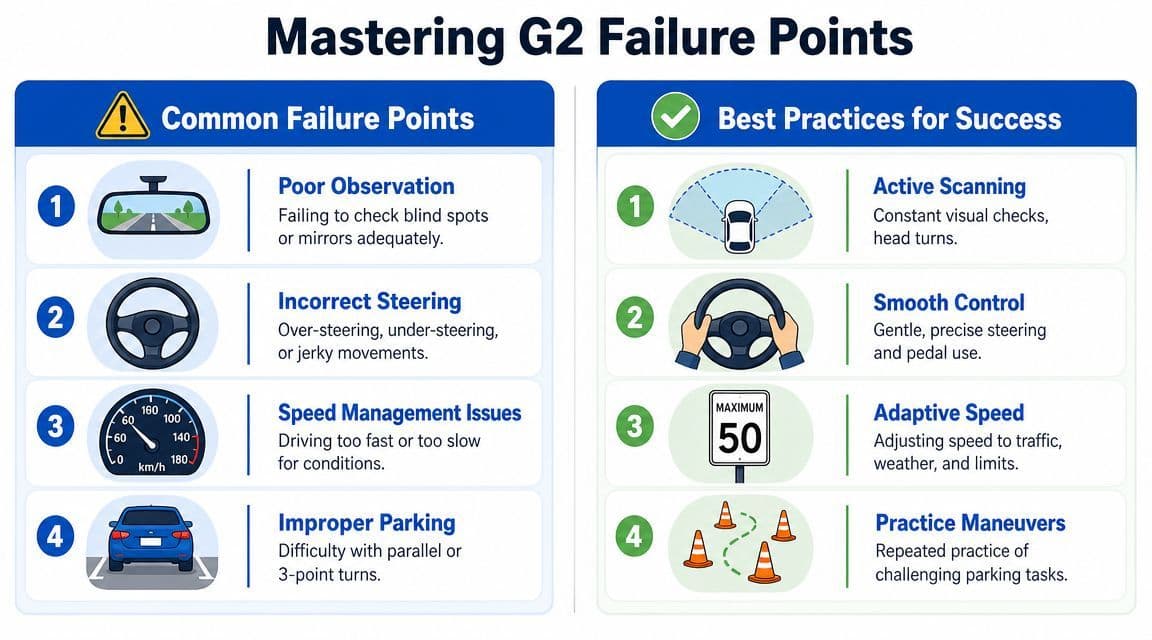
Parking matters, but many G2 failures start with weak rule application during normal driving. That is the gap many practice guides miss. The test measures how well you use your G1 knowledge under pressure, with limited time to decide and no coaching from the examiner.
What examiners are scoring
Examiners score the full chain of a decision. They watch whether you scanned early, chose the right lane position, adjusted speed in time, and followed the rule without prompting.
That matters because a G2 road test is not just a driving task. It is a decision-making test built on road rules. Many learners search for practice tests as if the missing piece were only repetition. Often, the missing piece is slower thinking at the exact moment a rule must be applied. Public G2 prep material keeps returning to lane changes, mirror checks, blind-spot checks, parking, and curb-side manoeuvres because those tasks reveal whether the driver can show awareness clearly and on time (Ontario G2 practical skills focus in public training material).
Use that standard in every practice run. Ask a simple question after each manoeuvre: what did I do that made my judgment visible?
The big mistakes behind ordinary manoeuvres
The most talked-about manoeuvres are parallel parking, three-point turns, and lane changes. Learners often practise them like memorized routines. On the test, they are judged as rule-based decisions.
Lane changes show this clearly. Plenty of learners can guide the car into the next lane. Fewer complete the sequence at the right time and in the right order. Mirror. Signal. Blind spot. Move when clear. Settle in the lane. A poor lane change usually fails on observation and timing, not steering.
Parallel parking works the same way. The final position matters, but the examiner also sees whether you chose a safe space, checked around the car, controlled speed, and stayed aware of traffic while backing. If your setup or reference points are inconsistent, this parallel parking driving test guide can help tighten that part of your practice.
Three-point turns expose pressure fast. Learners pick a location without enough space, start steering too late, or forget to observe before each direction change. The common thread is not weak vehicle control. It is weak decision order.
I also see problems when learners treat Ontario road rules as background knowledge instead of active tools. They may know the handbook answer in a quiet study session, then hesitate on the road when they need to judge right-of-way, a safe gap, or whether a movement is allowed in that specific setting. Public prep discussions often focus on those uncertain moments because context changes how a manoeuvre is scored (Ontario G2 prep discussions around test-day expectations).
Common serious errors usually start as rule errors first:
- Rolling stops show incomplete compliance with the stop requirement.
- Failure to yield shows weak priority judgment, even when the hazard was visible.
- Unsafe turns or lane changes show that the move began before observation was finished.
Confidence on test day comes from practising decisions in the right order until they hold up under pressure. That is what turns G1 knowledge into G2 performance.
Your G2 Practice Checklist and Study Plan
A good study plan answers one question before every drive: what decision am I training today?
That matters because the G2 test is not a tour of random manoeuvres. It is a pressure test of whether you can apply road rules quickly, in the right order, while still controlling the car. Learners who practise without that filter often log plenty of hours and still stay inconsistent. They can steer and park, but they hesitate at the moments that decide the test.
Use your practice sessions to track both execution and judgment.
What to check off before test day
Run through this checklist across multiple drives, not all in one session:
- Starting routine. Seat, mirrors, hand position, signal use, release from the curb, and early scanning
- Stopping habits. Full stops, controlled braking, stopping in the right place, and holding position without creeping
- Intersection decisions. Observation, right-of-way, gap choice, and commitment once the decision is made
- Turns. Correct lane choice, speed before the turn, steady steering, and returning to the proper lane
- Lane changes. Mirrors, signal, blind-spot check, space judgment, and smooth movement without drift
- Backing and parking. Setup, observation, slow control, and consistency under time pressure
- Roadside awareness. Pedestrians, parked cars, cyclists, driveways, school areas, and sudden movement near the curb
- Speed choice. Matching the posted limit when appropriate, adjusting for traffic and conditions, and avoiding hesitation that disrupts flow
- Recovery after mistakes. Regaining rhythm, following the next instruction correctly, and avoiding rushed corrections
One weak area can affect three others. A learner who is unsure about right-of-way often brakes late, turns late, and misses observation checks because the mind is still trying to solve the rule.
If your hands know the sequence but you still freeze on priority, safe gaps, or what the sign requires in that exact setting, the road test will find it.
A simple four-week practice rhythm
Short, focused sessions usually produce better progress than long drives with no clear target. Keep each week centred on a small group of decisions, then repeat them until they hold up under mild pressure.
Week Focus Area Key Skills to Practice Week 1 Core control and rule recall Smooth starts and stops, curbside pull-outs, backing, parking setup, and verbal review of the rule behind each action Week 2 Residential decisions Stop signs, uncontrolled intersections, right-of-way, pedestrian checks, local turns, and speed discipline Week 3 Busier traffic Lane changes, gap judgment, mirror timing, traffic-light decisions, and staying organized with more vehicles around you Week 4 Full mock tests Test-style routes, one-step examiner instructions, timed practice, mistake review, and a second run focused on the same weak points
Add one useful habit to every drive. Say the rule to yourself before the action. For example: full stop, yield to pedestrian, left lane to left lane, blind spot before moving out. That small step forces G1 knowledge into live driving decisions, which is where many learners lose marks.
Keep a notebook after each session. Write down one mistake that repeated, one rule you hesitated on, and one decision you handled faster than last time. Over a few weeks, that record shows whether your practice is building real test readiness or just familiarity with the car.
Conclusion From Practice to Confidence
Passing the G2 road test usually looks calm from the outside. Inside the car, it comes from repetition with purpose.
That's why effective G2 practice tests are built around simulation, not wishful thinking. You need drives that feel like the actual test, feedback that points to specific habits, and practice that connects every manoeuvre back to the rule behind it. When learners do that, they stop treating the test like a mystery.
Real confidence on test day doesn't come from hoping the route is easy. It comes from knowing how to read the road, make the correct decision quickly, and show that decision clearly through your observation and control. That's what examiners are trying to see.
If you're still struggling with parts of the G2, don't assume you need more random hours. You may need better structure, better review, and a stronger grip on the handbook knowledge that supports every turn, stop, and lane change. The road test starts in the car, but success begins earlier than that. It begins with understanding the rules well enough to use them under pressure.
If you want to strengthen the knowledge side of your driving decisions before your road test, G1ready.ca is a practical place to study Ontario rules, signs, and handbook-based questions in a structured way.


