
You've got a Class G licence, a promising offer to drive a tractor-trailer, and a list of unfamiliar terms in front of you. Someone mentions Class A, air brakes, mandatory training and a road test vehicle, and suddenly the path looks more complicated than booking an exam.
That reaction is understandable. A Class A driver's licence in Ontario is a regulated commercial qualification, not just an advanced version of a passenger-vehicle licence. The process is organised as a pipeline, and each stage affects the next decision you make.
Why the Class A Driver's Licence in Ontario Matters
A Class G driver who accepts a long-haul position quickly learns that experience behind a car doesn't automatically qualify them to operate a tractor-trailer. The same applies to a newcomer who has driven commercially elsewhere and wants to work in Ontario, or an owner-operator planning to tow a heavy trailer under their own business.
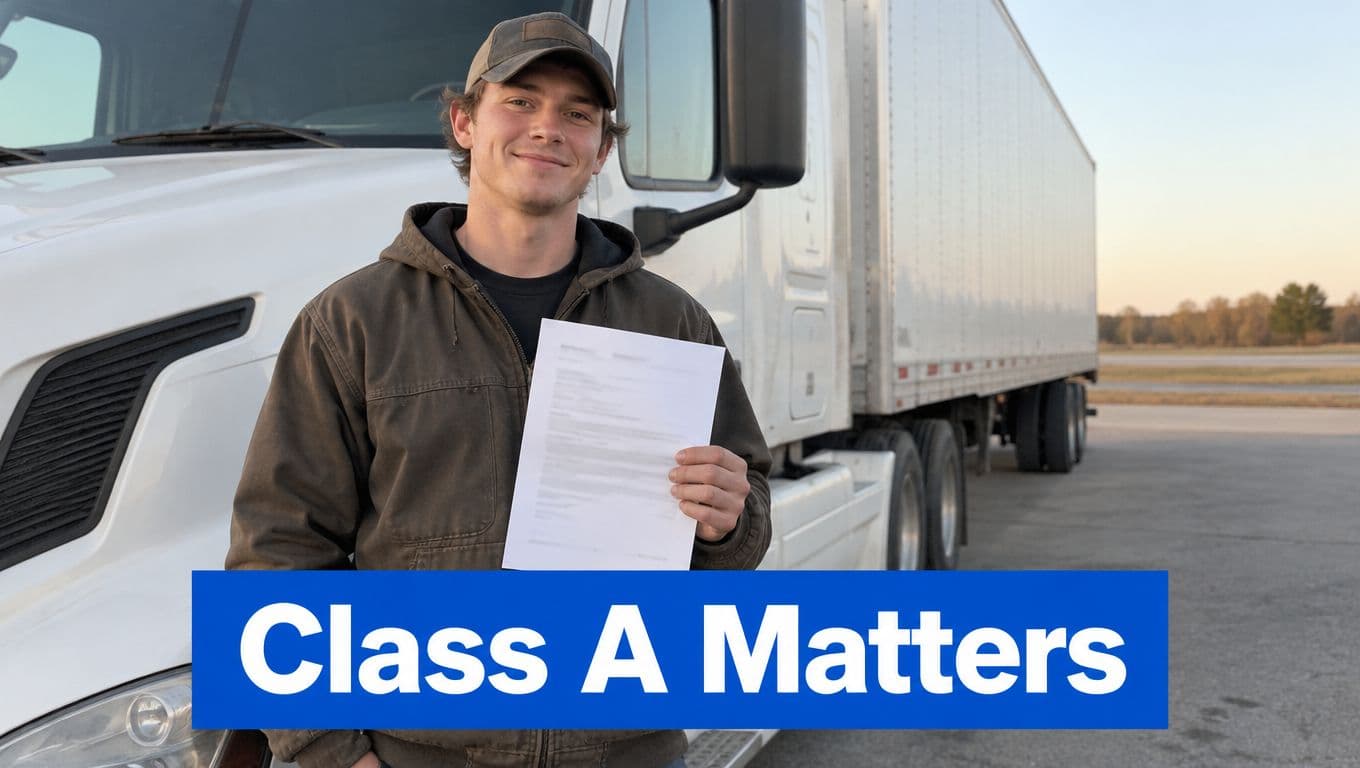
Class A is Ontario's commercial credential for specific heavy vehicle combinations. It's aimed at drivers whose work or towing plans involve tractor-trailers, certain heavy trailer combinations, large recreational vehicles towing substantial trailers, and similar equipment. A fleet operator may need it for employees moving combination vehicles between terminals, while a private driver may need it for a large RV and trailer arrangement that falls within the Class A category.
The reason Ontario treats this licence separately is practical. A combination vehicle behaves differently from a car, requires a different inspection routine, and creates different risks while turning, reversing, braking and changing lanes. The driver must understand both the tractor and the equipment being towed.
A Class A licence makes sense when the vehicle combination requires it, not simply because the truck looks large.
Class A isn't the right target for every driver. If your plans involve ordinary passenger vehicles or a vehicle covered by another licence class, pursuing it may add training and testing you don't need. The deciding question is whether your intended combination falls within Ontario's commercial licensing rules.
The rest of the pathway becomes easier to manage when you separate it into four stages: scope, eligibility, training and testing. Once those are clear, you can make better choices about your starting licence, approved provider, test vehicle and timing.
What a Class A Licence Actually Covers
A tractor-trailer can look familiar on the highway, yet the licensing question depends on the vehicles it is towing. Ontario's legal definition focuses on a combination whose gross weight of the towed vehicles exceeds 4,600 kilograms, excluding a bus carrying passengers. A Class A licence also allows the holder to drive vehicles in Classes D and G, as described in the Ontario Ministry of Transportation truck handbook.
That threshold changes how you assess a vehicle. A large pickup towing a light trailer may not require Class A, while a smaller-looking truck pulling a heavier trailer may. Start with the combination, then check the gross weight of the towed units rather than judging by height, engine size or appearance.
Reading the road scene
A tractor pulling a semitrailer is the clearest example. Other combinations can include a dump truck with a heavy pup trailer, a car carrier with a substantial towed unit, or a large recreational vehicle pulling a trailer above the applicable threshold. The legal question is whether the configuration meets Ontario's definition.
A Class D licence covers certain heavy single vehicles. Class G covers ordinary passenger vehicles. If your vehicle does not include a qualifying heavy towed combination, one of those classes may meet your needs. The regulatory definition of Class A connects the class to the total gross weight of the towed vehicles and identifies the related Class D and G privileges.
Class A works like a broader professional ticket. Once you qualify for the heavier combination, the credential also carries the lower vehicle privileges. You do not need a separate Class D or G licence for those included categories.
That makes Class A an upgrade in scope, not a replacement for your everyday driving rights. Your passenger-vehicle privileges remain part of the broader licence category, while the added qualification covers combinations that require Class A. This distinction helps you decide whether the full training pipeline fits your work plans, towing needs and expected test vehicle.
For a practical comparison of vehicle categories and licensing requirements, review this Class A and Class B licence guide. Confirm the vehicle's configuration and towed weight before choosing a training provider, booking a test vehicle or deciding when to pursue the licence.
Eligibility Rules You Must Meet First
A training provider may be ready to enrol you, yet your licence history or medical status can still stop the application. Check those conditions before paying for lessons or arranging a road test. Ontario treats Class A licensing as a pipeline: first you qualify to enter, then you complete training and testing.
You must be at least 18 years old and hold, or have previously held, a driver's licence issued by a Canadian province or territory. Ontario does not accept a G1, G2, M, M1 or M2 for this pathway. For many applicants, a full Class G provides the practical starting point.
The counter check
Review your licence history early. This matters if you recently moved to Ontario or held a licence in another Canadian jurisdiction. A learner licence does not provide the same standing as the full licence Ontario expects for this commercial category, so confirm your record before choosing a school or test vehicle.
Medical and vision fitness make up the next checkpoint. Ontario's standards specify visual acuity of at least 20/30 in the better eye and 20/50 in the weaker eye, along with a horizontal visual field of at least 120 degrees in each eye. Corrective glasses or contact lenses may help with acuity, while serious loss of side vision can prevent qualification.
The reason is practical. A commercial driver must check mirrors, adjacent lanes, pedestrians, signs and changing traffic while controlling a large combination vehicle. Ontario may also require a medical declaration or examination at renewal, depending on the circumstances and the reporting obligations that apply to commercial drivers.
Use this checklist before contacting an approved provider:
- Age: You're 18 or older.
- Licence status: You hold, or have held, a qualifying Canadian licence, usually a full Class G.
- Vision: You can meet the applicable acuity and field-of-vision standards, with corrective lenses if needed.
- Documentation: You can provide medical information if Ontario requests it.
If each item is in place, you have cleared the entry checkpoint. You still cannot book the road test merely because you meet the basic rules. Your next decision is to find approved training that matches the vehicle and licence outcome you plan to pursue.
Mandatory Entry-Level Training Before the Test
Ontario's mandatory entry-level training is the bridge between knowing traffic rules and controlling a heavy combination vehicle. The approved course contains at least 103.5 hours, divided into classroom, in-yard and behind-the-wheel instruction, as described by the Ontario mandatory training requirements.
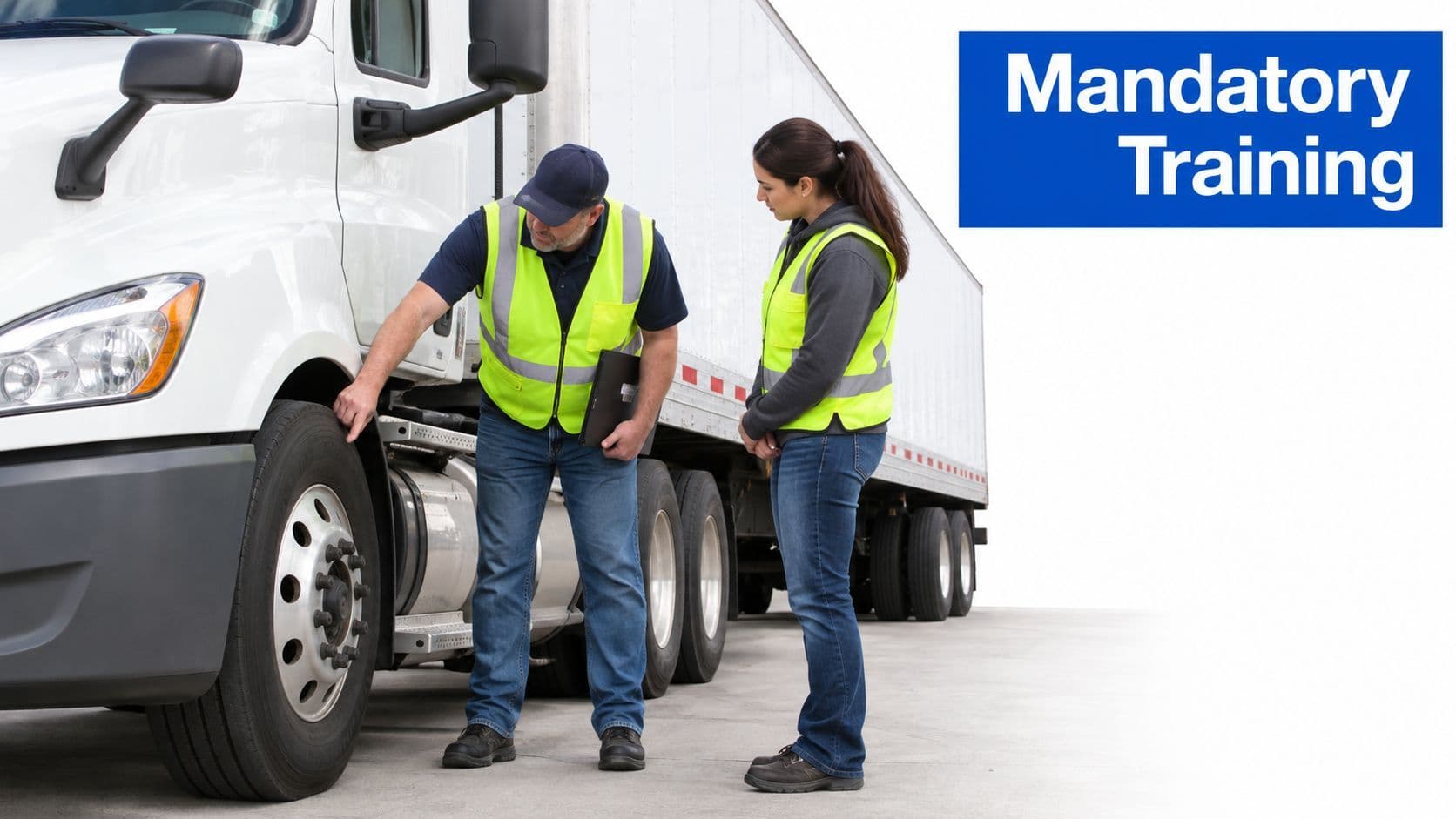
The classroom portion accounts for 36.5 hours. In this segment, learners build the reasoning behind safe commercial operation, including vehicle responsibilities, inspection knowledge, traffic decision-making and the rules that guide professional driving. It can feel less exciting than sitting in the cab, but a driver who can't explain why a procedure matters will struggle when conditions change.
The in-yard component provides 17 hours of controlled practice. Learners work on low-speed control, coupling and uncoupling, inspection routines and manoeuvres in a setting where an instructor can stop the exercise and correct the technique. The yard is where you turn a sequence described on paper into a repeatable physical routine.
From controlled practice to traffic
The remaining 50 hours are behind-the-wheel instruction. That's where the driver applies the earlier lessons to steering, shifting, lane position, turns, space management and traffic interaction. The progression resembles pilot training: classroom knowledge supports controlled practice, and supervised operation develops judgment before the driver faces an evaluated test.
Training choice matters: An approved provider is part of the licensing process, not a separate service you can treat casually.
Completion must be recorded in Ontario's system through a province-approved provider before DriveTest will permit the Class A road test. Ask a school how it verifies completion, what equipment students use and how much practical time each learner receives. A low advertised price can be misleading if it excludes vehicle access, meaningful practice or support for a retest.
The requirement can also apply beyond a first-time application. It covers situations such as a restricted Class A holder seeking a full licence, a former full Class A holder whose licence has been invalid for three or more years, and an applicant holding a commercial licence from another country. Check your specific history with Ontario or an approved provider before assuming previous driving experience removes the requirement.
How the Class A Road Test Actually Works
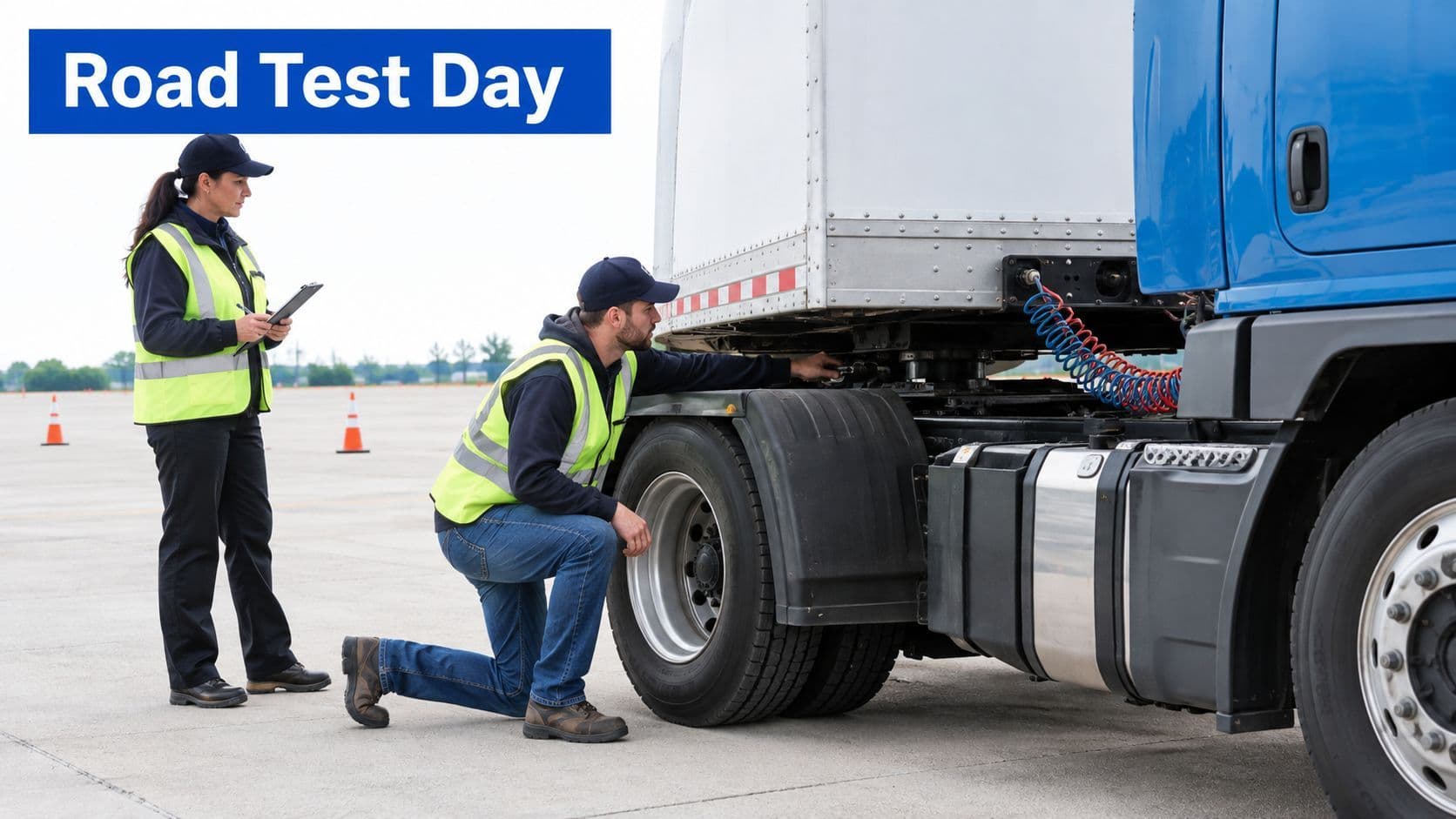
Test day follows a sequence designed to assess whether you can manage the vehicle before, during and after entering traffic. The Ontario truck licence road-test guidance identifies four central areas: daily inspection, coupling and uncoupling, backing manoeuvres and on-road driving.
Start with the vehicle
The daily inspection comes first. You'll identify equipment items and describe their condition to the examiner. Don't treat this as a recital detached from driving. You're demonstrating that you can recognise a defect, explain its significance and decide whether the vehicle is safe to operate.
Coupling and uncoupling follows. The sequence involves more than moving the tractor into position. You must perform the required checks methodically, because a missed connection or unsecured component can create a serious hazard. Instructors often have students say each step aloud during practice so the routine remains organised under pressure.
Backing manoeuvres test control at low speed. You'll need to manage mirrors, steering input, trailer movement and stopping points without relying on someone outside the vehicle to guide you. Straight-line reversing and an offset or alley-dock style manoeuvre require patience. Fast corrections usually create more problems than they solve.
The traffic portion
The on-road drive evaluates how you manage the combination in real traffic. The examiner observes merging, lane control, intersections, speed adherence, observation and hazard response. A technically correct turn can still reveal poor judgment if you approach too quickly or fail to account for surrounding road users.
Book carefully and confirm the appointment details through a reliable Ontario driving test appointment guide. Confirm the vehicle before test day. Ontario requires the test combination to include:
- Trailer rating: A trailer with a Manufacturer's Gross Vehicle Weight Rating of at least 4,600 kg.
- Air brakes: A full air-brake system on both the truck or tractor and the trailer.
- Transmission: A manual transmission with at least eight forward gears plus a high-low range.
These specifications create a direct link between training and testing. A driver can have solid practical ability and still be unable to take the unrestricted test if the vehicle is underspecified. Verify the tractor, trailer, brakes, transmission and rating documents before arriving.
Every major test component is rehearsed during the mandatory programme. That's why the training record, the provider's equipment and your test-day vehicle all belong to the same plan.
Restricted Versus Full Class A and Upgrades from Class G
A restricted Class A and a full Class A aren't interchangeable. The difference generally concerns what the combination can include, such as a restriction involving the trailer's air-brake system. If your goal is tractor-trailer employment across a wider range of equipment, you'll need to understand what qualification removes the limitation.
For a Class G driver, the upgrade is additive. Your Class G isn't erased when Class A is added. That relationship explains why Ontario requires an existing qualifying licence rather than allowing a G1 or G2 holder to move directly into the commercial category.
Configuration What it permits Prerequisite How it relates to Class G Restricted Class A A qualifying heavy combination subject to the restriction recorded on the licence Applicable eligibility and training requirements, followed by the relevant qualification Builds on an existing qualifying licence, but doesn't provide every privilege of a full Class A Full Class A A qualifying combination with the broader Class A privileges Eligibility, mandatory training and the unrestricted road-test pathway Adds commercial combination privileges while retaining Class G privileges Class G upgrade path Starts with passenger-vehicle privileges and progresses toward Class A A qualifying Class G or equivalent licence, then approved training and testing Class G is the foundation, not a separate licence that must be surrendered
Choosing the right direction
If you're considering a restricted route, ask what equipment your intended employer operates. A restriction may be workable for one fleet and unsuitable for another. The right choice depends on the combination you need to drive, not just the fastest licence label available.
The mandatory training requirement still matters for the upgrade pathway, including situations where a restricted holder seeks a full licence. The road-test structure also remains practical and skills-based rather than purely theoretical.
A full Class A includes permission to operate vehicles in Classes D and G. You therefore don't need a separate Class D test because you want to drive a vehicle covered by that class after obtaining full Class A privileges. Think of the licence as a broader category layered over your original passenger-vehicle qualification.
Real Costs You Should Budget For
A Class A licence budget has several moving parts. The government examination fees are the clearest starting point: Ontario lists a $15 knowledge examination fee and an $85 road-test fee for Class A, B, C, D, E or F tests, according to the provincial fee schedule. Drivers aged 65 or older taking a Class A, B, C, E or F road test may pay the reduced $14 road-test fee.
Those charges cover testing only. The larger commitment is usually the approved mandatory training programme, which can cost thousands of dollars rather than hundreds. Provider prices vary, so request a written breakdown before enrolling. To place the licence fees in context, compare them with the wider training budget in this Ontario driving test price guide.
Ask what the tuition includes
A low headline price can represent a limited package. Confirm whether the quote includes:
- Learning materials: Textbooks, digital resources or practice material.
- Equipment time: Use of the training tractor-trailer and the amount of supervised driving.
- Practice access: Extra yard or road sessions beyond the required course.
- Test support: Vehicle use for the road test and any retest charges.
The test vehicle deserves close attention. If you do not own one or work for a carrier with a qualifying combination, arranging compliant equipment may add to the total. Ask what vehicle the provider supplies, whether it matches the configuration you have practised in, and which related costs are included.
Other expenses can include medical documentation if Ontario requests it, travel, and time away from work during classroom or practical instruction. These costs may be less visible than tuition but still affect the amount you need available.
Government fees are the visible starting point. Training, time and vehicle access often shape the larger budget.
Compare providers by equipment, schedule, instructor access and included services. A cheaper course may require extra practice later or leave you responsible for securing a suitable test vehicle, making the initial quote less useful for comparison.
Putting the Pieces Together into a Next-Step Plan
Treat the Class A pathway like a chain. Eligibility comes before training, training completion comes before the road test, and vehicle compliance comes before test day. If one link is missing, the next stage may be delayed even if you've done well elsewhere.
Use this order:
- Confirm your starting point. Check your age, qualifying licence status and vision readiness before paying a provider.
- Choose an approved provider. Compare the course schedule, tuition, equipment, practical access and test-vehicle arrangements.
- Complete the mandatory programme. Finish the full 103.5-hour course and confirm that completion appears in Ontario's system.
- Prepare the vehicle early. Verify the trailer rating, full air-brake system and manual transmission requirements before booking or attending the test.
- Book and practise deliberately. Rehearse inspection, coupling, uncoupling, backing and traffic driving in the same type of combination you'll use for testing.
- Check the result and licence card. After passing, verify the class recorded on the new card and remember that your Class G privileges remain included.
A failed first attempt isn't a verdict on your suitability for commercial driving. It identifies a gap, whether that's inspection language, backing control, traffic judgment or vehicle preparation. Review the examiner's feedback, practise the specific weakness and arrange the next attempt only when the missing link has been repaired.
G1ready.ca offers Ontario licence guides and structured knowledge-test practice, including explanations that help learners understand licence categories before they begin the commercial pathway. Visit G1ready.ca to review the relevant preparation tools and build a stronger foundation for your next licensing step.


