
You're approaching a highway entrance, the traffic is moving faster than you're used to, and the acceleration lane seems to disappear too quickly. Your hands tighten on the wheel, and one question takes over: should you speed up, slow down, or wait for another driver to let you in?
That decision becomes much easier when you understand the patterns behind Ontario G1 test questions. Driving on a highway depends on anticipation, safe gaps, lane discipline, speed control, and attention. The aim isn't to react at the last moment. It's to read the road early and make one calm decision before the situation becomes urgent.
Understanding Highway Driving Fundamentals
City driving gives you frequent chances to stop. Traffic lights, intersections, parked vehicles, pedestrians, and lower speeds create a rhythm of short decisions. Highway driving has a different rhythm. Vehicles travel faster, traffic flows continuously, and a mistake such as a late lane change can affect several drivers around you.
Ontario's road safety reporting recorded 28,160 fatal and personal-injury collisions, 641 people killed, and 38,007 people injured in 2023. That same report recorded 11,548,593 licensed drivers and 181,609 million vehicle-kilometres travelled. These figures help explain why Ontario monitors safety using exposure-based rates, including a fatality rate of 0.56 deaths per 10,000 licensed drivers, a fatal-collision rate of 0.32 per 100 million kilometres travelled, and a fatal-plus-injury collision rate of 15.51 per 100 million kilometres travelled. You can review the figures in the Ontario road safety preliminary statistics.
Those rates don't make careless driving acceptable. They show that highway risk is measured in relation to the large amount of travel taking place. When drivers maintain space, choose appropriate speeds, and avoid sudden movements, a flowing road can be more predictable than stop-and-go urban traffic.
Read traffic farther ahead
Look beyond the vehicle immediately in front of you. If several brake lights appear farther ahead, begin easing off the accelerator before the car directly ahead brakes. If traffic is opening, notice that pattern early instead of accelerating sharply when the gap reaches you.
A useful highway mindset is:
- Look ahead: Scan traffic, signs, lane markings, ramps, and changing road conditions.
- Leave options: Keep enough space to brake or change position without a panic manoeuvre.
- Move early: Signal and prepare before an exit, merge, or lane reduction becomes immediate.
- Stay predictable: Smooth steering and steady speed help other drivers understand your intention.
Practical rule: On a highway, the safest decision is usually the one you can make early and smoothly.
Ontario's handbook guidance connects highway safety with behaviours such as following too closely, speeding, failing to yield, improper turns, running red lights, and frequent lane changes. The provincial summary recorded 115 deaths connected with speeding and aggressive driving and 92 deaths linked to inattentive driving in 2022. The Ontario G2 highway rules guide can help you connect these habits with the licence stages that follow your G1.
Entering and Merging onto the Highway
The on-ramp gives you time to prepare, not time to wait until the last moment. Your goal is to enter the highway at a speed that fits the traffic flow, while selecting a gap that gives you room ahead and behind.
Use the acceleration lane properly
As you move along the ramp, check the road and traffic conditions. Build speed progressively so you can approach the speed of highway traffic if conditions permit. A vehicle entering far below the flow creates a large speed difference, which forces drivers already on the highway to brake or move around it.
Use this sequence:
- Accelerate on the ramp. Use the available lane to build a suitable speed. Don't treat the ramp like a stop sign unless traffic or a hazard requires you to stop.
- Scan the highway. Check your inside mirror, side mirror, and the traffic beside the lane you'll enter.
- Signal early. Your signal tells highway drivers what you intend to do, but it doesn't give you the right to move into an occupied gap.
- Check the blind spot. Turn your head briefly over your shoulder before steering toward the highway lane.
- Choose a safe gap. Look for enough room in front of and behind your vehicle. Avoid forcing another driver to brake.
- Merge smoothly. Steer into the lane with controlled movement, then cancel the signal and settle into the traffic flow.
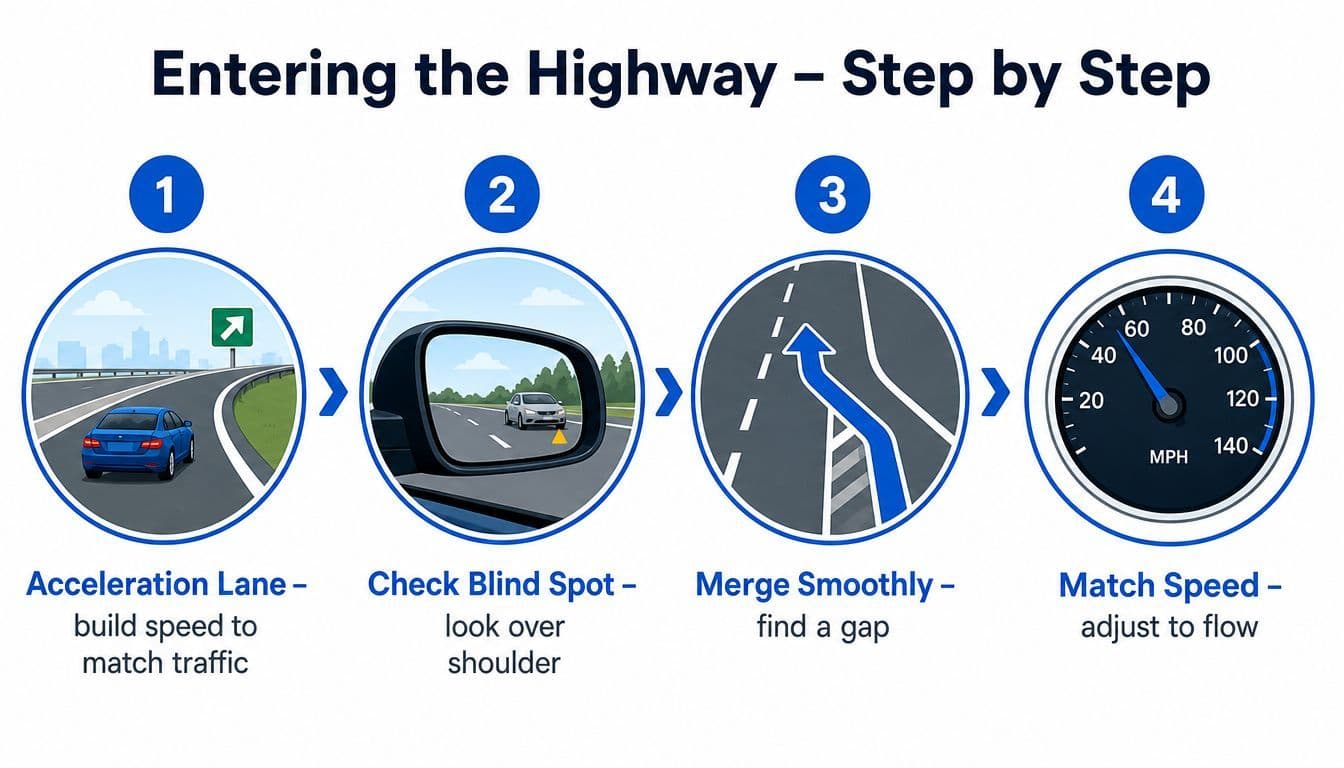
The mirror-signal-shoulder check order appears often in learner questions because each action has a different purpose. Mirrors show the larger traffic picture. The signal communicates your intention. The shoulder check confirms that a vehicle, motorcycle, or other road user isn't hidden beside you. You'll find a focused explanation in this mirror, signal, and shoulder check guide.
When the gap feels too small
Suppose you're entering a busy 400-series highway during rush hour. Several vehicles are close together, and you don't see an immediate opening. Don't accelerate blindly into the first space, and don't stop at the end of the ramp just because merging feels uncomfortable. Continue scanning, adjust your speed to align with a suitable opening, and merge when the gap is safe.
A short acceleration lane demands earlier observation. Check traffic while you still have room to adjust. If you wait until the lane ends, you may have to make a sudden decision, and sudden decisions leave fewer safe options.
The MTO guidance used in Ontario describes a practical lane-entry sequence involving traffic checks, early signalling, safe in-lane spacing, and a lane change only when a safe gap exists. It also states that travelling within about 10 km/h of the posted limit can be appropriate when conditions permit, provided the speed limit isn't exceeded. Read the Ontario MTO handbook export for the official wording and licence restrictions.
A G1 holder has an important legal limitation on freeways. On Ontario freeways, a G1 driver may drive only when accompanied by a licensed driving instructor. That restriction matters both for real driving and for test questions asking who may operate on a freeway.
Lane Discipline and Positioning
Many G1 questions present a multi-lane highway and ask which lane you should use. The safest answer usually starts with Ontario's keep-right principle. The official handbook says drivers should keep to the right on multi-lane roads unless they're turning left or passing another vehicle. It also says the far-left lane should be used only to pass traffic moving slower than the speed limit, and drivers shouldn't remain there.
That rule creates a predictable pattern. The right lane is the normal cruising lane when you aren't passing. A middle lane may be useful when traffic is entering from the right, when you're preparing for a left exit, or when you're passing slower traffic. The far-left lane is not a permanent home for a driver who prefers that position.
Apply the rule to common test scenarios
On a three-lane highway, you're travelling steadily and aren't passing anyone. The right lane is generally the appropriate position. If a slower truck is ahead, check mirrors, signal, perform a shoulder check, and move left only after confirming that the lane and gap are safe.
Once you've passed, return right when it's safe. Don't cut back in closely, and don't move right if doing so would interfere with another vehicle. Ontario's official handbook guidance on driving along explains the lane-position rules that commonly support these questions.
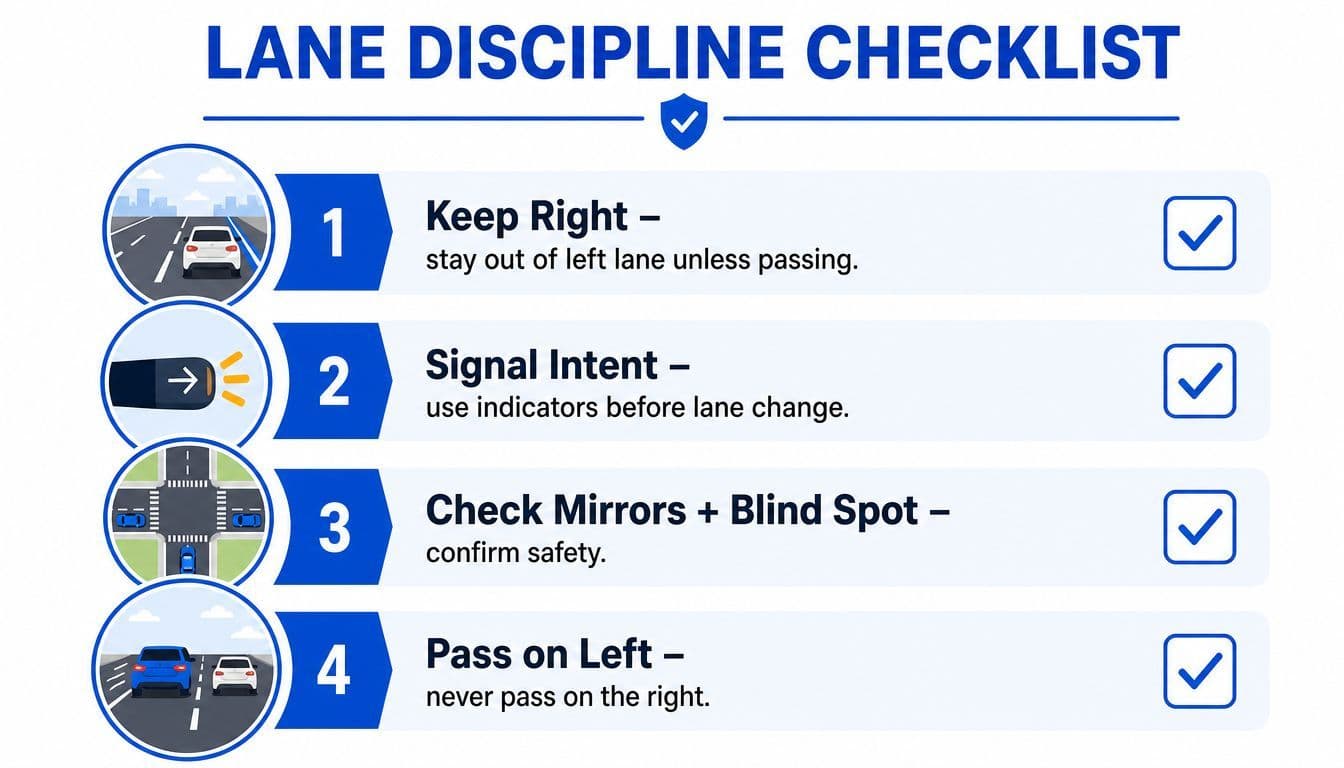
A lane change is a complete observation process, not just a signal. First decide whether the move is necessary. Then check the rear-view and side mirrors, signal, check the blind spot, and move only when the space remains safe. Keep steering controlled and avoid drifting across lane markings while searching for a gap.
Separate passing from positioning
Passing and positioning can look similar, but the reason for the movement matters. If you move left to pass a slower vehicle, complete the pass without lingering beside it, then return right when safe. If you move left because your exit or route requires it, prepare well in advance and follow the signs rather than making a last-second crossing.
You also need to distinguish highway lane rules from situations involving oncoming traffic. Ontario's Highway Traffic Act requires a driver meeting another vehicle on a highway to turn right from the centre of the roadway and allow the other vehicle half of the roadway free. The Ontario Highway Traffic Act provides the legal basis for keeping right when meeting oncoming traffic.
Speed Management and Following Distance
A posted speed limit is a maximum under suitable conditions, not a promise that the same speed is safe in every situation. Rain, snow, ice, fog, darkness, construction, congestion, and limited visibility all change the amount of time and space you need.
Begin by asking three questions:
- Can I see far enough ahead?
- Can my vehicle grip the road surface?
- Do I have enough room to stop if traffic changes?
If the answer to any question is no, reduce speed smoothly. Avoid abrupt braking unless an immediate hazard requires it. Your speed should also fit the traffic pattern. Driving much slower than surrounding traffic can create a dangerous speed difference, particularly near entrances and lane changes, but matching traffic never means exceeding the posted limit.
Build a usable space cushion
The three-second following-distance method gives you a simple starting point. Choose a fixed object such as a sign, light standard, or pavement feature. When the vehicle ahead passes it, count steadily. Your vehicle shouldn't reach the same object until at least three seconds have passed.
Increase the interval when conditions become less forgiving. Add more space when the road is wet or slippery, visibility is reduced, traffic is heavy, you're following a large vehicle that blocks your view, or the vehicle ahead may stop suddenly. More space gives you time to recognise brake lights, assess the lane beside you, and brake progressively.
A sudden slowdown is easier to manage when you're already looking beyond the vehicle ahead. Release the accelerator, maintain your lane, and brake in a controlled way. If traffic is compressing quickly, keep scanning for an open escape path, but don't change lanes without checking that the alternate lane is safe.
For construction zones, follow the temporary signs and lane markings rather than relying on your usual highway speed. Drivers should expect narrowed lanes, workers, equipment, and abrupt traffic changes. The best G1 answer is normally the one that reduces risk while preserving a smooth, predictable flow.
Handling Highway Emergencies and Unexpected Situations
A vehicle ahead brakes hard, debris enters your lane, or another driver moves over too soon. On a highway, each event develops quickly, so the safest response follows a clear order: look, control the vehicle, then choose an escape path.
For a sudden slowdown, look beyond the vehicle's rear bumper through the windscreen. Ease off the accelerator and brake firmly but progressively while keeping the steering pointed in your lane. Change lanes only after checking mirrors and confirming that the alternate lane is clear. Swerving on instinct can replace one hazard with a collision beside you.
Respond without adding a second hazard
A tire blowout may make the vehicle pull or vibrate. Hold the steering wheel firmly, avoid an abrupt turn, and ease off the accelerator. Do not slam on the brakes. Let the vehicle lose speed under control, signal, and move toward a safe stopping place when it is safe to do so. Reviewing these responses in an Ontario defensive driving course can reinforce the decision pattern used in emergency questions.
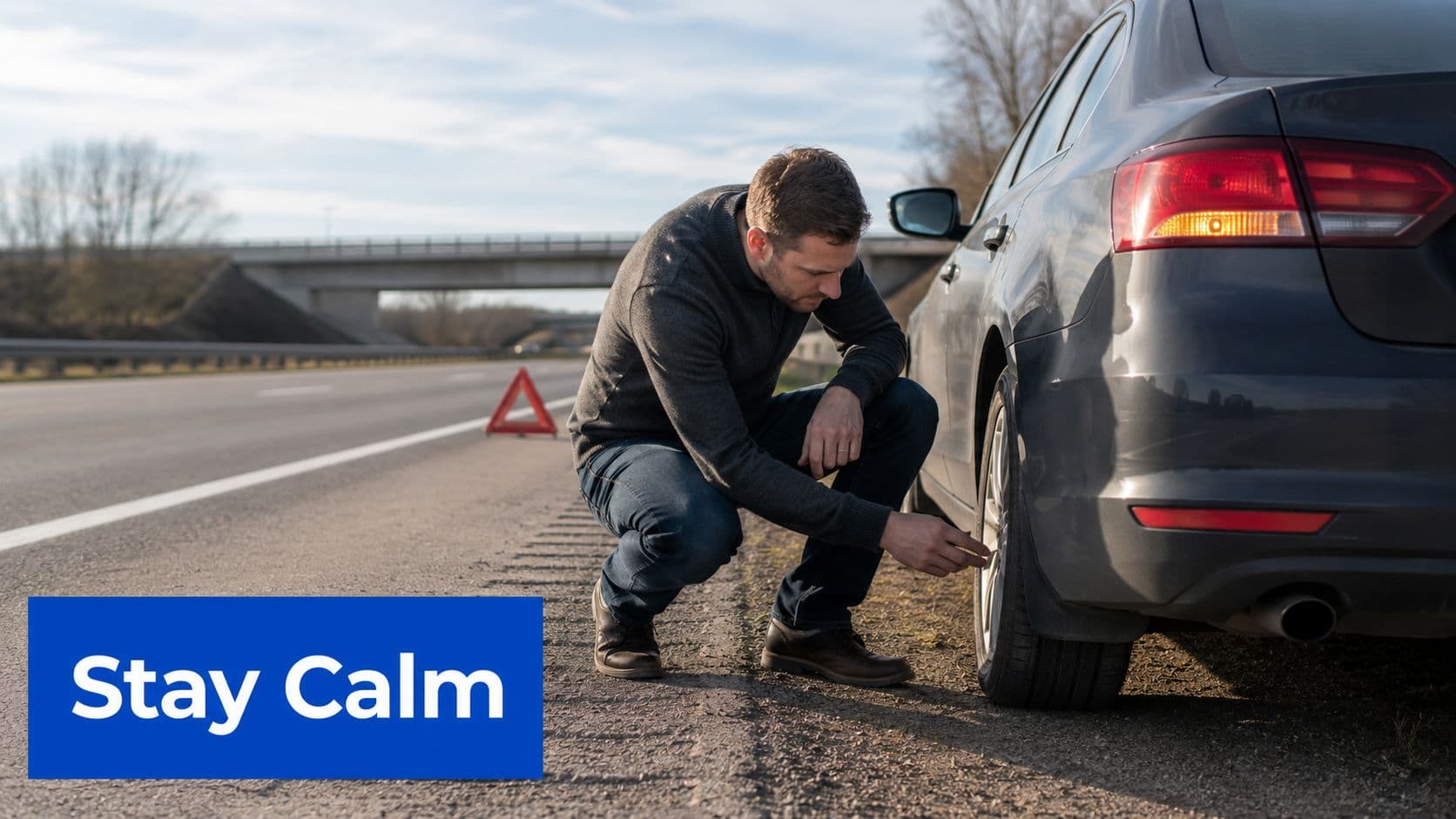
If debris blocks your path, check your mirrors before changing lanes and reduce speed when you have room. A small steering correction is safer than a sharp swerve. When an emergency vehicle approaches, stay calm, check surrounding traffic, and follow Ontario's emergency-vehicle requirements and road signs. Do not stop in a live lane unless stopping is unavoidable.
An aggressive driver creates a separate hazard. Do not compete, gesture, brake-check, or chase. Increase your space, let the driver pass when safe, and keep your attention on the road.
Treat inattention as an immediate risk
A vehicle moving beside you, a sudden brake light, or a missed sign can demand attention without warning. The CBC report on highway inattention provides road-safety context about deaths linked to driver inattention on Ontario highways.
Ontario's distracted-driving rules include fines, demerit points, and a suspension for a first conviction, as described in the provincial distracted-driving rules. Put the phone away before entering the highway. On a G1 test, the safe choice is to remove the distraction before it affects your ability to scan, steer, or respond.
Missing an exit is not an emergency. Continue driving, take the next safe route, and let navigation recalculate. Never reverse, stop, or make a sudden turn on the highway.
Exiting the Highway Safely
An exit begins before the deceleration lane. Read the overhead signs early, identify which lane leads to your exit, and move right in stages when there's a safe opportunity. A late lane change across several lanes is rarely safer than continuing to the next exit.
Once you're in the exit lane, use the deceleration lane to reduce speed. Don't brake sharply in the through lane because you suddenly noticed the ramp. Highway traffic behind you may be moving quickly, and an unexpected speed change can cause a rear-end collision.
Match each decision to the road layout
A curved exit ramp requires a speed that suits the curve, visibility, surface, and signs. If the ramp is short, begin slowing after you've entered it unless signs or conditions require earlier action. Keep your vehicle in its lane and avoid accelerating until you can see the ramp's direction and traffic clearly.
When an exit ramp is backed up, don't stop on the highway to wait for space. Continue in your lane, leave room ahead, and follow the queue only after you've entered the exit lane. If you miss the exit, accept the extra distance. Reversing or crossing a gore area is never a safe correction.
G1 test questions often hide the key decision inside a small detail. Look for the acceleration lane when entering, the blind-spot check before changing lanes, the right-lane preference when cruising, the passing-only purpose of the far-left lane, and the deceleration lane when exiting. The correct answer usually protects traffic flow while giving you time and space to respond.
Ontario's road safety summary recorded 623 road fatalities and 1,703 serious injuries in its most recent summary, while the Auditor General reported 147,756 reportable collisions and 498 fatal collisions in 2021. You can review the provincial road safety highlights and trends and use those facts as a reminder that highway decisions deserve attention even when traffic appears routine.
G1ready.ca offers free, registration-free practice exams, targeted quizzes, mixed tests, a diagnostic test, marathon practice, and an exam simulator aligned with the Ontario G1 handbook. Visit G1ready.ca to practise highway scenarios such as merging, lane selection, speed control, and safe exits with immediate explanations.


