
Yes, you can drive on Ontario highways with a G2, including 400-series highways and expressways, and you don't need a supervising driver. But that freedom only applies if you follow the novice-driver rules that still come with your G2.
A lot of new drivers hit the same moment. You pass your G2, you finally have the keys, and then you pull up beside an on-ramp and hesitate. The sign says 401, QEW, or DVP, traffic is moving fast, and suddenly the question isn't just “am I allowed?” It's “am I ready?”
That's the core issue behind most searches about G2 rules on highway driving. The legal answer is simple. The practical answer takes a bit more work. You need to know what your licence allows, which restrictions still apply, what mistakes get novice drivers into trouble, and how to handle the basic highway skills that aren't automatically built by passing your G2 test.
Your G2 Licence and the Open Highway
Getting your G2 feels like a major shift. With a G1, every drive depends on someone else being available. With a G2, you can drive on your own, make your own trips, and start building real experience.
That's where many drivers get confused. They assume highways are still off-limits until the full G test because the G test includes highway driving. That assumption sounds logical, but it's wrong.
Ontario's graduated licensing system is built around a staged move from G1 to G2 to full G. The G2 stage is where drivers begin practising more complex road environments, including 400-series highways, before moving on to the final road test, as explained in this overview of Class G licence stages in Ontario and in the discussion of G2 versus G licence differences.
Why this catches new drivers off guard
Your G2 licence gives you more freedom, but it doesn't mean you've already mastered every driving environment. Highways demand quicker scanning, steadier speed control, better lane judgment, and calmer decision-making than most city streets.
A new G2 driver often knows the signs and rules, but still hasn't had enough real practice with:
- Long merge lanes where traffic is already moving quickly
- Multi-lane flow where cars change position often
- Exit planning because missing an exit can trigger panic
- Traffic spacing at higher speeds
Practical rule: Legal permission and practical readiness aren't the same thing.
If you're nervous about your first highway drive, that doesn't mean you shouldn't go. It means you should approach it the way a smart driver does. Choose an easier time of day, know your route, limit distractions, and treat your first few trips as practice rather than performance.
Highway Access for G2 Drivers Explained
Here's the part you should be fully clear on. A G2 driver may legally operate on all highways in Ontario, including 400-series routes and expressways, without a supervising driver, according to this explanation of G2 highway driving privileges.
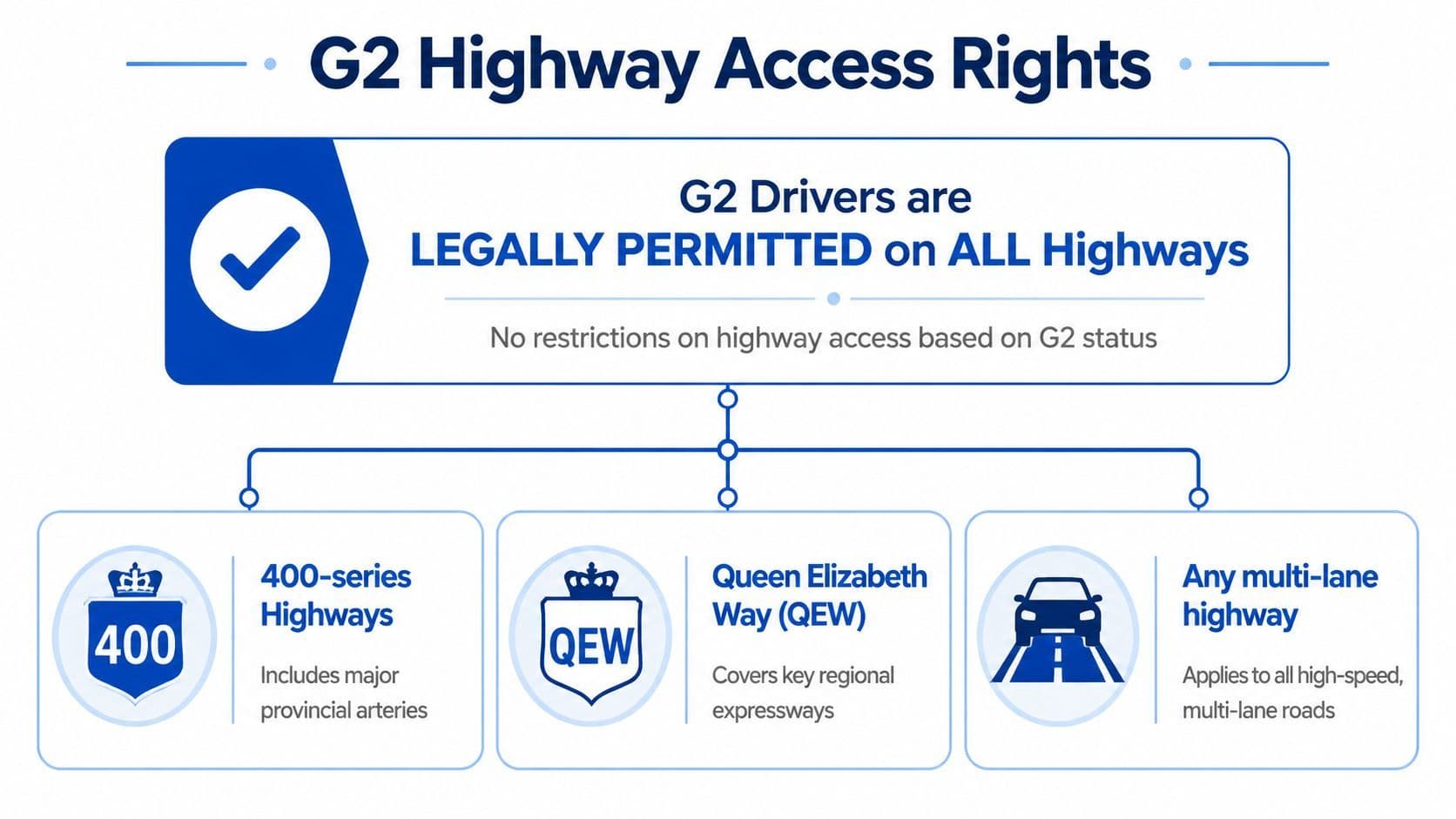
That includes the kinds of roads new drivers usually worry about most. If it's a normal Ontario highway, a G2 licence doesn't block you from using it.
What your G2 test did and didn't prove
The misunderstanding often begins with this point: Passing the G2 road test proves you can handle important lower-speed skills such as lane changes, parking, intersections, and safe turning. It does not mean the road test has already measured your highway ability in the same way.
The same source notes that the G2 road test focuses on urban and residential competencies rather than a highway segment, which means your licence grants highway access before highway readiness is fully tested. In plain language, Ontario expects you to build that skill through practice.
A simple way to think about it is this:
Licence stage What it means for highway driving G1 You're still in a supervised learning stage G2 You may drive highways independently Full G You've completed the final stage that includes highway-level driving ability
What this means in real life
A lot of G2 drivers make one of two mistakes.
Some avoid highways completely because they think they're not allowed. That slows down their progress and leaves them underprepared later.
Others jump onto a busy expressway just because they're allowed. That can be rough if they haven't learned how to merge smoothly, hold lane position, and plan ahead.
Highway access is a privilege your G2 gives you. Highway confidence is something you earn trip by trip.
If you want the safest approach, start with a quieter route, go in daylight, and practise short entries and exits before trying a long trip across the city.
The Non-Negotiable G2 Highway Restrictions
Being allowed on the highway doesn't wipe away your novice-driver conditions. In fact, those conditions matter more at highway speed because small errors get bigger faster.
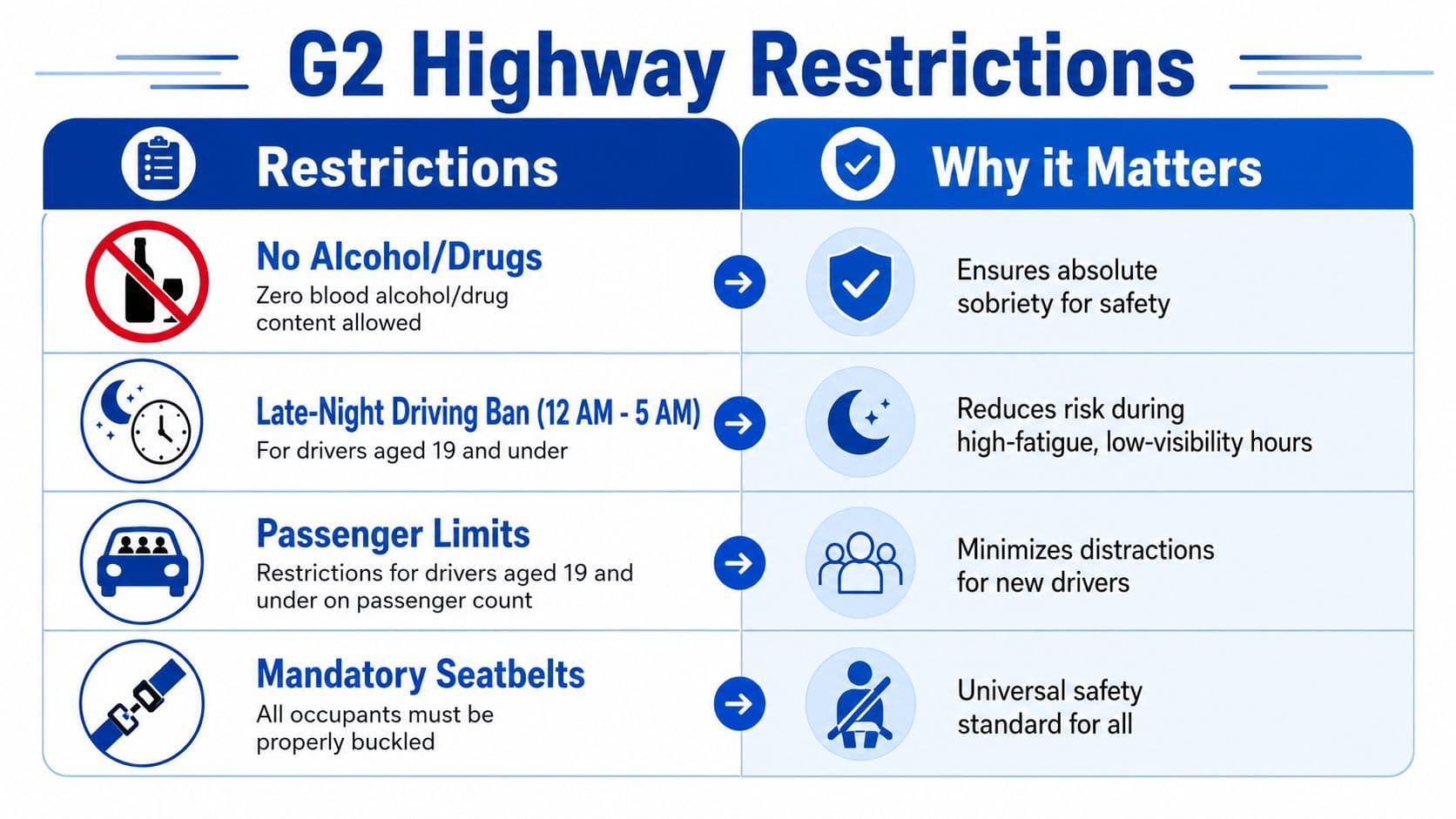
The Ministry handbook confirms that G2 drivers have full Class G highway privileges, but it also ties G2 status to driving-behaviour rules that matter heavily on fast roads, including lane discipline, safe merging, and shoulder stops. It also confirms that G2 drivers must maintain 0.00 BAC and avoid handheld device use, with violations potentially leading to suspension or demerit consequences, as outlined in the Ontario driver's handbook guidance for level two drivers.
Zero alcohol means zero
For a G2 driver, 0.00 BAC isn't a suggestion. It means if you're driving, you don't drink first. Not a little. Not “I feel fine.” Not “it was hours ago.”
On a highway, judgment matters constantly. You're reading closing speeds, checking mirrors, choosing gaps, and reacting with less time than you have on city streets. Any impairment, even the kind a novice driver thinks is minor, is a bad gamble.
Phone use is not a small mistake
New drivers often think distraction means texting. On the highway, distraction includes the quick glance that turns into a missed brake light, a late lane correction, or a drift toward another lane.
That's why handheld device use is a hard line. If your phone needs attention, it can wait. If your route needs adjusting, pull off safely first.
Put the phone out of reach before you move. If you can grab it easily, you'll be tempted to check it.
Passenger rules can change the risk
Passenger-related restrictions still matter for G2 drivers, and they matter even more when the car is moving quickly and decisions come fast. Extra noise, conversations, and social pressure can pull attention away from the road at the worst time.
Use this checklist every time you leave:
- Know who's in the car: If your licence conditions affect passengers, check before you drive.
- Set expectations early: Tell friends you need calm during merges, exits, and heavy traffic.
- Insist on seatbelts: Don't start moving until everyone is buckled.
- Keep your focus narrow: Your job is driving, not hosting.
A quiet car is not boring. For a new highway driver, it's useful.
Mastering Highway Skills Beyond the Rules
Rules tell you what you may do. Skills determine whether you can do it smoothly and safely.
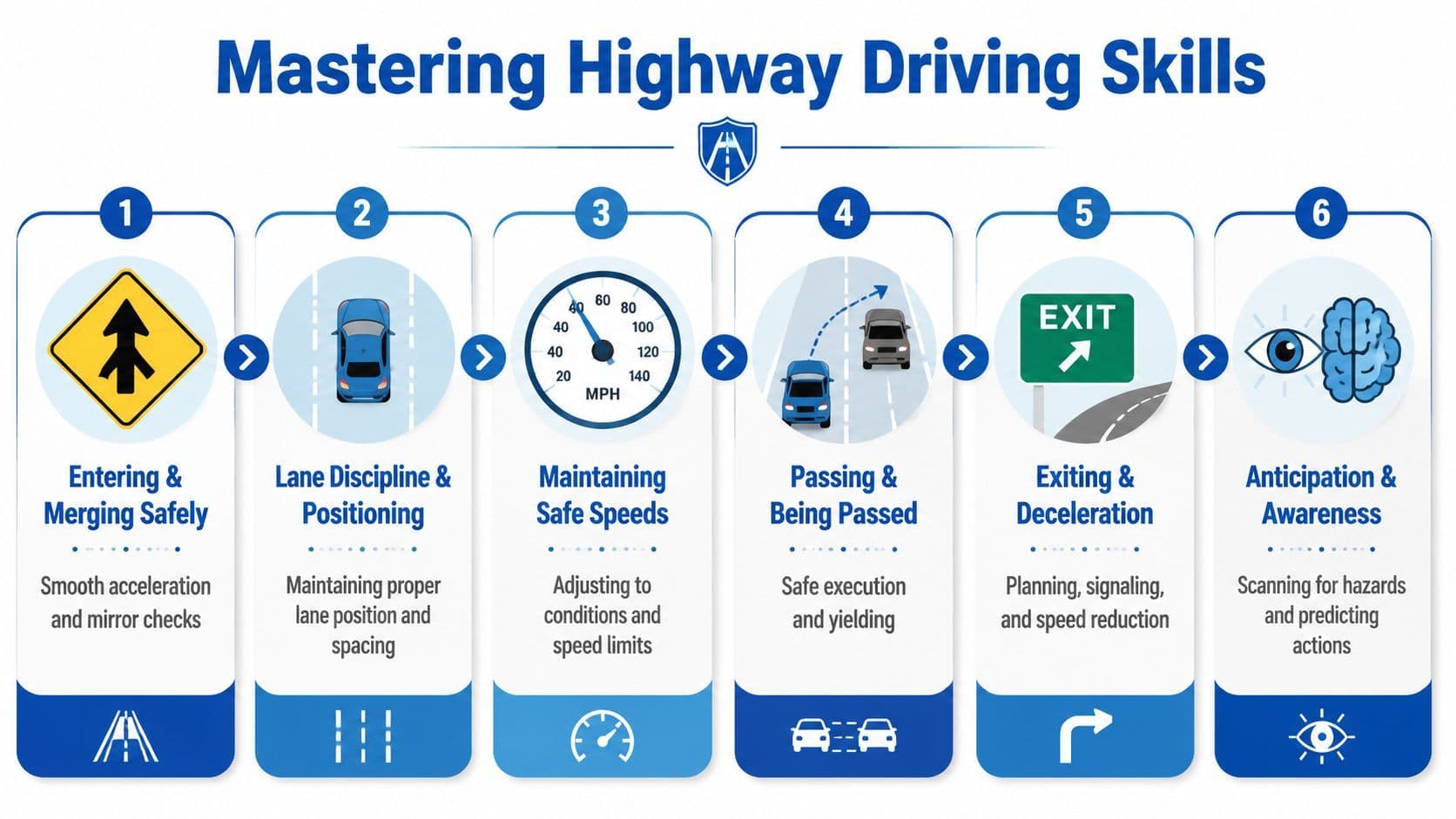
A lot of first-time highway anxiety comes from one thought: “What if I run out of ramp and still can't get in?” That usually happens when drivers hesitate instead of building speed early. The highway isn't the place to stop and negotiate your way in unless traffic forces you to.
Merging without panic
Use the ramp for what it's designed for. Accelerate with purpose, check your mirrors, do a shoulder check, and look for a gap while you're still building speed. You're trying to blend into traffic, not force traffic to slow down for you.
Think of merging as one continuous action:
- Look ahead early to see traffic flow.
- Build speed on the ramp so you're close to highway pace.
- Signal before moving over.
- Check mirrors, then shoulder check.
- Move into the gap smoothly.
If you freeze at the end of the ramp, everything gets harder. Your steering becomes jerky, your speed drops, and other drivers have less idea what you're doing.
To build defensive habits before your full G test, many learners review highway scanning, space management, and hazard awareness through resources such as an Ontario defensive driving course guide.
A visual walkthrough can help if you learn best by watching someone do it first.
Lane discipline and spacing
Once you're on the highway, your job changes from “get in” to “stay predictable.”
That usually means:
- Keep right unless passing: Don't sit in faster lanes if you're not actively overtaking.
- Hold a steady lane position: Avoid wandering within the lane.
- Leave space ahead: You need room to react if traffic compresses.
- Plan lane changes early: Last-second weaving creates stress and raises risk.
On the highway, smooth is safe. Sudden steering, sudden braking, and sudden lane changes usually mean you planned too late.
Lane changes and exits
For lane changes, use the same sequence every time. Signal, check mirrors, shoulder check, then move when the space is clear. Don't reverse that order.
For exits, decide early. If you miss one, take the next one. New drivers create problems when they dive across lanes or brake sharply because they're afraid of being “wrong.” Missing an exit is inconvenient. Making a desperate correction is dangerous.
Penalties for G2 Highway Violations
Highway driving can make some drivers feel anonymous. Fast road, lots of cars, easy to blend in. That's the wrong mindset for a novice driver.
The rules attached to your G2 matter because Ontario treats novice-driver violations seriously. The ministry guidance highlighted earlier points to potential suspension or demerit consequences for breaking conditions such as the 0.00 BAC requirement or handheld-device rules. On a highway, those violations are often more dangerous because the speed and traffic volume leave less room to recover from a mistake.
Why the stakes feel higher with a G2
A fully licensed driver and a G2 driver may commit the same bad decision, but the G2 driver is still in a graduated system. That means your licence status itself is part of the equation.
Common highway situations that can trigger major trouble include:
- Using a phone in moving traffic
- Driving after drinking
- Aggressive speeding
- Unsafe lane changes
- Careless responses to congestion, merging, or shoulder incidents
Even when a driver focuses only on the ticket, the bigger issue is often the effect on their licence record and future progress.
The smart way to think about consequences
Don't think only in terms of “Can I get away with this?” Think in terms of “What happens next if I'm stopped, charged, or suspended?”
That next step can affect your ability to drive to work, school, or appointments. It can also interrupt your path to the full G.
The easiest way to protect your G2 is to drive in a way that never makes an officer, examiner, or insurer question your judgment.
From G2 Practice to Your Full G Licence
Your highway driving during the G2 stage isn't extra. It's preparation for the next licence level and for everyday driving after that.
Ontario's licensing path moves from G1 to G2 to full G, and the G2 stage is where drivers begin handling more complex roads, including highways, before advancing, as described in this guide to the G2 driver's test and next-stage preparation.
Every good highway habit you build now helps later. Smooth merging, proper lane changes, safe following distance, and calm exit planning all carry forward into the full G stage. If your highway experience is shaky, the full G won't feel like a natural next step. It'll feel like a catch-up job.
A strong knowledge base matters too. Some learners build that foundation through the handbook, some with lessons, and some with practice tools. One option is G1ready.ca, which offers Ontario G1 practice tests with feedback and topic-based review.
The best G2 drivers aren't the ones who act fearless. They're the ones who know the rules, respect the risks, and keep practising until the highway feels familiar rather than overwhelming.
If you're still building confidence with Ontario road rules, G1ready.ca is a practical place to study. It offers G1 practice tests, targeted quizzes, and explanations that can help new drivers strengthen the basics before moving from classroom knowledge to real-road decisions.


