Ontario driver's licence renewal usually means a 5-year renewal cycle, a $90 fee, and a new card that arrives in about 4 to 6 weeks after an eligible online renewal. If you're not eligible for the quick online path, the rules change fast, and that's where many drivers lose time.
You're probably here because your licence is coming due, your card has already expired, or you're trying to help a parent sort out an 80-plus renewal without making three unnecessary trips. Ontario does not treat every renewal the same, and pretending it does is how people end up stuck at the wrong counter, missing a test, or waiting on paperwork they never needed to trigger in the first place.
What Ontario Driver's Licence Renewal Involves
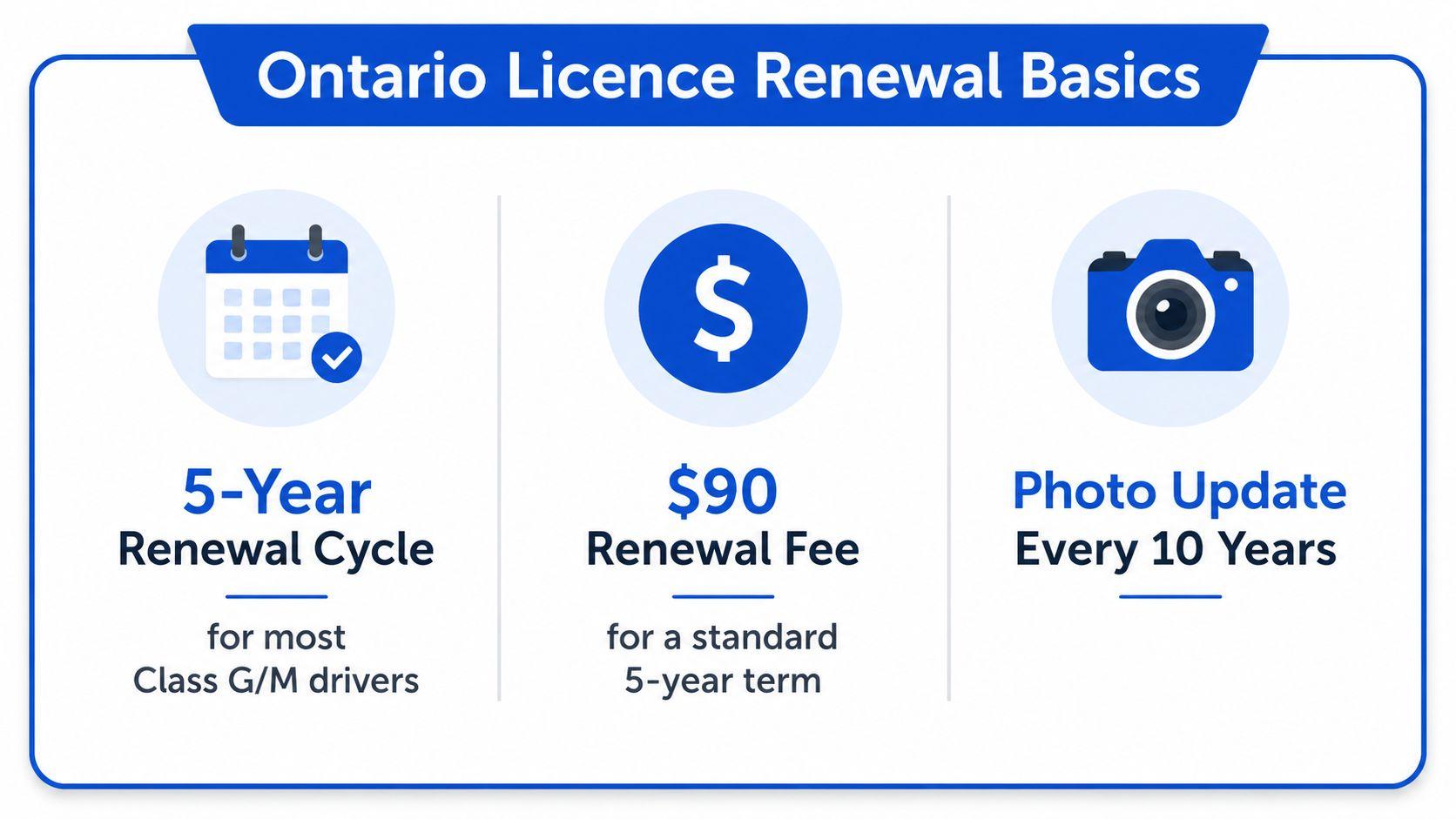
Ontario's standard driver's licence renewal for Class G and M drivers runs on a 5-year cycle, and the current standard fee is $90 for that 5-year licence. After an eligible online renewal, the new card is typically mailed within 4 to 6 weeks, so that is the window to plan around. Those are the baseline numbers that matter before you sort out tests, screening, or special cases. Ontario-based renewal guidance
Sort yourself into the right track first
Start with the renewal pathway, not the form. If your licence is valid and your record is clean, the online path is usually the fastest route. If you have expiry issues, holds, or required tests, you belong in the in-person or testing track instead. If you are 80 or over, you are in a separate renewal process with extra screening.
Practical rule: do not start by typing. Check whether you are eligible to renew the way you expect to first.
Ontario's online renewal program is designed for Class G or M licences that are still valid and have no disqualifying issues. The province also uses age-based renewal screening for older drivers, including a one-stop visit for drivers 80 and over that combines vision assessment and a 5-minute screening exercise at select ServiceOntario locations starting February 3, 2025. That tells you how the system is set up, it is administrative when it can be, and safety-focused when it has to be. Ontario policy update on online renewal and older-driver screening
What most drivers need to do
Most adult drivers only need to confirm eligibility, pay the fee, and wait for the card. That is the easy path, and it is why online renewal exists in the first place.
Ontario does not let every driver use the same route. Recent address changes, fines, or test requirements can push you out of the quick route, and expired licences can move you into a testing sequence. If you skip the eligibility check, you are wasting time and setting yourself up for a failed renewal attempt.
Online, In-Person, or Mail Renewal Compared
The mistake I see most often is simple, people assume online renewal is available until the system tells them otherwise. That's backwards. You should identify your channel before you start, because the wrong choice costs you more than the fee.
Channel Who Can Use It Typical Time Best For Online through ServiceOntario Eligible drivers with a valid Class G or M licence and no disqualifying issues About 6 to 8 minutes end-to-end Drivers with a clean record who want the fastest option In person at ServiceOntario Drivers who don't meet online criteria, including recent address changes, outstanding fines, or pending vision, written, or road tests Longer, because it depends on the issue Drivers who need records updated or in-person verification DriveTest Centre visit Drivers whose expiry status or testing requirements move them out of simple renewal Depends on required testing Drivers who need a vision test, written test, or road test
Ontario's own guidance says the online route is only for eligible drivers, while in-person renewal is required when online criteria aren't met. That includes things like a recent address change, outstanding fines, or pending vision, written, or road tests. In other words, the online system is not rejecting you randomly, it's routing you to the correct lane. Ontario Ministry of Transportation renewal guidance
Mail renewal is not the main plan
Mail is not the route I'd plan around. In practice, Ontario renewal is dominated by online or in-person handling, and the cleanest guidance focuses on those two channels.
If your situation is uncomplicated, online is the sensible choice. If your file has any friction, go straight to the appropriate in-person route instead of trying to force a digital renewal that won't stick. That's faster than learning the hard way after you've already started the transaction.
My recommendation: check your expiry status and record first, then choose the channel. Don't “try online and see” if you already suspect a problem.
One page to check before you commit
If you want a simple fee reference while you're sorting this out, use this renewal-fee overview: renewal fees for driving licence.
Documents and Information You Need Before You Start
Renewal fails for boring reasons, and the biggest one is entering the wrong identifier or missing a payment method. Don't sit down at the computer and hope you remember everything. Grab the basics first and you'll avoid the dumb delays.
Keep this in front of you
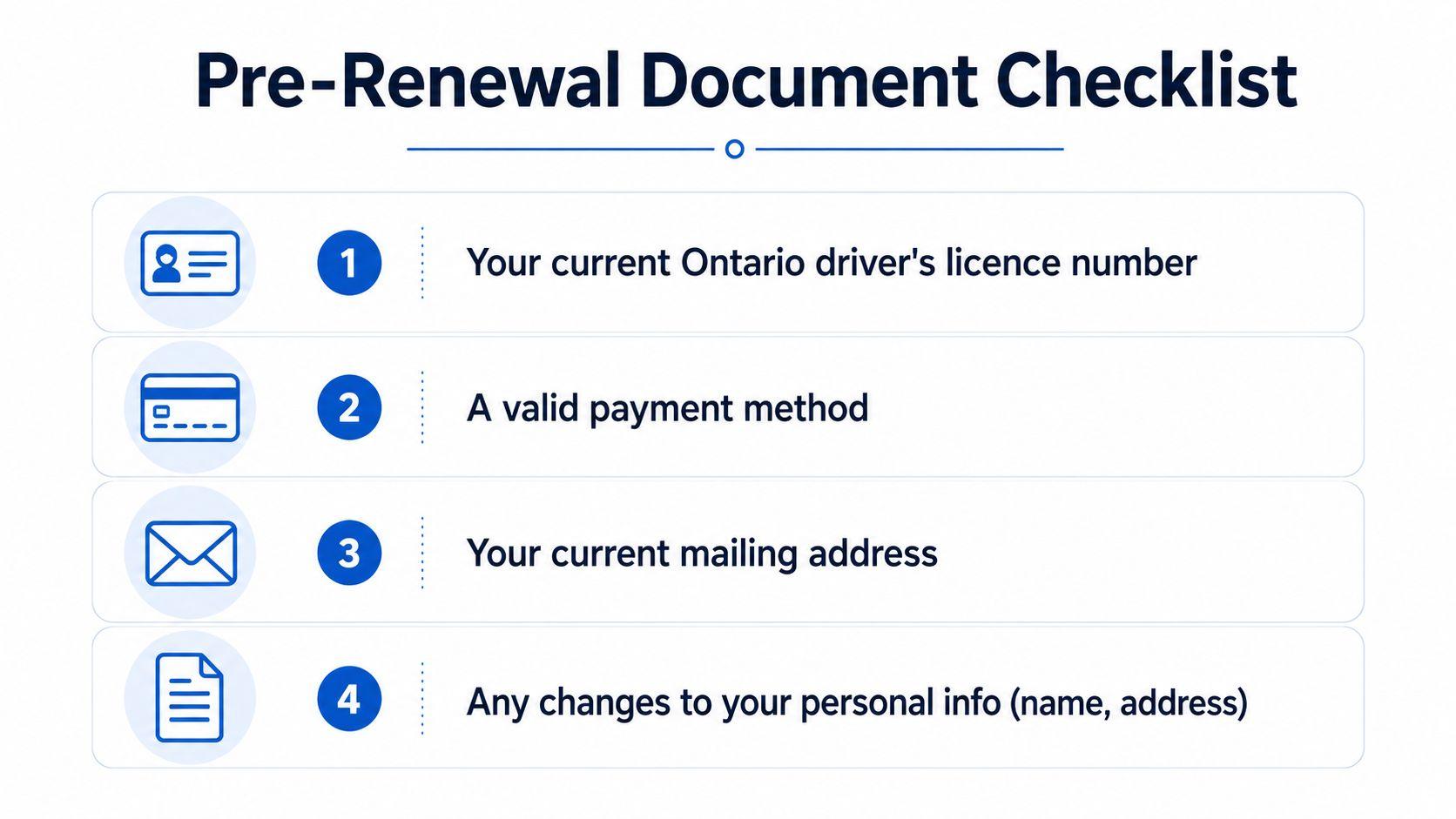
- Your current Ontario driver's licence number. You need the correct identifier, not a close guess.
- A valid payment method. If you can't pay, you can't finish.
- Your current mailing address. If the card needs to be mailed, this has to be right.
- Any personal information changes. Name changes, address changes, or anything else that affects what the system sees.
- Anything that might block renewal. Unpaid fines, pending tests, or medical flags can change the path before payment goes through.
The point here is speed. If you have to stop halfway to hunt for a card or confirm an address, you've already made the renewal more complicated than it needs to be.
What to bring for an in-person visit
For people renewing after a name change or address move, an in-person visit is usually where you solve it cleanly. Bring whatever supports the change and be ready to answer basic identity questions without improvising.
If your record has a hold, don't try to talk your way around it. Fix the hold first. Ontario's renewal system is built around eligibility, and it will not reward optimism.
Before you touch the portal
Double-check that the details on your licence match the details you're entering. If they don't, stop and sort that out before you pay. A five-minute check is cheaper than a wasted trip and a second attempt.
Walking Through the Online Renewal Step by Step
If your renewal is eligible for the online track, use the online track and skip the rest. That is the point. ServiceOntario-guided summaries describe the process as short, and that matches the actual experience when your details are ready and your record is clear. ServiceOntario-guided online renewal timing
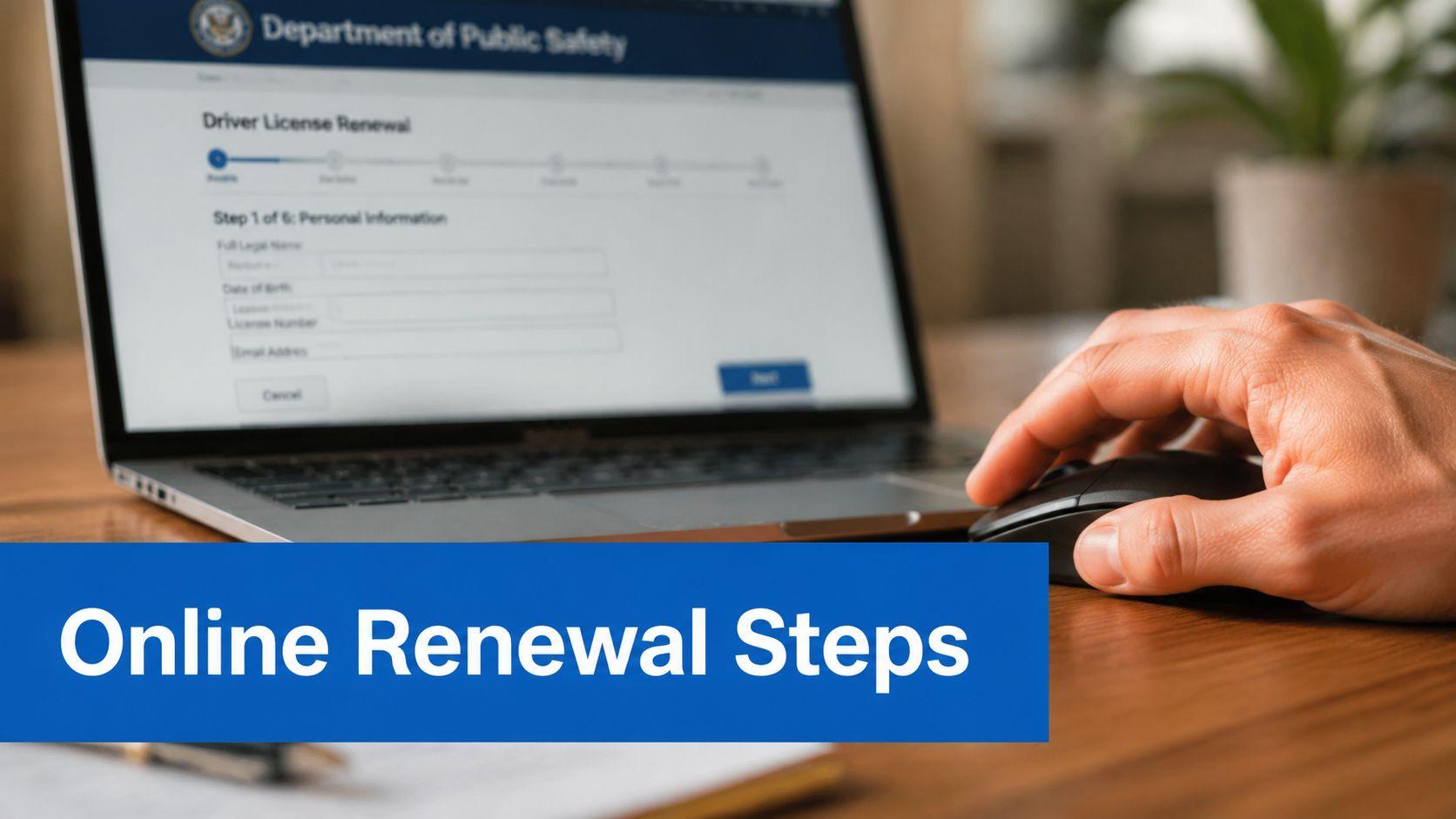
The screens you'll actually see
Start with your licence number, last name, and date of birth. The portal uses those details to pull up your record and confirm it is you. After that, it moves into address confirmation and eligibility checks.
The address screen is the first place where many drivers are caught off guard. If your mailing details or record status no longer fit the online route, the system should push you out of the quick path and into the correct renewal method. The next screen checks for fines or other holds, and those issues can stop the online flow before payment goes through.
Pay, confirm, and keep the record
If you pass the eligibility checks, pay and save the confirmation. Keep that number. If there is a problem later, that confirmation is your proof that you finished the renewal.
The new licence is usually mailed within 4 to 6 weeks after online renewal. Until it arrives, do not submit another application out of panic. If you need temporary identification while you wait, use whatever other valid ID you already carry and keep the confirmation details nearby. Ontario renewal timing and mail window
Don't force the online route
The online process should stay simple. If you can confirm your identity, address, and payment, you are usually done. If you cannot, stop trying to push it through online and move to the correct path instead.
For a separate checklist on updating licence details, see our guide to update driver's licence.
Renewing an Expired Licence in Ontario
Expired licences follow a different rulebook, which often catches people off guard. Ontario's compliance ladder depends on how long the licence has been expired, so the first thing you need is the actual expiry date, not a rough memory of it. Once you know that, the rest gets much clearer.
The escalation ladder
- Expired more than 1 year but less than 3 years. You need a vision test.
- Expired over 3 years but less than 10 years. You need a written knowledge exam in addition to the vision test, and some cases also require road tests.
- Expired more than 10 years. You may be looking at the full re-test process, including a road test.
That structure is the actual issue. People assume they can walk in and “just renew,” but an expired licence often means you're being re-entered into the system through testing rather than simple renewal. Regional Ontario renewal guide on expiry-based testing
Where each step happens
If the renewal only requires the simpler escalation, you're typically dealing with ServiceOntario. Once a written or road test is required, the path shifts to a DriveTest Centre first. That's why guessing wrong on expiry status costs you time and makes the process feel harder than it is.
Practical rule: check the expiry date before you leave home. If the licence has been expired for a long stretch, assume you're not doing a simple online renewal.
Why online usually stops being an option
Online renewal is built for valid licences with no disqualifying issues. Once expiry crosses into testing territory, the system is no longer just taking payment, it's enforcing compliance. That's exactly why the expiry date matters more than your assumption about convenience.
If you're already in this lane, stop looking for shortcuts. Go in prepared, bring the right identification, and expect testing if your expiry window puts you there. That's the fastest way through.
For learner-related paperwork that sometimes overlaps with re-entry into the licensing process, this guide can help: renew learners license.
Renewal Rules for Senior Drivers Aged 80 and Over
Drivers 80 and over do not renew like everyone else. Ontario's standard renewal cycle changes for this group, and the renewal process becomes a safety review as much as an administrative step. If you're helping a parent or spouse, stop thinking in terms of a simple card renewal and start thinking in terms of screening and preparation.
The age-80 cycle is different
Ontario drivers normally renew every 5 years, but drivers who are 80 years old or older must renew every 2 years. Toronto's municipal guidance points seniors into the Senior Driver Renewal Program, which means they are not just booking a routine renewal appointment. They're entering a separate process that may include education and screening before renewal is completed. Toronto senior driver renewal guidance Ontario age-based renewal rule
What the appointment can involve
Starting February 3, 2025, Ontario introduced a one-stop renewal visit for drivers 80 and over at select ServiceOntario locations. That visit combines a mandatory vision assessment with a 5-minute screening exercise. Depending on the result, the driver may need follow-up steps such as a road test or medical documentation. Ontario backgrounder on older-driver renewal
The practical point is simple. This is not just paperwork. If family members show up unprepared, they create avoidable stress for everyone in the room.
How to prepare without making it a production
Bring the basics, but also be ready for a screening conversation. If the driver uses glasses, bring them. If there's a medical issue on record, don't hide it or minimise it, because the process is designed to surface exactly those concerns.
If you're booking for someone else, ask what the appointment is meant to include before you go. That way, nobody is surprised if the visit feels more like a fitness-to-drive review than a card pick-up.
Practical Tips and Common Renewal Mistakes to Avoid
The best renewal move is the dull one, renew early. Waiting until the last minute is how people discover they've been pushed into a test requirement, and that's a bad day to find out. The expiry date is not a suggestion.
What I tell drivers to do
- Check your address first. If ServiceOntario doesn't have your current address, online renewal may not be available.
- Pay outstanding fines before you start. Don't wait until the portal rejects you.
- Treat the 4 to 6 week mail window as a buffer. It's normal timing, not a guarantee you should build your life around.
- Separate lost from expired. A lost licence and an expired licence are not the same problem.
- Handle name changes early. If your name changed, fix the record before you renew so you don't create an avoidable in-person issue.
The quickest way to save time is to stop treating renewal like one universal process. It isn't.
If the new card doesn't arrive
If you renewed online and the card still hasn't shown up after the normal mailing window, use your confirmation details and follow up through the proper ServiceOntario channel. Don't submit random duplicate requests just because the envelope hasn't arrived yet. That usually creates more confusion, not less.
Match your situation to the right path
If your licence is valid and your record is clean, use the online quick path. If your licence is expired or there are holds, go to the in-person or testing path. If you're 80 or over, prepare for the senior renewal path with screening built in.
G1ready.ca helps Ontarians handle the paperwork side of licence-related tasks with clear, practical guides, and that includes renewal questions that don't fit the standard lane. If you want straightforward Ontario driving resources in one place, visit G1ready.ca and use it to plan your next step before you book anything.