

You look at the front of your licence, spot the expiry date, and the panic starts immediately. Many individuals assume they can renew a learner's licence the way they renew other government ID. Then they start searching, get mixed answers, and end up even less sure whether they need a quick online update, a DriveTest visit, or a full restart.
That confusion is normal. In Ontario, the biggest mistake isn't missing a study topic. It's misunderstanding what an expiring G1 means. If you're near the end of your timeline, the practical question isn't just how to renew learner's license paperwork. It's whether you're still inside the graduated licensing window, or whether you're about to start over.
If you've been trying to decode the rules, the short version is this: a G1 isn't something typically "renewed" in the ordinary sense. It's part of Ontario's graduated licensing path. If you need a quick refresher on how that system fits together, Ontario's graduated licensing system explained gives the bigger picture.
Your G1 Licence Is Expiring What Happens Next
A lot of Ontario drivers hit the same moment. The licence sat in a wallet for years while school, work, family, or nerves got in the way. Then one day they notice the expiry date and realise they don't know what comes next.
The first thing to know is that panic usually leads to the wrong move. People try to book the wrong service, show up with half their documents, or assume they'll sort it out at the counter. That's how a simple errand turns into a wasted morning.
What helps is treating this like two separate questions.
First, is your G1 still valid right now? Second, are you dealing with an ordinary record update, or has your place in the graduated licensing process run out? Those are very different situations, and DriveTest handles them differently.
Practical rule: Before you leave home, decide whether you're updating a still-valid record or restarting after expiry. That one distinction changes everything.
Most of the stress comes from using the word "renew" too loosely. For a full G licence, that word makes sense. For a G1, it often doesn't. If you're close to the deadline, the smart move is to check your status, gather your original documents, and plan for an in-person visit rather than assuming an online shortcut will save you.
That's the path that avoids surprises.
Understanding G1 Licence Expiry and Eligibility
The core misunderstanding is simple. People think a G1 works like a health card or a standard driver's licence renewal. It doesn't.
A G1 is the entry point into Ontario's graduated licensing system. That means your licence is tied to a finite period in which you move through the program. When people say they need to renew learner's license status, what they often mean is that their G1 is near expiry and they want to keep moving forward without losing progress.
Why people get this wrong
The confusion starts because the licence itself has an expiry date, so it feels like a standard renewal should exist. In practice, the more important issue is whether you still have a valid place inside the graduated system.
If that window closes, you're not just updating a card. You're usually restarting from the beginning.
The decision point that matters
Think about your situation in one of these ways:
- Your G1 is still valid: you're still inside your licensing timeline, so your next move depends on where you are in the process.
- Your G1 is close to expiry: you need to act quickly and confirm what options are still open before the date passes.
- Your G1 has expired: you're no longer dealing with a routine update. You're dealing with a restart.
That last point is the one people resist, but it saves time to accept it early. Arguing with the rule at the counter won't change the outcome.
A learner's licence near expiry is an administrative problem. A learner's licence past expiry is usually a start-over problem.
There's a useful comparison in another jurisdiction that shows why learner permits are often built around fixed milestones rather than open-ended use. In California, a minor's instruction permit must be held for at least 6 months before the road test, and permit eligibility also depends on driver education enrolment for applicants under 18, according to the California DMV permit and licence rules. Ontario's system has its own rules, but the practical lesson is the same. Learner credentials are tied to timelines, not unlimited extensions.
Once you understand that, the next step becomes more straightforward. Stop asking, "Can I renew this like a normal card?" Start asking, "Am I updating a valid record, or am I re-applying?"
Documents and Fees for Your DriveTest Visit
The fastest way to ruin a DriveTest visit is to arrive with photocopies, expired ID, or a document that doesn't match the name on file. Staff aren't being picky. They're checking legal identity, record accuracy, and whether they can process your application without creating a mismatch in the system.
If you're heading in because your learner status needs attention, build a paper folder before you leave. Don't rely on screenshots or assumptions. Bring original documents.
For a practical overview of acceptable ID categories, this guide to G1 test document requirements is a useful starting point.
Bring originals and assume staff will verify everything
When people ask me what works, my answer is always the same. Bring more proof than you think you'll need, as long as it's legitimate and original. The counter staff can only process what they can verify on the spot.
A safe checklist usually includes:
- Primary identity document: bring original proof of legal name and date of birth.
- Supporting name-change document: bring it if the name on one document doesn't match the others.
- Current address support: bring documentation that reflects your current residence if your record needs updating.
- Payment method: assume you'll need to pay applicable fees at the visit.
- Glasses or contacts: bring them if you use them, because vision screening can be part of the process.
Required Documents Checklist for G1 Renewal Re-Application
Item Requirement Details Notes Legal name ID Original government-issued proof of legal name Photocopies can create problems Date of birth proof Original document showing your birth date Often covered by the same identity document Signature support Bring ID or documents that support your identity record Matching details matter Address update proof Bring current original documentation if your address has changed Use current information only Name change support Bring original legal change documents if applicable Needed when records don't match Payment Bring a valid payment method for fees and testing charges Confirm accepted payment options before visiting Corrective lenses Bring glasses or contacts if you use them for vision Don't leave them in the car
If your details have changed, don't treat that as a minor issue. A changed name or address can affect how the transaction is processed. That's one reason people who expected a quick counter visit end up going home to get more paperwork.
The same goes for fees. Expect charges related to application or testing when you're re-applying or retesting, and check the current amount directly with DriveTest or the province before you go. Fee schedules can change, and guessing doesn't help.
Navigating the In-Person G1 Application Process
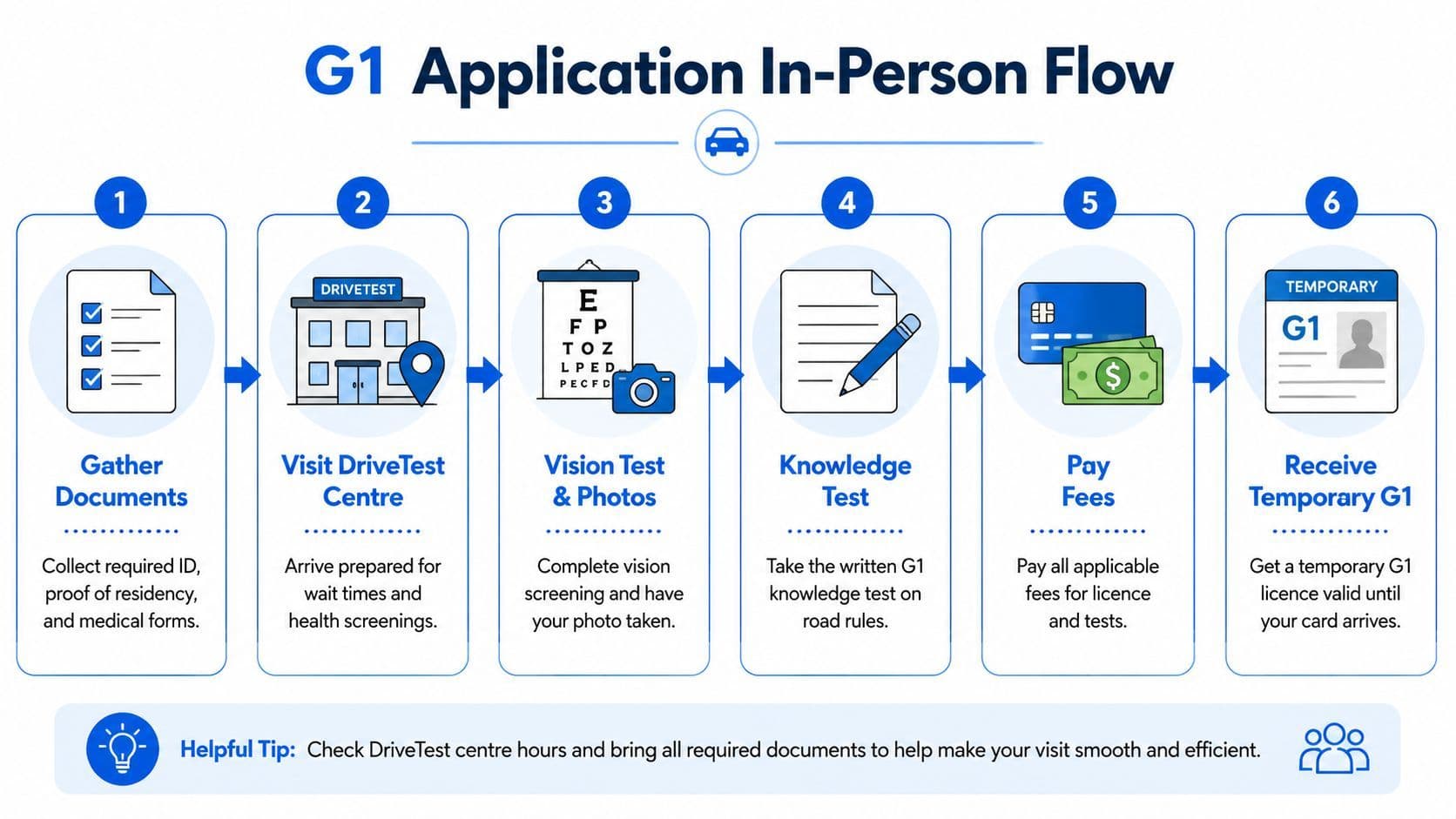
The in-person visit is usually less dramatic than people fear. It's mostly administrative. The challenge is that many applicants walk in expecting a simple renewal, then realise the staff are treating the visit as identity verification, record review, photo processing, vision screening, and possibly a fresh application.
What the visit usually feels like
You arrive, take a number or check in, and wait longer than you'd prefer. That's normal. Use that time to organise your documents in the order you'll hand them over.
When you're called, the staff member starts with the basics. They look at your documents, compare the names and other identifying details, and decide whether your request is a straightforward record transaction or a more involved application. If something doesn't line up, they stop there and ask for the missing proof.
After that, expect the practical parts. If your process requires it, you'll do a vision test. If a photo needs to be updated, that gets handled during the visit as well. Then any applicable fees are collected, and if you're restarting, you'll be directed into the testing stream rather than a simple update path.
What staff are actually checking
People often misunderstand the point of the visit. They think the counter is there to "renew learner's license" status in a few clicks. In reality, the visit is often about confirming that the person standing there matches the record, and that the record is still usable.
A helpful operational clue comes from Ontario-style renewal workflow guidance. ServiceOntario says many licences can be renewed online, but first-time renewals and cases involving changed photo, signature, or address often require an in-person visit. Online renewal only works when the record is eligible and the current details match what the registry holds, according to the licence renewal eligibility guidance. The practical takeaway is simple. If your record needs identity, residency, or legal-name proof, expect to do this in person.
The counter process isn't just paperwork. It's a checkpoint for identity, record accuracy, and whether your application can legally move forward.
A typical visit goes more smoothly if you act like you're presenting a file, not asking for help piecemeal. Hand over your documents together. Answer directly. If your address changed, say so immediately. If your name changed, put the supporting legal document on top.
That approach cuts down on back-and-forth and makes it easier for the clerk to process you correctly the first time.
Handling an Expired Licence or Personal Info Changes
People often lump these together because both involve going back to the licensing office. They shouldn't. One is a reset. The other is usually an update.
If the licence is already expired
This is the harder scenario, and it's where people waste the most energy hoping for an exception.
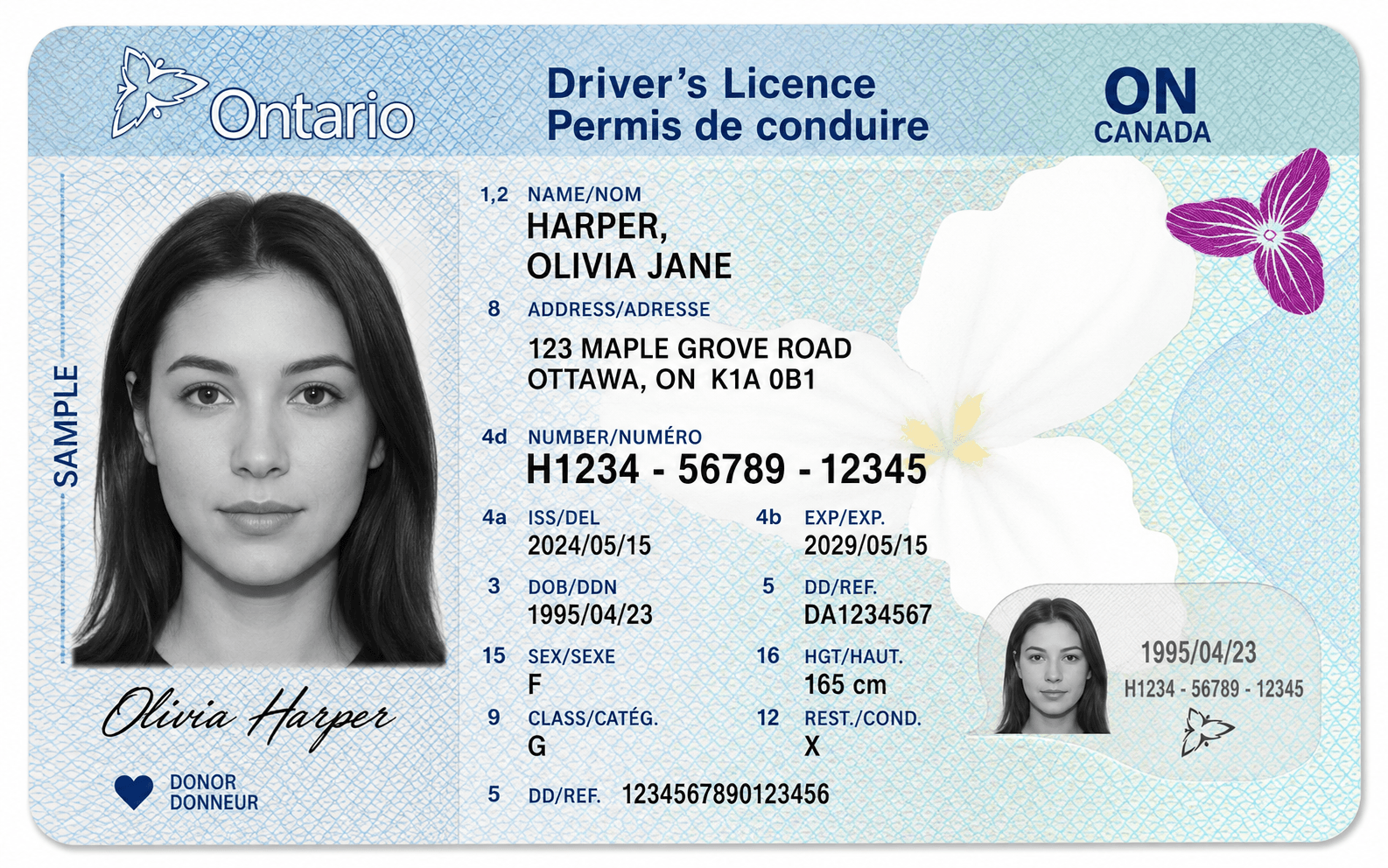
If your G1 has expired and your graduated licensing time has run out, treat it as a restart. Don't walk in expecting staff to revive the old learner status because you were "almost ready" or because life got busy. Those explanations are common, but they don't change the process.
What works is accepting the restart quickly and preparing for it properly. That usually means:
- Bring full ID again: don't assume your old card is enough.
- Prepare for testing: if you're restarting, expect the knowledge and vision requirements to apply again.
- Budget time, not just money: the bigger cost is often the extra trip caused by poor preparation.
If the card is expired, the conversation changes from extension to re-application.
This short video gives a basic visual refresher on dealing with licence issues before you head out:
If your name or address changed
This part is much simpler, but only if you show up with the right proof.
A new address, updated legal name, or other record change can trigger extra checks. That's why some people assume they can do everything online and then discover the transaction can't be completed that way. The problem isn't the update itself. It's whether the record still matches what the system already holds.
For name changes, bring the legal document that connects the old name to the new one. For address changes, bring current documentation that supports the new address if the transaction calls for it. Don't bring outdated mail and hope it'll pass.
The practical trade-off is straightforward. If your licence is still valid and you're only fixing personal information, this is an admin task. If the licence has expired, personal updates become secondary because the primary issue is that you're no longer in an active learner stage.
Preparing for a G1 Retest and Common Mistakes to Avoid
A G1 retest feels discouraging if you treat it like punishment. It's more useful to treat it like a second chance to prepare properly. People fail the re-entry process for familiar reasons. They rely on memory, skim road signs, and assume general driving experience will carry them through the written test.
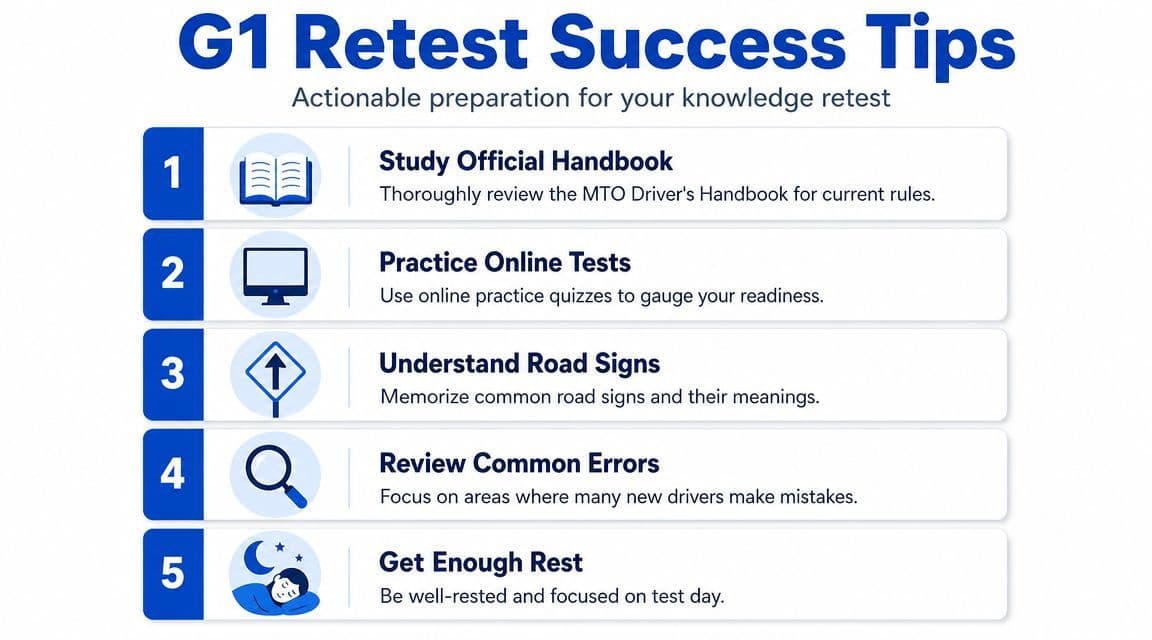
That approach doesn't hold up well because the G1 exam is split into two sections, and you need to clear both. DriveTest requires 16 out of 20 correct on the road signs section and 16 out of 20 correct on the rules of the road section, which means an 80% pass mark in each section, according to the DriveTest G1 exam pass-standard explanation. The common failure mode is obvious. Someone does well overall but falls short in one section.
Study for the actual pass standard
If you're retesting, don't use a vague plan like "I'll do a few mixed quizzes." Split your prep by topic.
A stronger method looks like this:
- Start with diagnostics: separate signs from rules so you can see where you're weaker.
- Drill one domain at a time: if signs are shaky, don't hide that weakness inside mixed practice.
- Review explanations slowly: many errors come from misreading exceptions, not from not studying at all.
- Use timed practice carefully: pressure changes how people read questions.
Ontario-focused prep works best when it mirrors the structure of the actual test. If you want a sense of the traps candidates fall into, common G1 test mistakes is worth reviewing before your next attempt.
Mistakes that waste a retest
The biggest mistake is overconfidence. Someone has driven with family, knows basic signs, and assumes the written exam will be easy. Then one weak section sinks the whole attempt.
Other avoidable problems come up all the time:
- Cramming mixed questions only: this hides section-specific weaknesses.
- Rushing right-of-way questions: these often trip up otherwise solid candidates.
- Ignoring signage details: similar-looking signs can produce easy errors.
- Arriving mentally scattered: tired test-takers misread simple wording.
Read every answer choice as if one small word changes the rule, because sometimes it does.
What works is boring, but effective. Short practice sets. Careful review. Repeating weak categories until your results are consistently strong in both sections, not just acceptable overall. That's the difference between walking in hopeful and walking in ready.
If you're restarting the process or want to make sure you're prepared before your next DriveTest visit, G1ready.ca is a practical place to study. It offers Ontario-focused practice tests, targeted quizzes by topic, and explanations that help you catch weak areas before they cost you an attempt.


