You're probably here because you want a straight answer before you spend money, book training, or switch careers. Maybe you're looking at trucking, bus driving, construction work, or delivery jobs in Ontario and keep seeing two labels that seem simple at first: Class A and Class B.
The problem is that most guides stop at the legal definitions. That doesn't help much when you're trying to decide what life will look like after you get licensed. The better question is this: which licence fits the work you want, the income path you want, and the kind of schedule you can live with?
Class A vs Class B License What's the Difference
If you're choosing between a Class A class B license path, you're really choosing between two different commercial driving careers.
A Class A licence points you toward combination vehicles, the kind of equipment commonly associated with highway freight. A Class B licence points you toward heavy single-unit vehicles, often tied to local routes, public services, and site-based work. Both are valuable. They just solve different career problems.
The biggest point of confusion is that people often compare these licences as if one is “better.” That's the wrong way to think about it. A Class A licence gives broader commercial driving privileges, but that doesn't mean it's the right move for every Ontarian. Some drivers want highway freight and larger combinations. Others want to stay local and work in construction, transit, or community-based transport.
If you're still early in your licensing journey, it helps to understand where Ontario's full-licence system begins before moving into commercial classes. A quick refresher on the Ontario Class G licence can make the commercial progression much easier to understand.
Practical rule: If the job involves a heavy trailer or tractor-trailer setup, think Class A first. If the job centres on a large single vehicle, think Class B first.
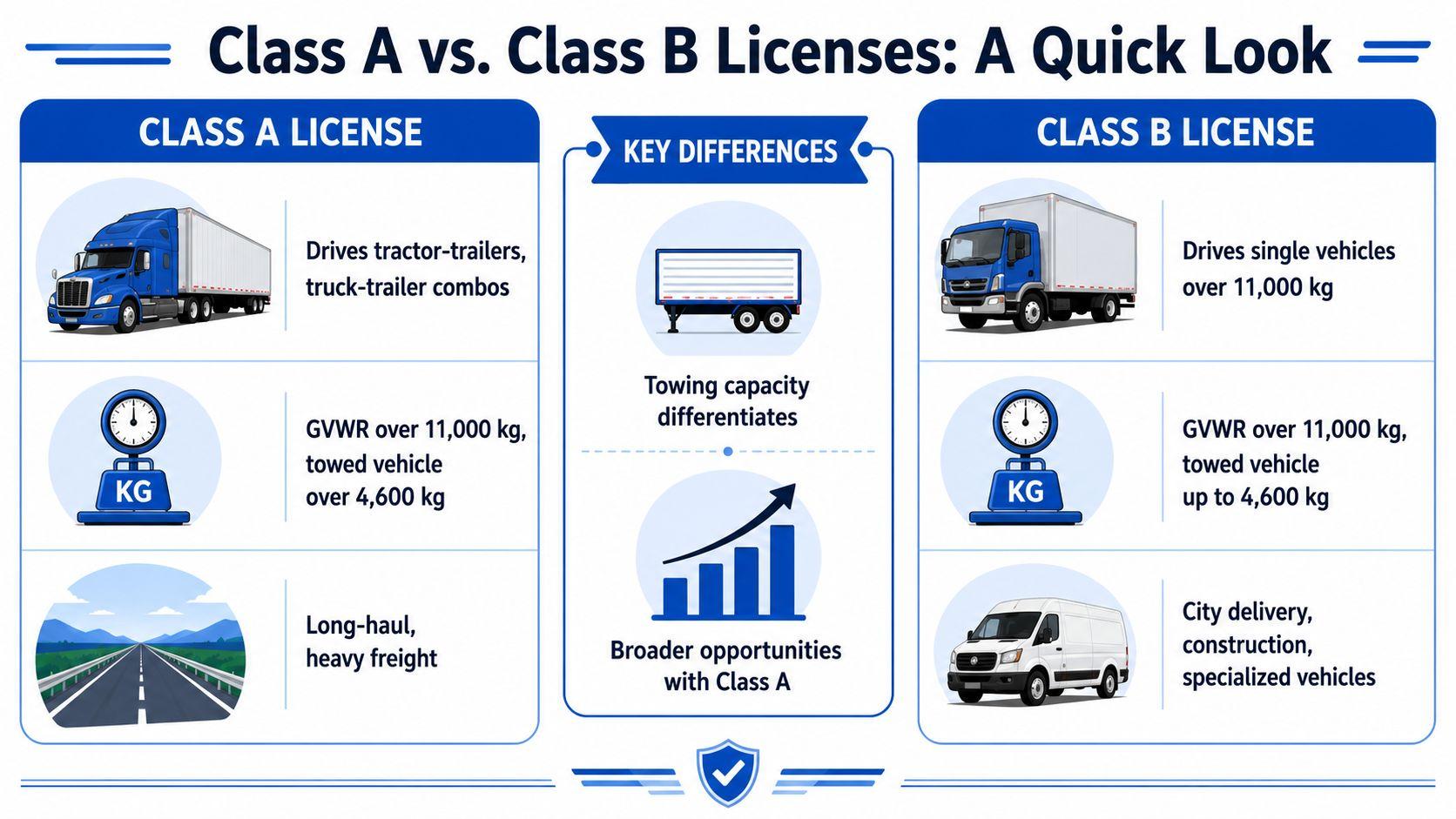
Here's the simple anchor to remember. Class A is about heavier combination driving. Class B is about large single vehicles with limited towing. Once that clicks, the rest of the decision gets much easier.
At a Glance Comparing Class A and Class B Licenses
When people ask me for the fast version, I give them the table first. Then I explain the towing rule, because that's where most licence mistakes start.
Class A vs Class B Licence Quick Comparison
Feature Class A License Class B License Main vehicle type Combination vehicles Single vehicles Weight rule Used for combination vehicles with a GCWR of 26,001 pounds or more where the towed unit is over 10,000 pounds Used for single vehicles with a GVWR over 26,001 pounds and towing limited to 10,000 pounds or less Typical examples Tractor-trailers, truck-trailer combinations, tankers Straight trucks, box trucks, dump trucks with small trailers, large buses Towing ability Can tow heavier units over 10,000 pounds Cannot tow a vehicle over 10,000 pounds Licence hierarchy Covers vehicles in Class B or C Can operate Class C vehicles, but not Class A combinations General career direction Long-haul freight and broader commercial options Local delivery, transit, municipal, construction, regional work
The one rule that decides most cases
The clearest technical difference is the trailer threshold. In Ontario, Class A permits towing equipment with a GVWR exceeding 10,000 pounds, while Class B restricts towing to trailers with a GVWR of 10,000 pounds or less, as outlined in this Class A and Class B towing distinction reference.
That sounds dry, but in real life it matters a lot.
A dump truck used on a local worksite may fit comfortably into Class B territory if the vehicle is a heavy single unit and the trailer stays within the legal limit. A tractor pulling a loaded semi-trailer is different. Once the setup moves into heavier combination territory, you're in Class A land.
Why this matters for your decision
Most licence regret comes from solving the wrong problem. Some people train for Class B and then realise the jobs they want involve larger combinations. Others aim for Class A without considering that they want local work and home-daily routines.
Use the table as a career filter, not just a legal checklist. Ask yourself what you want to drive every day, where you want to work, and how much variety you want in your licence.
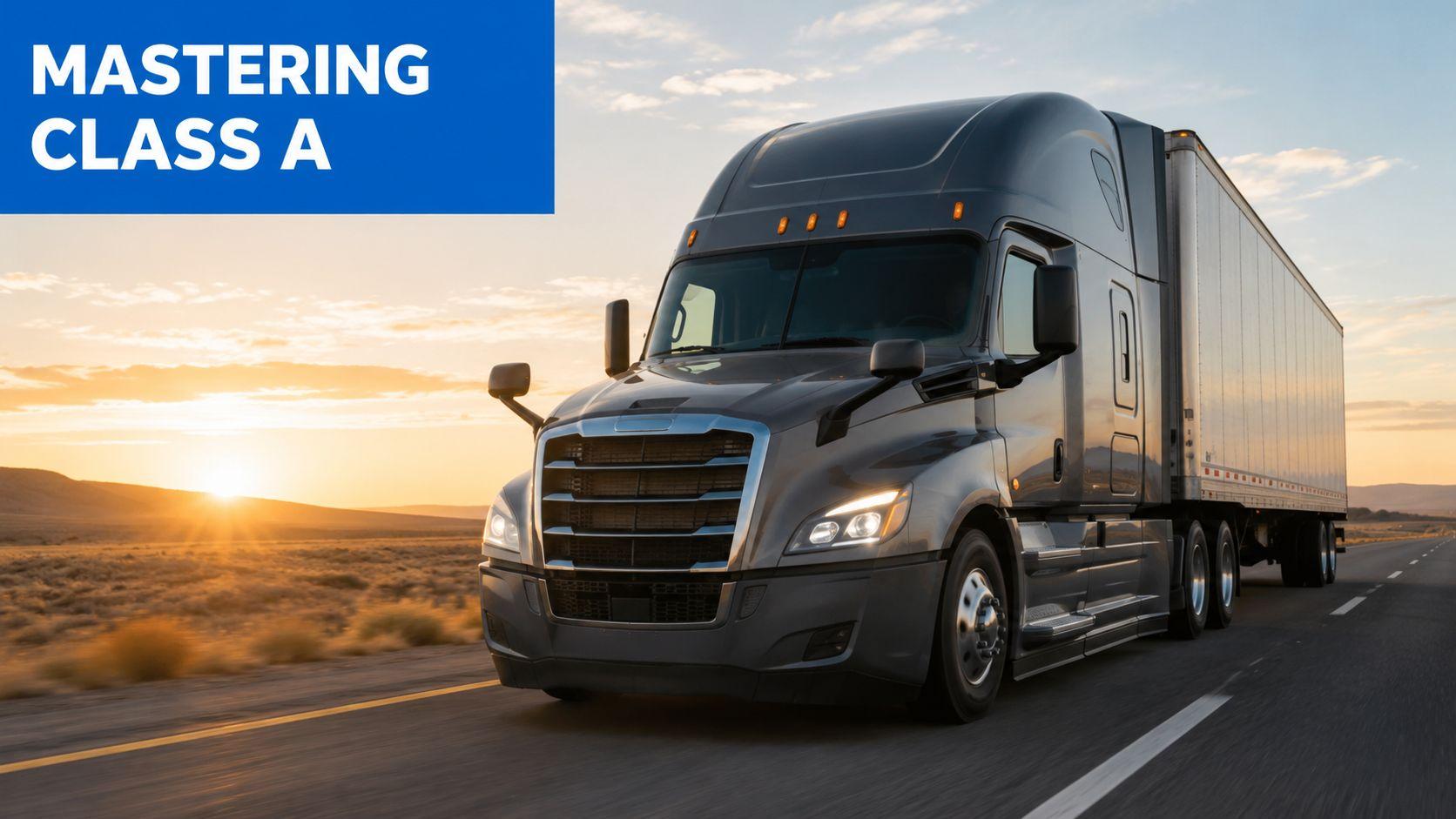
What is a Class A License Driving the Biggest Rigs
A Class A licence is the top tier for commercial driving in this comparison. It's the licence built for the biggest combinations on the road and for the drivers who want access to the widest range of heavy commercial work.
In Ontario, a Class A licence is required for combination vehicles with a gross combination weight rating of 26,001 pounds or more, where the towed unit exceeds 10,000 pounds, according to this commercial licence class overview. That's the legal line that separates a heavy combination setup from the single-unit world.
What you can drive with Class A
This is the licence many imagine when they think about commercial trucking.
It can include equipment such as:
- Tractor-trailers: The standard long-haul freight setup seen on Ontario highways.
- Double or triple trailers: Higher-complexity combination driving where permitted for the work involved.
- Tankers: Heavy combination vehicles used for bulk transport.
- Class B or C vehicles: Class A sits above those classes in scope.
That last point matters. If you hold Class A, you're not boxed into one narrow category. You can move across a wider range of commercial vehicle work because the licence covers vehicles included under Class B or Class C.
What the work often looks like
Class A work usually attracts drivers who are comfortable with scale, planning, and responsibility. You're dealing with longer vehicles, wider turns, coupling and uncoupling, air brake awareness, loading differences, and more serious space management.
The trailer changes everything. Your stopping, turning, lane use, and backing all demand more discipline than single-unit driving.
This licence is also closely tied to long-haul freight operations across Ontario. If you're aiming for highway logistics, major freight corridors, or work involving Class 8 tractors, this is the licence that opens that door.
Costs and practical commitment
The cost side matters because many new drivers only budget for the school portion and forget the licensing pieces. In Ontario, the cost of obtaining a CDL can vary by municipality, with permit fees up to $90, application fees between $0 and $43, and skills testing reaching $250, with up to $120 for the licence itself, based on the verified Ontario figures provided above.
That doesn't mean every driver will pay the exact same amount. It means you need to budget for more than one fee and expect variation depending on where you apply and test.
Class A is a serious step. It gives serious flexibility too.
What is a Class B License Powering Local Economies
A Class B licence is often misunderstood because people compare it to Class A and stop there. That misses the point. Class B isn't a “lesser” path. It's a different path, and for many drivers it's the better fit.
Class B is built for single vehicles with a GVWR greater than 26,001 pounds. These are the vehicles that keep local operations moving every day. Think straight trucks, box trucks, dump trucks with small trailers, school buses, city buses, and tourist buses. The key restriction is towing. A Class B holder can't tow any vehicle exceeding 10,000 pounds GVWR.
Vehicles that fit the Class B world
The Class B category is where many practical, community-facing driving jobs live.
Common examples include:
- Straight trucks: Used in regional freight and commercial deliveries.
- Box trucks: Common in moving, supply, and scheduled delivery work.
- Dump trucks with small trailers: Often seen in construction and aggregate support.
- Large buses: Used in passenger transportation, subject to the right endorsement where required.
This licence also allows the holder to operate Class C vehicles, but it doesn't allow operation of Class A combinations.
Why many drivers prefer it
A lot of Class B work is tied to local and regional service. That often means a different rhythm from long-haul freight. You may start and finish in the same area, work with a municipality, contractor, school operator, or local fleet, and develop route familiarity faster.
For some people, that's the deciding factor. They don't want life built around combination equipment, long stretches away, or constant trailer management. They want heavy vehicle work with more routine and more stable day-to-day geography.
Pay and training basics
As of June 29, 2026, CDL Class B driver jobs in Ontario offer an average hourly pay of $20.98, with most workers earning between $17.55 and $24.04 per hour, based on the verified Ontario data above. That gives you a grounded starting point when you compare job listings.
A few process details also catch people off guard. Training for Class B requires a Medical Examination Report Form, plus vision and knowledge testing. After passing the physical testing, you can receive a learner's permit, and there's a minimum 14-day wait before scheduling road skills tests, according to the verified data above.
If your goal is steady local work in delivery, transit, or site operations, Class B often matches the lifestyle better than people expect.
The strength of Class B is focus. It prepares you for heavy single-vehicle work that Ontario relies on every day.
Job Opportunities and Career Paths for Each License
The licence you choose shapes more than the vehicle you drive. It affects where you work, how often you're home, what employers expect, and how easy it is to pivot later.
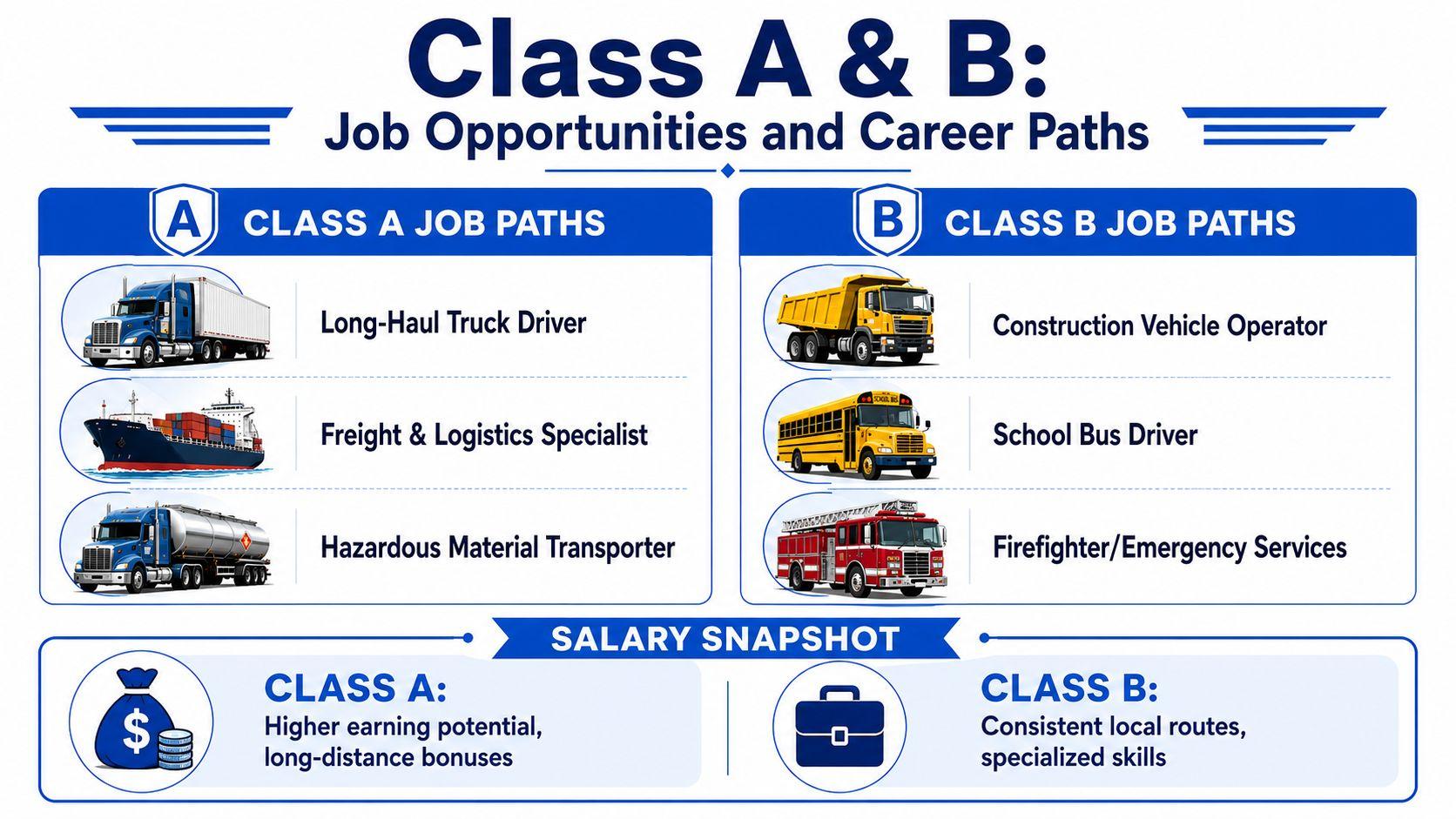
Class A usually suits broader freight mobility
A Class A holder usually has the wider job map. The licence fits long-haul freight, highway-focused work, heavy combination operations, tanker work, and fleet roles built around tractor-trailers. If you want the flexibility to move between segments of commercial freight, Class A gives you more room to do that.
It also gives you licensing crossover. Because Class A includes vehicles covered under Class B or C, drivers can shift into different roles without stepping down to a separate commercial class.
Class B usually suits local specialisation
Class B careers tend to be rooted in place. That can mean local delivery, municipal fleets, site support, community transportation, or regional operations with repeated routes and familiar equipment.
That kind of work appeals to drivers who want a more predictable routine. Many also like that Class B jobs often connect directly to visible local services. You're not just moving freight through Ontario. You're supporting construction, passenger movement, maintenance, and day-to-day supply.
The bus endorsement detail many people miss
One of the most common misunderstandings in Ontario is bus driving eligibility. A lot of summaries say Class B covers large buses and leave it there. That's incomplete.
Ontario specifically requires a P endorsement for any bus carrying 16 or more people, including school buses, as set out in the Ontario bus licence classes and combinations handbook. So if your plan is school transportation or city transit, Class B alone isn't enough.
Important: If the vehicle carries passengers, always check whether the job requires a passenger endorsement rather than assuming the base licence class covers everything.
Choosing by career pattern
A practical way to decide is to match the licence to your likely work pattern:
- Choose Class A if you want freight flexibility, combination vehicle work, and the broadest commercial driving range.
- Choose Class B if you want large single-unit driving, local service roles, or a route structure that often keeps you closer to home.
- Pause and check endorsements if your target job involves passengers or specialised cargo.
That last point saves people a lot of frustration. A licence class gets you in the right category. The endorsement often gets you into the actual job.
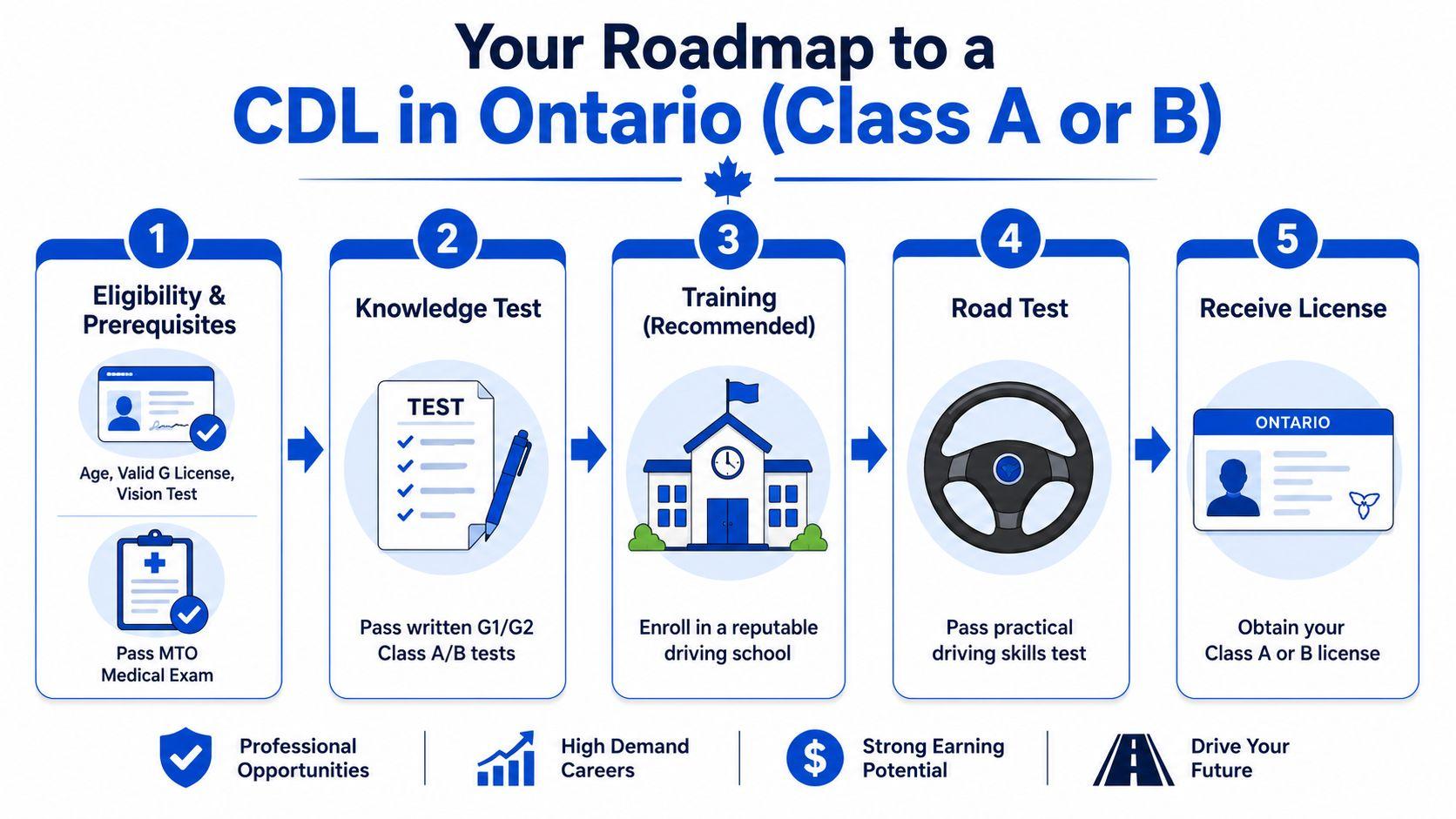
How to Get Your Class A or Class B License in Ontario
Most applicants do better when they treat licensing as a sequence instead of a single event. You're not just booking a road test. You're clearing several gates in the right order.
Step 1 meets the legal entry rules
To apply for a Class A or D driver's licence in Ontario, you must be at least 18 years old and hold a valid Ontario Class G or higher licence, excluding G1, G2, M, M1, or M2, according to the Ontario truck handbook licence requirements. For commercial applicants, this is the first hard filter.
Before you budget for training, make sure your base licence status is in order. If you're also reviewing licence administration costs more generally, this guide to Ontario licence renewal fees can help you understand the broader fee environment.
Step 2 clears medical and knowledge requirements
Both Class A and Class B require a medical component, vision screening, and written knowledge preparation. Ontario also requires both classes to achieve an 80% passing grade on the General Knowledge Test, and both require an Air Brakes Test, based on the verified Ontario data tied to the Class A versus Class B testing comparison.
Class A applicants face an extra layer here. Ontario requires Class A applicants to pass a knowledge test on large trucks and tractor-trailers and complete mandatory Entry-Level Training before the road test, as noted in the verified data above.
Step 3 prepares you for the vehicle you'll actually test in
At this juncture, students either save time or waste it. The road test is class-specific. You need to train in the kind of vehicle that matches the class you want.
For Class A, that means practising with a full tractor-trailer setup that reflects the demands of combination driving. For Class B, the focus is on large single-unit operation. The skill set overlaps in some areas, but the feel of the vehicle is very different.
Don't train “close enough.” Train in the same type of equipment you'll be tested in.
Step 4 books and completes the road test
After you're eligible and prepared, you can book the road test. Class B applicants should remember the minimum 14-day wait after permit issuance before scheduling the road skills test, as noted earlier from the verified data.
If you fail the road test for a commercial licence in Ontario, there is a mandatory 10-day wait before trying again, and you must pay the applicable re-test fees, according to this Ontario commercial road test retake rule.
A useful checklist before test day:
- Bring the right documents: Missing paperwork can end the appointment before it starts.
- Check the vehicle condition: Commercial road tests are unforgiving when lights, brakes, or required equipment are off.
- Practise inspections out loud: Examiners need to see that you know what you're checking and why.
- Prepare for nerves: Many good drivers fail because they rush, not because they lack skill.
Step 5 pays the required fees
Fee questions come up constantly, and the answer is that costs vary.
For Class A, verified Ontario figures show permit fees up to $90, application fees between $0 and $43, and skills testing up to $250, with up to $120 for the licence itself. For Class B, verified Ontario figures show permit fees up to $90, written tests up to $125, and skills testing up to $250, with approximately $120 for the licence.
Build your budget around the full process, not just one payment. Testing, permit stages, and licence issuance all count.
Making Your Choice Which License Is Right for You
The right answer depends less on prestige and more on fit.
Choose a Class A licence if
You want access to the broadest commercial driving category. You're comfortable with heavier combinations, more complex manoeuvring, and the training commitment that comes with tractor-trailer work. You also want the flexibility that comes from holding a licence class that covers Class B and C vehicle categories.
Choose a Class B licence if
You want to work with heavy single vehicles and you prefer local or regional routes. You like the idea of construction support, straight-truck work, community transport, or service-based driving that often keeps you closer to home. You also don't want to train around large trailer combinations unless your career requires it.
One final reality check
If your target job involves buses, don't stop at the licence class. Check the endorsement requirements carefully. If your target job involves freight combinations, make sure the trailer weight rules match the work before you spend money on the wrong training path.
You'll also be a stronger commercial driver if your defensive habits are already solid. A good refresher on an Ontario defensive driving course can sharpen the judgment that matters in any heavy vehicle.
The best Class A class B license choice is the one that matches the work you want to do next year, not the one that only sounds bigger on paper.
If you're building toward any Ontario licence and want a stronger foundation before test day, G1ready.ca offers free practice tools, realistic study support, and a simple way to build confidence with Ontario road rules at your own pace.