
You're cruising a quiet Ontario street, the perfect parking space opens up near a stop sign, and then the hesitation hits. Is it close enough to the curb? Is it too close to the corner? Would a G1 tester count this as legal, or would a police officer see a ticketable mistake?
That moment is exactly why curbside parking rules feel harder than they look. The handbook language mixes distances, signs, curb position, wheel angle, and special zones, so one small judgment error can turn a normal stop into a failed test question or a real roadside violation. Ontario drivers don't just need to know where to park, they need to know how to read the whole curb in seconds.
Why Curbside Parking Trips Up New Ontario Drivers
A learner driver sees an open space on a residential street and does what many new drivers do, slow down, glance at the curb, and start second-guessing everything at once. There's a stop sign nearby, a driveway on one side, and another car already tucked close to the corner. The spot looks usable, but the driver can't tell whether it's legal, risky, or both.
That hesitation is normal, because curb parking isn't one rule. It's a bundle of rules that work together, and Ontario tests often wrap them into a single question. A driver has to notice the curb, the signs, the markings, the nearby features, and the vehicle's final position all at the same time.
The trap is not the curb itself, it's the context
The Ontario handbook treats curbside parking as a safety issue, not just a space-management issue. Transportation research has long linked curb parking with urban crashes, especially on busy streets where moving traffic, parked cars, pedestrians, and driveways all compete for the same edge of the road. That means the learner who treats “parking by the curb” as a simple yes-or-no decision usually misses the test, which is whether the space works safely with everything around it.
Practical rule: don't judge the space from the driver's seat alone. Check the curb, then check the nearest sign, then check the nearby road feature.
A failed parallel park isn't always about crooked wheels. Sometimes the problem is that the car ended up too close to a hydrant, across from a crosswalk, or inside a restricted zone. Once you start thinking that way, the rules stop feeling random and start reading like a street-safety checklist.
What Curbside Parking Actually Means on Ontario Roads
Curbside parking means your car is positioned along the roadway beside the curb, rather than angled into a lot or tucked into a driveway. In plain English, it's the everyday act of parking at the edge of a public street where the curb, lane, and nearby access points all matter. Ontario's official handbook says that when parking along a roadway with adjacent curbs, the vehicle must be parked with the right-hand wheels parallel to and within 30 cm, about 12 inches, of the right-hand curb.
That distance matters because a car parked too far from the curb can eat into traffic space, while a car parked badly can create a dooring risk or block access. The curb isn't just decoration. It marks the edge of the road space you're trying to share with other drivers, pedestrians, cyclists, and emergency vehicles.
Parking, stopping, and standing are not the same thing
Ontario drivers also need to separate parking, stopping, and standing. Parking usually means leaving the vehicle, but stopping can be brief and still legal if no rule is broken. Standing sits in the middle, because it can allow the driver to remain near the vehicle, but local signs or restrictions may still limit it.
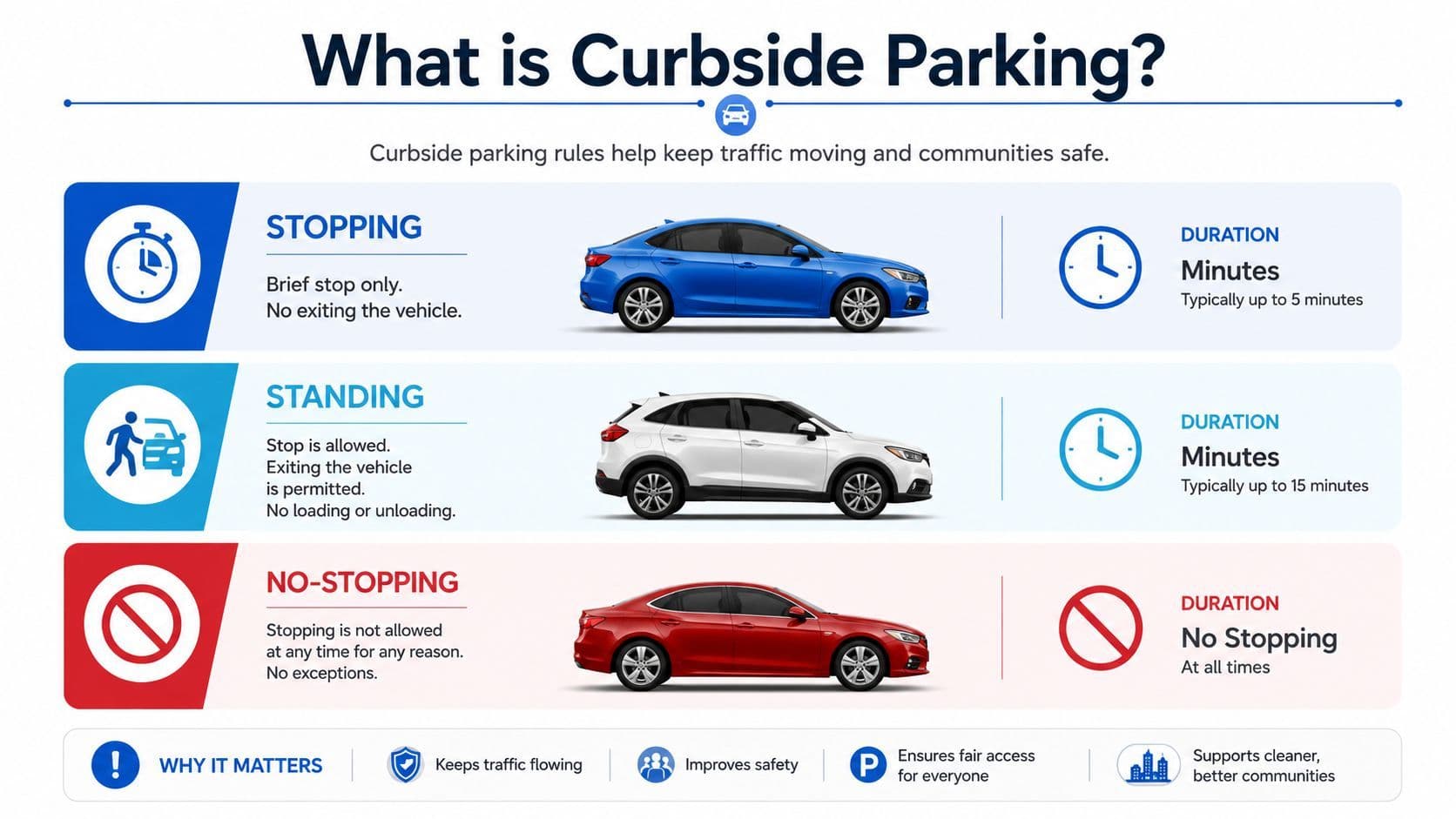
Simple distinction: if the sign says no stopping, you don't get to “just drop someone off” and assume that's fine.
Learners get caught here. A spot can look open, but a no-parking or no-stopping restriction may still apply. On a G1-style question, that distinction matters because the correct answer often depends on whether the vehicle is legally allowed to be there at all, not just whether it fits physically. For extra practice with road-sign meaning, a learner can review information signs and then compare them with the curb itself.
Setback Distances Every Driver Must Memorize
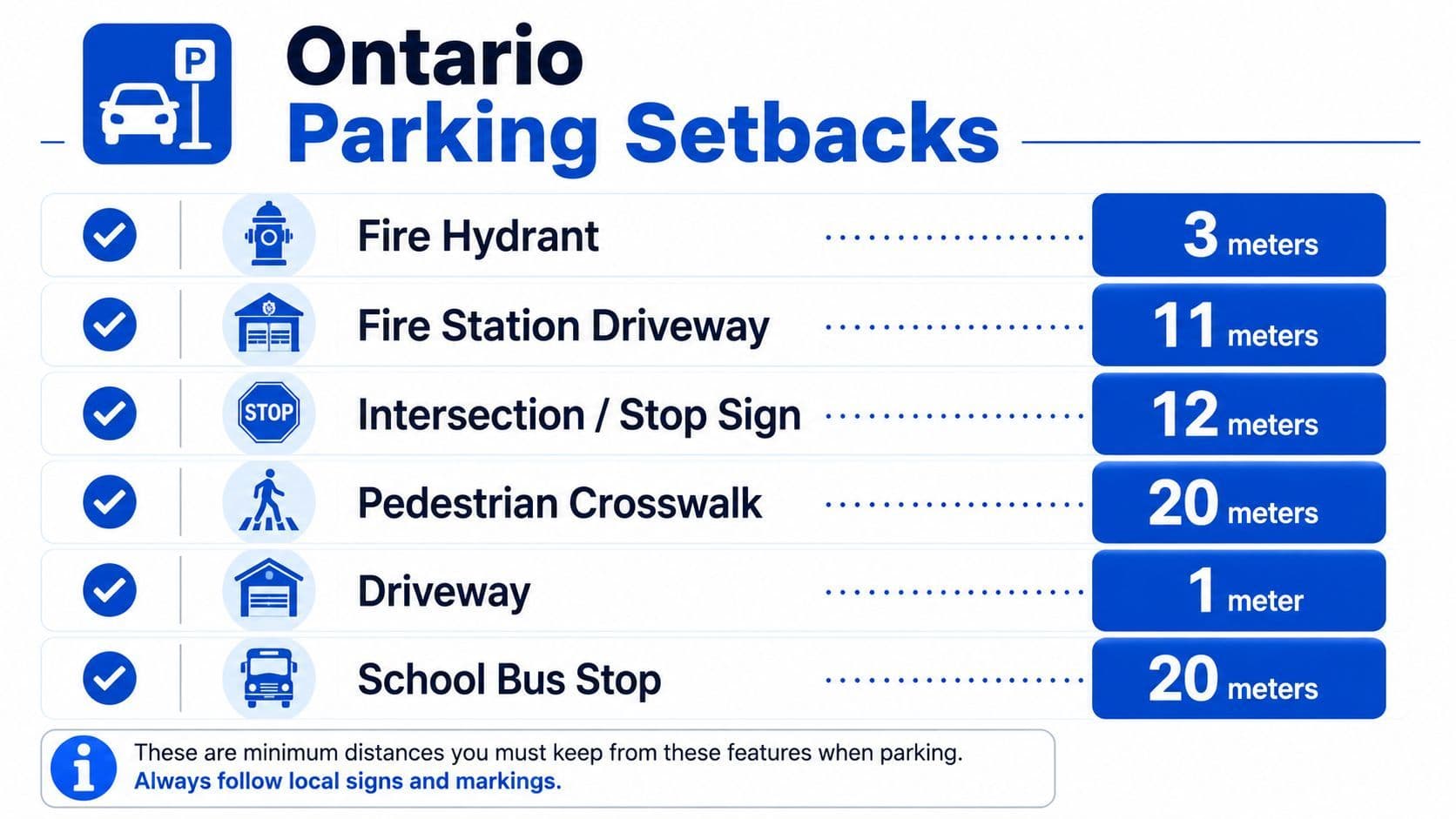
The easiest way to study curbside parking is to think in landmarks. Once you know the common distances, you can scan a street and rule out bad spots before you even start the manoeuvre. Ontario's handbook uses fixed setback rules to protect sightlines, access routes, and vulnerable road users, and these are the numbers learners keep meeting on tests.
The distances, in plain English
- Fire hydrant, 15 feet. Leave room so emergency crews can reach it fast. If a learner parks too close, the car can block urgent access when every second counts.
- Fire station driveway, 15 feet. That buffer keeps emergency vehicles from getting boxed in or forced to squeeze around a parked car.
- Unmarked or marked crosswalk, 20 feet. This keeps the crossing visible and gives turning drivers a clearer view of pedestrians stepping out.
- Curb extension, 15 feet from the crosswalk area. The smaller offset reflects the geometry of the extended curb, but the basic goal is still sightlines and space.
- Sidewalk ramp for disabled persons, 3 feet. That small gap matters because a parked car can block access and narrow the route for someone using a mobility aid.
- Driveway, no blocking the entrance. The car can't sit in front of a driveway at all, because the point is to preserve access, not merely reduce congestion.
Ontario's official handbook also says drivers must not park on a sidewalk, in a crosswalk, or in a disabled-access crosshatched area. Those are absolute curbside conflicts, not “close enough” situations.
Memory cue: hydrant, station, crossing, ramp, driveway. If you can name the feature, you should already be asking whether your car is taking away access.
The reason behind all of this is simple. Parked vehicles change how people can see, turn, cross, and enter or leave a property. The more crowded the curb, the more careful the driver has to be about what the car is blocking.
Reading Signs and Pavement Markings at the Curb
A curb can look ordinary and still carry a lot of legal information. One sign can allow short stops in one time window and prohibit everything in another. That's why Ontario drivers need to read the curb like a sentence, not like a single word. First the sign, then the time plate, then the paint, then the nearby symbol.
What the sign is really telling you
A restrictive sign tells you what you can't do. A permissive sign tells you what is allowed, but usually only under certain conditions. A loading zone sign often means commercial activity is allowed for a limited purpose, while ordinary parking is not.
Time-of-day plates change the rule without changing the post. A street that allows parking in the morning may become restricted later in the day, so a driver who only reads the main sign can easily make the wrong call. Arrow directions matter too, because they show which side of the post or block the restriction covers.
Paint on the curb can matter as much as the sign
Yellow, red, and white curb conventions are used by Ontario municipalities to reinforce what the sign already says or to mark a special condition. The colour itself is not the only thing that matters, but it is a strong clue that the default rule has changed. A learner who sees painted curb edges should treat them as an extra check, not a decorative detail.
The practical habit is simple. Slow down, read the sign from top to bottom, check the times, and then match the paint to the message. If any part of the block says no parking, assume the safest answer is to keep looking.
Curbside cue What it usually means What a learner should do No parking sign Parking is not allowed Keep driving and find another space Time plate The rule changes by hour or day Check the clock before committing Loading zone marker Stopping may be limited to loading activity Don't assume ordinary parking is allowed Painted curb edge The curb colour reinforces a restriction or permission Read the sign first, then confirm the paint
Parking on Hills, Curves, and Unmarked Streets
Wheel direction is where many learners freeze up, because the logic changes with the slope. On a flat street, the main goal is to park neatly and legally beside the curb. On a hill, the goal changes to preventing the vehicle from rolling into traffic if it moves unexpectedly.
The hill rule depends on curb presence
If you're parking uphill with a curb, turn the wheels away from the road, so the front wheels rest toward the curb. If you're parking uphill without a curb, turn the wheels toward the road edge so the car won't roll freely into the lane. If you're parking downhill, the wheels go toward the curb.
That pattern feels confusing at first, but the reasoning is steady. The wheels should help the car settle safely if the brakes fail or the vehicle starts to roll. On a curb street, the curb acts as a barrier. On an uncurbed street, the road edge becomes the reference point.
Curves, crossings, bridges, and restricted places
Not every roadside edge is a legitimate parking spot. Curves reduce sightlines, railway crossings need clear approach space, and bridges can narrow the available operating room. Those places often carry restrictions because parked vehicles can hide hazards or leave too little room for safe movement.
A learner who memorises the wheel rule but ignores the surrounding road features is only half prepared.
A good mental script is short. Check slope, check curb, turn wheels, then look for any extra restriction on the block. If the space sits near a bend, crossing, or bridge, keep scanning before you shut the car off. The curb can be legal and the location can still be wrong.
Time Limits, Permits, and Exceptions to the Default Rule
A driver can see a permit, a posted time limit, and still park illegally. The rule order matters. A local sign may set the parking window, a permit may open access to a marked zone, and a painted curb can support the instruction, but none of those erase a safety setback such as a fire hydrant clearance or a no-stopping order.
A simple way to sort it out is to ask which rule is stronger. A permit helps only where the permit system is meant to work. It does not turn a blocked space into a legal one, and it does not make a driveway, a hydrant, or another protected area fair game. The curb is part of the road system, so the rules around it stay in force even when a permit is on the dashboard.
Situation What It Allows What It Does Not Override Signed time limit Parking for the posted duration Fire hydrant setbacks, no-stopping signs Municipal permit zone Parking by eligible permit holders Safety setbacks and absolute prohibitions Accessible parking permit area Parking in marked accessible spaces when authorized Crosswalks, hydrants, driveways Loading zone Short stop for loading activity Rules that ban stopping entirely School zone restriction Parking or stopping limits during active times Higher-priority restrictions already posted
A learner studying for a G1-style question can use that same order of thinking. If the sign says one thing and the curb situation creates a safety restriction, the safety rule wins. That is why G1ready.ca practice questions can help you sort out curbside parking examples before test day, because the same spot can look acceptable at first glance and still fail the rule check.
Use three checks before you leave the car. Look for a sign, look for a setback rule, and ask whether a permit applies to that space. If any part is unclear, keep driving and find another spot.
Three G1 Practice Examples With Step-by-Step Reasoning
A learner in a practice test sees a car positioned a little too close to a fire hydrant. The question asks whether the parking is allowed. The right response starts with the feature, not the driver's intention. A hydrant has a fixed setback rule, so even a quick stop is not fine if the car is inside that space.
The most common wrong choice is the one that sounds practical, not legal. “It's just for a minute” or “there's still room on the curb” won't matter if the car is too close. The question is not whether the driver planned to return soon. It's whether the parked vehicle took away the protected space.
A sign-and-time question on a busy street
Another G1-style question shows a curb with a parking sign and a time plate, then asks whether parking is allowed at a certain hour. The driver has to read both parts together. The sign controls the rule, and the time plate controls when that rule applies.
The mistake here is reading only the main sign. A spot can be legal in one window and illegal a few hours later, so the timing changes the answer. This is exactly the kind of question that rewards calm, line-by-line reading instead of quick guessing.
A hill-parking wheel question
The third question asks what direction to turn the wheels when parked on a hill. The answer depends on both slope and curb presence, so the driver has to identify the setting first. Once that's clear, the wheel direction follows the pattern already covered in the hill section.
The wrong answer usually comes from mixing up uphill and downhill logic. Learners often remember a piece of the rule but not the whole decision tree. A quick replay helps: slope first, curb second, wheels third.
For more timed drilling on this kind of scenario, G1 practice tests can help you rehearse the wording Ontario uses and spot where your attention slips.
Fines, Penalties, and Habits That Keep Tickets Away
Parking mistakes can cost more than a failed answer on a test sheet. Ontario parking violations can bring fines, and some serious situations can also lead to demerit consequences or towing when a vehicle blocks a hydrant, crosswalk, or driveway. The risk rises fast when the car interferes with emergency access or pedestrian movement.
The best protection is a short pre-park routine. Scan the sign. Check the curb paint. Measure the setback by eye before you commit. Set the wheels if the street slopes. Then confirm the time limit one last time before walking away.
Good habit: if you feel rushed, don't park yet. A bad curb decision usually starts with speed, not distance.
If you want to understand how parking mistakes can connect to broader licence consequences, review Ontario demerit points alongside the parking rules. The cleaner your parking routine becomes, the less likely you are to collect avoidable trouble on test day or after you get your licence.
If you want more Ontario-focused practice in the same calm, test-style format, visit G1ready.ca and work through the parking, sign, and road-rule questions before your next lesson. It's a straightforward way to turn curbside parking rules into something you can read, recognise, and use with confidence on test day and on real streets.


