

You're studying for your G1, or you've just started driving on your own, and one thought keeps coming up. What happens if you get pulled over? A lot of new drivers in Ontario hear people say you “lose points” on your licence, which makes the whole system sound confusing and scary.
The first thing to clear up is simple. In Ontario, you don't start with points and lose them. You start at zero, and points are added to your record after certain convictions. Once you understand that, the rest of the demerit points Ontario system starts to make much more sense.
For a new driver, this matters more than is widely understood. A mistake that seems small can carry much bigger consequences when you have a G1 or G2. If you're still learning how graduated licensing works, this guide to Ontario's graduated licensing system helps put the point system into that wider context.
Understanding Ontario's Demerit Point System
You pass your G2 test, start driving on your own, and a few weeks later you hear someone say, “I lost three points.” For many new drivers, that makes Ontario's system sound like a licence starts with a pile of points you can spend. It does not work that way.
Ontario uses demerit points to keep track of unsafe driving convictions. The point values rise with the seriousness of the offence, so the system works like a warning gauge. A smaller number can still cause trouble. A larger number signals behaviour the province treats as a bigger safety risk.
For a new driver, that distinction is more impactful than commonly recognized. G1 and G2 drivers are still in Ontario's graduated licensing stage, and the rules are less forgiving while you build experience. If you are still getting familiar with those stages, this guide to Ontario's graduated licensing system for new drivers gives helpful background.
The simplest way to understand demerit points is this. They are a record of convictions tied to risky driving behaviour. They are not a score that starts high and counts down. You start at zero, and points are added to your record if you are convicted of certain offences.
That is why the language around “losing points” confuses so many beginners. A cleaner way to say it is that a conviction adds points to your driving record. Once you see it that way, the system becomes easier to follow.
The point total also does not tell the whole story by itself. For a fully licensed driver, points can trigger warnings, interviews, and suspensions if they pile up. For a novice driver, the consequences can arrive earlier and hit harder because graduated licensing comes with extra conditions and less room for error.
A good mental model is a teacher watching for patterns. One mistake gets noticed. Repeated mistakes raise concern much faster. Ontario uses demerit points in a similar way, especially for drivers who are still proving they can handle the road safely.
If you are new behind the wheel, the practical lesson is simple. Learn what actions put points on your record early, because even a small number can matter more when you have a G1 or G2 licence.
How the Demerit Point System Actually Works
Demerit points work like a running total you want to keep at zero. For a new driver with a G1 or G2 licence, that matters even more because the system leaves less room for mistakes.
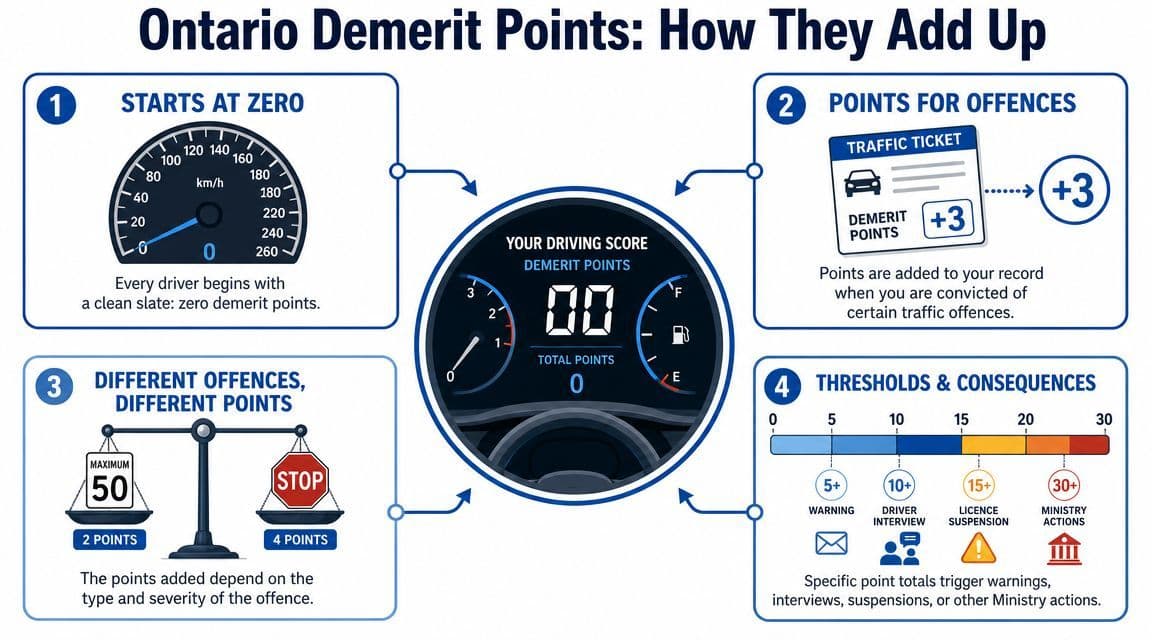
The first part to understand is the difference between a ticket and a conviction. An officer can stop you and issue a ticket at the roadside, but demerit points are tied to a conviction, not to being pulled over. That distinction confuses many beginners.
A simple way to picture it is a school record. A teacher may warn you about a mistake right away, but the official record changes only after the school processes it. Demerit points work in a similar way. The roadside stop is the warning or charge. The point consequence attaches to your driving record if the offence results in a conviction.
Here is the system in practical terms:
- You begin at zero: A clean driving record starts with no demerit points.
- Points are added after conviction: The ticket itself does not automatically place points on your record.
- Different offences carry different point values: More dangerous behaviour brings a higher point total.
- Your total can trigger Ministry action: As points build up, warnings, interviews, or suspensions can follow, depending on your licence class.
For novice drivers, the lesson is straightforward. A single conviction can matter more than you expect because graduated licensing rules already place you under closer scrutiny. In other words, the same offence can create a tougher practical problem for a G1 or G2 driver than for someone with full driving privileges.
Another part that trips people up is timing. Points stay on your record for two years from the date of the offence, as noted earlier, not from the day the court process ends. If a ticket takes time to resolve, the starting point for that two-year period does not shift.
That detail can be easy to miss. Say a new driver commits an offence, then spends months dealing with the ticket. The point record still traces back to when the offence happened. For a novice driver trying to move from G1 to G2 or from G2 to G, that timing can affect how long the mistake follows them.
One last point helps clear up the language. Drivers often say they “lost points,” but Ontario's system does not work that way. You are not spending points from a bank. You are building a record of convictions, and the safest result is to keep that record at zero.
Common Offences and Their Demerit Point Values
A new driver often learns about demerit points right after a small mistake. You roll through a stop sign a little too quickly, or you change lanes without checking carefully enough, and then the question hits you. How serious is that ticket going to be for a G1 or G2 licence?
That is the right question to ask. Point values help you sort offences by risk, but they also show how fast a beginner can run into trouble. For novice drivers, the issue is not only whether an offence seems minor. It is whether that conviction adds pressure to a licence class that already has less room for error.
What the point values tell you
Ontario uses demerit points as a kind of warning scale. The higher the point value, the more seriously the province treats that behaviour from a road safety perspective.
For a new driver, that scale works like a temperature gauge in a car. A small rise should still get your attention. You do not wait for the engine to fail before you respond.
Ontario Demerit Points for Common Offences
Demerit Points Example Offences 2 Improper opening of a vehicle door 2 Improper right turn 3 Disobeying a stop sign 3 Failing to share the road with another vehicle 3 Driving the wrong way on a one-way road 4 Improper passing 6 Careless driving
This list is more useful if you group offences by the kind of mistake involved.
Some are judgment errors at everyday city speeds. An improper right turn, opening a door when it is unsafe, or missing a stop sign can happen during the kind of driving beginners do all the time. That is exactly why novice drivers should pay attention to them. These are not rare highway situations. They are common test-route and neighbourhood mistakes.
Other offences point to weak observation habits. Failing to share the road, driving the wrong way on a one-way street, or passing improperly often come from rushing, poor scanning, or misunderstanding who has space and priority. Instructors see this pattern often with new drivers. The driver is focused straight ahead and misses the bigger picture around the car.
Careless driving sits in a different category because it covers conduct that shows a broader lack of reasonable care. If the lower-point offences are single cracks in your routine, careless driving is more like a sign that the whole routine needs work.
A novice driver should read this table with one practical question in mind. Which mistakes am I most likely to make in the first year or two? For many G1 and G2 drivers, the primary risk is not dramatic behaviour. It is everyday errors at intersections, during turns, while parking, or while dealing with busy traffic.
That is also why memorising numbers only gets you part of the way. The safer approach is to build habits that prevent the common beginner mistakes behind these tickets:
- Come to a full stop and count a beat before moving.
- Check mirrors and blind spots before every turn or lane change.
- Slow down early so turns and passes do not become rushed decisions.
- Treat one-way streets, signs, and lane arrows like instructions, not suggestions.
For a fully licensed driver, one conviction may feel like an annoyance. For a G1 or G2 driver, the same mistake can have a much bigger effect on your progress and peace of mind. Keeping your record clean starts with spotting the ordinary situations where beginners slip up most.
Penalties for Demerit Point Accumulation
A new driver can feel fine after one ticket because the car still runs, the licence is still in your wallet, and nothing seems to change overnight. The problem is that demerit point penalties build in stages. For G1 and G2 drivers, those stages arrive much sooner than many people expect.
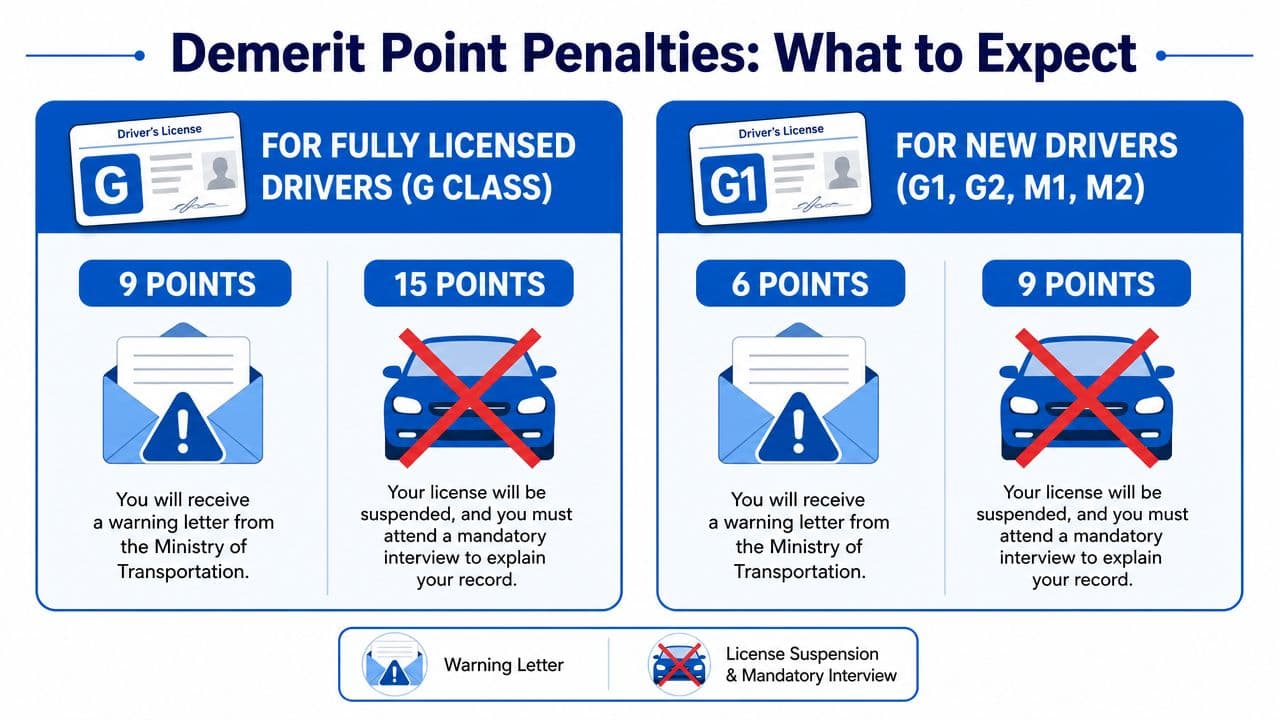
Novice drivers G1 and G2
Ontario treats novice drivers like drivers who are still under close supervision. That means the margin for error is smaller. A low point total can trigger a warning letter, a higher total can lead to an interview, and at 9 or more points a novice driver can face an automatic suspension. Ontario-focused guidance commonly describes that novice suspension as 60 days, while fully licensed drivers face a different set of thresholds and a longer path before suspension, as summarized by Traffic Ticket Advocates' Ontario demerit points overview.
For a new driver, this is the practical takeaway. The system does not wait for a long pattern of mistakes before stepping in. It responds early because G1 and G2 drivers are still proving they can drive safely and consistently.
A simple way to understand the novice rules is to picture a smaller cup. It fills faster. Two or three convictions that seem minor on their own can put a beginner much closer to Ministry action than a full G driver.
Here is what that means in real life:
- Ministry attention starts early: Even a small number of points can put a novice driver on the Ministry's radar.
- There is less room for repeat mistakes: A couple of tickets can affect your licence status much faster than many beginners expect.
- Suspension can arrive sooner than you think: Reaching 9 or more points is a serious turning point for G1 and G2 drivers.
This video gives a useful visual overview of how the system affects Ontario drivers:
Fully licensed drivers G
Drivers with a full G licence have more breathing room. Warning letters generally apply across a wider range, interviews happen at a higher point level, and suspension does not usually start until a much higher total. The key difference is not just the numbers. It is the amount of forgiveness built into the system.
That comparison matters for new drivers. A parent, older sibling, or fully licensed friend might shrug off one ticket because their licence status gives them more cushion. A G1 or G2 driver does not have that same cushion.
If you have a G1 or G2, treat every ticket like it can slow down your progress toward a full licence.
Ontario is stricter with beginners for a practical reason. New drivers are still building judgment, routine, and hazard awareness. If you want to keep your record clean while those skills are developing, it helps to practise habits from an Ontario defensive driving guide for new drivers so small mistakes do not turn into convictions.
How to Check and Manage Your Demerit Points
You do not want to learn about your demerit points from a suspension notice in the mail.
For a G1 or G2 driver, that kind of surprise can hit hard. New drivers have less room for error, so checking your record is less like a formality and more like checking your fuel gauge before a long trip. It tells you where you stand before a small problem turns into a bigger one.
How to confirm your record

Your best source is your official Ontario driver record. That record shows convictions and helps you check whether points may still be affecting your licence.
Use this simple routine:
- Order your driver record: Request your official record through Ontario government services.
- Read each conviction carefully: Focus on the offence listed, the date, and whether it belongs to you.
- Check the offence date: Demerit points are tied to the date the offence happened, which can be different from the court date or payment date.
- Keep your own paperwork: Save tickets, notices, and copies of your record in one folder so you can spot mistakes or patterns early.
This habit matters even more for novice drivers. A fully licensed driver may have more room before serious consequences begin. A G1 or G2 driver often needs to catch problems earlier.
If you are trying to rebuild good habits after a ticket, this defensive driving guide for Ontario learners gives practical ways to reduce repeat mistakes on everyday drives.
What to keep an eye on
Two details confuse new drivers again and again.
First, demerit points stay on your record for two years from the offence date. The clock does not start on the day you pay the ticket or the day the case finishes. If you got the ticket months ago, that earlier date is usually the one that matters.
Second, some convictions from outside Ontario can still follow you back to your Ontario record. This catches many beginners off guard, especially after a trip or a move.
The safe approach is simple. Check your record instead of guessing, keep your documents, and deal with tickets promptly. If you have a G1 or G2, treat your driving record like a progress report. The sooner you read it clearly, the easier it is to protect your licence and keep moving toward a full G.
Tips for Avoiding Demerit Points as a New Driver
For a new driver, avoiding demerit points isn't just about staying out of trouble. It's about protecting your chance to keep learning without interruption.
Habits that protect your licence
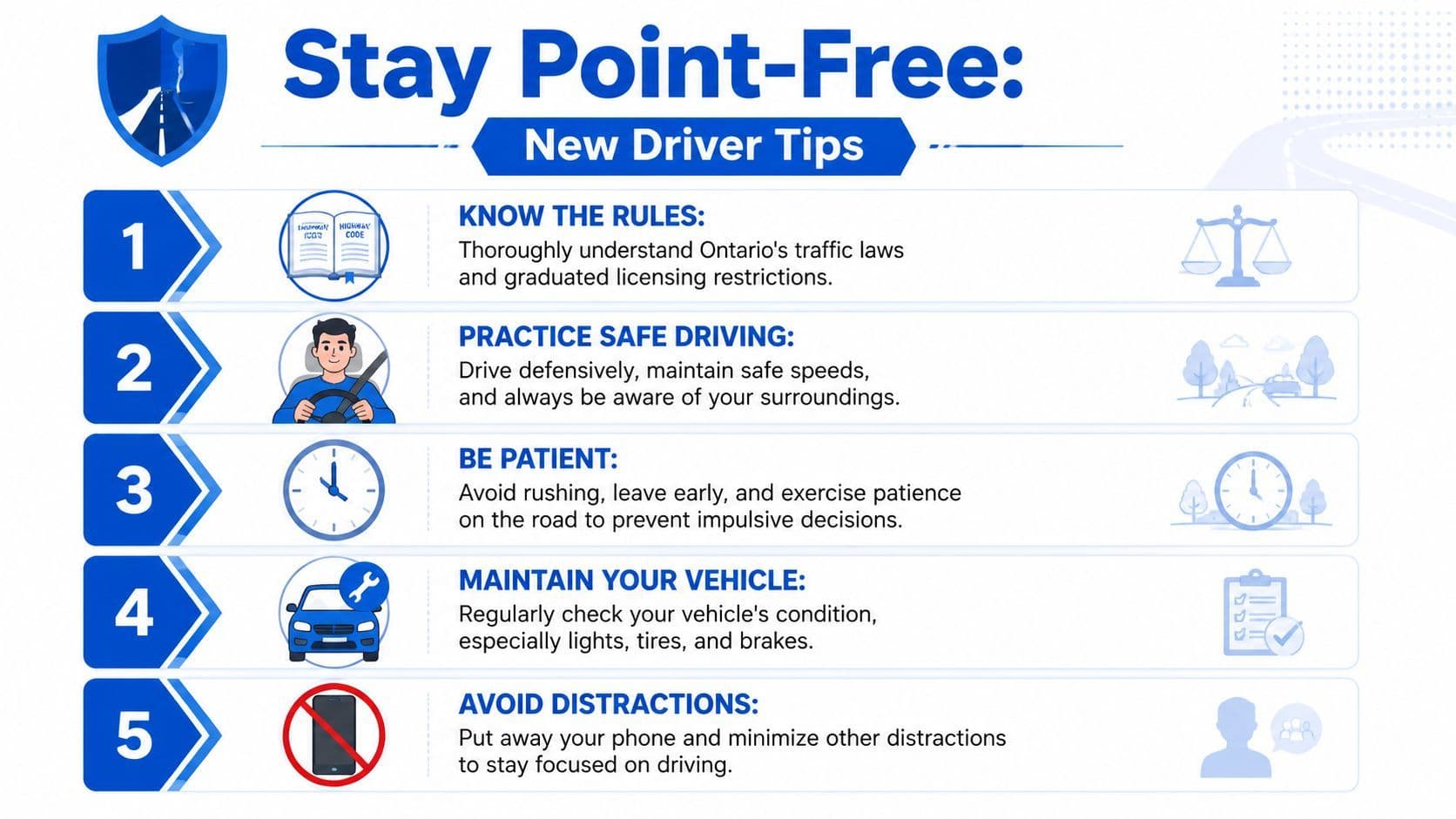
Start with the habits that reduce common beginner mistakes:
- Know your licence conditions: A lot of novice driver problems begin with not fully understanding G1 or G2 rules.
- Leave early: Rushing leads to speeding, late lane changes, and poor judgment.
- Put the phone away before you start the car: Don't rely on willpower once you're already moving.
- Scan ahead instead of reacting late: New drivers often focus too close to the hood and miss developing hazards.
- Treat every stop sign, signal, and speed limit as a test habit: The way you practise becomes the way you drive.
One useful study method is to regularly review rule-based questions before your road habits harden. Tools such as G1ready.ca's G2 test guide can help learners practise Ontario-specific rules and refresh weak spots before they become on-road mistakes.
The safest new drivers aren't the ones who feel fearless. They're the ones who stay patient, predictable, and hard to surprise.
There's also a mindset piece. Don't drive to prove you're confident. Drive so that other people can easily predict what you're about to do. Smooth braking, legal speeds, proper signalling, and full attention at intersections do more to protect your licence than any last-second correction ever will.
If you're preparing for your G1 or trying to build safer habits early, G1ready.ca offers Ontario-focused practice tests and study tools that can help you learn the rules behind common demerit-point mistakes before they happen on the road.


