
The morning of a Drive Test Ontario G2 appointment has a specific kind of pressure. You've checked the mirrors twice, the car feels too quiet, and every familiar street on the way to the centre suddenly seems sharper than it did yesterday. That feeling is normal, because this isn't a paperwork stop. It's the first real provincial road test where your everyday city driving gets judged in public, under the same system that handled 1.34 million road tests in 2022 (Ontario's Level Two Road Test handbook).
What the G2 Road Test Is in Ontario
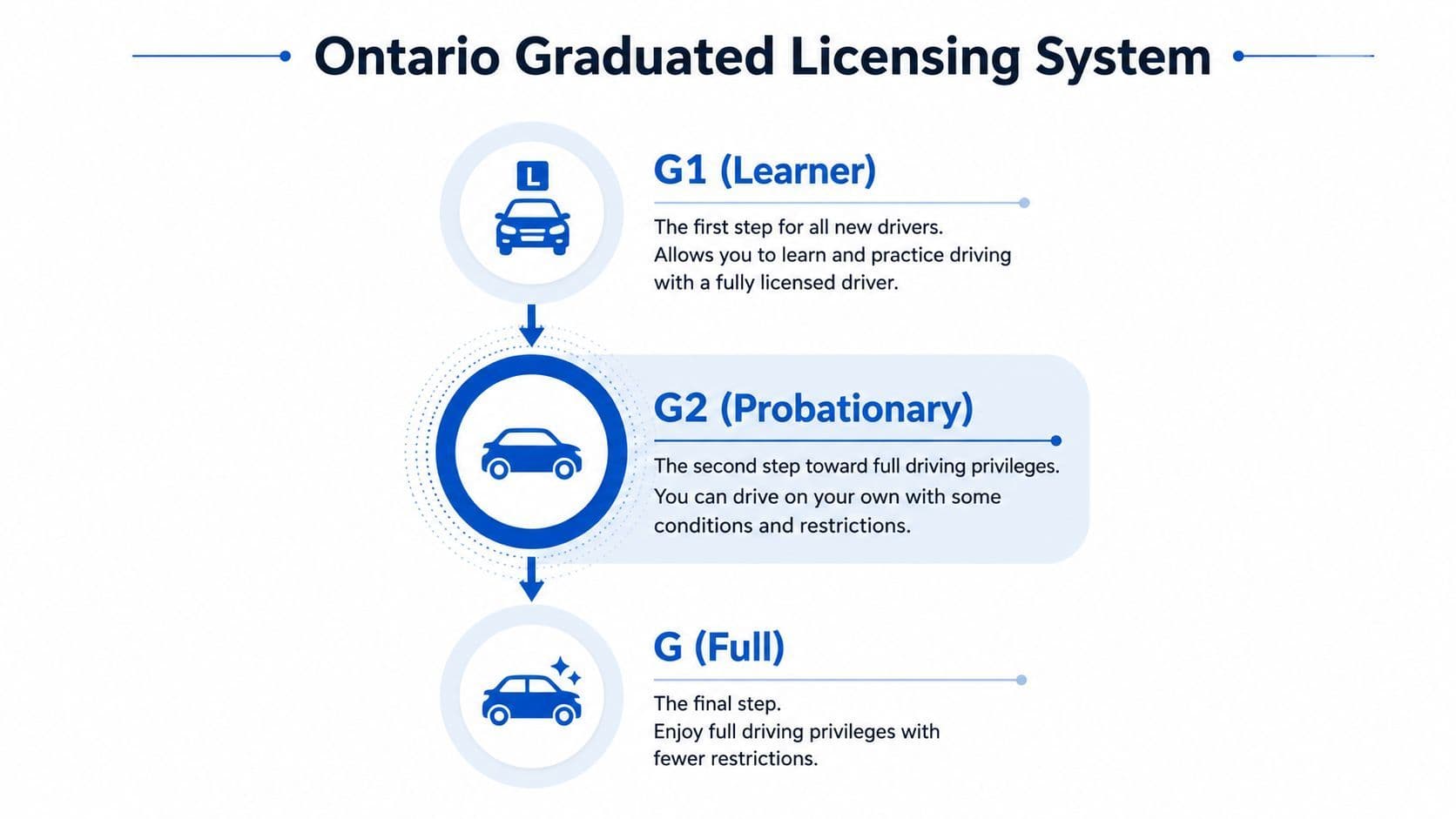
A G2 test is the point where Ontario checks whether a learner can drive in normal city traffic with enough control, observation, and judgment to do it without constant supervision. The official Ontario handbook and the DriveTest overview place the G2 road test as the Level Two Road Test, the practical step that moves a driver from G1 toward full driving privileges (Ontario handbook, DriveTest road tests for cars).
Why the G2 carries real weight
The test is part of a very large licensing system, so the pressure around booking and preparation is not an exaggeration. Ontario's handbook records 1.34 million road tests in 2022, which helps explain why families, newcomers, and teenagers all feel the same scramble for appointment windows and why a cancelled slot can throw off a plan that has been building for months (Ontario handbook).
The bigger issue is that the same G2 can play out differently depending on the centre. The Ontario Auditor General's 2023 report showed that Bancroft reached an 89% G2 pass rate in the East Region sample, while the broader appendix showed centre-by-centre differences instead of a single provincial pattern. CBC later reported an Ontario average of 69%, with Bancroft at 88% and Brampton at 59%, which makes the practical point clear. Route design, traffic mix, and examiner habits at busy urban centres can make one skill set look easy in one place and shaky in another (CBC pass-rate coverage).
Practical rule: treat the G2 as a real gatekeeping exam. If you prepare like it is a short drive around the block, the centre will show the gaps quickly.
That is why the Drive Test Ontario G2 is more than a checkbox in the licensing ladder. It is the first Ontario exam where a driver has to show steady lane discipline, clean observation, and calm judgment under route variation, with the test centre itself acting as part of the challenge. Some locations hand you heavier traffic and more pressure, others hand you quieter streets but still expect clean fundamentals. Either way, luck does not carry a driver very far.
Eligibility, Documents, and Booking the Right Slot
Before you book, the paperwork has to be in order. Ontario's Level Two road test includes an expressway-driving component, and you must complete and sign a Declaration of Highway Driving Experience before taking it. The form asks how many times, in the three months before the test, you drove on a freeway or a highway with a speed limit of at least 80 km/h, and whether those trips were typically under 5 km, 5 to 15 km, or over 15 km (Ontario handbook).
Book only when your timeline is ready
The common mistake is to grab a slot first and sort out eligibility later. That creates avoidable problems. Make sure your G1 holding period is satisfied, your highway experience declaration is truthful and complete, and your licence has not lapsed. If you are planning around a drive school course or a specific test-centre window, write the dates down before you pay.
Use the DriveTest booking flow with the centre in mind, not just the earliest open slot. A booking in a smaller municipality can feel very different from a GTA appointment, and the pass-rate spread in the section above shows why that choice can matter. If you want a practical booking walkthrough, one Ontario-focused option is this G2 booking guide, which lays out the logistics without burying the steps.
Double-check the basics before test day
Bring the documents that prove who you are and that you are allowed to test. Bring the vehicle you plan to use, and make sure it is the same one you have practised in whenever possible. A mismatch between your booking details, licence status, or vehicle condition can waste the appointment before you ever leave the lot.
The mistake I see most often is not speed, it is assumption. A learner assumes “I'm booked, so I'm fine,” then arrives missing a form, with the wrong glasses, or in a car they have not driven recently. That is not a driving failure. That is a planning failure.
A centre will not care that you were “basically ready.” It cares that the file is complete and the vehicle is acceptable on that day.
Key Skills and Manoeuvres Examiners Score
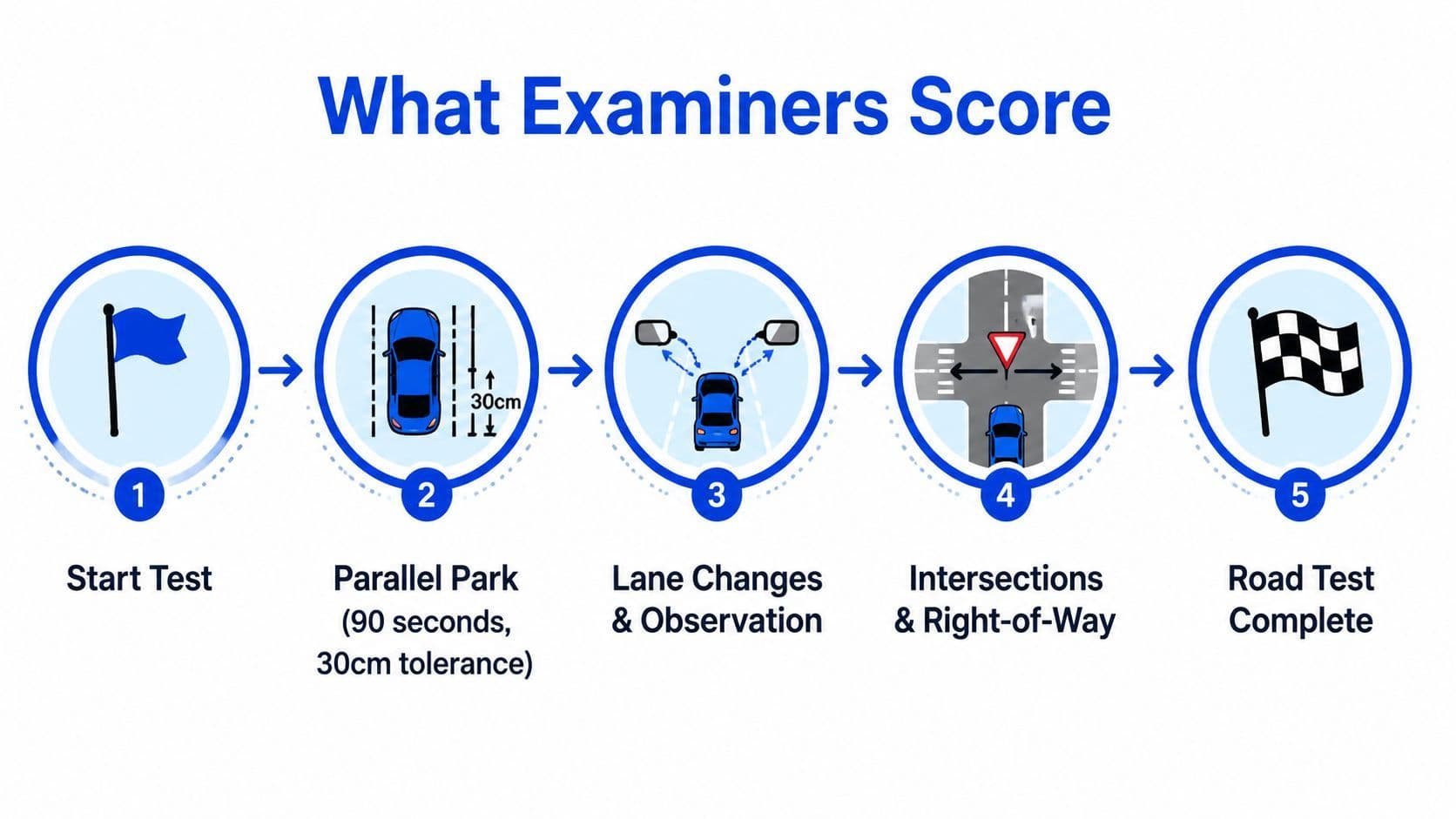
A G2 road test rewards settled habits. Examiners watch whether you check mirrors at the right moments, make legal right-of-way decisions, and keep the car under control without small errors turning into bigger ones. The official test materials point to observation, lane changes, and right-of-way judgment as core parts of the drive, so the priority is awareness first and comfort second.
The route can look ordinary from the passenger seat and still expose weak habits. A student who stays tidy in a parking lot can drift once traffic starts moving, because the examiner is tracking how the driver reads space, timing, and other vehicles under pressure.
Parking and observation are where nerves show
Ontario test-prep guidance says parallel parking on the G2 route should finish within 30 cm of the curb. That gives you a clear target instead of a vague hope. If the car finishes crooked, too far out, or still being adjusted at the end, the examiner sees a rushed manoeuvre rather than one the driver has settled.
The same guidance stresses full stops at stop signs and intersections, plus repeated left-right-left scanning and right-of-way compliance. Learners often lose marks there without realising it. They roll through a stop, glance once, or move before the space is clear, and that tells the examiner the driver is reacting instead of reading the scene.
A lot of students can park when the street is quiet. The problem appears when they rush the final correction, forget to look over the shoulder, or stop checking the surroundings once the car is nearly in place. That is the difference between a completed skill and a partly managed one.
The expressway component changes the rhythm
Ontario's G2 test also includes expressway driving, so mirror checks, blind-spot checks, entry speed, lane position, and exits all matter in a way lower-speed residential driving does not. The point is to merge and reposition without making other drivers brake or guess what you will do next.
That part of the route often reveals the difference between a driver who can follow instructions and a driver who can manage traffic flow. A student may look fine on quiet streets, then hesitate too long at speed or drift in lane choice once the pace picks up. Those are the moments examiners notice.
For a more local look at how one test centre is described by drivers, see the Burlington DriveTest review notes. A centre can feel calm on paper and still test very different habits once the traffic pattern, intersection spacing, and merge points show up in the actual route.
After the test, the same basic rules still apply. G2 drivers must maintain a zero blood-alcohol level and everyone in the vehicle must have a working seatbelt. For drivers aged 19 and under, Ontario also limits overnight passengers between midnight and 5 a.m. to one passenger under 19 during the first six months of G2, then up to three passengers under 19 after six months.
The cleanest G2 drives aren't dramatic. They're boring in the right way, because every move is legible to the examiner.
Why Test Centre Location Changes the Same Drive
A G2 route is never just the route on paper. The same basic driving skill can look clean at one DriveTest centre and shaky at another, because traffic flow, turn spacing, lane pressure, and examiner expectations change with the location. A student who handles quiet residential streets well can still lose marks at a busier site if they hesitate on merges, miss lane discipline, or leave too much uncertainty for other drivers.
That is why centre selection is part of preparation, not a side issue. Pick the place you can prepare for. If you struggle in dense traffic, a calmer centre may give you a better chance to show control instead of getting overwhelmed by movement around you. If you already drive in heavier traffic, a busier centre may better reflect your normal conditions and what you need to prove.
Small-town routes and urban routes test different habits
Smaller centres and urban centres do not test the same habits in the same way. A quieter route can expose overconfidence, because drivers get used to light traffic and start relaxing their observation too soon. A busier GTA route can expose the opposite problem, because a driver may look fine on a calm street and then fall apart once lane changes, merges, and faster decision-making pile up.
That difference matters more than many students expect. The examiner is not grading your comfort level, they are watching whether you can keep your decisions clear to everyone else on the road. If your routine is solid in one environment but weak in another, the location itself changes the difficulty of the same skill.
Use the centre to match the conditions you can actually rehearse
Booking around the test centre should be about repetition, not luck. Practising near the route, nearby school zones, common turning patterns, and local construction pinch points makes the test feel familiar instead of unpredictable. That familiarity shows up in your speed control, your scanning, and how early you communicate what the car is going to do.
The practical trade-off is simple. A calmer centre may reduce traffic pressure, but it can also leave fewer chances to practise under real movement. A busier centre can better match normal Ontario driving, but it punishes weak observation and late lane decisions much faster. If you want a centre-specific read before you book, a local reference like this Burlington DriveTest guide can help you think through the environment, not just the licence rules.
Sample Ontario DriveTest Centre G2 Pass Rates Region Reported G2 Pass Rate Kenora Northern Ontario 93% Bancroft East Region 88% Burlington GTA / West 70% Oakville GTA / West 68% Brampton GTA 47% Downsview GTA 48% Etobicoke GTA 48%
The cleanest G2 drives are predictable. The examiner can see what you are doing, other drivers can guess your next move, and the route stays under control even when the traffic pattern changes.
Practice Drills That Move the Needle
Generic driving time helps, but targeted drills change the result faster. The reason is simple. The G2 doesn't fail people on vague “confidence” issues, it fails them on specific behaviours that can be repeated under pressure. If you can run those behaviours cleanly at home or with a supervising driver, you've turned the test into a series of known tasks instead of a surprise.
Use drills with a benchmark, not just a feeling
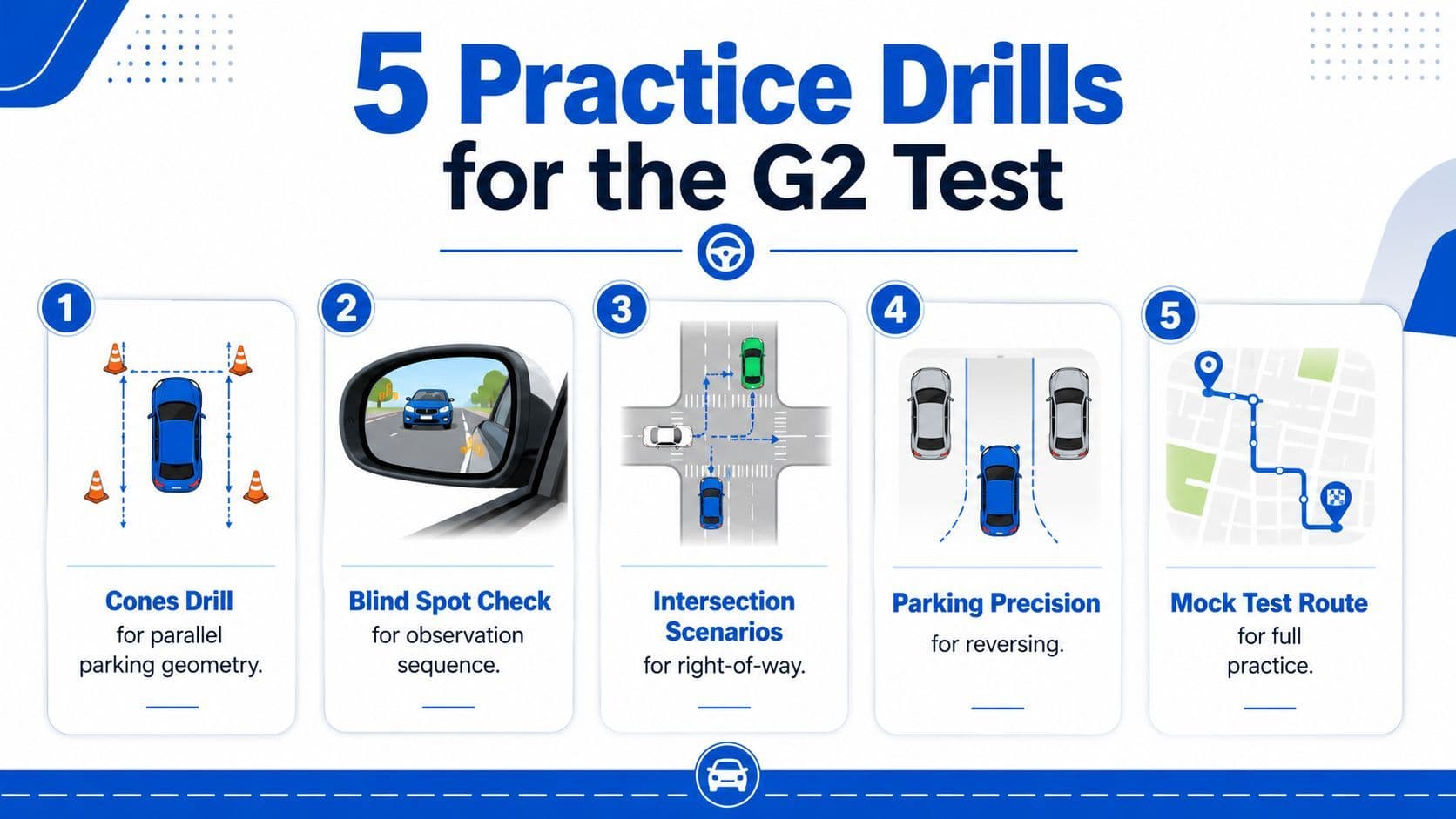
A solid parallel parking drill starts with a parked vehicle and a curb line, then ends only when the car sits straight and close enough to meet the curb standard. For lane changes and intersection work, a good rule is that your mirror and shoulder sequence should happen before the move, not during it. If you can't repeat that without reminders, you're not ready yet.
- Cones Drill: Set markers and practise the parking geometry until your final position is consistently controlled, not lucky.
- Blind Spot Check: Say the observation sequence out loud as you drive, then repeat it until the habit is automatic.
- Intersection Scenarios: Approach stop signs and green-light turns with deliberate right-of-way decisions, not speed.
- Parking Precision: Reverse into the same space several times and judge whether the entry is clean on the first attempt.
- Mock Test Route: Drive a full route with no coaching chatter, so you can feel the rhythm of the test.
The two-week ramp that usually works
Start by cleaning up the basics, then add pressure. In the final stretch, practise in the same neighbourhoods and time windows that match your appointment, because route familiarity reduces surprise. If your speed, signalling, and scanning still fall apart when someone watches, keep the practice quiet and repetitive until that changes.
Useful benchmark: if you need a running commentary from your supervisor to get through a manoeuvre, the manoeuvre isn't stable yet.
One Ontario-specific practice resource that fits this approach is this G2 practice test guide, which can complement real in-car time. Use it as support, not as a substitute for the wheel.
Test Day at the DriveTest Centre
The day usually starts before the exam itself, when the parking lot already feels louder than it should. You arrive early, check in, and wait while the centre processes a steady flow of other drivers doing the same thing. That's when the smartest move is to stop scanning everyone else and focus on your own vehicle, your own documents, and your own breathing.
What the examiner sees before the car moves
The pre-drive moment matters more than most learners think. The examiner checks that the vehicle is ready, then gives the briefing, and from that point on the tone changes from waiting to performing. If your lights, signals, brake lights, or general vehicle condition create a problem, the test can end before the route begins.
What matters in the cab is simple. Adjust the seat, settle the mirrors, buckle properly, and listen to the directions without interrupting. If you miss a turn instruction, ask for it again calmly, because a missed direction is recoverable, but a panicked scramble usually isn't.
What the route feels like from the driver's seat
Most routes feel like ordinary Ontario driving, which is exactly why they're revealing. Quiet streets show whether your steering is steady. Busier roads show whether your speed and spacing stay controlled when traffic stacks up. The on-ramp tells the examiner whether you can merge cleanly instead of drifting into the lane like you're hoping the gap will appear by magic.
If you make a mistake, keep driving. A single rough turn, late signal, or imperfect stop doesn't automatically define the test, but sulking, freezing, or apologising repeatedly can make the rest of the drive worse. The examiner wants to see whether you can recover and keep making safe decisions.
The strongest candidates look almost dull in the car. Their hands are calm, their eyes are busy, and they don't keep proving that they're nervous by over-talking or over-correcting.
After the Result and What Comes Next
The moment the examiner hands back the result, you need a clear next move. If you pass, you move into G2 status and the rules still apply, including zero blood-alcohol, working seatbelts for everyone, and the overnight passenger limits for drivers 19 and under that change after the first six months, as noted earlier. That stage is not the finish line. It is the point where you are expected to drive more independently and keep building experience in real traffic, at the same centres and on the same kinds of roads that catch weaker habits.
If you do not pass, the examiner feedback is the part that matters. Treat the score sheet as a map of the exact habits that need work, not as a formality you fold into the glove box and forget. Then go back to those drills before you book again. The goal is not to try the same weak routine with more confidence, it is to remove the mistake that caused the fail.
Your next attempt should come from three checks. Did you miss observation? Did you lose control of a manoeuvre? Did the route environment expose you to traffic patterns you had not practised enough? In a busier urban centre, that might mean rushed lane changes, tighter gaps, or more pressure at intersections. In a smaller town, the issue is often the opposite, slower roads can hide weak scanning, so the examiner has more room to notice whether you are checking mirrors, shoulder, and cross traffic. Once you answer those questions, the rebook becomes a targeted correction instead of another gamble.
G1ready.ca focuses on Ontario licence prep, including G1 practice and G2-related study support that helps learners review rules before test day. If you want a practical study routine that fits the same cautious, step-by-step approach used here, visit G1ready.ca and use it to tighten up your prep before you book or rebook your Drive Test Ontario G2.


