You're probably doing what most Burlington test candidates do the week before their appointment. You open one tab with route videos, another with Reddit comments, another with reviews, and then you try to figure out which advice is real and which advice is just someone venting after a bad day.
That search makes sense. People look for Drive Test Burlington reviews because they want something more useful than generic “be confident” advice. They want to know what the centre feels like, what examiners tend to focus on, how the kiosk works, where people get tripped up, and what helps when the nerves hit.
The problem is that Burlington-specific data is thin. That's why practical review reading matters here. A lot of the useful information lives in scattered anecdotes, route breakdowns, and local tips. When you organise those pieces properly, a clear pattern shows up.
Decoding the Drive Test Burlington Experience
If you've searched for Drive Test Burlington reviews, you've already noticed something frustrating. There's plenty of opinion, but not much official local performance data to help you judge how Burlington compares.
That gap is real. CBC's reporting on Ontario pass-rate differences notes that Simcoe sits at 73% while Hamilton is at 67%, but there's no public Burlington-specific G2 or G pass-rate breakdown. So Burlington drivers end up doing what learners always do when the official data isn't there. They read reviews, compare stories, and try to build a test-day strategy from first-hand accounts.
Why reviews matter more here
A review won't tell you everything. It can't predict your examiner, traffic, weather, or how well you handle pressure that morning.
What it can do is reveal patterns. In Burlington, the repeated themes aren't mysterious. Drivers keep circling back to the same practical issues: check-in flow, route familiarity, highway speed control, parking expectations, and whether the examiner's instructions feel clear.
Practical rule: Don't treat one review as truth. Treat repeated details across many reviews as useful signals.
That's the right mindset for this centre. You're not looking for a magic shortcut. You're looking for enough reliable detail to take the unknowns off the table.
What a useful Burlington review actually tells you
The best local reviews usually help in three ways:
- They reduce surprise: You know the centre is busy, the check-in process matters, and the route expectations are fairly structured.
- They identify habits that get noticed: Observation, stopping properly, and steady speed control come up often.
- They calm the wrong fear: Most candidates don't fail because Burlington is secretly impossible. They struggle because nerves make them rush simple tasks.
A calm, prepared driver usually does better than a talented but scattered one. That's especially true at a centre like Burlington, where process and consistency matter as much as raw driving skill.
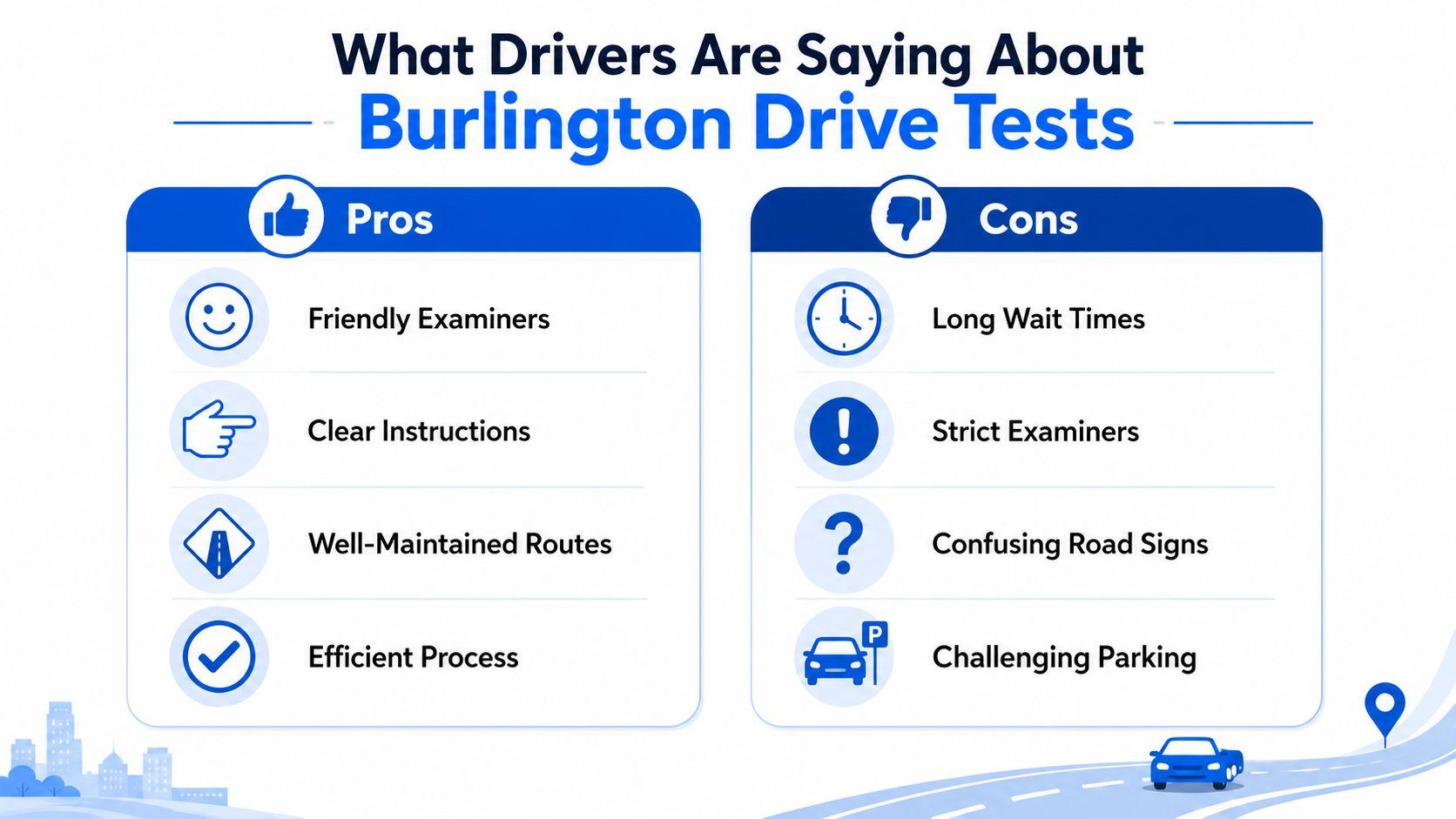
What Drivers Are Saying Pros and Cons
Most review pages mix good advice with emotional reactions. That's normal. A road test is stressful, and people remember strong feelings more than fine detail. Still, when you filter those comments properly, Burlington's pattern becomes fairly readable.
Where reviews are helpful
A common positive theme is efficiency. One well-known Burlington anecdote mentions an examiner arriving within 3 minutes after kiosk registration, but there's no newer data showing whether that speed is still consistent, and broader DriveTest Trustpilot complaints often mention booking problems. That's why candidates still feel uncertain about the pre-test experience even when some local reviews sound reassuring.
Another positive theme is examiner professionalism. Even when people say they were nervous, many describe the instructions as direct and manageable. That matters more than “nice” or “strict.” An examiner who speaks clearly gives you a fair chance to show what you know.
You'll also see praise for the routes feeling straightforward when the driver has already practised in the area. Burlington doesn't get described as random. It gets described as unforgiving when a student skips local practice.
Common praise
- Clear instructions: Drivers often say the test itself feels simpler once the examiner starts speaking and the routine becomes familiar.
- Structured routes: Repeated route patterns mean preparation can be specific instead of vague.
- Professional tone: Reviews often suggest the centre runs like a busy workplace, not a chaotic guessing game.
- Accessible location: Burlington remains heavily used because it's easy to reach and well known in the GTA.
Where reviews can mislead you
The biggest trap is taking “easy” at face value. A driver who says a route was simple may also be someone who practised it many times beforehand. That doesn't mean the route is forgiving if your lane changes are late or your mirror habits are weak.
You'll also see complaints about strict examiners. Sometimes that's fair. Sometimes it's just the normal outcome of a test where rolling stops, missed blind spots, and rushed parking are being scored.
Some of the harshest reviews come from candidates who describe the examiner more than they describe their own driving.
That's worth remembering when you read local feedback. Reviews are most useful when they mention specific behaviours, not just emotions.
Common complaints
Theme What it usually means in practice Check-in confusion Drivers feel flustered before the test even starts Strict marking The examiner noticed observation, speed, or stopping errors Parking pressure Nervous candidates rush simple manoeuvres Road sign confusion The issue is usually late processing, not trick signage
If you read Drive Test Burlington reviews with that filter, they stop feeling contradictory. The “pros” and “cons” usually describe the same centre from two different levels of preparation.
Test Day Logistics Booking and Arrival at Brant Street
The logistical part of the test is where many candidates burn energy they should be saving for the drive. A smooth arrival matters because you want to start calm, not already rattled.
The centre is at 1250 Brant Street #2. Local guidance says applicants should arrive 20 to 30 minutes early and check in at the kiosk by entering vehicle details before an examiner is assigned, according to local Burlington centre guidance.
Before you leave home
Booking is one job. Showing up prepared is another. If you're still sorting out scheduling questions, this guide to Ontario G road test booking steps gives a clean overview of the process.
For test day itself, organise the boring details first. Those are the ones that create avoidable stress.
- Confirm your appointment details: Don't rely on memory.
- Check the vehicle you're using: If something feels off, fix it before you leave.
- Know the centre entrance and parking layout: That reduces the “where do I go?” panic when you arrive.
- Give yourself buffer time: Burlington is busy enough that last-minute arrival is a bad gamble.
What to do when you arrive
At Burlington, the check-in kiosk matters. You'll need to enter the required vehicle information accurately. If you rush that step, you can create confusion before the examiner even reaches your car.
Some local route guidance also warns students to avoid parking spots 1 and 2 because access is tighter. That's a small detail, but it's exactly the kind of location-specific tip that helps. If a better spot is available, take the easier setup and remove one more source of pressure.
Here's the practical sequence I'd want any student to follow:
- Park neatly in a suitable space. Don't choose the tightest spot if you have a choice.
- Take a breath before touching the kiosk. Accuracy matters more than speed.
- Enter your information carefully. Plate, make, colour, and any requested details should match the vehicle.
- Return to the car and settle in. Adjust your seat, mirrors, and mindset.
- Wait for the examiner without rehearsing panic. Quiet focus helps more than last-second overthinking.
Your test starts before the car moves. If you arrive rushed, park badly, or fumble the kiosk, your attention is already split.
Burlington rewards candidates who make the pre-drive routine look organised.
Navigating the Burlington G2 and G Road Tests
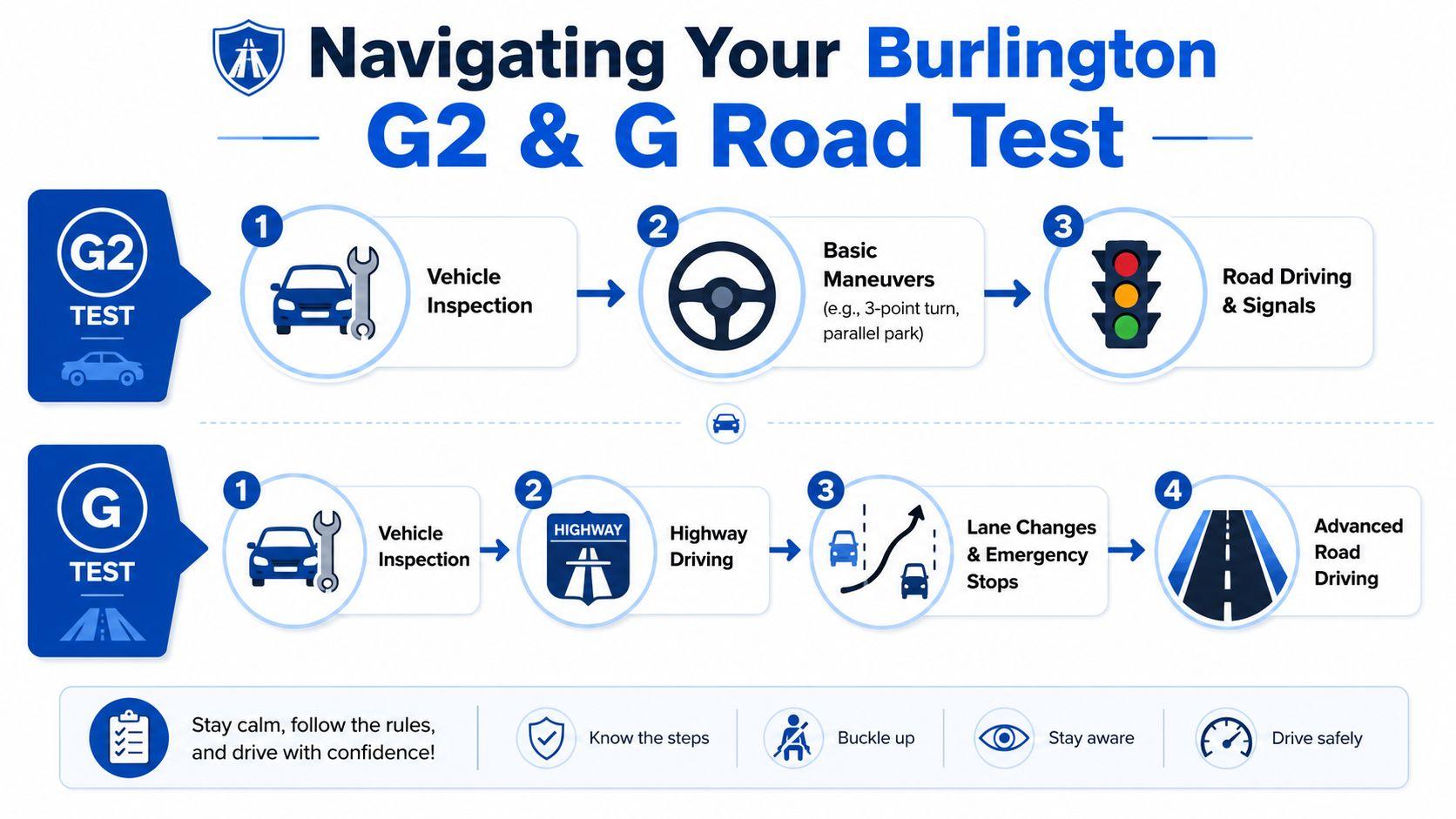
Burlington road tests don't feel random when you understand what the examiners are trying to verify. They want to see whether your habits are dependable. Not flashy. Dependable.
Local route material and driver accounts show that Burlington's standardized G2 routes include reverse parking, frequent blind spot checks every 5 to 8 seconds, and complete stops without rolling, based on a detailed Burlington G2 experience write-up.
What the G2 usually emphasizes
The G2 is where examiners watch for discipline in the basics. They're not only checking whether you can physically turn the car or park it. They're checking whether you observe properly before, during, and after each manoeuvre.
If you're reviewing what the province expects at this stage, this breakdown of the Ontario G2 driving test is a useful refresher.
The common Burlington stress points usually look like this:
- Reverse parking: Students often know how to do it, but they rush the setup.
- Stop signs: Full stops matter. Rolling even slightly can hurt you.
- Blind spot checks: Examiners want to see them clearly, not assume you did them.
- Right turns and lane changes: These are routine until nerves make them sloppy.
A manoeuvre can be technically correct and still look uncertain. That's why visible observation matters so much.
If your head and eyes don't show the check, the examiner can't give you credit for what only happened in your mind.
What the G test usually emphasizes
The full G test raises the standard from neighbourhood control to highway judgment. In Burlington, that means merge quality, lane discipline, speed consistency, and mirror habits become harder to hide if they're weak.
Regional route analysis for Burlington notes a 30 to 40 km/h tolerance window on some residential ramps, with speed control concerns if a driver goes above 40 km/h or below 30 km/h without reason. The same analysis says highway merge sections require maintaining 100 km/h smoothly, and mirror checks should happen every 5 to 10 seconds on downhill sections where appropriate, according to this Burlington route analysis video summary.
That tells you a lot about what matters here. Not aggression. Not hesitation. Controlled commitment.
What works well in Burlington
Skill What examiners usually want to see Merging Smooth acceleration and confident entry Observation Mirrors and blind spots done early and clearly Braking Planned, steady slowing instead of late correction Parking tasks Full checks, proper setup, no rushed finish
What doesn't work
- Driving under the limit for comfort alone: On higher-speed sections, that can create its own problem.
- Checking mirrors invisibly: Tiny eye flicks don't communicate enough.
- Treating stops casually: Burlington route reports repeatedly point to full compliance.
- Trying to “game” the route: Good habits travel better than memorised turns.
A student who practises Burlington-specific roads usually feels more settled. A student who only memorises turns often falls apart the first time traffic changes the rhythm.
How to Prepare for a Confident Pass
Strong road test performance starts long before your examiner opens the passenger door. It starts with rule knowledge that's automatic enough to hold up under stress.
For the G1 knowledge test, Ontario candidates need at least 80% overall, which means getting 16 out of 20 correct in both the road rules and road signs sections, as outlined in this Ontario G1 scoring guide.
Build rule knowledge before road confidence
A lot of learners separate the written test from the road test too sharply. That's a mistake. The person who thoroughly understands signs, right-of-way, stopping rules, and lane-use logic usually drives more calmly because fewer decisions feel improvised.
That's why I tell students to treat handbook study as driving training, not just test prep. If you know the rule clearly, you hesitate less at real intersections.
Use your study time in layers:
- Start with accuracy: Learn the rule before trying to go fast.
- Mix question types: Don't only practise the sections you already like.
- Review mistakes immediately: Wrong answers are where your safest progress happens.
- Carry the rules into the car: Ask yourself why each move is legal, safe, and expected.
Use parking practice to sharpen judgment
Parking drills do more than prepare you for a single manoeuvre. They teach spacing, control, patience, and visual discipline. If you want a focused refresher, this parallel parking driving test guide is worth reviewing before your next practice session.
By the time you're preparing for Burlington, your goal isn't perfection. Your goal is repeatability. You want the same calm sequence every time: scan, signal, position, control speed, complete the move, check again.
This video gives a useful visual reset before practice:
Good preparation makes the test feel familiar. That's what confidence really is on the road.
When students feel overwhelmed by Drive Test Burlington reviews, they usually need less internet and more deliberate repetition. Learn the rules until they're obvious. Practise until the routine feels normal.
Your Ultimate Burlington Test Day Checklist
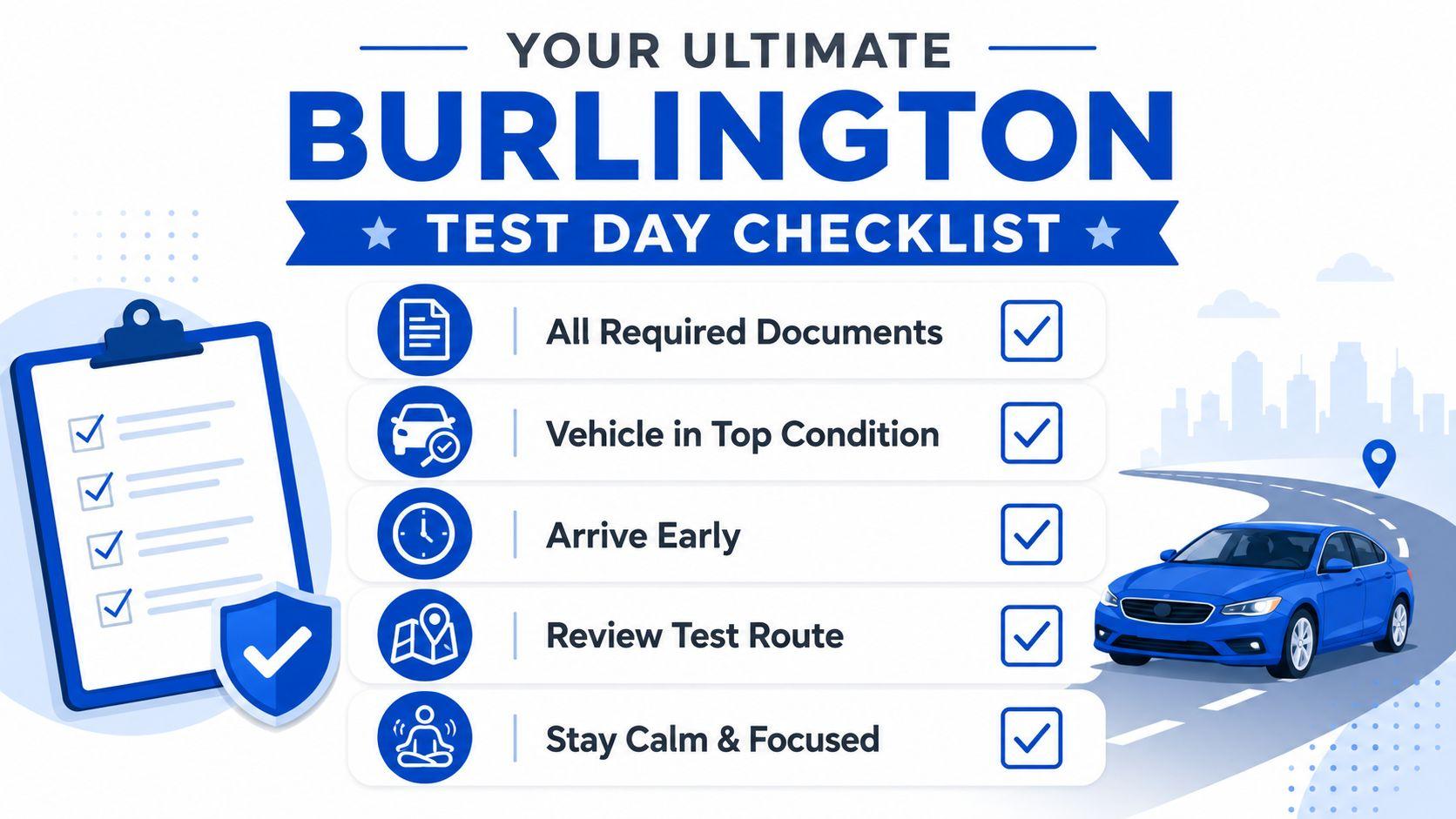
The final hours before the test should feel organised, not dramatic. A short checklist helps because stress makes people forget simple things first.
The day before
- Check your documents: Put everything you need in one place so you're not searching in the morning.
- Inspect the vehicle calmly: Lights, signals, mirrors, cleanliness, and general road readiness all matter.
- Drive the area if possible: Not to memorise every turn, but to get comfortable with the pace and lane flow.
- Sleep instead of cramming: A tired driver misses easy observations.
The morning of
Eat something light, leave with time to spare, and avoid conversations that spike your nerves. You don't need a motivational speech. You need a steady routine.
A simple pre-drive reset works well:
- Arrive with margin.
- Sit for a moment before getting out.
- Slow your breathing.
- Remind yourself to show observation clearly.
Upon arrival
Here, candidates either settle down or start spiralling. Keep it mechanical.
- Choose a sensible parking spot: Don't make the first task harder than it needs to be.
- Use the kiosk carefully: Accuracy beats speed.
- Set up the car after check-in: Seat, mirrors, and posture first.
- Wait with purpose: Don't replay worst-case scenarios.
- Listen fully to the first instruction: A calm start often shapes the rest of the drive.
If you want one final mental cue, use this: drive the way you practise when someone's watching closely. That's all the test is.
If you're still building your confidence before test day, G1ready.ca is a practical place to sharpen your Ontario road-rule knowledge with realistic practice tests, instant feedback, and study tools that help you turn weak spots into dependable habits.