
If you're getting ready for the G1 written test in Brampton, there's a good chance you're juggling two things at once. You want to pass on the first try, and you also don't want to waste a day standing in line only to realise you missed something simple.
That mix of nerves and uncertainty is normal. Brampton isn't a place where casual preparation works well. The test itself is standard Ontario content, but the local reality around wait times, pressure, and pass rates means you need a sharper plan than the average generic guide gives you.
Why Your Brampton G1 Test Needs a Special Game Plan
A lot of learners assume the G1 is just a basic written test, so any Ontario study guide should be enough. In Brampton, that mindset causes problems.
The hard truth is that the Brampton DriveTest knowledge centre has the lowest G1 pass rate in Ontario at 59%, compared with the provincial average of 69% and Bancroft at 88%, according to CBC's reporting on Ontario DriveTest pass rates. If you've heard people say Brampton feels tougher, that concern isn't random.
That doesn't mean the test is unfair. It means you shouldn't prepare like someone who's walking into a quieter, less pressured location.
Practical rule: In Brampton, "good enough" studying is risky. Aim for clean, repeatable scores in practice, not lucky passes.
Why generic advice falls short
Most province-wide guides treat every test centre as if the learner experience is the same everywhere. It isn't. In Brampton, learners often deal with a busier environment, more distractions before the test, and more pressure to perform well on the first attempt.
That changes what works. Reading the handbook once and doing a few random quizzes might help you recognise familiar questions, but it usually doesn't build enough recall under pressure. You need a plan that is more organised and more deliberate.
What actually helps in Brampton
A stronger approach focuses on three things:
- Separate mastery of signs and rules: Don't lump everything together in one long study session.
- Test-day planning: A bad arrival time can drain your focus before you even start.
- Error review: Every wrong answer should teach you something specific, not just tell you that you were wrong.
Brampton learners often don't need more motivation. They need a tighter system. If you treat the G1 written test in Brampton like a local challenge instead of a generic Ontario task, your odds improve immediately because your preparation becomes more focused.
Finding and Booking Your G1 Test in Brampton
You leave home expecting a quick written test, then spend a long stretch in line before you even reach the counter. I see that mistake often in Brampton. The written test itself is manageable, but the centre's walk-in process catches first-time applicants off guard.

The key thing to know before you go
For the G1 written test in Brampton, the knowledge test is generally handled as a walk-in, first-come-first-served process.
That matters more in Brampton than in a quieter location. If you arrive at a busy hour, your energy goes into waiting, paperwork, and noise before you even sit down. For a centre where many learners already feel extra pressure, that is a bad trade.
How to plan your visit
Use a simple plan that protects your focus:
- Arrive early: Early intake usually means less waiting and a calmer start.
- Keep the rest of your day open: Delays are common, especially during busy periods.
- Set out your documents before you leave home: Do not sort through a wallet or backpack at the counter.
- Eat and hydrate first: A hungry, rushed learner makes more careless mistakes.
- Treat the trip as part of test prep: Your test day starts with your arrival routine, not with the first question on the screen.
If you want to confirm nearby centres and location details before heading out, check this Ontario G1 test locations guide.
What trips people up in Brampton
The common mistake is not lack of knowledge. It is poor timing.
Applicants often assume the written test will be a fast errand, show up later than they should, and walk into a packed waiting area. By the time they reach the test station, they are already distracted. In Brampton, where the centre can feel busier and less forgiving, that mental drain shows up on simple questions about signs, right-of-way, and wording.
A calm arrival gives you an edge. That is part of the Brampton strategy.
What to Bring to the DriveTest Centre
Many individuals lose easy points before the test even starts. Not because they answered a question incorrectly, but because they arrived without the right documents or didn't think through the on-site process.
The non-negotiables
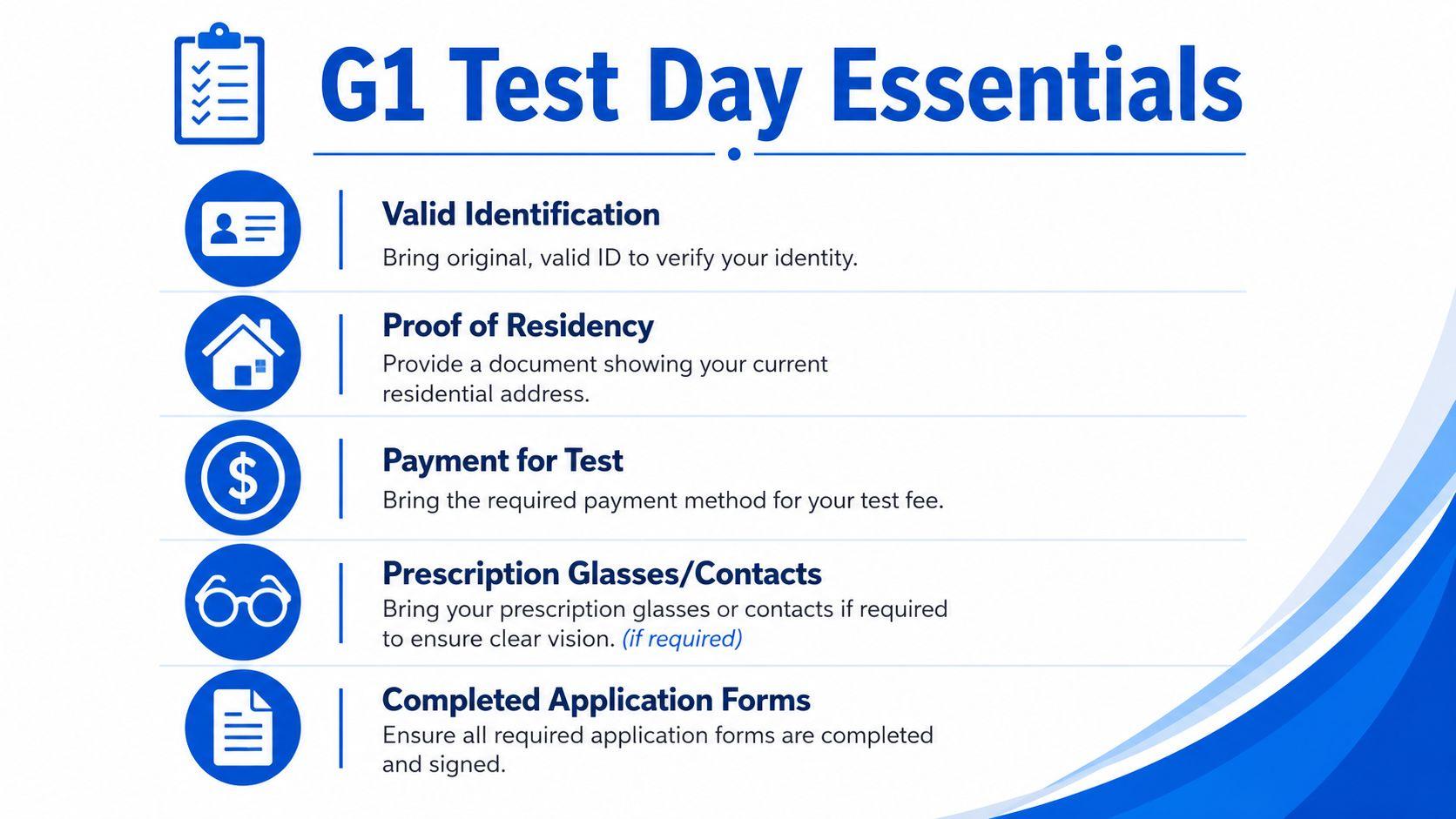
To apply for and pass the G1 test, applicants must be at least 16 years old, must present original identification showing legal name and date of birth, and should study the Official Ministry of Transportation Driver's Handbook, which is the sole authorised source for test content preparation, as outlined in InsuranceHotline's summary of Ontario G1 requirements.
Original documents matter. Copies, unclear scans, or expired identification can create avoidable delays.
Your test-day checklist
Bring these as a baseline:
- Original ID: Your identification must clearly show your legal name and date of birth.
- Any supporting paperwork you were told to complete: Keep it organised in one folder so you aren't searching at the counter.
- Payment method: Check accepted options before you go so you don't get stuck.
- Prescription glasses or contact lenses: If you use them, bring them. You may need them for the vision screening.
- Handbook-based preparation: The MTO handbook is the core reference. Practice tools should support it, not replace it.
For a more detailed breakdown of acceptable paperwork, this guide to G1 document requirements can help you check your list before you leave home.
The vision test catches some people by surprise
Many learners focus only on the written portion and forget there's also an on-site vision check. If you normally wear corrective lenses for distance, don't leave them at home because you're "only doing a written test."
That small mistake can turn into a wasted trip.
Bring what you need to function normally, not what you think you might get away without.
A practical way to pack the night before
Don't rely on memory in the morning. Put everything together the evening before in one place.
Item Why it matters Original ID Needed to verify who you are Glasses or contacts Useful for the vision screening if required Payment method Prevents check-in delays Organised papers Makes the counter process quicker Handbook notes Good for a quick review before entering
A calm test day usually starts with a simple bag check at home. That's especially true for the G1 written test in Brampton, where long waits can make any missing item feel even more frustrating.
A Winning Study Plan for the Brampton Test
Most learners don't fail because they never opened the handbook. They fail because they studied passively. They read, recognised, and highlighted, but they didn't train themselves to recall answers cleanly under pressure.
Passive reading won't carry you
The MTO handbook is your foundation. You still need it. But if your full strategy is "read the book and hope the questions look familiar," you're making the test harder than it needs to be.
A better method combines handbook study with repeated question practice, focused mistake review, and separate work on signs and rules. That's where many learners tighten up quickly because they stop guessing what they know and start measuring it.
Newcomers need an Ontario-specific reset
This matters even more for newcomers and international licence holders. Kruzee's article on hard G1 questions cites Ontario 2025 MTO report data showing 41% of international licence holders fail the signs section due to unfamiliarity with hyper-local signs.
Previous driving experience helps with judgment. It doesn't automatically help with Ontario sign language. A confident driver from another country can still miss local signs because the symbols, light patterns, or wording aren't what they're used to.
A study routine that actually works
Use a plan that looks like this instead of endless rereading:
- Start with the handbook Read for understanding first. Don't rush to memorise every line. Focus on what the rule means in real driving situations.
- Split your practice Study road signs separately from rules of the road. If one side is weaker, fix that side directly instead of hiding it inside mixed quizzes.
- Review every wrong answer Don't just click through and move on. Ask why the correct answer is right and why your answer was tempting.
- Practise in shorter rounds Short sessions are easier to repeat and easier to review. They also keep your attention sharper.
One useful option is this guide on how to study for the G1 test, and some learners also use G1ready.ca for realistic exam simulators, targeted signs and rules quizzes, and immediate answer explanations. The value in tools like that isn't hype. It's that they let you practise in the same structure you need to handle on test day.
For a quick visual refresher, this walkthrough is worth watching before your final review session.
Strong G1 prep isn't about doing more pages. It's about spotting weak patterns early and fixing them before the test exposes them.
Navigating Test Day and Understanding Your Score
By test day, you don't need more motivation. You need a clear picture of what happens from the moment you walk in to the moment you see your result.
What the test experience feels like
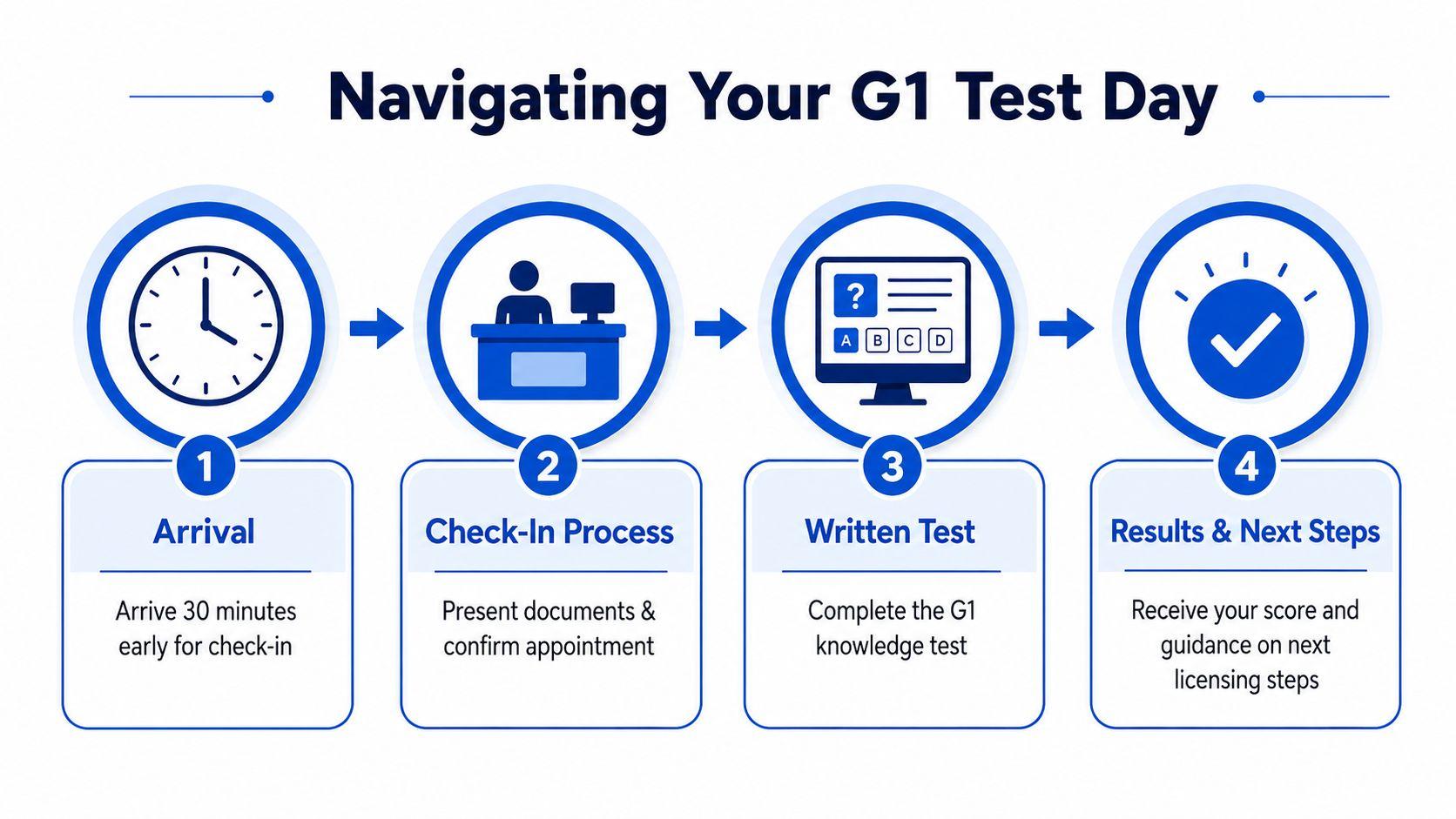
You arrive, check in, handle the front-desk steps, complete the vision screening, and then wait for your turn at the testing station. Once you're seated, the key is to slow your brain down. Read each question fully. A lot of mistakes come from rushing familiar-looking questions.
The G1 test in Brampton is often misunderstood as one overall pass mark. That's not how it works. According to this explanation of Ontario's dual-section G1 scoring, you must pass both sections separately at 80% (16/20), and failing one section means failing the whole test.
Why some learners are shocked by a fail
This is the part that catches people. They think, "I did fine overall," but one weak section pulls the result down.
Here is the simplest way to understand this:
Section What you need Road signs Pass this section on its own Rules of the road Pass this section on its own Overall result You only pass if both sections are passed
So if a learner does well on rules but slips too much on signs, the test result is still a fail. That's why separate practice matters so much.
Read every sign question as if it's testing a precise meaning, not a general impression. Similar-looking signs are where careless errors happen.
After the result appears
If you pass, great. Stay focused, follow the instructions you receive at the centre, and keep your documents organised for the next licensing steps.
If you don't pass, don't turn one failed attempt into a story about your ability. Most often, the result points to a study problem, not an intelligence problem. Usually it's one of these:
- You studied broadly but not thoroughly
- You recognised content without being able to recall it
- You underprepared one section
- You let nerves speed you up
That kind of failure is fixable. In fact, it's often easier to fix after one attempt because you now know what the testing environment feels like. The smart move is to review the section that tripped you up, tighten your method, and return with a cleaner plan.
Your Brampton G1 Test Success Checklist
A lot of Brampton learners reach test day with decent general knowledge and still come up short because their preparation was too loose. This centre rewards clean habits. You need the right documents, a clear study routine, and enough margin in your schedule to handle a busy test day without rushing.
Use this checklist the way I tell students to use it. Read it once a few days before the test, then check it again the night before and once more in the morning.
The week before
- Study from the official handbook first: Build your base from the MTO material so your answers match Ontario test wording.
- Train signs and rules separately: In Brampton, weak sign recognition catches people more often than they expect. Split your practice so one area cannot hide behind the other.
- Track repeat mistakes: If you miss right-of-way, demerit points, licence suspensions, or warning signs more than once, review that topic the same day.
- Get your documents together early: Put your original ID, payment method, corrective lenses if you use them, and any supporting paperwork in one folder.
- Practise at your real energy level: If your appointment will be in the morning, do some timed practice in the morning. Tired studying gives a false sense of readiness.
- Plan your route to the Brampton DriveTest centre: Check traffic patterns, parking, and how early you want to arrive. In Brampton, poor timing creates stress before the test even starts.
The night before
Keep it simple.
Do one short review session, then stop. Last-minute cramming usually leads to second-guessing, especially on signs that look similar at a glance. Get your clothes, ID, and payment ready so the morning feels routine.
Test day morning
- Leave earlier than feels necessary: Brampton traffic and centre volume can make a tight plan fall apart quickly.
- Bring only what you need: Organized documents speed things up and reduce avoidable stress at check-in.
- Do a brief refresh, not a full study session: Review a few signs, common rule traps, and licence penalties, then close your notes.
- Read every question once, then answer: Fast guessing is expensive on a test where one weak category can cost you the result.
- Stay calm if the centre feels busy: Noise, lines, and other anxious applicants can throw off your pace if you let them.
One more practical point. Brampton often feels less forgiving than quieter test locations because the pressure starts before you even sit down. That is why a local plan matters. If your prep is organised and your test-day routine is steady, the G1 written test in Brampton becomes far more manageable.
If you want extra practice before your test, G1ready.ca gives you a structured way to work through realistic questions, targeted quizzes, and exam-style practice so you can sharpen weak areas before you head to the DriveTest centre.