You're probably in the same spot most new riders hit in Ontario. You've decided you want to ride, you've started looking up the M1, and within a few minutes the process feels more complicated than it should. Some advice talks about the written test only. Some skips straight to courses. Some assumes you already know how Ontario's graduated licensing works.
That confusion is normal. The good news is that the permit motorcycle test itself isn't mysterious once you understand what Ontario is asking you to prove. They're not only checking whether you memorised motorcycle facts. They're checking whether you understand road signs, general road rules, and the motorcycle-specific judgement that keeps riders out of trouble.
If you treat the M1 as a mixed exam instead of a pure bike quiz, your study plan gets much better. If you treat test day as a simple admin task instead of a high-stakes event, it gets less stressful. If you build your prep around how the questions connect, not just around isolated facts, you give yourself a much better shot at walking out with your permit.
Your First Step to Riding in Ontario
The M1 is where your riding life starts, but it helps to stop thinking of it as a box to tick. It's your first real filter. Ontario wants to know that before you touch a throttle on public roads, you can read the road environment the same way a safe rider does.
That matters because a beginner's problem usually isn't lack of enthusiasm. It's overload. You're trying to learn licensing rules, bike control, road signs, protective gear, lane discipline, and paperwork at the same time. Learners often don't fail because they're careless. They struggle because the process is fragmented and they prepare for the wrong thing.
A better way to approach the permit motorcycle test is to see it as part of Ontario's graduated system, not as a standalone motorcycle quiz. If you need a clean overview of how the province stages licences and progression, this guide on Ontario's graduated licensing system lays out the big picture clearly.
Practical rule: Prepare for the M1 like a road user first and a motorcyclist second. Then add the motorcycle layer on top.
That mindset changes how you study. Instead of asking, “What motorcycle facts do I need to memorise?” ask, “What would a safe rider need to know in traffic, and how does a motorcycle change that answer?” That's the frame that makes the test easier and riding safer.
Confirming Your Eligibility and Gathering Documents
Before you think about questions, practice tests, or passing marks, make sure you can be processed at the counter. A surprising amount of frustration comes from showing up excited and underprepared, then being turned away over identity or application details.
What to have before you leave home
For an M1 application, get your documents together like you're assembling a file, not grabbing items on the way out. You want age, identity, Ontario residency, and any forms you'll need to complete handled in advance.
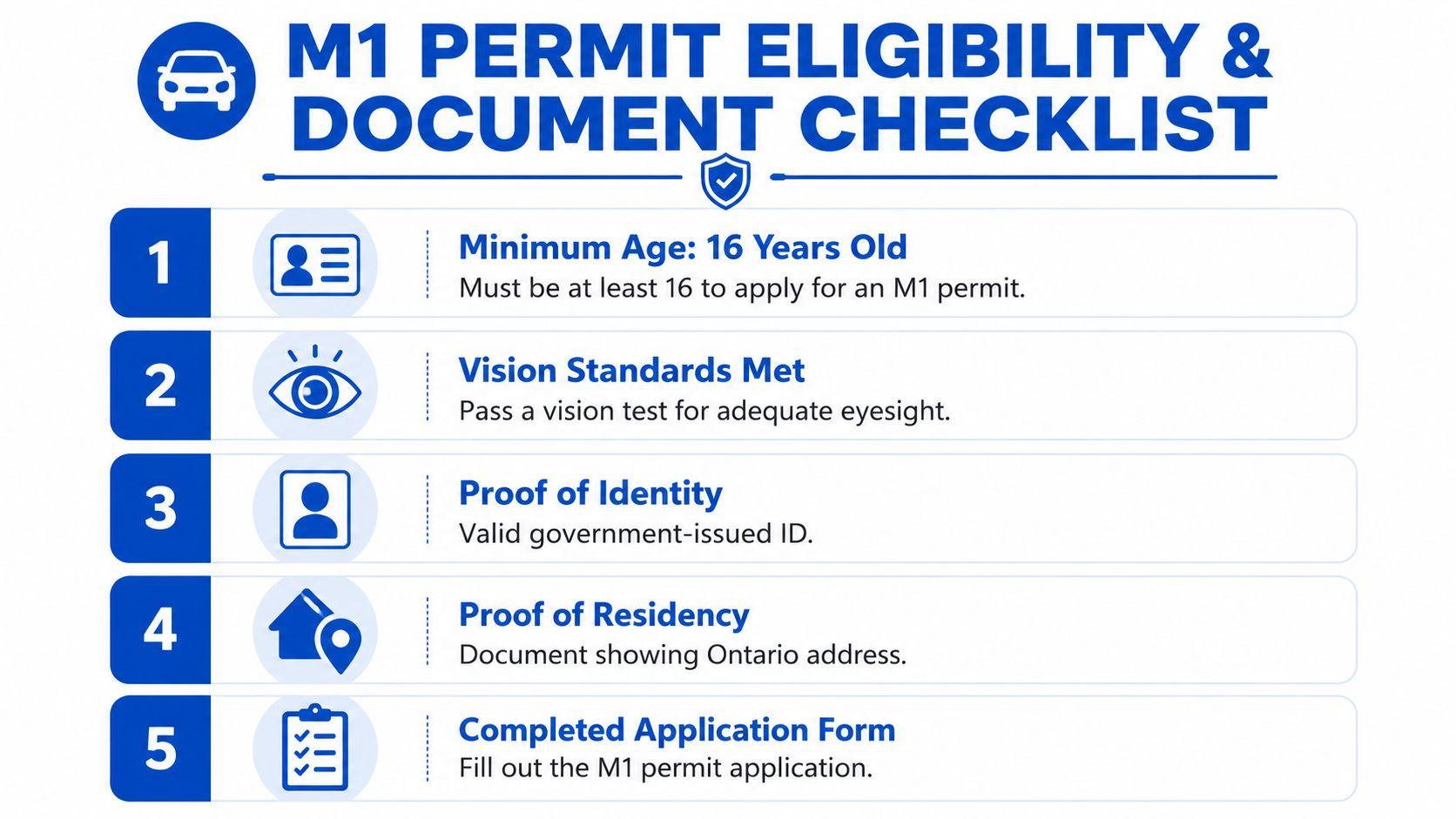
Use this practical checklist:
- Minimum age: You must be old enough to apply for the M1. If you're close to the threshold, don't assume they'll be flexible. Bring identification that makes your date of birth unmistakable.
- Vision readiness: Expect a vision screening. If you normally wear glasses or contact lenses, bring them and use them.
- Proof of identity: Bring valid government-issued ID. It needs to be current, legible, and accepted by DriveTest staff.
- Proof of Ontario residency: If your current address matters for your documents, make sure it matches what you'll provide.
- Application details: Don't arrive fuzzy on your personal information. Fill things out carefully and consistently.
If you're a newcomer or you have documents from outside Ontario, it's worth checking accepted document combinations before you leave. This rundown of documents needed for the G1 test is useful because the same basic document logic applies at the licensing counter.
Bring more identification than you think you'll need. Staff can only work with what's in front of them, and guessing never helps at the counter.
The study material that actually matters
The necessity of the motorcycle handbook is widely recognized. Fewer people realise that they also need to be comfortable with general road rules and signs. That's where the M1 catches people who only study one book.
Your prep should include two streams of material:
Handbook What it covers Why it matters Official MTO Driver's Handbook General rules of the road and traffic signs The M1 draws from the same traffic language every road user is expected to know Official MTO Motorcycle Handbook Motorcycle-specific operation, safety, control, and legal responsibilities This is the rider-specific layer that separates the M1 from a standard car knowledge test
Read both with a purpose. Don't try to memorise every sentence. Mark sections that answer real riding questions, such as right-of-way, lane use, following distance, blind spots, braking, protective equipment, and where motorcycles become vulnerable in traffic.
A smart folder for test day is simple. ID, residency proof, eyewear if needed, payment method, and your confidence that the admin side is handled. Once that's sorted, your brain can stay on the exam instead of the paperwork.
Booking Your Test and The DriveTest Centre Experience
The first thing to clear up is the booking question. Many new riders assume the M1 works like an appointment-only service. In practice, people often handle the knowledge test by going to a DriveTest centre in person and working through the walk-in process.
That means your real preparation isn't just academic. It's logistical. Choose a day when you aren't rushed, leave enough time for waiting, and arrive expecting some admin friction. If the centre is busy, the hardest part of the day may be patience, not the permit motorcycle test itself.
What the visit usually feels like
A typical visit starts with check-in, paperwork, and document review. You'll wait your turn, answer staff questions, complete the required processing, and then be directed toward the testing area.
The room itself matters more than people expect. Knowledge tests are usually done at computer terminals, and the environment can feel clinical and distracting. You may hear other candidates moving around, staff talking, or keyboards clicking. That's not a reason to panic. It's just part of the setting.
Don't treat the room like an obstacle. Treat it like weather. Notice it, then ignore it.
When you sit down, slow yourself on the first few questions. New riders often lose marks early because they're still settling their nerves and reading too quickly. The better move is to establish rhythm. Read every question fully, eliminate obvious wrong answers, and only then choose.
What helps on the day
A few habits make the DriveTest visit smoother:
- Arrive with margin: If you show up already stressed, small delays feel bigger.
- Eat and hydrate beforehand: Hunger makes concentration worse.
- Read exactly what's asked: Many wrong answers come from answering a different question than the one on screen.
- Expect immediate results: Once you finish, you'll know quickly whether you passed or need another attempt.
The riders who handle the centre best aren't always the ones who studied the longest. They're the ones who arrived organised, accepted the wait, and kept their attention narrow when the screen was in front of them.
Decoding the M1 Written Exam Format
A lot of first-time riders walk into the M1 expecting a straight motorcycle quiz, then get tripped up by signs and road rules they have not reviewed in years. That mismatch is the fundamental format problem. The test is checking whether you can ride and whether you understand the road system you are about to enter.
The M1 written exam combines motorcycle-specific knowledge with the same road signs and rules foundation used in Ontario's G1 testing. If you want a quick refresher on how the province structures the non-motorcycle side of knowledge exams, this guide to the Ontario G1 test format helps put the M1 in context.
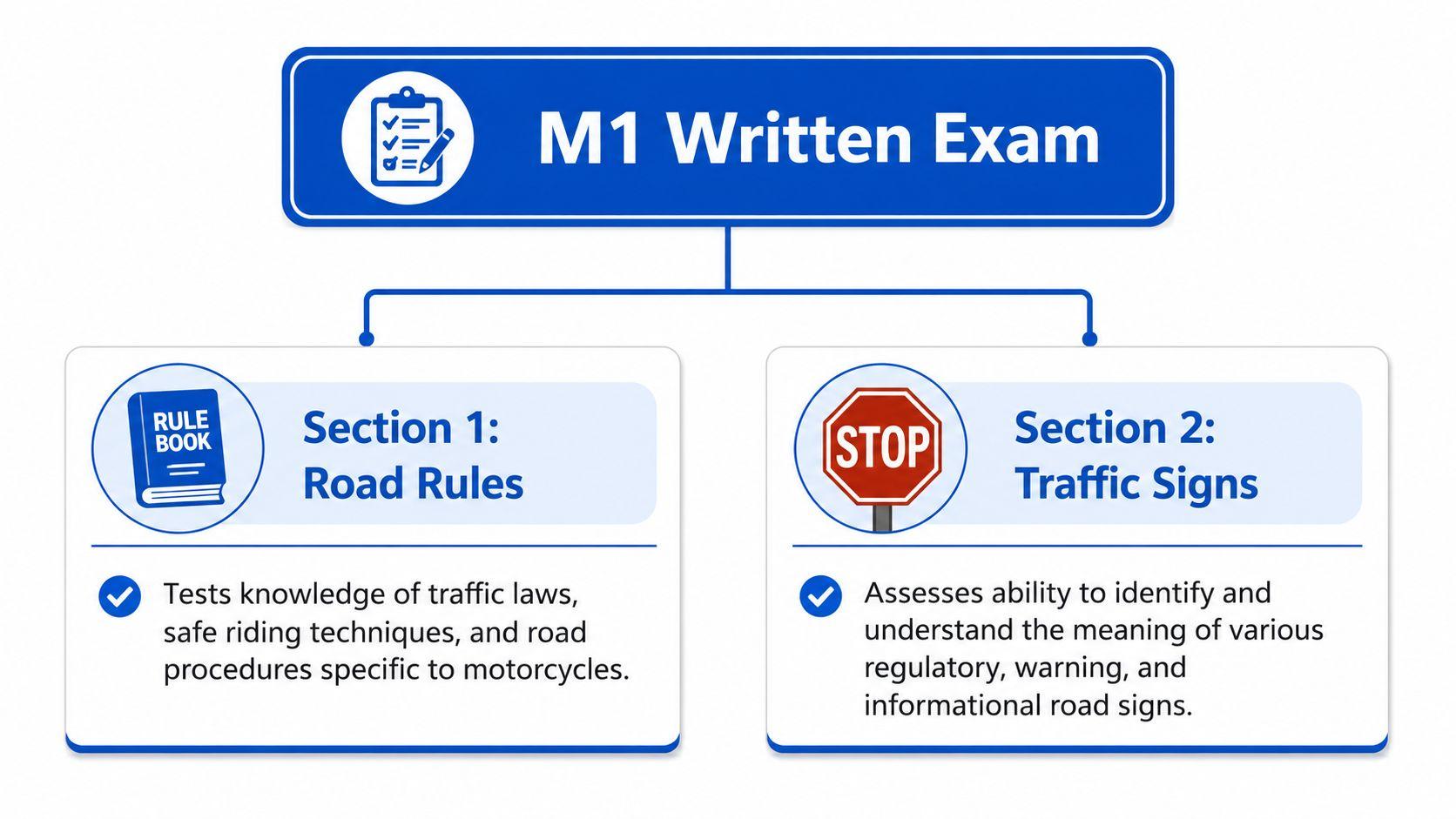
That mixed format explains why decent riders sometimes fail on the first try. They study lane position, braking, and gear, but they are rusty on sign meanings or right-of-way questions. The opposite happens too. Someone with fresh G1 knowledge can still miss questions about visibility, surface hazards, or where a rider should place the bike in a lane.
The useful way to read the exam is as one safety system with three parts.
Section What Ontario is really checking What usually causes trouble Road signs Fast recognition of regulatory, warning, and information signs Confusing similar-looking signs or second-guessing obvious answers General road rules Whether you understand right-of-way, lane use, legal duties, and traffic procedures Reading too fast and answering from habit instead of the question on screen Motorcycle-specific questions Whether you understand rider risk, control, visibility, spacing, and hazard response Memorizing phrases without understanding why the safer option matters
That last column matters more than people expect.
The motorcycle portion is rarely about obscure trivia. It usually asks you to choose the answer that gives a rider more time, more space, and better control. If two options both sound possible, the better answer is usually the one that reduces exposure to other drivers, poor surfaces, or sudden braking.
Here's a useful visual primer before you keep studying:
A practical example helps. If a question asks about lane position, do not treat it like a fixed rule with one permanent correct spot. Ontario wants to know whether you understand why a rider changes position. Visibility, road debris, oncoming traffic, parked cars, and escape space all affect the safest choice. Riders who only memorize one sentence from the handbook often miss that kind of question.
Use this filter on test day: legal, safe, stable. If an answer checks all three, it is usually the right one. If it is legal but leaves you with less visibility or less margin, keep reading.
That mental framework is what ties the whole exam together. Signs tell you what the road demands. General rules tell you what the law expects. Motorcycle questions ask whether you can apply both while managing the extra risks that come with riding.
Crafting Your High-Pass Study Plan
You are sitting in the DriveTest waiting area, and the question in front of you looks familiar but not identical to what you studied. That is the moment weak prep falls apart. Riders who pass consistently usually prepare for the logic behind the answer, not just the wording.
The M1 written exam rewards connected knowledge. One part checks whether you understand Ontario road rules and signs. The other checks whether you can apply those rules with motorcycle-specific judgment. If you study those pieces separately for too long, the test feels harder than it is.
Study in two layers, then blend them
Start with the G1 material until the basics feel automatic. Road signs, right-of-way rules, speed limits, and common penalties should come quickly. If you still have to stop and decode a sign question, the motorcycle section will feel crowded because your attention is already tied up.
Then study the Motorcycle Handbook with a rider's filter. Look for patterns that keep showing up:
- Visibility: lane position, blind spots, and how to stay seen without giving up space
- Control: braking, cornering, throttle use, and what changes on gravel, wet pavement, or uneven roads
- Legal responsibilities: rules Ontario expects you to know before you ride
- Risk reduction: gear, following distance, scanning habits, and escape options
After that, combine the two layers. A lane position question is never only about lane position. It can also test your understanding of visibility, traffic flow, road surface hazards, and how much space you leave for a mistake by another driver. That is the habit to build before test day.
How to study without wasting time
A lot of new riders put in enough hours and still make their prep harder than necessary. The problem is usually method, not effort.
Use short sessions for signs and definitions. Use longer sessions for motorcycle topics that need judgment. At the end of each study block, close the book and explain the rule in plain language. If you cannot explain why the safer answer is safer, keep working that topic.
This approach helps with the questions that trip people up most. Ontario often puts two plausible answers beside each other. One may be technically possible. The better one gives you more time, more visibility, or a larger safety margin. That difference matters on the exam.
Mistakes that cost otherwise prepared riders
These are the trouble spots I see again and again:
- Focusing only on motorcycle material: the bike questions feel more interesting, so signs and road rules get pushed aside
- Memorising question shapes: this works until the wording changes
- Reading passively: highlighting a page does not show whether you can recall or apply the rule
- Ignoring wrong answers: your misses show you exactly where your judgment or memory is weak
- Studying rules without context: you remember the sentence, but not the reason behind it
One practical fix is to keep a short mistake list. Write down the questions or topics you miss, then label the problem. Was it a sign you did not recognize? A law you mixed up? A motorcycle safety principle you understood only halfway? That turns review into something specific instead of rereading pages you already know.
I also suggest one final test-day habit during your prep. Before choosing an answer, ask: is it legal, does it give the rider space, and does it keep the bike stable? That quick check works across both halves of the exam and keeps you from getting pulled toward answers that sound confident but leave too little margin.
You Passed Your Permit Test What Happens Next
Passing the written test is satisfying, but it's only the entry point. Your M1 gives you limited riding privileges while Ontario expects you to build real skills before moving on.
Ontario's system is unusual in an important way. The province uniquely requires a two-tier on-motorcycle skills evaluation beyond the preliminary knowledge test for probationary motorcyclists, making it the only North American jurisdiction mandating an advanced skills test for unrestricted licensing, as described in the MSF report on the Ontario experience. That's worth knowing early because it changes how you should think about the M1. It isn't the finish line. It's the gate into practical development.
Your M1 restrictions at a glance
These restrictions are the ones every new rider should treat seriously:
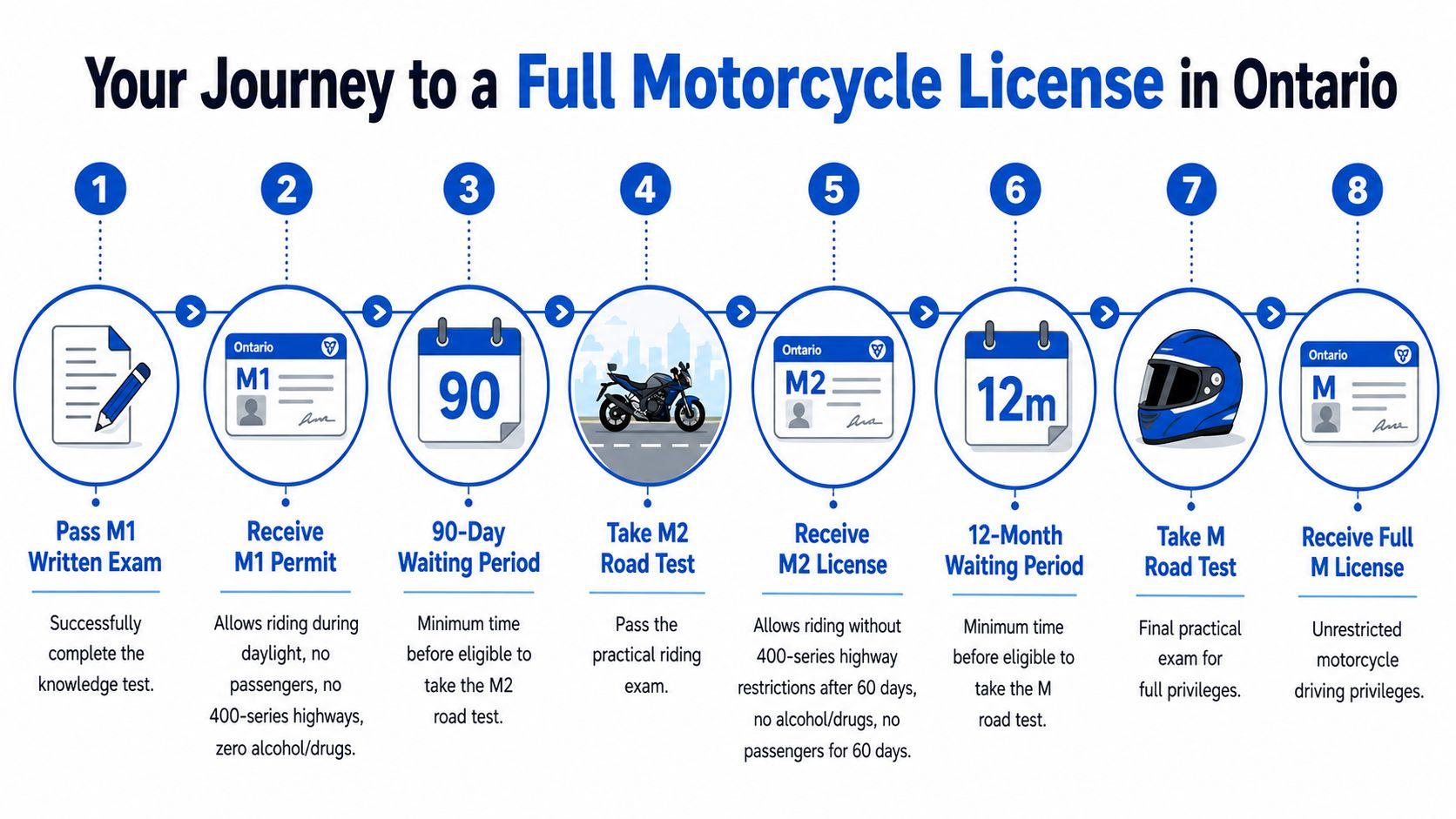
Restriction Rule Daylight riding only Ride only during daylight hours Passengers You can't carry passengers Alcohol and drugs You must maintain zero alcohol and zero drugs in your system Highway limits You can't ride on highways where the speed limit is over 80 km/h, including 400-series highways
These rules shape how you should practise. Keep rides short, simple, and deliberate. Choose routes with manageable traffic, predictable intersections, and plenty of room to think.
The road from M1 to full M
Ontario's licensing path continues through practical riding stages. The broad roadmap looks like this:
- Pass the M1 written exam: That gets you into the graduated motorcycle stream.
- Ride within M1 restrictions: This is your early learning period.
- Move toward the next skills stage: Ontario adds practical evaluation after the knowledge phase.
- Advance to later licensing stages: Full privileges come after continued progression and successful on-bike testing.
The provided Ontario testing details also note that the M2 road test is structured into three distinct sections, residential, commercial, and highway, and typically lasts about 30 minutes, requiring the rider to ride through several blocks in each zone and perform two highway on/off manoeuvres according to this Ontario rider walkthrough of the M2 test. That should tell you something important right now. Ontario doesn't just want machine control. It wants a rider who can stay organised across very different road environments.
The smartest move after passing the permit motorcycle test is to think ahead. Don't use your M1 to improvise your entire riding education. Use it to begin learning under structure, with habits that will still hold up when a practical examiner is watching.
If you want help with the signs and road-rules side of M1 prep, G1ready.ca is a practical place to start. It gives Ontario learners a straightforward way to practise the G1-style knowledge that also appears on the M1, with focused quizzes, realistic exam simulation, and immediate feedback that helps you correct mistakes before test day.