
You've probably done some version of this already. You open the handbook, answer a few random questions, get a few right, miss a few badly, then wonder whether you're improving or just seeing new questions. That's where most G1 prep starts to feel messy.
The problem isn't effort. It's direction.
For most learners searching for a practice G1 test Canada option, the default approach is random repetition. Take another quiz. Guess again. Hope the next set feels easier. Sometimes that works. More often, it creates false confidence in easy topics and leaves real weaknesses untouched until test day.
A better plan is diagnostic first, then targeted practice, then full simulation. That's the method that reduces guesswork and builds confidence the right way. You stop treating the G1 like a trivia game and start treating it like what it is: a rules test that rewards clear understanding, careful reading, and steady preparation.
Beyond Random Practice A Smarter G1 Study Plan
Many individuals don't fail the G1 because they didn't study at all. They fail because they studied in a scattered way. They answered lots of questions without ever identifying the pattern behind their mistakes.
That matters because the G1 is not just a memory check. It asks whether you can recognise signs quickly, but it also asks whether you can apply Ontario rules correctly when the wording changes. A learner who keeps doing random sets often mistakes familiarity for readiness.
Why random quizzes stop helping
Random practice has one benefit. It exposes you to variety.
But it also hides your weak spots. If you miss right-of-way questions, then get a batch of easier sign questions after that, you can walk away feeling better without fixing the underlying problem. That's not progress. That's a mood swing.
Practical rule: Don't measure readiness by how many quizzes you've taken. Measure it by how clearly you understand the topics you keep missing.
The stronger approach is to break preparation into phases:
- Diagnose your baseline so you know whether signs or rules are the bigger issue.
- Build a schedule around weak topics instead of studying everything equally.
- Use targeted quizzes and explanations to fix misunderstanding at the concept level.
- Finish with full exam simulation so the actual test feels familiar.
What this approach changes
When learners follow a structured plan, three things usually improve fast:
- Focus gets sharper because study time is spent on weak topics first.
- Stress drops because uncertainty is replaced with a routine.
- Confidence becomes more realistic because it's based on repeated performance, not hope.
That's the core value of a smart practice G1 test Canada plan. It turns preparation from a vague grind into a sequence of decisions. And once your prep becomes organised, the test starts to look much more manageable.
Phase 1 Find Your Baseline with a Diagnostic Test
You finish a few practice sets, score decently on signs, then get blindsided by rules questions about right-of-way or penalties. I see this pattern all the time. The problem usually is not effort. It is that the student has never measured where the misses are coming from.
A diagnostic test gives you that starting point. It shows whether your problem sits in road signs, rules of the road, or a smaller group of topics inside those sections. That matters because the Ontario G1 test is split into two parts, and you need to pass both. A decent overall score can still leave you failing one side of the exam, as outlined in the Ontario driver study materials and G1 handbook.

What a baseline test should tell you
A useful diagnostic does more than label you pass or fail. It should show where you are dropping marks, and whether the issue is knowledge, confusion between similar rules, or careless reading.
Common patterns include:
- Strong on signs, weak on rules. Common with students who memorize symbols faster than they process scenario-based questions.
- Fine on basic rules, weak on penalties. Demerit points, suspensions, and fines often expose shallow memorization.
- Mixed results across both sections. This often points to inconsistent attention, rushed reading, or second-guessing.
If you want a clean starting point, use a G1 diagnostic test built to identify weak topics and review the result like a coach reviews an early lesson. The score matters less than the pattern.
How to use the result properly
Write down your weak areas right away.
Do not rely on memory. Students who skip this step usually drift back to random quizzes and end up repeating what already feels comfortable.
Your notes might include:
- Right-of-way situations
- Yielding rules
- Night-driving visibility
- Penalties and suspensions
- Specific sign categories you keep mixing up
That list becomes the basis for your study schedule. It also keeps you honest. If your weak topics are right-of-way and penalties, those are the topics that should get the first attention, not another easy set of sign questions.
One more point matters here. Some G1 topics are hard because they test interpretation, not simple recall. Learners often struggle with demerit points, fines and suspensions, right-of-way and yielding, and night-driving visibility, as noted in recent G1 topic guidance. A baseline test helps separate memorization gaps from reasoning mistakes, and leaves actual weaknesses touched first instead of hidden under random scores.
Phase 2 Design Your Personalized Practice Schedule
Once you know your weak areas, your next job is simple. Put your study sessions where they'll matter most.
A lot of learners never do this. They study when they feel motivated, skip days when they're busy, then try to make up for it with a long cram session. That approach feels productive in the moment, but it usually creates fatigue and sloppy retention.
Build around consistency, not marathon sessions
Short, focused practice works better than forcing yourself through a huge block when your attention is gone. The schedule doesn't need to be rigid, but it does need a structure.
The key is front-loading your weak topics. If your diagnostic showed that right-of-way and penalties are your weakest areas, those should get the first and most consistent attention. Don't wait until the last few days to deal with them.
Here's a simple framework you can adapt.
Sample 4-Week G1 Study Schedule
Week Primary Focus Secondary Focus Goal Week 1 Weakest topic from diagnostic Light review of stronger topic Understand mistakes, not just answers Week 2 Second-weakest topic Targeted review of Week 1 Improve consistency in problem areas Week 3 Mixed topic practice Timed short quizzes Shift from learning to recall under pressure Week 4 Full mock tests and simulator work Final review of recurring errors Build confidence and reduce test-day hesitation
How to adjust the plan to your results
Not everyone needs the same schedule. A newcomer to Ontario rules may need more time on rule interpretation. A teen learner might know signs well from observation but struggle with penalties and technical wording.
Use your schedule like this:
- If signs are weak, spend early sessions on sign groups and quick recognition.
- If rules are weak, slow down and study by scenario type instead of volume.
- If both are uneven, split sessions and keep each one narrow.
A practical weekly rhythm often works well:
- one session for topic study
- one session for targeted quiz work
- one session for reviewing mistakes
- one session for mixed practice
That keeps the plan balanced without making it heavy.
What not to do
Avoid these common mistakes:
- Don't study strongest topics first because they feel rewarding.
- Don't keep repeating full tests too early if you haven't corrected the underlying errors.
- Don't change resources every day. Consistency matters more than novelty.
- Don't chase a perfect streak. Aim for stable understanding.
The best schedule is the one you'll actually follow for several weeks, not the one that looks impressive on paper.
Many learners preparing through a practice G1 test Canada routine either level up or stall out. The ones who improve fastest usually don't study more. They study more deliberately.
Phase 3 Master Concepts with Targeted Quizzes and Explanations
Once you've identified weak areas and built a schedule, the next step is where real learning happens. This is also where many learners waste the most time.
They get a question wrong, glance at the correct answer, and move on. That feels efficient. It isn't. If you don't understand why the answer was wrong, you're likely to miss the same concept again in slightly different wording.
Why explanation review matters more than question volume
The G1 rewards rule recognition in context. That means repeated exposure helps, but only if each mistake teaches you something.
The hardest topics often involve interpretation, not just memory. That's why targeted practice works better than endless mixed sets when you're still shaky on a concept. If a learner keeps missing yielding rules, more random quizzes won't necessarily fix that. Focused review will.
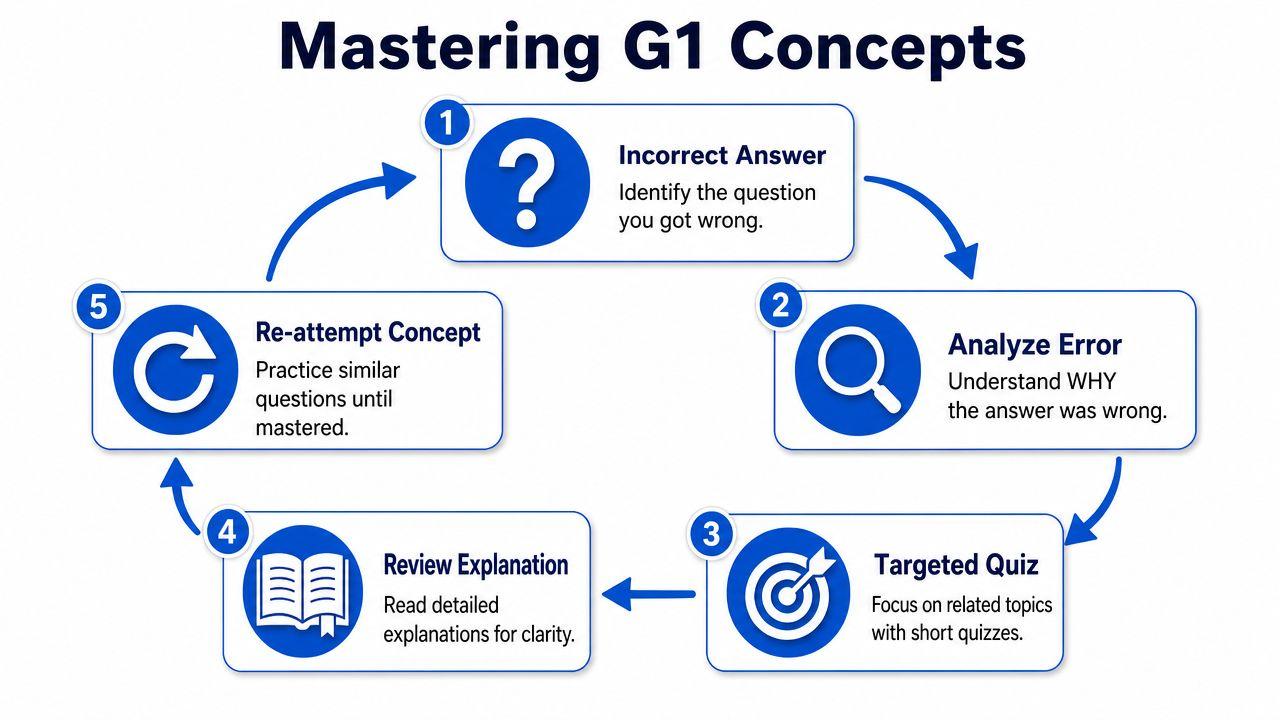
Use a mistake loop, not a guessing loop
A better cycle looks like this:
- Answer the question without guessing what looks familiar.
- Check the explanation if you miss it.
- Identify the rule behind the error.
- Take a short targeted quiz on that topic.
- Revisit similar questions later to confirm the concept stuck.
This is the difference between memorising an answer and learning a rule.
If you're using topic-based practice, a G1 practice test resource can be useful when it separates categories cleanly and shows explanations after each question. That lets you isolate one weakness at a time instead of burying it in a mixed set.
Topics that deserve extra attention
Some topics tend to cause more trouble because they involve exceptions, penalties, or judgment:
- Right-of-way and yielding
- Demerit points
- Fines and suspensions
- Night-driving visibility
These aren't hard because they're obscure. They're hard because learners often try to memorise outcomes without understanding the condition behind them.
If you can explain the rule in your own words, you're much closer to keeping it under pressure.
A practical review method
After each quiz, keep a simple error log with three notes:
- What I chose
- Why it was wrong
- What rule I need to remember
That one habit will make your study sessions far more useful than rushing into another full test. It also makes your later review sessions much faster because you're revisiting patterns, not starting from scratch.
Phase 4 Build Endurance and Confidence with Exam Simulators
When learners get close to test day, many of them make the same mistake. They stay in study mode when they should switch into performance mode.
At this stage, you shouldn't be hunting for completely new material. You should be practising how to stay calm, read carefully, and finish a realistic test without second-guessing every answer.
Why simulators matter more than another random quiz
A simulator does something ordinary quizzes can't. It reproduces the feeling of test flow.
That matters because passing the G1 isn't only about knowing the material. It's also about handling the sequence of questions without rushing, freezing, or getting sloppy after one bad item. Learners who know the rules can still underperform if the test environment feels unfamiliar.
A realistic simulator helps in two ways:
- It builds endurance so concentration doesn't fade mid-test.
- It reduces anxiety because the structure feels familiar before you arrive at the test centre.
By the final week, your main goal is to make the real test feel boring.
What a good simulator should include
Not every mock exam helps equally. The more realistic the setup, the better the payoff.
Look for these features:
- Exam-style layout that feels like an actual written test
- Balanced section mix so you're not overpractising one category
- Clear scoring feedback after completion
- Timed conditions so you feel some pressure before test day
That last point matters. Pressure changes behaviour. Learners read faster, miss keywords, and click too quickly when a timer is involved. It's better to discover that during practice.
After you've done a few realistic rounds, this video gives a helpful visual sense of what G1 preparation looks like in practice:
When you know you're ready
You're close when your simulator scores stop swinging wildly. Readiness usually looks like calm, repeatable performance, not one lucky result.
That's why exam simulation is the final stage of a strong practice G1 test Canada plan. It turns knowledge into composure. And composure is often what separates learners who almost pass from learners who walk in and get it done.
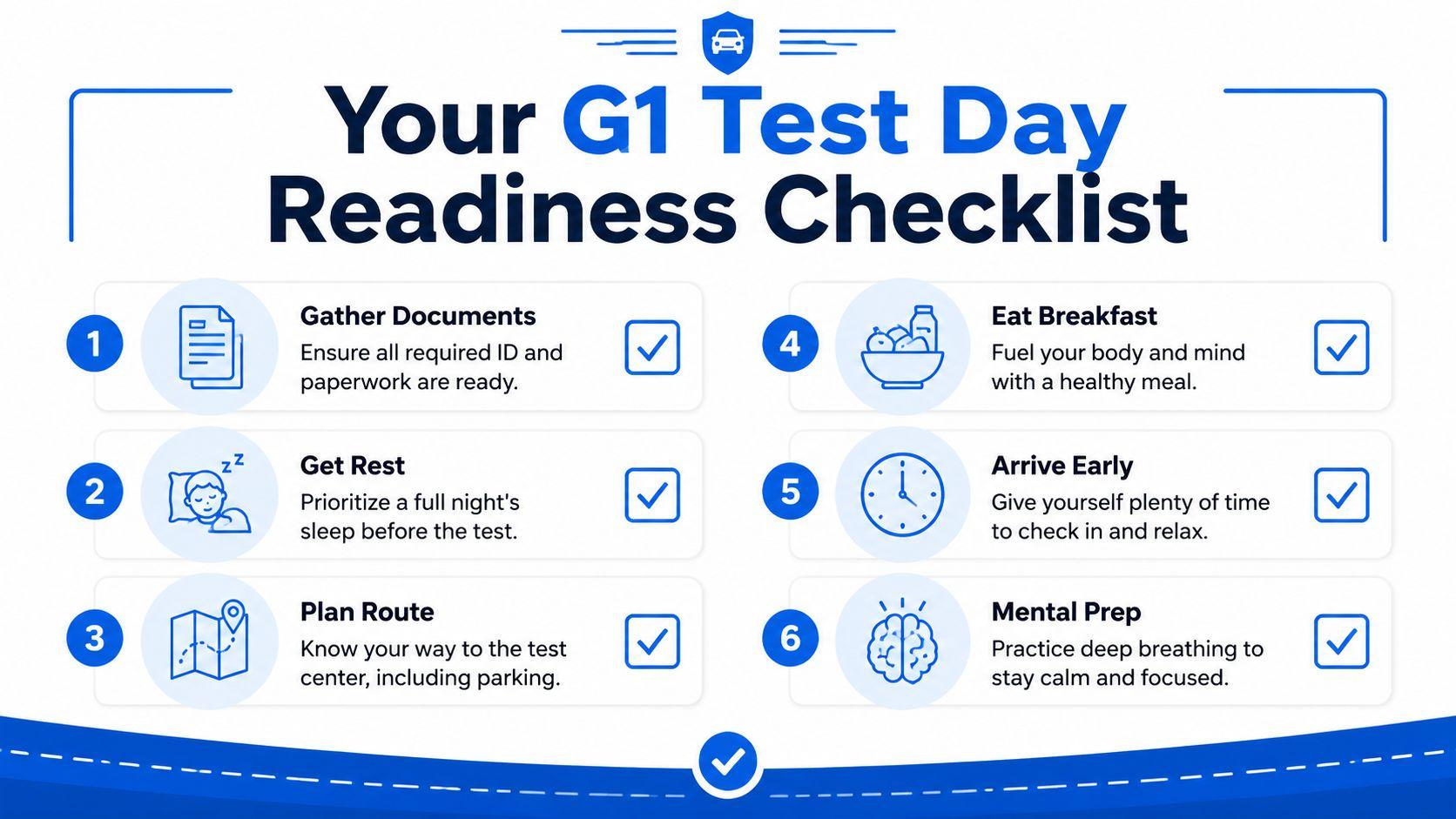
Your G1 Test Day Readiness Checklist
A common test-day mistake looks like this. The student studied enough, scored well in practice, then shows up rushed, second-guesses simple questions, and drops marks they usually keep. Passing often comes down to protecting the work you already put in.
Treat test day like the final step in the same diagnostic plan you used to study. No new material. No random cramming. The goal is a clear head, the right documents, and a routine that keeps your judgment steady.
The night before
Keep the evening controlled.
- Gather your documents and put them in one place.
- Set out what you need for the morning so you are not making decisions half-awake.
- Stop studying when recall starts slipping instead of forcing another hour.
- Go to bed on time so your reading speed and attention stay sharp.
Students often ask if they should squeeze in one last full review at night. Usually, no. If your practice over the last week has been stable, extra volume rarely helps. Fatigue causes more wrong answers than a missed late-night fact.
The day of the test
Keep the morning predictable.
- Eat something light so hunger does not distract you.
- Leave early so traffic or check-in delays do not raise your stress level.
- Skip parking-lot cramming and use that time to settle in.
- Read every question all the way through before you answer.
Even prepared learners still lose marks. They spot a familiar keyword, assume they know the answer, and click too fast. On the G1, careful reading matters as much as memory.
If a question feels obvious, slow down and read it again. That habit saves more marks than last-minute review.
A simple final check
Before you walk in, confirm four things:
- I slept enough to think clearly.
- I have the documents I need.
- I know exactly how I'm getting there and when I need to leave.
- I'm focusing on staying calm, not relearning the handbook in 20 minutes.
If you want a practical walkthrough of arrival, check-in, and the overall process, read this guide on what to expect on G1 test day.
One last point. The test has age and fee requirements, and a rewrite costs more time and money. That is why a structured study plan matters. Diagnose weak areas first, fix them with targeted practice, then use simulations to make your performance steady before test day.
If you want a structured way to prepare, G1ready.ca offers diagnostic tests, topic-based quizzes, mixed practice, and exam-style simulation so you can study by weakness instead of guessing your way through random question sets.