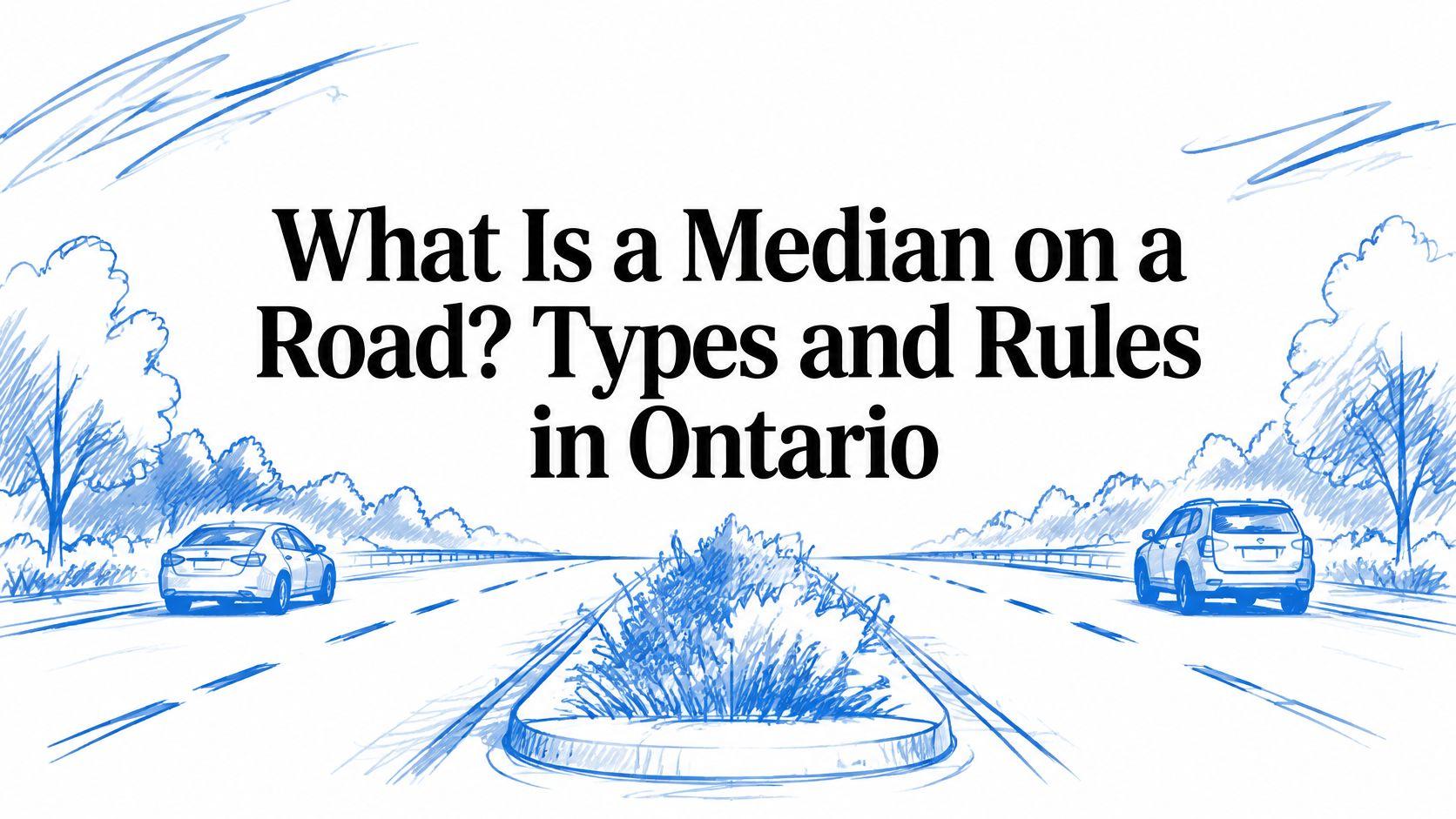
In Ontario, a median strip is the part of a highway that separates traffic travelling in opposite directions and is not meant to be crossed. You're studying for your G1 test, you reach a photo of a wide street with a grass strip in the middle, and the question asks where you can turn. If you treat that strip like an empty lane, you'll pick the wrong answer.
That confusion is common because several features sit in the centre of a road. A concrete barrier, a painted line, a shared left-turn lane, and a grass island can look similar from the driver's seat, but they don't give you the same permission to cross, wait, or turn. Learning what is a median on a road means learning to spot the physical separation first, then apply the rule that fits it.
What a Median Is on an Ontario Road
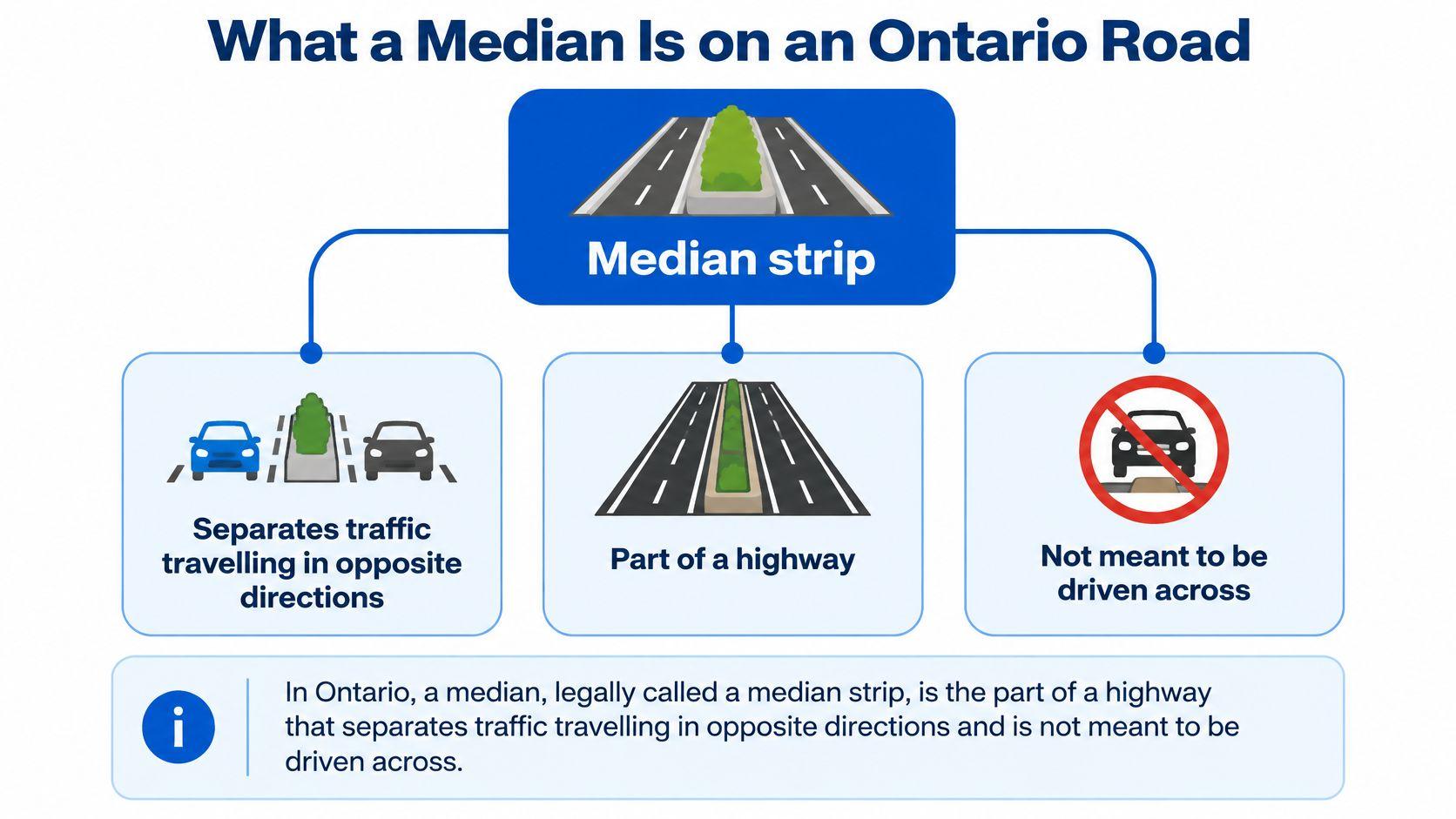
In Ontario, a median, legally called a median strip, is the part of a highway that separates traffic travelling in opposite directions and is not meant to be driven across. Ontario's Highway Traffic Act defines it as a physical barrier or a raised, depressed, paved, or unpaved separation area that isn't intended to permit vehicles to cross. That wording matters because a median doesn't have to look like a wall.
Say you're driving beside an earth strip with trees and a low curb. There's no concrete wall, so it can feel like unused space. It still counts if it's built to separate opposing traffic and prevent crossing. A depressed grass section between two carriageways and a tall concrete divider do the same legal job, even though one looks soft and the other looks solid.
Median Versus Painted Centre Line
A painted centre line separates traffic visually. A median separates it physically. Paint tells you where lanes run on the same roadway, while a median divides the highway into separate roadways for traffic moving in opposite directions.
Use this simple test when you're unsure. Ask whether opposing traffic could reach your lane without climbing, dropping into, or crossing a built strip. If the strip blocks that movement by design, you're looking at a median, not just a marking.
If you can't reach the other side without crossing a built separation, don't treat that space as a lane, a shoulder, or a waiting area.
For the G1 test, that distinction controls later decisions about turning, reversing, and lane choice. Once you identify a true median, your job isn't to find a way over it. Your job is to stay on your side and follow the roadway you're on until signs, signals, or an interchange give you a legal way to change direction.
Types of Road Medians and How Drivers Treat Each
Separation type What it looks like Can drivers cross it? What a learner should remember Raised concrete or curbed median Physical barrier with curbs No Treat it as a wall between opposing traffic Depressed grass or earth median Lowered landscaped strip No Still a median when it separates opposing traffic Raised paved or unpaved median Paved or gravel island with a raised edge No Counts as a median when built to prevent crossing Centre turn lane Painted lane shared for left turns Only to turn left where signs and markings allow Not a median; check the signs before turning Painted double yellow line Paint only, no physical separation Not a median, so lane rules apply Paint alone does not create a separation Designated crossover Gap marked by signs, signals or road markings Only at the marked location Never assume a gap from how the median looks
The first three rows share one rule. Whether the median is concrete, depressed grass, or a raised paved island, you don't drive over it. The material changes, but the purpose doesn't.
The Two Lookalikes That Cause Mistakes
A centre turn lane causes the most confusion because it sits between opposing traffic, just like a median does. The difference is function. It's a shared lane marked for left turns, so you may enter it to turn only where the signs and markings allow that move. If you're reviewing paint and lane markings, our guide to lines on a road in Ontario helps you separate a turn lane from a physical divider.
A designated crossover is different again. It's an opening in the median that's marked by signs, signals, or road markings, and it's the only place where crossing the separation is intended. An unmarked break in the grass or a worn path where other drivers have cut through doesn't create permission.
Before you act, run a fast routine. Check for a physical separation, look for a marked opening, then apply the rule for what you've found. That order stops you from treating every gap as a legal turn.
How Medians Split Traffic Into Two One-Way Roads
A median doesn't just sit in the middle of one wide road. It creates two separate roadways, each carrying traffic in one direction. Ontario's Highway Traffic Act provisions on divided highways require vehicles to operate on the right-hand roadway relative to their direction of travel where a highway is divided into two separate roadways.
Think of it as two one-way roads running side by side. You don't choose the side that looks closer to your destination. You use the roadway on your right for your direction, and traffic coming toward you uses the other roadway on its own right.
Reading the Divided Highway Signs
The divided highway begins sign warns you that opposing traffic will continue on separate roads ahead. From that point, you keep to the right-hand road and expect one-way traffic on your side. Lane markings, guide signs, and interchanges then control where you enter, exit, or change direction.
The divided highway ends sign gives the opposite warning. Opposing traffic will soon share the same roadway again, so you need to prepare for vehicles approaching on the other side of a centre line rather than beyond a physical separation. Your scanning and lane position need to adjust before the median disappears.
Direction check: name the roadway you're on and its direction of travel before you signal, turn, or exit.
Say you miss your exit on a divided highway and your destination is now behind you on the left. You don't cross the median or drive against traffic to save time. You stay on your roadway, take the next legal exit or interchange, and work your way back on roads that permit that direction.
That detour feels slower, but it's the whole point of the design. The separation keeps opposing streams from meeting head-on on that stretch, and it only works if drivers accept the route the roadway gives them.
Turning, Crossing and Reversing Rules at a Median
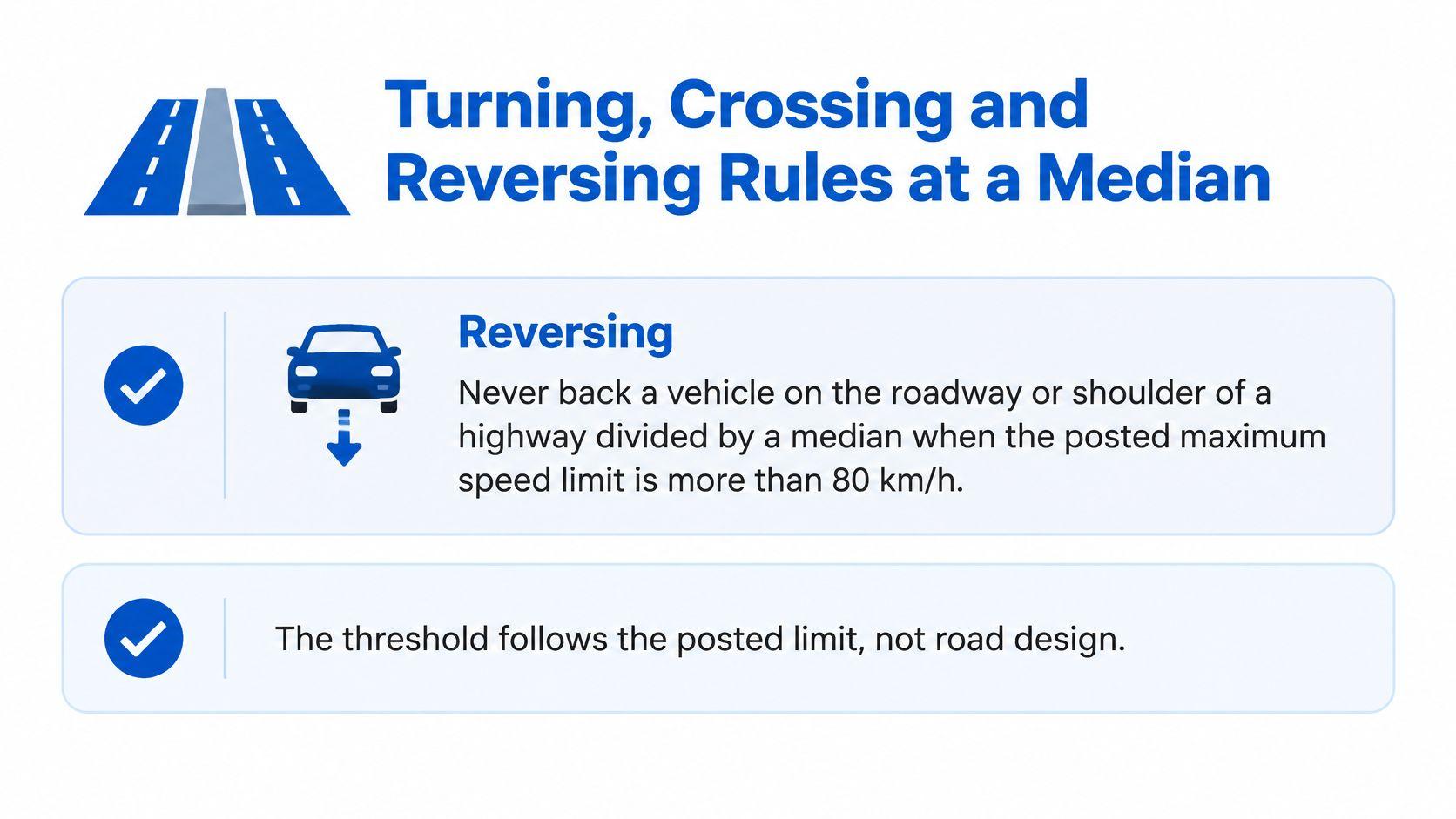
Start with reversing, because it's the rule learners most often try to bend after a missed exit. Ontario's Highway Traffic Act reversing restriction says a driver must not back a vehicle on the roadway or shoulder of a highway divided by a median strip when the maximum speed limit is more than 80 km/h. The threshold follows the posted maximum speed limit, not how fast you're travelling.
Moving onto the shoulder doesn't create an exception. The rule covers both the roadway and the shoulder, which closes the loophole of pulling over first and then reversing beside the median.
What to Do Instead of Reversing or Crossing
Say you're on a divided highway posted at 100 km/h and you pass your exit. Don't stop on the shoulder and back up toward the ramp. Continue to the next lawful exit or turnaround, leave the highway there, and rejoin in the correct direction. Traffic behind you is travelling at highway speed and won't expect a vehicle moving backward near a live lane.
Apply the same patience at lower speeds and on city streets.
- Never cross the median to reach the opposite roadway, a driveway, or a side street.
- Turn only at a marked opening, a designated crossover, an intersection, or an interchange where signs and markings permit the turn.
- Stay on the right-hand roadway for your direction and follow the lane markings on that side.
- Check signs before using a centre turn lane, since that painted lane isn't a median and it has its own turning purpose.
If you're also studying where direction changes are allowed, review U-turn rules in Ontario alongside these median rules. A median opening doesn't automatically make every turn legal.
Two Scenarios That Test Your Judgement
You're approaching an intersection and you see a grassy strip with a gap that lines up with a plaza entrance. Don't assume it's a crossover. Look for signs, signals, pavement markings, or a clearly built opening that shows vehicles are meant to cross there. Without those cues, treat the gap as part of the separation and continue to a legal turning point.
Now picture a street posted at 50 km/h with only a painted double yellow line in the centre. That's not a median, so you don't apply median rules to it. Ordinary lane, passing, and turning rules for a painted centre line govern what you can do there.
Before any turn or correction, ask three questions. Is the separation physical, is there a marked opening, and what's the posted speed limit?
Those three answers settle most test scenarios. A physical median with no marked opening means no crossing. A marked opening means you still follow its signs and signals. A posted limit over 80 km/h on a median-divided highway means reversing on the roadway or shoulder is off the table.
School Bus and Pedestrian Rules Near a Median
A stopped school bus is the clearest case where a median changes your answer. Ontario's official driver's handbook states that on a road with a median, only traffic approaching the stopped school bus from behind must stop, while vehicles travelling in the opposite direction are exempt. The median prevents opposing traffic from reaching the bus's lane.
Don't apply that exemption from memory alone. Work through the decision in order.
- Confirm the separation is physical, such as a raised, lowered, earth, paved, or barrier median, not just paint.
- Identify the bus's direction and which side of the median it's serving.
- Stop if you're approaching from behind the bus on its side of the median.
Where Learners Generalize Too Far
A common mistake is believing every opposing vehicle must always stop, then missing that the physical median changes the rule. The opposite mistake is just as risky. A learner sees a wide painted centre area, assumes it's a median, and drives past a bus they should have stopped for. A painted centre line doesn't create the same exemption, so confirm the separation before you decide.
Pedestrian duties don't disappear near a median either. You must wait for people to clear a pedestrian crossover, a school crossing, or a crossing guard location before proceeding. Our guide to pedestrian crossing rules in Ontario covers those waiting duties in detail.
Winter adds one more layer. Snowbanks, slush, and poor visibility can hide median edges, crossover markings, and people stepping off a centre island. Rely on signs, signals, lane position, and the visible structure of the road rather than assuming you know where the median ends.
Practise Median Questions Before Test Day
Median questions can appear with road rules or with road signs, because the topic covers both a physical feature and the signs that warn you about it. A short, steady routine works better than reading the definition once and hoping you'll recognize it in a photo.
Here's a learner reviewing signs and road rules together before a practice run.
Start with our Road Rules Test, which has 20 questions, to drill lane choice, turning, and reversing decisions. Follow it with the Road Signs Test for divided highway warnings and guide signs. Then use the intersections, signals and right-of-way topic quiz, one of the topic tests we list alongside quizzes for Chapter 1 through Chapter 22, to practise crossing decisions at marked openings.
After that, this short video gives you another way to review the material before you try a longer mixed set.
Move to the 100-question practice test next. Its traffic regulations coverage includes road rules, right-of-ways, lane changes, and parking rules, so median scenarios appear beside the other decisions you'll face on test day. Read the explanation for every median question you miss, note whether you misread the separation or the sign, and retake that topic until your results are steady.
Finish with the Diagnostic Test to find weak areas before a full mixed test. Take it this week, write down every median question you miss, and fix those specific gaps first.
Build your median, sign, and right-of-way knowledge with free Road Rules, Road Signs, and Diagnostic practice tests that give you immediate explanations for every answer. Visit G1ready.ca today, run the diagnostic, and turn each missed median question into a rule you can apply with confidence on test day.